Seven Twenty Three
- Episode aired Sep 27, 2009
- TV-14
- 1h

As Don secures an account with Conrad Hilton, Sterling and Cooper try to strong-arm Don into signing a contract. Meanwhile, Betty meets with her acquaintance from the governor's office, and ... Read allAs Don secures an account with Conrad Hilton, Sterling and Cooper try to strong-arm Don into signing a contract. Meanwhile, Betty meets with her acquaintance from the governor's office, and Duck tries to get Peggy to leave Sterling Cooper.As Don secures an account with Conrad Hilton, Sterling and Cooper try to strong-arm Don into signing a contract. Meanwhile, Betty meets with her acquaintance from the governor's office, and Duck tries to get Peggy to leave Sterling Cooper.
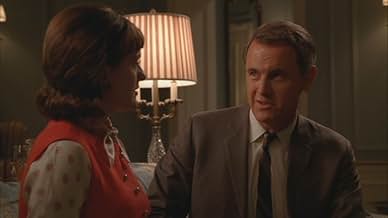


- Joan Harris
- (credit only)


- Ken Cosgrove
- (credit only)


Featured reviews
Simply perfect!
This particular episode amazed me. Its story was presented in a completely different way and still it was in the spirit of Mad men... I honestly don't know where the writers and the creator get all of those wonderful ideas, but don't care - as long as they keep up the great work!
A great Dick Whitman episode
The non-linear plot structure showing how the above characters get to a certain situation works very well, with strongest and most dramatic scenes involve Don.
Dick Whitman's history comes to the surface in some of the character's most difficult moments so far in the show. Seeing him backed into a corner by so many and reacting is very compelling to watch. John Hamm gives one of his best performances so far.
Likewise the scenes involving Betty and Peggy are intriguing, particularly for what the future will bring for both characters.
Visually it is as excellent as ever. The images of Betty on the fainting couch are like a classical painting. The filmmakers use January Jones' striking screen presence to full effect in several scenes.
Mighty Don is no mighty at all.
Back to Mad Men
I think the writers knew that "Guy Walks" was not really what Mad Men is usually like, so they needed to slow things down in the next episode to give the viewers a chance to breathe. And, they really slowed things down.
This is a great episode, but think for a moment about what it's really about. There are three main plots. The first is the company trying to get Don to sign the contract. The second is Duck pursuing Peggy Olson. The final is Betty deciding what to do with her living room. That's right. The only one even close to exciting is Peggy's.
And yet, the episode still works. Sure, it's slow, even for Mad Men, but is skillful. It's precise. The writers and director really examined what they had to do, and you can tell they settled for nothing less that perfection. Now, if the show can apply this level of skill to a more interesting plot (rather than it being one or the other usually), then we'll have some real magnificent episodes on our hands.
It's not as good as the one before it, but that's one hell of a tough act to follow.
Don's professional predicament-his sudden loss of freedom at Sterling Cooper-with Betty Draper's personal desires as she pursues a political flirtation with Henry Francis
The primary storyline revolves around Don Draper being strong-armed into signing an employment contract with PPL. Having always boasted of his independence-a power derived from the fact that he was unburdened by legal or financial obligations-Don is utterly resistant to being legally bound. This resistance is not about money; it's about the psychological cost of having his freedom monetized and codified. The negotiation scenes are fraught with tension, highlighting Don's primal fear of commitment and exposure. He attempts to use the situation to his advantage by negotiating higher salaries for Peggy Olson and Pete Campbell, a subtle move to both assert control and protect the two individuals whose merit he genuinely respects. However, the eventual confrontation with the partners and the chilling realization that they are all expendable forces Don's hand. The signing of the contract is a devastating moment for Don, signifying the official end of his ability to simply walk away-the ultimate defense mechanism of the self-made man-and marking the beginning of his sense of being trapped within the very system he has mastered.
The parallel domestic plot focuses on Betty Draper's growing relationship with Henry Francis, the political aide. Henry is presented as the anti-Don: stable, emotionally available, and genuinely interested in Betty's mind, not just her appearance. Betty actively pursues this connection, using a political rally as cover for their increasingly romantic meetings. This flirtation is not merely infidelity; it is Betty's desperate quest for autonomy and external validation outside the suffocating confines of her marriage. The contrast between Don, who is running away from commitment, and Henry, who offers Betty a sincere commitment, is a key thematic device. However, the storyline subtly critiques Betty's political awareness; her interest in politics is purely a vehicle for romantic fulfillment, underscoring her reliance on men for her sense of self, even in her search for independence. The tension peaks when Don receives an anonymous letter revealing Betty's activities, which he dismisses, having already detached himself emotionally from the possibility of her betrayal-an act of self-protection that is profoundly dismissive of his wife.
The office subplot continues the arc of Peggy Olson and Pete Campbell, both of whom are struggling to consolidate their positions under the new, ruthless PPL regime. Don successfully negotiates raises for both of them, a nod to their meritocratic talent that contrasts with the inherited positions of the partners. Pete, however, is not satisfied; his ambition demands public acknowledgment and power, not just a higher salary. His subsequent, aggressive confrontation with Lane Pryce over a corner office showcases his insecurity and sense of entitlement, ultimately leading to his humiliation and marginalization. Peggy, on the other hand, accepts the raise with quiet gratitude, understanding that professional currency is more valuable than symbolic status. Their contrasting reactions reflect their different class motivations: Pete craves the appearance of privilege he feels is owed to him, while Peggy craves the substance of financial independence, which she knows is the true measure of freedom in the corporate world.
"Seven Twenty Three" is fundamentally an episode about control and the illusion of privacy. The signing of the contract exposes Don to the corporate structure he always feared, legally trapping him within the identity he created. Similarly, the entire staff is forced to undergo a psychological evaluation, another method employed by PPL to analyze and control their assets.
This evaluation is not just a comedic interlude but a serious thematic element: the agency that sells images of psychological fulfillment is forced to confront its own internal dysfunction and vulnerabilities. The anonymous note Don receives about Betty serves as a warning that exposure is always imminent, further blurring the lines between the private and public self. Daisy von Scherler Mayer's directorial style often isolates the characters in frames, enhancing the sense of their personal paranoia and the feeling of being watched, drawing parallels between the corporate scrutiny and the emotional surveillance within the marriage.
The acting in this episode is characterized by a high degree of controlled tension. Jon Hamm subtly conveys Don's shift from arrogant control to quiet defeat, particularly in the moment he signs the contract. January Jones brings a palpable sense of anxiety and desperate calculation to Betty's pursuit of Henry Francis. Socioculturally, the episode is highly relevant to the Cold War environment of 1963, where the constant threat of surveillance and the pervasive sense of being "used" (whether by the government or corporations) colored American life. The corporate structure of PPL attempting to bind Don is a metaphor for the larger forces attempting to bind and define the individual. Cinematically, the episode borrows from the suspenseful, paranoia-driven thrillers of the early 1970s, establishing an atmosphere of looming threat and distrust that permeates every interaction.
"Seven Twenty Three" is a crucial, high-stakes episode that marks the moment Don Draper's unique power begins to wane. The creators present a bleak but resonant truth: ultimate freedom is an illusion. Don's signing of the contract and Betty's flirtation with Henry are two attempts at securing agency, both of which are fraught with the inevitable consequence of commitment. The episode argues that whether through a legally binding contract or an emotional tie like marriage, life is defined by the commitments we are forced to keep. Don is now professionally trapped, and Betty, through her attraction to Henry, is actively seeking a new form of emotional imprisonment. The episode leaves the audience with a chilling sense of entrapment, suggesting that the Drapers have reached the point of no return, where all their carefully constructed escapes have finally failed.

Did you know
- TriviaAction takes place from July 20, 1963, the day of the solar eclipse, until July 23, 1963.
- GoofsThe first edition of the General Mills Hostess Cookbook that is shown on the counter top in Betty's kitchen wasn't released until 1967, this point in time is 1963 as shown when Don signs his contract in front of Burt Cooper at the end of the show.
- Quotes
Connie: I don't know what I'm more disturbed by: The fact that you don't have a Bible, or that there's not a single family photo.
Don Draper: I'm easily distracted.
Connie: You should have those things. They'll make you feel better about what you do. Start showing up on time.
Don Draper: Maybe I'm late because I was spending time with my family reading the Bible.
- ConnectionsReferences In Cold Blood (1967)
Details
- Release date
- Country of origin
- Official sites
- Language
- Filming locations
- Production companies
- See more company credits at IMDbPro