

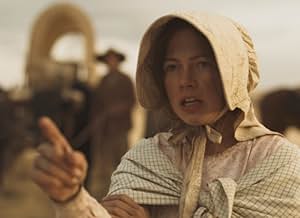
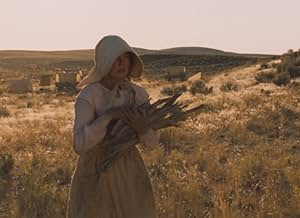
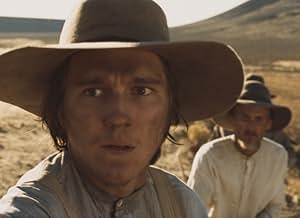
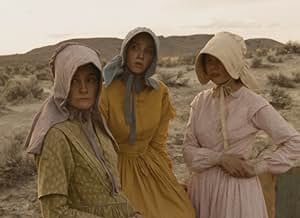
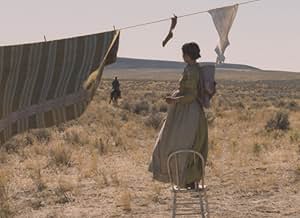
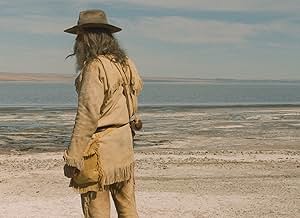
Settlers traveling through the Oregon desert in 1845 find themselves stranded in harsh conditions.Settlers traveling through the Oregon desert in 1845 find themselves stranded in harsh conditions.Settlers traveling through the Oregon desert in 1845 find themselves stranded in harsh conditions.
- Awards
- 7 wins & 14 nominations total


- Director
- Writer
- All cast & crew
- Production, box office & more at IMDbPro
6.516K
1
2
3
4
5
6
7
8
9
10
Featured reviews
A foreign home.
Last year I was really surprised with the latest film of Niclas Winding Refn, Valhalla Rising, mainly because of how he was able to generate such a grand-scope epic with as minuscule a budget as he must've had. His production consisted basically of taking a group of actors, props and costumes into some stunning locations and start filming, just trying to capture the magnificence of those landscapes the best way they could. The result was somewhat awe-inspiring, a film that created some visions so epic that it made Peter Jackson's The Lord Of The Rings look tiny and unimportant in comparison, almost like they had reversed budgets. in many ways, Meek's Cutoff does just that, although in turn it delivers a much, much better film as well.
The film is set during the travels through the Oregon Trail in 1845, where three families led by a contractual guide Stephen Meek get lost in the desert. Meek keeps saying they'll be there soon, but the route he promised took no more than two weeks to get through has already lasted for five, and they seemed nowhere close to the mountain pass they were aiming for. As he becomes more and more unreliable, and water starts running out, they come across a native, who they capture and want to force to have him lead them to water.
There are a couple of reasons why this reminds me of not only Valhalla Rising, but also Werner Herzog's Aguirre: The Wrath Of God before it. The most obvious connection between these films is that they all treat that notion of a group of people foreign to a particular land begin a journey through it and quickly lose their way, so much of the film we spend seeing them drift aimlessly through these landscapes, becoming more desperate about the growing shortage of food and water. Then, as I mentioned earlier, there's also the matter of the production scheme - Herzog did something similar when he made up these rafts and dressed a troupe of actors as conquistadores and went ahead and started telling his story. In the case of Meek's Cutoff, what we see throughout the entire film are a group of people, oxen and horses carrying a couple of wagons with them across some superbly shot arid landscapes, with the story needing only that to flesh out, but it is all so incredibly captured, so nicely treated from the sound and the atmosphere, that one can't help but be engulfed by what he's watching.
Much like Herzog and Winding Refn, though, what also makes this film work is that there is a constant sense of a metaphysical element working in the background. It is not just merely that these natural terrains hold an ancient charm to them, in a sense that you can almost imagine the world's history just by looking at them, but because all of these locations are heavily tinged by the native culture and beliefs, by their rituals and their own codes and languages. All throughout this journey, within each location one can notice several paintings on the rocks, carvings, and signs such as rocks piled up in an almost totemic fashion. This all becomes more apparent when the native character appears in the scene, and thus the protagonists are also forced to live with the culture and beliefs of this individual without being able to communicate with each other. There's an absolutely magnificent moment late in the film where a man falls down due to dehydration, and the native beings to spray sand on him and sing and everyone around him just looks. It's a sequence that reminded me a lot to that shot in Aguirre: The Wrath Of God where Aguirre is standing beside a man playing a traditional Andean melody on a panflute.
It's an absolutely wonderful film and I urge everyone to see it, a stunning meditation on the idea of the foreigner invading a land and culture he does not truly understand. The ending left me chills running down my spine.
The film is set during the travels through the Oregon Trail in 1845, where three families led by a contractual guide Stephen Meek get lost in the desert. Meek keeps saying they'll be there soon, but the route he promised took no more than two weeks to get through has already lasted for five, and they seemed nowhere close to the mountain pass they were aiming for. As he becomes more and more unreliable, and water starts running out, they come across a native, who they capture and want to force to have him lead them to water.
There are a couple of reasons why this reminds me of not only Valhalla Rising, but also Werner Herzog's Aguirre: The Wrath Of God before it. The most obvious connection between these films is that they all treat that notion of a group of people foreign to a particular land begin a journey through it and quickly lose their way, so much of the film we spend seeing them drift aimlessly through these landscapes, becoming more desperate about the growing shortage of food and water. Then, as I mentioned earlier, there's also the matter of the production scheme - Herzog did something similar when he made up these rafts and dressed a troupe of actors as conquistadores and went ahead and started telling his story. In the case of Meek's Cutoff, what we see throughout the entire film are a group of people, oxen and horses carrying a couple of wagons with them across some superbly shot arid landscapes, with the story needing only that to flesh out, but it is all so incredibly captured, so nicely treated from the sound and the atmosphere, that one can't help but be engulfed by what he's watching.
Much like Herzog and Winding Refn, though, what also makes this film work is that there is a constant sense of a metaphysical element working in the background. It is not just merely that these natural terrains hold an ancient charm to them, in a sense that you can almost imagine the world's history just by looking at them, but because all of these locations are heavily tinged by the native culture and beliefs, by their rituals and their own codes and languages. All throughout this journey, within each location one can notice several paintings on the rocks, carvings, and signs such as rocks piled up in an almost totemic fashion. This all becomes more apparent when the native character appears in the scene, and thus the protagonists are also forced to live with the culture and beliefs of this individual without being able to communicate with each other. There's an absolutely magnificent moment late in the film where a man falls down due to dehydration, and the native beings to spray sand on him and sing and everyone around him just looks. It's a sequence that reminded me a lot to that shot in Aguirre: The Wrath Of God where Aguirre is standing beside a man playing a traditional Andean melody on a panflute.
It's an absolutely wonderful film and I urge everyone to see it, a stunning meditation on the idea of the foreigner invading a land and culture he does not truly understand. The ending left me chills running down my spine.
Western indie and a waking dream
It's 1845 Oregon. Three families Tetherows (Michelle Williams, Will Patton), Gatelys (Zoe Kazan, Paul Dano), and Whites (Shirley Henderson, Neal Huff, Tommy Nelson) are led by the mountain man Stephen Meek (Bruce Greenwood) who claims to know a short cut across a high plain desert. They struggle as their water supplies dwindle. When the group captures an Indian, the group is torn about what to do with him.
This is a slow pace movie with long uncut scenes. The style is minimalist. Kelly Reichardt is usually an indie director. That's what this is. It's nine actors and a crew out in the wilderness making a western indie. This is like a waking dream where we are waiting for something dire to happen. The acting is mostly reserved with a steady quiet tone. However I must object to the ending, and rate the movie lower because of it. It is not a proper ending.
This is a slow pace movie with long uncut scenes. The style is minimalist. Kelly Reichardt is usually an indie director. That's what this is. It's nine actors and a crew out in the wilderness making a western indie. This is like a waking dream where we are waiting for something dire to happen. The acting is mostly reserved with a steady quiet tone. However I must object to the ending, and rate the movie lower because of it. It is not a proper ending.
Beautiful non-narrative film
It is interesting reading all of these angry people here, who seem to appreciate having seen an amazing film but don't understand why it does not have a 'three act structure' or Hero's journey. If you are a fan of early Michael Haneke or even Tarkovsky (to a lesser extent), then you will like this film. It is a very gentle observational piece which takes its time to even let you hear human voices. It wants you to feel the wind on the scrub desert or to hear the bubbling of the river.
To make a film like that, especially in America where the audience is weened on cleanly prepared stories that have beginnings, middles and ends, is brave, stubborn and amazingly lucky that Kelly Reichardt was able to raise the money to make it.
Fantastic. Unique, Beautiful.
But just do not expect to be 'told' what happens next, because nothing massively important actually does. Just like life really.
To make a film like that, especially in America where the audience is weened on cleanly prepared stories that have beginnings, middles and ends, is brave, stubborn and amazingly lucky that Kelly Reichardt was able to raise the money to make it.
Fantastic. Unique, Beautiful.
But just do not expect to be 'told' what happens next, because nothing massively important actually does. Just like life really.
In need of drama
Kelly Reichardt's western 'Meek's Cutoff' is dour, unmelodramatic, realistic, claustrophobic, and ultimately unresolved. These qualities are (along with its striking use of the semi-desert of eastern Oregon) the film's strengths; but ultimately, also its weaknesses. While there's atmosphere, not a lot happens; and while the film is pleasingly un-glib, there's not too much characterisation either: the braggart explorer, the Puritan settlers, the mysterious native, none of the characters go far beyond stereotype, even if their micro-behaviour is impressively restrained and convincing. As a piece of recreated history, the film has merits: but as dramatic entertainment, it's sadly guilty of not even trying.
slow paced but you dwell on it for days afterward
I have many friends who don't like most of the high tech movies that involve car races, shoot um ups, special effects & overall fast pace.
well, here is a movie for you! Slow & easy it is You take a small group of travelers in 3 covered wagons & experience what it was like 150+ years ago for the folks who settled the rugged and undeveloped areas of our country.
Wandering travelers and dependent on a guide who is "lost" and then a captured Indian who is questionable in where he leads. No real communication with the language barrier.
It wasn't pretty. But they did not know much different and had the simpler life in every way imaginable. For those who long for the "good old days" I think this exemplifies that the nostalgic images lack reality At the end we don't know if the party survived, if a baby was born and lived, if the Indian took pity (if it was an ambush) on the brave woman who defended and protected him.
I can envision a sequel with the story narrated by the young boy in the party as an adult looking back. The photography is very rich and tells a story of its own. The music is bold and beautiful. The acting is very well done & well cast.
In a way I was disappointed after I saw it but then in reflection decided I was very amazed with what was conveyed and the real impact it had on me. Not a movie for everyone but a well done work of art
well, here is a movie for you! Slow & easy it is You take a small group of travelers in 3 covered wagons & experience what it was like 150+ years ago for the folks who settled the rugged and undeveloped areas of our country.
Wandering travelers and dependent on a guide who is "lost" and then a captured Indian who is questionable in where he leads. No real communication with the language barrier.
It wasn't pretty. But they did not know much different and had the simpler life in every way imaginable. For those who long for the "good old days" I think this exemplifies that the nostalgic images lack reality At the end we don't know if the party survived, if a baby was born and lived, if the Indian took pity (if it was an ambush) on the brave woman who defended and protected him.
I can envision a sequel with the story narrated by the young boy in the party as an adult looking back. The photography is very rich and tells a story of its own. The music is bold and beautiful. The acting is very well done & well cast.
In a way I was disappointed after I saw it but then in reflection decided I was very amazed with what was conveyed and the real impact it had on me. Not a movie for everyone but a well done work of art


Did you know
- TriviaLoosely based on a true incident involving trail guide Stephen Meek and a band of settlers in 1845.
- GoofsIn an early scene with the three women walking, there was abundant Russian thistle on the ground. The film was set in 1845, but Russian thistle (Salsola tragus) wasn't introduced to the United States until arriving in South Dakota in 1870 or 1874, as weed seed in flaxseed imported from Russia.
- Quotes
[last lines]
Stephen Meek: I'm taking my orders from you now, Mr. Tetherow. Miss Tetherow. And we're all taking our orders from him, I'd say.
[about the Indian walking ahead]
Stephen Meek: We're all just playing our parts now. This was written long before we got here. I'm at your command.
- ConnectionsFeatured in At the Movies: Venice Film Festival 2010 (2010)
- How long is Meek's Cutoff?Powered by Alexa
Details
- Release date
- Country of origin
- Official site
- Language
- Also known as
- Meek's Oregon 1845 Cutoff
- Filming locations
- Production companies
- See more company credits at IMDbPro
Box office
- Budget
- $2,000,000 (estimated)
- Gross US & Canada
- $977,772
- Opening weekend US & Canada
- $20,024
- Apr 10, 2011
- Gross worldwide
- $1,205,257
- Runtime
- 1h 44m(104 min)
- Color
- Sound mix
- Aspect ratio
- 1.33 : 1
Contribute to this page
Suggest an edit or add missing content