The Good News
- Episode aired Aug 8, 2010
- TV-14
- 48m

Don flies to Los Angeles to visit Anna before his New Year's vacation to Acapulco, but her bad news influences him to cancel his vacation and return to New York, where he discovers that Lane... Read allDon flies to Los Angeles to visit Anna before his New Year's vacation to Acapulco, but her bad news influences him to cancel his vacation and return to New York, where he discovers that Lane has problems of his own.Don flies to Los Angeles to visit Anna before his New Year's vacation to Acapulco, but her bad news influences him to cancel his vacation and return to New York, where he discovers that Lane has problems of his own.


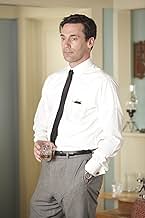


- Betty Francis
- (credit only)


- Ken Cosgrove
- (credit only)


- Sally Draper
- (credit only)

- Bertram Cooper
- (credit only)


Featured reviews
The episode belongs to Don Draper, who makes a pilgrimage to visit Anna Draper in California, the only person who knows and accepts his true identity as Dick Whitman
The most emotionally resonant thread of the episode belongs to Don Draper, who makes a pilgrimage to visit Anna Draper in California, the only person who knows and accepts his true identity as Dick Whitman. This trip is Don's search for a safe haven and a temporary escape from the lies and chaos of his new life in New York. The initial discovery that Anna is secretly dying of cancer-kept hidden by her sister, Patty-is a devastating blow. Anna represents the last, untainted link to Dick Whitman's past and, more importantly, the only person with whom Don can be his authentic self without pretense or performance. Her terminal illness signifies the final, inevitable loss of Don's ability to maintain a connection to his true self. The scenes between Don and Anna, captured with a tender, heartbreaking intimacy by Getzinger, are filled with unspoken history and genuine affection. Their final, poignant conversation, where Anna gives Don the ring and reassures him that he is "not a good man, but not a bad man," is a crucial moment of psychological absolution for Don, granting him a moral foundation that no one else can provide.
In stark contrast to Don's search for emotional truth, Lane Pryce's storyline is a dark, almost farcical depiction of a man suffocated by inherited duty and filial expectation. Lane is attempting to secure a divorce from his estranged wife, Rebecca, to pursue an authentic romance with his new American girlfriend, Toni. However, the unexpected arrival of his stern, judgmental father from London immediately derails his plan. Lane's attempts to present a façade of happiness and control to his father are pathetic and fruitless. The father, representing the stifling traditions and emotional repression of the British class system, refuses to acknowledge Lane's personal happiness and, in a shocking moment of paternal cruelty, physically forces Lane to return to London with his wife. Lane's ultimate humiliation-his professional power and financial freedom rendered meaningless by the sheer weight of his family's expectations-underscores the theme that freedom is often a matter of geography and emotional severance. Lane's failure to escape his past contrasts bitterly with Don's temporary, idealized flight to California.
The episode also features Joan Harris's return to SCDP after her maternity leave, a storyline that highlights the growing tension between professional ambition and traditional domesticity in 1964. Joan, deeply dissatisfied with the intellectual emptiness of her suburban life, attempts to reclaim her managerial authority at the office. However, she is quickly reminded that her time away has shifted the power balance, particularly with Peggy Olson's increased competence. The moment where Joan snaps at Harry Crane (who tries to order her around), fiercely reasserting her professional command, is a key moment of feminist resilience. Joan's return is not merely a job; it is a desperate search for intellectual and social stimulation that her traditional role as a doctor's wife denies her. Her struggle reflects the broader societal difficulty women faced in integrating their professional identities with the demands of motherhood during this period.
The episode's structure is built around a potent geographical and thematic duality. California, with its bright light, spaciousness, and casual atmosphere, symbolizes freedom, authenticity, and the potential for a new self. For Don, it is the only place where he can shed the rigid armor of his New York persona. New York and London, conversely, represent entrapment, cold tradition, and inescapable obligation. Lane Pryce's failure to thrive in the constricted environment of his father's expectations is the thematic inverse of Don's brief liberation. This use of setting is crucial to the show's argument that identity is often shaped by environment and the gaze of those around us. Don can be Dick Whitman only where the demanding expectations of the Eastern establishment do not reach.
The performances in "The Good News" are characterized by a restrained, but deeply affecting, sorrow. Jared Harris (Lane) beautifully conveys Lane's internal humiliation and despair under his father's oppressive thumb. Jon Hamm and Rhia Silver (Anna) share a remarkable on-screen chemistry, communicating years of unspoken history and trust through subtle gestures and quiet dialogue. Jennifer Getzinger's direction emphasizes the melancholy of the late 1964 setting. The California scenes utilize warm, natural light and the sprawling, slightly unkempt aesthetic of the West Coast, contrasting sharply with the dark, formal interiors and sharp tailoring of the New York and London environments. The technical execution masterfully uses this visual language to reinforce the emotional and thematic distance between the characters' desires and their stark realities.
"The Good News" is a profound meditation on the impossibility of truly escaping one's past or one's familial constraints. The creators assert that solitude is the default state for ambitious individuals in the modern era, and the only genuine connections are the rare, temporary ones that ultimately face inevitable loss (Anna) or are brutally suppressed by duty (Lane). The episode leaves the viewer with a sense of quiet, existential sadness. Don returns to New York armed with Anna's blessing and ring, a small, fragile souvenir of truth, but the death of his only witness means the difficult work of finding his own moral center must now be done entirely alone, with no safe harbor left to visit.
Hippie Platitudes
The further this show goes into the hippie era the... well not the worse it becomes because it's always a great show, one of the best, from beginning to end... however it's far more compelling earlier on because of the early 1960's where Don really fits... but after the whole peace movement took over, we had to hear their dumb childish ideals, and the kind of idealism Don would shrug-off with Midge's jerky beatnik friends he now embraces with the younger generation, who aren't even as smart as those beatniks...
Anyhow, not a bad episode, but the whole Dick Going To California stories are getting old, which, obviously, given what happens, even the writers were aware of: We know Don is Dick and not Don, but who cares... the cat's out of the bag... let it roam free again and enough of "the big secret" already.
But thankfully the episode is saved by Don and Lane's night out, great stuff, two fantastic actors, from America and England, sharing great chemistry... need more moments like this: stretching out the legs and going out amongst 'em.
Heart wrenching.

Did you know
- TriviaThe comedian calls Don and Lane, "George and Martha." Those are the names of the main characters from the 1962 Edward Albee's play, "Who's Afraid of Virginia Woolf?" The play deals with the complexities of marriage between a middle-aged couple, and would later be adapted into a movie of the same name. Since the play's 1962 opening, there has been, in some communities, an alternative interpretation of it being a veiled story of turmoil in a homosexual relationship. This theory received mainstream exposure when powerful critics such as Leslie Fiedler and Stanley Kauffman started publishing it in such widely read periodicals as the Partisan Review, Newsweek, and the New York Times. Albee himself was vehemently opposed to the interpretation.
- GoofsThe imported Japanese monster film, Gamera, had not been released until after the date that the episode was set.
- Quotes
Joan Harris: Sandra, everyone makes mistakes, but the fact that you're the kind of person who cannot accept blame is egregious.
Sandy Schmidt: I don't know what that means.
Joan Harris: It means I can't believe I hired you.
- ConnectionsFeatures Gamera: The Giant Monster (1965)
Details
- Release date
- Country of origin
- Official sites
- Language
- Filming locations
- Production companies
- See more company credits at IMDbPro
- Runtime
- 48m
- Color
- Sound mix
- Aspect ratio
- 1.78 : 1
- 16:9 HD