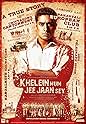
Khelein Hum Jee Jaan Sey
- 2010
- 2h 48m
IMDb RATING
5.8/10
1.5K
YOUR RATING


Children who are not allowed by the oppressive British colonists to play football decide to join a group of freedom fighters.Children who are not allowed by the oppressive British colonists to play football decide to join a group of freedom fighters.Children who are not allowed by the oppressive British colonists to play football decide to join a group of freedom fighters.
- Awards
- 6 nominations total



Sikandar Kher
- Nirmal Sen
- (as Sikander Kher)


5.81.4K
1
2
3
4
5
6
7
8
9
10
Featured reviews
A Nutshell Review: Khelein Hum Jee Jaan Sey
The intermission of this nearly three hour film serves as an automatic marker at how Gowariker planned the narrative, the first half being the introduction, characterization and planning stage that we get to witness going behind any schemes of this nature of an armed struggle, where the definition of whether one is a terrorist or freedom fighter, is naturally decided in context by the victor in history. A lot of time goes into establishing the character of Masterda Surya Sen, played by Abhishek Bachchan as the school teacher who indoctrinates his class, and other followers of his exploits, into the need to drive the British out and to attain freedom for India, starting with Chittagong (present day located in Bangladesh).
In some ways this film has shed some light that those who persist in armed struggles, never really changed the essence of their modus operandi much. It starts off with a charismatic leader and his ideology, a band of faithful followers, and a mass recruitment of those who have faced the wrong end of oppression, eager to join the cause to exact some form of revenge, now elevated to a greater struggle for something way above the petty personal objectives. We observe how resources get assembled, from the raising of funds through whatever means possible, even if it means in kind instead of cash.
Target surveillance becomes the must do as well in order to prepare for that strategic attacks, and from what we can learn from history, simultaneous attacks on key targets isn't something that's conceived in the new era, but has been used a long time back, with the revolutionaries keeping in mind the importance of timing, and to hit places controlling communications, weapons depot, and of course the places where the foreigners congregate. There's this sense of chill when watching the film, because these are lessons obviously not learnt, and it's about time we wise up to see that the jungle too serves as an attractive training ground away from prying eyes and ears either to train on weapon handling, or to assemble explosives.
But for the gripping set up, the second half turned out to be somewhat of a letdown, and I do not mean what had actually happened in history, which of course cannot be changed lest this film becomes a farce. There were enough elements here that made it the action packed second half it was meant to be, with the firing of weapons and the proverbial Murphy paying the revolutionaries a visit and really screwing up their plans. All these translated to edge of your seat excitement worthy of any thriller, and we see how the execution of the plan turn the perpetrators from hunters into prey.
A lot of things got muted in the movie, which is something not quite typical of an Ashutosh Gowariker film. Known for the opulence and grandeur of his productions, this one seemed a little bit toned down and stripped down to reflect the state of the revolutionaries, being required to work with bare minimum resources, and with faulty intelligence as well, being caught off guard in their plans, especially the more critical factors in ammunition and prisoners / hostages. It's quite back to basics for Gowariker, whom I felt if given the allowance for a longer runtime like almost all his previous works, could have told a more complete and robust story.
Abishek Bachchan performed credibly as the legendary historical character, although the storyline, in having a number of notable revolutionaries to focus on, tended to dilute the importance of his character, and hence an opportunity for him to shine. Deepika Padukone plays Kalpana Dutta, also another historical character, and the much talked about scene is of her character playing badminton in her introduction was relatively short to begin with. The actress continues to be paired opposite big name counterparts, but is able to hold her own without being awed. There's some romantic tension between the two lead characters here, though it served more as a distraction and soon got canned before it even had the chance to start.
As it stands, most of the last act turned out to be quite rushed, with fairly little being given to characterization, opting instead for quick resolution often through action sequences which do get tired after a while. Englishmen all play the token bad guys, and we don't see a lot as to how nasty they actually are, as compared to the oppression dished out by those portrayed in Lagaan. The courtroom drama also seemed to be cursory rather than to provide for a platform, and lacked the usual legalese oomph to have made an impact to an audience, having everything seem a little bit routine, well, even if it may be true in real life. Music by Sohail Sen, who had worked on the previous Gowariker film What's Your Rashee, is commendable, especially its rousing themes that will get to grow on you.
This is Ashutosh Gowariker's equivalent of Braveheart or any other freedom fighters' struggle to gain freedom for their motherland, but we could all have benefited from a little bit more of walking around inside Masterda Surjya Sen and going deeper into his beliefs and motivation. While it's still an epic scale and its presentation of the opening credits mimics that of epic greats, it somehow didn't manage to live up to its potential that we know Gowariker is capable of, and this is coming from a fan.
In some ways this film has shed some light that those who persist in armed struggles, never really changed the essence of their modus operandi much. It starts off with a charismatic leader and his ideology, a band of faithful followers, and a mass recruitment of those who have faced the wrong end of oppression, eager to join the cause to exact some form of revenge, now elevated to a greater struggle for something way above the petty personal objectives. We observe how resources get assembled, from the raising of funds through whatever means possible, even if it means in kind instead of cash.
Target surveillance becomes the must do as well in order to prepare for that strategic attacks, and from what we can learn from history, simultaneous attacks on key targets isn't something that's conceived in the new era, but has been used a long time back, with the revolutionaries keeping in mind the importance of timing, and to hit places controlling communications, weapons depot, and of course the places where the foreigners congregate. There's this sense of chill when watching the film, because these are lessons obviously not learnt, and it's about time we wise up to see that the jungle too serves as an attractive training ground away from prying eyes and ears either to train on weapon handling, or to assemble explosives.
But for the gripping set up, the second half turned out to be somewhat of a letdown, and I do not mean what had actually happened in history, which of course cannot be changed lest this film becomes a farce. There were enough elements here that made it the action packed second half it was meant to be, with the firing of weapons and the proverbial Murphy paying the revolutionaries a visit and really screwing up their plans. All these translated to edge of your seat excitement worthy of any thriller, and we see how the execution of the plan turn the perpetrators from hunters into prey.
A lot of things got muted in the movie, which is something not quite typical of an Ashutosh Gowariker film. Known for the opulence and grandeur of his productions, this one seemed a little bit toned down and stripped down to reflect the state of the revolutionaries, being required to work with bare minimum resources, and with faulty intelligence as well, being caught off guard in their plans, especially the more critical factors in ammunition and prisoners / hostages. It's quite back to basics for Gowariker, whom I felt if given the allowance for a longer runtime like almost all his previous works, could have told a more complete and robust story.
Abishek Bachchan performed credibly as the legendary historical character, although the storyline, in having a number of notable revolutionaries to focus on, tended to dilute the importance of his character, and hence an opportunity for him to shine. Deepika Padukone plays Kalpana Dutta, also another historical character, and the much talked about scene is of her character playing badminton in her introduction was relatively short to begin with. The actress continues to be paired opposite big name counterparts, but is able to hold her own without being awed. There's some romantic tension between the two lead characters here, though it served more as a distraction and soon got canned before it even had the chance to start.
As it stands, most of the last act turned out to be quite rushed, with fairly little being given to characterization, opting instead for quick resolution often through action sequences which do get tired after a while. Englishmen all play the token bad guys, and we don't see a lot as to how nasty they actually are, as compared to the oppression dished out by those portrayed in Lagaan. The courtroom drama also seemed to be cursory rather than to provide for a platform, and lacked the usual legalese oomph to have made an impact to an audience, having everything seem a little bit routine, well, even if it may be true in real life. Music by Sohail Sen, who had worked on the previous Gowariker film What's Your Rashee, is commendable, especially its rousing themes that will get to grow on you.
This is Ashutosh Gowariker's equivalent of Braveheart or any other freedom fighters' struggle to gain freedom for their motherland, but we could all have benefited from a little bit more of walking around inside Masterda Surjya Sen and going deeper into his beliefs and motivation. While it's still an epic scale and its presentation of the opening credits mimics that of epic greats, it somehow didn't manage to live up to its potential that we know Gowariker is capable of, and this is coming from a fan.
Terribly made historical
For me, Kheley Hum Jee Jaan Se will probably be the last time I am going to invest time and money in a Ashutosh Gowariker movie. It marks a very sad decline for someone regarded as one of India's finest directors not too many years back. While length had always been his weakness, his story telling has now become a joke. What started off in the laborious Jodhaa Akbar has reached the nadir in this movie – the story and screenplay lack any drama, any sense of cinema or emotional highs and lows.
The story of the Chittagong uprising of 1930, a forgotten chapter of our freedom struggle – when revolutionaries under Surya Sen tried to make an example out of Chittagong. They decided to rid Chittagong of all Britishers by taking out five key targets in one audacious night – the telegraph office, the police lines armory, the railway tracks, the European Club and the British Army Cantonment. And if you watch the movie, you will realize how agonizingly close they came to rewriting history of British India.
And I do have to concede - even with his failings as a moviemaker, Ashutosh Gowarker has to be applauded for bringing this forgotten story to light. Because of it, I have a new sense of respect for all those who gave up so much for the fight to free this country. But ironically, I got it not from the movie but only from the end credits - where the photos of all the people who were involved in the Chittagong uprising makes the events of the movie spine-chillingly real. The biggest emotional surge for me came towards the end of the credits when I read the name of some Bengali gentleman who is still living in Bangladesh ! Alive, 80 years after the event !
Kheley Hum Jee Jaan Sey is in two distinct parts. The first part shows all the planning that went into the raids and how the group of rebels got together. The second half shows the actual raid and the aftermath of the raids as the British ruthlessly hunted down every one of the conspirators. The planners of the raid were Surya Sen and couple of his friends. Together they trained and inducted into his plans some 50 odd teenagers, mostly students, for the attack.
Did Surya Sen misuse his position as a teacher to whitewash impressionable minds into the rebellion? The movie doesn't even consider the question relevant – everything is clearly black and white and Masterda Surya Sen never did anything wrong.
In the first half, we are introduced to innumerable number of characters, without any depth or detail on any of them. Even Abhishek Bachhan as Surya Sen seems unreal. He is always straight-faced and speaks only in a measured tone. He has always the right things to say, his shirt is always crisp white and he composure remains unruffled in most situations. Though his actions seem to suggest there is a fire in his belly, one sees no other visible signs of it anywhere. Deepika, with her size-zero, looks completely out of place in the movie – and quite frankly I didn't think this movie needed a leading lady or any romantic angle.
The bad characterization is compounded by the absolute lack of any drama in the screenplay. I have seen documentaries with more emotional highs and lows than this movie. Emotional scenes are wretchedly handled, everything happens with an unreal sense of detachment – as if each actor was gnawing away with doubt about the lines he/she was spouting on the screen. Some actions of a lot of characters are completely unexplained – and things fall into place for the revolutionaries in remarkably convenient ways till the night of the actual assault.
Such a white-washed version of history is a little hard to digest for any intelligent audience – ironically the very same audience this movie is trying to entice. The characters fail to make any connection with the audience because they do not show much more depth than cardboard cutouts. The movie also drags on for the mandatory 3 hours of an Ashutosh Gowariker production. And frankly, the entire second half dedicated to the pursuit and capture of the revolutionaries was quite depressing – it could have been given much less screen time. All it did was to serve as a vehicle to showcase melodramatic deaths of some of the characters. Instead of focusing on their lives
The story of the Chittagong uprising of 1930, a forgotten chapter of our freedom struggle – when revolutionaries under Surya Sen tried to make an example out of Chittagong. They decided to rid Chittagong of all Britishers by taking out five key targets in one audacious night – the telegraph office, the police lines armory, the railway tracks, the European Club and the British Army Cantonment. And if you watch the movie, you will realize how agonizingly close they came to rewriting history of British India.
And I do have to concede - even with his failings as a moviemaker, Ashutosh Gowarker has to be applauded for bringing this forgotten story to light. Because of it, I have a new sense of respect for all those who gave up so much for the fight to free this country. But ironically, I got it not from the movie but only from the end credits - where the photos of all the people who were involved in the Chittagong uprising makes the events of the movie spine-chillingly real. The biggest emotional surge for me came towards the end of the credits when I read the name of some Bengali gentleman who is still living in Bangladesh ! Alive, 80 years after the event !
Kheley Hum Jee Jaan Sey is in two distinct parts. The first part shows all the planning that went into the raids and how the group of rebels got together. The second half shows the actual raid and the aftermath of the raids as the British ruthlessly hunted down every one of the conspirators. The planners of the raid were Surya Sen and couple of his friends. Together they trained and inducted into his plans some 50 odd teenagers, mostly students, for the attack.
Did Surya Sen misuse his position as a teacher to whitewash impressionable minds into the rebellion? The movie doesn't even consider the question relevant – everything is clearly black and white and Masterda Surya Sen never did anything wrong.
In the first half, we are introduced to innumerable number of characters, without any depth or detail on any of them. Even Abhishek Bachhan as Surya Sen seems unreal. He is always straight-faced and speaks only in a measured tone. He has always the right things to say, his shirt is always crisp white and he composure remains unruffled in most situations. Though his actions seem to suggest there is a fire in his belly, one sees no other visible signs of it anywhere. Deepika, with her size-zero, looks completely out of place in the movie – and quite frankly I didn't think this movie needed a leading lady or any romantic angle.
The bad characterization is compounded by the absolute lack of any drama in the screenplay. I have seen documentaries with more emotional highs and lows than this movie. Emotional scenes are wretchedly handled, everything happens with an unreal sense of detachment – as if each actor was gnawing away with doubt about the lines he/she was spouting on the screen. Some actions of a lot of characters are completely unexplained – and things fall into place for the revolutionaries in remarkably convenient ways till the night of the actual assault.
Such a white-washed version of history is a little hard to digest for any intelligent audience – ironically the very same audience this movie is trying to entice. The characters fail to make any connection with the audience because they do not show much more depth than cardboard cutouts. The movie also drags on for the mandatory 3 hours of an Ashutosh Gowariker production. And frankly, the entire second half dedicated to the pursuit and capture of the revolutionaries was quite depressing – it could have been given much less screen time. All it did was to serve as a vehicle to showcase melodramatic deaths of some of the characters. Instead of focusing on their lives
Remembering the HEROES
It may be not a good movie or i would say justice was not done with the production but somehow it made me to write few words for this. Why? The question is simple as well as the answer. I am always a fan of all these freedom fighters who always kept the spark. Many people consider Ghandi and Jinnah for the Indo-pak freedom but i whole heartedly believe it were the people like Surey sen, whom ideas were the main cause of todays free India and Pakistan. The list is full of heroes, whom we are proud today. Being a Pakistani i always have a great respect for all those great freedom fighters because of whom we are enjoying the independence today. Bhagat Singh, Surya sen, Bakht Khan, Mangal panday are all portrayed beautifully in the movies.
Yet an unsung hero is still to show up on a big screen, The brave Pathan freedom fighter Sher Ali Afridi who killed the Indian viceroy, Lord Miyo. This was the only unique case of killing a viceroy on Indian soil. I wish if his life story is taken in a movie depiction.
Over all the movie gives you a good feel of that times freedom struggle. I still recommend the movie as its watchable and touchy.
Yet an unsung hero is still to show up on a big screen, The brave Pathan freedom fighter Sher Ali Afridi who killed the Indian viceroy, Lord Miyo. This was the only unique case of killing a viceroy on Indian soil. I wish if his life story is taken in a movie depiction.
Over all the movie gives you a good feel of that times freedom struggle. I still recommend the movie as its watchable and touchy.
It's a perfect history lesson.
Ashutosh Gowariker retells the astounding true story of the Chittagong uprising of 1930. Led by a fiery school teacher, a band of 64 revolutionaries, most of them school-going teenagers, launched five simultaneous attacks on British strongholds in Chittagong including the cantonment area and the telegraph office Ashutosh recreates this largely forgotten event with sincerity and sweat but unfortunately Khelein Hum Jee Jaan Sey comes off a high school history lesson: plodding, stilted and in long stretches.
The film's entire first half is the set-up to the event the nuts and bolts of planning a revolt, getting enough investment, planning and co-ordinating each step. Ashutosh introduces us to half a dozen characters but the screenplay doesn't adequately flesh out even one.
The second half has more urgency and momentum and climaxes in the inevitably tragic but rousing finale.The dialogue is always lofty and theatrical and the actors are insistently noble. Abhishek Bachchan, who plays the leader Surjya Sen, is in sober, benevolently smiling mode. We get little hint of the fire in his belly.
This is a great effort to bring such hidden subject in front of us but if you like fast paced cinema then its not your type of movie.
If you love good cinema,watch it. My vote 7 out of 10.
The film's entire first half is the set-up to the event the nuts and bolts of planning a revolt, getting enough investment, planning and co-ordinating each step. Ashutosh introduces us to half a dozen characters but the screenplay doesn't adequately flesh out even one.
The second half has more urgency and momentum and climaxes in the inevitably tragic but rousing finale.The dialogue is always lofty and theatrical and the actors are insistently noble. Abhishek Bachchan, who plays the leader Surjya Sen, is in sober, benevolently smiling mode. We get little hint of the fire in his belly.
This is a great effort to bring such hidden subject in front of us but if you like fast paced cinema then its not your type of movie.
If you love good cinema,watch it. My vote 7 out of 10.
Excellent!!!!!!
People r complaining about the length of the movie.....movie being bore.....what they expected from this movie???? a 90 minutes fast paced brainless comedy.....as far as i m concerned i expected a engaging,gripping depiction of a true story about a incident in history of independence of India which is not very well known to most of the public....and i was not disappointed.... In fact movies of this genre are meant to be made in this way....they take there time to narrate various incidents.Various Hollywood movies like Schindlers List, The pianist etc were the movies of same genre telling the true stories from the history and there running time was more than KHJJS and they are regarded as all time masterpieces in west but unfortunately the same type of effort in our country will be stated as lame and boring. This a must watch movie for all the cine goers who prefer meaningful,informative and gripping cinema..... 8.5/10


Did you know
- TriviaThis is a historical film about the unsung heroes of India's freedom struggle against British rule.
- ConnectionsFeatured in Furiously Curious (2014)
Details
- Release date
- Country of origin
- Official sites
- Languages
- Also known as
- We Play with Our Lives
- Filming locations
- Production companies
- See more company credits at IMDbPro
Box office
- Gross worldwide
- $1,450,514
- Runtime
- 2h 48m(168 min)
- Color
- Sound mix
Contribute to this page
Suggest an edit or add missing content