

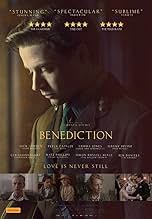
Legendary 20th century English war poet Siegfried Sassoon embarks on a life-long quest for personal salvation through his experiences with family, war, his writing, and destructive relations... Read allLegendary 20th century English war poet Siegfried Sassoon embarks on a life-long quest for personal salvation through his experiences with family, war, his writing, and destructive relationships. True salvation can only come from within.Legendary 20th century English war poet Siegfried Sassoon embarks on a life-long quest for personal salvation through his experiences with family, war, his writing, and destructive relationships. True salvation can only come from within.
- Awards
- 9 wins & 19 nominations total





- Director
- Writer
- All cast & crew
- Production, box office & more at IMDbPro
Featured reviews
Mixture of military, true story, and gay romance
This beautifully introspective film was written and directed by Terence Davies.
THINGS I LIKED: I loved hearing the sensitive poetry of Siegfried Sassoon while watching his life experience unfold which inspired his writing. If you're unfamiliar with the poet, you'll certainly receive an introduction through this movie. There is an incredible sadness and melancholy to the movie.
The talented cast includes Tom Blyth, Kate Phillips, Jack Lowden, Jeremy Irvine, Ben Daniels Julian Sands, and Peter Capaldi among many others whose acting is fantastic.
I thought it was very interesting to combine old footage from World War I with the new footage of the film. It almost feels like a dramatic documentary.
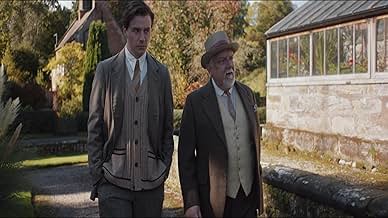
Filming was done in Willenhall near Wolverhampton, England.
In the movie, we learn interesting trivia about the poet's life. For example, we learn that T. E. Lawrence (Lawrence of Arabia) was a fan of Siegfried Sassoon and even attended his wedding.
Lovely musical score.
The dialogue is entertaining, insightful, and inspiring.
Some of the transitions in Act 3 are fantastic. Others in Acts 1 & 2 cut too abruptly.
THINGS I DIDN'T LIKE: Sadly, the audience for this film may be somewhat limited, as it is very British, bloated, and eloquent with elevated dialogue.
The film starts with its focus on the war and military actions, and then the tone turns more into a gay romance. Because of the flip-flopping, the tone seems to constantly change.
There are several unnecessary scenes I would immediately cut to shorten the film. For example, there are some church and singing scenes that don't particularly add much.
The timeline jumps around a bit, which might confuse viewers.
It's sad to hear people talk so cruelly to each other.
TIPS FOR PARENTS: Children and some adults will be extremely bored.
There is a lot of disturbing and real WWI footage and photography that shows dead bodies.
Lots of talk about homosexuality, as the poet Siegfried Sassoon was gay. You see men kiss, dance, and tumble in bed.
Psychiatric patients are heard and seen screaming.
THEMES: Truth Loyalty Personal honor War Yearning for what's been lost PTSD Writing and poetry Redemption Narcissism Talent Introspection Relationships Marriage and infidelity
indulgent languid catty
This long film is possibly better suited for TV viewing, so for UK viewers I expect to see it on BBC TV because BBC-Films was one of the funding sources. Despite that, I'm pleased to have seen it at the almost empty cinema if only for the better focus there with no distractions of home.
I liked this more than I was expecting, which possibly says more about me than the film.
It's a surprise to me that this film got made, especially in these pandemic times, as it is quite indulgent, languid and would appeal to a possibly limited segment of cinema goers.
It is not a biography of Sassoon, as there's no mention of his father, his father's early death, the bequest from his aunt, or Heytesbury, or his death etc.
Instead it is an absorbing slightly mesmeric collage of catty dialogue, music, poetry and grainy WW1 footage and still photography artfully assembled into a tale of searching for redemption and the angst for help to deal with the past, which presumably explains the title.
The initial early transition between actors (young Siegfried and old Siegfried) could have been better handled as at least one later transition of another character was clearly done. Peter Capaldi is fabulously haunted in the role of old Siegfried, though with a clipped accent to mask the rich Scottish tones underneath. The always watchable Geraldine James appears briefly as mother.
Jeremy Irvine is devilish as Ivor Novello. Calam Lynch is acidic as young Stephen Tennant. Jack Lowden is reasonable as young Siegfried.
The first of the song choices seemed anachronistic, as the backing for grainy WW-1 footage. But this is a minor detail.
Overall: best for TV maybe, 7/10.
One can appreciate Sassoon's poetry and the loaded trivia that TE Lawrence was his friend
An anti-war biopic of Siegfried Sassoon
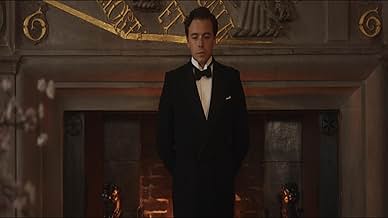
Siegfried Sassoon (Jack Lowden/Peter Capaldi) was a Second Lieutenant during World War I. His younger brother, Hamo (Thom Ashley), is killed during the war. Siegfried is further horrified by the tremendous human toll in death and lifelong disability caused by military leadership in which he no longer believes. Already a well-known poet, he refuses further participation in the war and is sent to the Craiglockhart War Hospital near Edinburgh technically for shell shock. There Siegfried meets and befriends Wilfred Owen (Matthew Tennyson), a much younger man. Siegfried also explicitly recognizes his own homosexuality.
The film then follows his anti-war sensibilities through snippets of his poetry and his chaotic love life, mainly focused on Ivor Novello (Jeremy Irvine) and Stephen Tennant (Calam Lynch/Anton Lesser). At a certain point, he tries to escape the chaos by marrying Hester Gatty (Kate Phillips/Gemma Jones). Together they have a son. George (Richard Goulding), but clearly, the marriage does not heal Sassoon's memories.
The film uses footage from the trenches in World War I and occasionally flips in time between the young Sassoon and the elderly Sassoon. Some of the editing decisions made little sense to me, particularly the early scene forecasting his conversion to Catholicism. Some edits made the film more complex than necessary. Nevertheless, the movie successfully portrays Sassoon as disabled because of World War I, from which he never psychologically recovered. This is clear from the multiple references to Wilfred Owens' poem, "Disabled."
Ignore the naysayers...this is a beautiful, deeply poetic, ethereal masterpiece...
All of the performances are 1st rate, the cinematography is exquisite, the production design is breath taking, and the dialogue is some of the best I've heard in a film in a very, very long time. Thanks to Mr. Terence Davies for making such an extraordinary movie.


Did you know
- TriviaSeven of Siegfried Sassoon's poems were narrated in the film: Concert Interpretation, Died of Wounds, When I'm among a Blaze of Lights, To my Mother, To my Brother, Attack, and Invocation.
- GoofsSassoon did not discard his M.C. medal as shown in this film. He tossed away the medal's corresponding ribbon. The medal itself was inherited by Sassoon's son George.
- Quotes
Dr. Rivers: Why not?
Siegfried Sassoon: Too afraid, too inhibited. Shamed by an inner corruption. Or perhaps it's simply because of... What's the phrase? "The love that dare not speak its name."
Dr. Rivers: You are not alone in that respect.
- How long is Benediction?Powered by Alexa
Details
- Release date
- Countries of origin
- Official sites
- Languages
- Also known as
- 베네딕션
- Filming locations
- Chillington Hall, Port Lane, Brewood, Wolverhampton WV8 1RE, United Kingdom(Interiors and outdoor scenes)
- Production companies
- See more company credits at IMDbPro
Box office
- Gross US & Canada
- $201,093
- Opening weekend US & Canada
- $50,970
- Jun 5, 2022
- Gross worldwide
- $847,418