
Amos Gitai returns to the West Bank to better understand the efforts of the citizens, both Israelis and Palestinians, to try to overcome the consequences of the 50-year occupation. Intersper... Read allAmos Gitai returns to the West Bank to better understand the efforts of the citizens, both Israelis and Palestinians, to try to overcome the consequences of the 50-year occupation. Interspersing footage of his interviews with Yitzhak Rabin from the 1990s with the contemporary int... Read allAmos Gitai returns to the West Bank to better understand the efforts of the citizens, both Israelis and Palestinians, to try to overcome the consequences of the 50-year occupation. Interspersing footage of his interviews with Yitzhak Rabin from the 1990s with the contemporary interviews of everyday citizens.
- Awards
- 3 nominations total




- Self
- (archive footage)


- Self
- (archive footage)
- Director
- Writer
- All cast & crew
- Production, box office & more at IMDbPro
Featured reviews
West of the Jordan River opens in 1994 when the then 35-year-old Gitai interviews Prime Minister Yitzhak Rabin about the peace process. According to Gitai, Rabin was "a man with a certain simplicity. Even if you disagreed with him, he was the only Israeli political figure who told the truth. He was rare the only leader who sought dialogue, who sought agreement." Now twenty two years after Rabin was assassinated by a Jewish extremist who opposed the Oslo accords, Gitai says "And now we are feeling the lack of a real political figure who wants to move forward, a lack that puts the whole Israeli project in danger." He asks "What can we do? We can make a film. It's a beginning. You have to be optimistic, and you mustn't be bitter about your own country because your country is the source of your inspiration." Though the film is heavily weighted toward an anti-government point of view, Gitai gives space to both sides including the young Israeli foreign affairs minister, Tzipi Hotovely who strongly defends the government's policy in the occupied areas. An editor from the newspaper Haaretz, however, offers a deeply pessimistic comment that if Israel continues to support Jewish settlements in the West Bank and Gaza, it is likely to cross the point of no return and disappear within ten years.
As the film progresses, however, a strong desire for peace and reconciliation emerges through the quiet, thoughtful questions posed by the director. In one scene, "The Parents Circle," a support group for both Israeli and Palestinian mothers who have lost sons in the conflict, come together to share the personal impact of their loss. Also featured are discussions with the non-profit group "Breaking the Silence" which encourages Israeli military veterans to talk about the harsh reality they have personally encountered in the West Bank. Though many work for reconciliation including those in the non-profit group "B'Tselem," also known as "The Israeli Information Center for Human Rights in the Occupied Territories," the culture of revenge and martyrdom runs deep.
In a heartbreaking moment, a 10-year-old boy tells Gitai that his dream is to blow himself up and become a martyr for Allah so that Allah will tell him about the good work he did during his life. In a more positive scene, Gitai talks with an Israeli settler who was shot in the hip by a would-be terrorist but who shows sympathy and understanding for the problems of the Palestinians. For those familiar with the issues, West of the Jordan River is a timely reminder of the human cost of the conflict. For those unfamiliar with the circumstances or the political players involved, however, the film does not clarify the issues or offer any background or context.
While Gitai acknowledges that there is intransigence on both sides, dramatized by the circular motion of a carousel going round and round, he neglects to mention that the Palestinians have consistently refused a two-state solution and, even to this day, do not recognize Israel's right to exist. In the Oscar-nominated 2001 film Promises by B.Z. Goldberg, a documentary that looks at the Arab-Israeli conflict from the point of view of seven Israeli and Palestinian children, one Jewish boy asks, "In war both sides suffer, maybe there's a winner, but what is a winner?" That question is still being asked sixteen years later.
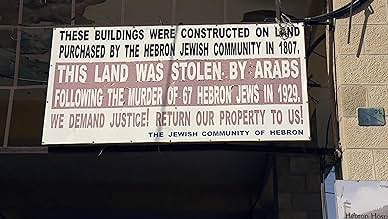
In my view Israel's relations with the Palestinians has similarities to S. African apartheid, however here in the U.S. it shares a resemblance to the herding of Native peoples onto reservations. In all cases we have fenced barriers w/containment of culture, opportunity, movement, resources, and rights. And, as the resources on these "reservations" became valuable those lands are taken away, often by force. Example from this doc: A Bedouin village (herders of sheep, goats in this desolate area) built a school in the West Bank. Israel which controls construction & access to materials has repeatedly denied their village building this school. So w/help from the E.U. they built it themselves out of used tires and mud. Again, Israeli settlement expansion in this area resulted in tearing down the school. Israel needs more territory. They do not see this decades long slow strangulation of Arab-Palestinians as a moral problem. Recently in the news Israel has assigned its Arab inhabitants to second class citizenship status. Also recently since Israel controls all Arab mail entering the West Bank from loved ones including packages w/necessities of life it was held/stored for up to 8 years before being delivered - some of those recipients probably died before receiving mail from family. A recent BBC doc on Hebron showed film of Israeli soldiers holding assault rifles to the heads of young Arabs while shouting to turn off their cameras or they will shoot them in the head. Also shown was thug style behavior and killings by settlers & soldiers seemingly w/impunity. It reminded me of Mexican cartels, and worse still the police & military in several Asian countries.


Did you know
- Quotes
Arab boy: This situation is shitty. Gaza is completely closed off.
- ConnectionsFeatures Field Diary (1982)
Details
- Release date
- Countries of origin
- Languages
- Also known as
- West of the Jordan River: Field Diary Revisited
- Production companies
- See more company credits at IMDbPro
Box office
- Gross US & Canada
- $1,926
- Opening weekend US & Canada
- $1,047
- Jan 28, 2018
- Gross worldwide
- $1,926
- Runtime
- 1h 24m(84 min)
- Color