

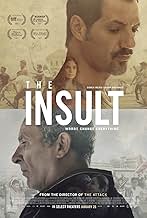
After an emotional exchange between a Lebanese Christian and a Palestinian refugee escalates, the men end up in a court case that gets national attention.After an emotional exchange between a Lebanese Christian and a Palestinian refugee escalates, the men end up in a court case that gets national attention.After an emotional exchange between a Lebanese Christian and a Palestinian refugee escalates, the men end up in a court case that gets national attention.
- Nominated for 1 Oscar
- 22 wins & 20 nominations total







Talal Jurdi
- Talal
- (as Talal El Jurdi)


- Director
- Writers
- All cast & crew
- Production, box office & more at IMDbPro
7.618.9K
1
2
3
4
5
6
7
8
9
10
Featured reviews
When Emotions Boil Over
I imagine "The Insult" will inspire strong feelings among certain viewers who have a close connection to the topic, and especially those from parts of the world that feel strongly one way or another about the Palestinian conflict. Most of the rest of us will probably learn a little something about the cultural and religious conflict between Lebanese Christians and Palestinians, something Americans (where I'm from) certainly don't ever learn much about unless we actively seek it out.
I very much enjoyed "The Insult" and I appreciated its attempts to be objective about a topic that most people who are directly affected by it can't be. People don't generally like to hear that there is often not a right or wrong side to a given issue but rather a vast middle area of gray, especially not in our current world climate where there's a "with us or against us" mentality about most things. But while I appreciated the film's approach, I couldn't help but feel it had a little bit of an after school special quality about it, a kind of preachy "can't we all just get along" tone that I don't necessarily disagree with but which feels a bit naive and facile in our extremely complicated times.
A worthy effort and one that has a lot to recommend it. It just didn't hit it out of the ball park.
Grade: A-
I very much enjoyed "The Insult" and I appreciated its attempts to be objective about a topic that most people who are directly affected by it can't be. People don't generally like to hear that there is often not a right or wrong side to a given issue but rather a vast middle area of gray, especially not in our current world climate where there's a "with us or against us" mentality about most things. But while I appreciated the film's approach, I couldn't help but feel it had a little bit of an after school special quality about it, a kind of preachy "can't we all just get along" tone that I don't necessarily disagree with but which feels a bit naive and facile in our extremely complicated times.
A worthy effort and one that has a lot to recommend it. It just didn't hit it out of the ball park.
Grade: A-
WHAT A TRIUMPH! WHAT A TOUR-DE-FORCE!
What a tour-de-force! What a triumph! What a masterpiece! I haven't seen such a powerful movie in years. This is the kind of movie you come across so very rarely, that shakes you to your very core, makes the art of cinema worthwhile and reminds you why you fell in love with the motion picture in the first place.
A universal issue, set in Lebanon
The movie is set in Lebanon, and based on real Lebanese problems. However, the setting could be in another country, another time, with two other groups that hate each other. It is about the universal problem of wrath and resentment boiling over.
The movie is well done, with some unnecessary dramatic flourishes - the story is dramatic enough in itself and didn't need these additional items (Don't wish to say what exactly in order not to have any spoilers).
In any case it deserves its Oscar nomination.
sticks and stones
Greetings again from the darkness. When a film opens with a statement that 'the views expressed are those of the authors and director, and not of the government of Lebanon', one quickly understands the difference in artistic freedom in that country versus what occurs in the United States, where cartoons and memes regularly poke fun at this country's President. Director Ziad Doueri and his co-writer Joelle Touma present an intense story of human nature that might happen anywhere, but since the leads are a Lebanese Christian and a Palestine refugee, that opening statement is warranted.
One morning, a seemingly innocuous exchange between Tony (Adel Karam) and Yasser (Kamel El-Basha) takes place. While watering flowers on his balcony, the overflow sprays Yasser on the street below. Yasser, a city contractor, orders his team to fix the drainage issue, and Tony reacts violently - leading to Yasser delivering the titular insult. From there, all heck breaks loose. Apologies are requested and never delivered. Appeals to rational reconsideration are made. Tony's pregnant wife (an excellent Rita Hayek) pleads with him to let it go. Yasser's boss threatens him with termination. Still, two stubborn and prideful men refuse to give in.
The subsequent courtroom drama feature other side stories, not the least of which is the relationship between the two opposing attorneys (Diamond Bou Abboud and Camile Salaheh), one a rising legal star and the other a veteran attempting to make up for a past failure. Emotions run high as two too-proud men turn what was little more than a playground standoff into a national incident being fought in the legal system and the media. Tony is a hot-head who somehow thinks an apology from Yasser is actually an apology for how Palestinians "messed up this country". Yasser's stoic nature barely shrouds his bitterness at the world since the Lebanon Civil War. History and childhood roots play a role, but mostly it's human nature that is at the core of this escalation.
Though the title is not plural, there are multiple insults slung throughout the film, each reminding us of the power of words and the futility of the "sticks and stones" phrase. Our own prejudices and preconceptions alter our views and reactions, often preventing us from standing in the other fellow's shoes. Again, this situation could have played out in most any neighborhood on the globe, but this particular locale shows various ethnic and religious groups are still grappling with what it means to live together - despite the years of wars and unrest. We don't see a great deal of Middle Eastern cinema, but three days after I watched this film, it became the first ever movie from Lebanon to receive an Oscar nomination (Best Foreign Language Film) ... proving yet again that the language of cinema is universal.
One morning, a seemingly innocuous exchange between Tony (Adel Karam) and Yasser (Kamel El-Basha) takes place. While watering flowers on his balcony, the overflow sprays Yasser on the street below. Yasser, a city contractor, orders his team to fix the drainage issue, and Tony reacts violently - leading to Yasser delivering the titular insult. From there, all heck breaks loose. Apologies are requested and never delivered. Appeals to rational reconsideration are made. Tony's pregnant wife (an excellent Rita Hayek) pleads with him to let it go. Yasser's boss threatens him with termination. Still, two stubborn and prideful men refuse to give in.
The subsequent courtroom drama feature other side stories, not the least of which is the relationship between the two opposing attorneys (Diamond Bou Abboud and Camile Salaheh), one a rising legal star and the other a veteran attempting to make up for a past failure. Emotions run high as two too-proud men turn what was little more than a playground standoff into a national incident being fought in the legal system and the media. Tony is a hot-head who somehow thinks an apology from Yasser is actually an apology for how Palestinians "messed up this country". Yasser's stoic nature barely shrouds his bitterness at the world since the Lebanon Civil War. History and childhood roots play a role, but mostly it's human nature that is at the core of this escalation.
Though the title is not plural, there are multiple insults slung throughout the film, each reminding us of the power of words and the futility of the "sticks and stones" phrase. Our own prejudices and preconceptions alter our views and reactions, often preventing us from standing in the other fellow's shoes. Again, this situation could have played out in most any neighborhood on the globe, but this particular locale shows various ethnic and religious groups are still grappling with what it means to live together - despite the years of wars and unrest. We don't see a great deal of Middle Eastern cinema, but three days after I watched this film, it became the first ever movie from Lebanon to receive an Oscar nomination (Best Foreign Language Film) ... proving yet again that the language of cinema is universal.
Pitting (Christian) Arabs vs. (Palestine) Arabs: there are no winners
"The Insult" (2017 release from Lebanon; 112 min.) brings the story of Tony, a Christian Lebanese, and Yasser, a Palestine refugee and long-time resident of Lebanon. As the movie opens, we see Tony at a rally of the Christian party in Beirut. When Tony gets back home, he spends time with his highly pregnant wife Shirine. Them by accident, and resulting from a faulty drainpipe on his balcony, he wets Yasser, a foreman in a construction crew that is repairing buildings in the neighborhood. One thing leads to another, and Yasser calls Tony a "f---ing prick". Tony is outraged, and decides to pursue the matter. At this point we are 10 min. into the movie, but to tell you more of the plot would spoil your viewing experience, you'll just have to see for yourself how it all plays out.
Couple of comments: this is the latest movie from accomplished Lebanese writer-director Zid Doueiri, who previously has brought us excellent films like 2012's "The Attack". Here Doueiri brings another heavily politicized tale that pushes all the right buttons, this time pitting Arabs against Arabs. I must admit that I wasn't really aware of this, but if we believe what Doueiri portrays in this film, there is a deeply-seeded resentment within the Lebanese Christian community against the many Palestinians what have over the years crossed into Lebanon and settled there. Central to the film are the long court proceedings that eventually take place between the two protagonists. I shan't say much more (biting my lip)! But I will say this: the movie flies by in no time. When the Best Foreign language Oscar nominations were recently accounted, I was a bit surprised to see that this was nominated. Now that I have seen the film, I can't help but feel whether this was nominated more for political reasons that for pure artistic reasons. Not to imply that "The Insult" is not a good movie, but in my humble opinion there are other foreign language movies from last year that seem to be more deserving, such as "Thelma" (from Norway). "B.P.M." (from France), or "The Commune" (from Denmark), just to name those.
"The Insult" opened in early February at my local art-house theater here in Cincinnati, and I couldn't wait to see it. The Super Bowl Sunday matinee screening where I saw this at was attended very nicely, somewhat to my surprise. Glad to see there seems to be a strong interest for this! If you are in the mood for a highly charged and political drama that pits Christian Arabs against Palestine Arabs, you cannot go wrong with this, so I encourage you to check out "The Insult", be it in the theatre, on VOD, or eventually on DVD/Blu-ray, and draw your own conclusion...
Couple of comments: this is the latest movie from accomplished Lebanese writer-director Zid Doueiri, who previously has brought us excellent films like 2012's "The Attack". Here Doueiri brings another heavily politicized tale that pushes all the right buttons, this time pitting Arabs against Arabs. I must admit that I wasn't really aware of this, but if we believe what Doueiri portrays in this film, there is a deeply-seeded resentment within the Lebanese Christian community against the many Palestinians what have over the years crossed into Lebanon and settled there. Central to the film are the long court proceedings that eventually take place between the two protagonists. I shan't say much more (biting my lip)! But I will say this: the movie flies by in no time. When the Best Foreign language Oscar nominations were recently accounted, I was a bit surprised to see that this was nominated. Now that I have seen the film, I can't help but feel whether this was nominated more for political reasons that for pure artistic reasons. Not to imply that "The Insult" is not a good movie, but in my humble opinion there are other foreign language movies from last year that seem to be more deserving, such as "Thelma" (from Norway). "B.P.M." (from France), or "The Commune" (from Denmark), just to name those.
"The Insult" opened in early February at my local art-house theater here in Cincinnati, and I couldn't wait to see it. The Super Bowl Sunday matinee screening where I saw this at was attended very nicely, somewhat to my surprise. Glad to see there seems to be a strong interest for this! If you are in the mood for a highly charged and political drama that pits Christian Arabs against Palestine Arabs, you cannot go wrong with this, so I encourage you to check out "The Insult", be it in the theatre, on VOD, or eventually on DVD/Blu-ray, and draw your own conclusion...


Did you know
- TriviaLebanon's first Oscar nomination ever.
- Quotes
Wajdi Wehbe: No one has a monopoly on suffering.
- ConnectionsReferenced in Sean Bradley's First Reaction: 90th Academy Awards - Nominations (2018)
- SoundtracksLebanese Forces Hymn
© & P The Lebanese Forces
- How long is The Insult?Powered by Alexa
Details
- Release date
- Countries of origin
- Official sites
- Language
- Also known as
- Case No. 23
- Filming locations
- Beirut, Lebanon(location)
- Production companies
- See more company credits at IMDbPro
Box office
- Budget
- €2,405,039 (estimated)
- Gross US & Canada
- $1,001,305
- Opening weekend US & Canada
- $24,957
- Jan 14, 2018
- Gross worldwide
- $3,666,268
- Runtime
- 1h 53m(113 min)
- Sound mix
- Aspect ratio
- 2.35 : 1
Contribute to this page
Suggest an edit or add missing content