Showing posts with label eurosploitation. Show all posts

Friday, November 28, 2025

FRECKLED MAX AND THE SPOOKS (1987)


PHENOMENALITY: *marvelous* 
MYTHICITY: *poor*
FRYEAN MYTHOS: *comedy*
CAMPBELLIAN FUNCTION: *sociological* 

Well, at least FRECKLED MAX can lay claim to being the best German cut of a Czech TV series adapted from a book, FRANKENSTEIN'S AUNT, by a Swedish author.

I usually don't review compilations, but given that the seven episodes of the Czech (I think) series FRANKENSTEIN'S AUNT probably won't ever come my way intact, I thought I might as well give this hour-and-a-half smorgasbord a look.

However, aside from noting MAX's place in the history of monster mashup movies, there's not a lot I can say. Often compilations can be incoherent because they leave out a lot of establishing elements. However, here there were only seven episodes, and it still seems incoherent. I think it's unlikely the show had regular scripts, but rather that the makers just jammed a lot of goofy incidents together and let the actors have fun performing them.

The "Max" of the title is an orphaned circus kid who resents the adults exploiting him after his parents' deaths. So he runs away from the circus, and to the Castle of Doctor Frankenstein, where he becomes the roving viewpoint character for some or all of the absurdities. Henry Frankenstein is gone, but both his monster, named "Albert" after Einstein, and his aunt Hannah (Viveca Lindfors) are still around. The main plot, such as it is, seems to be the quest of Albert-- who just looks like a big dumb guy-- to marry a local human girl, Klara (sexy Italian actress Barbara de Rossi). While Albert courts Klara, other monsters hang around the castle doing silly things for who knows what reasons-- the ghost of Erzebeth Bathory, called "The White Lady," and Dracula, played by Ferdy Mayne of FEARLESS VAMPIRE KILLERS fame. The IMDB page says that Eddie Constantine played some sort of water spirit in the TV show, but I didn't see him in the compilation.

Though MAX is about as plotless as a movie can be, I must admit all the actors and their costumes looked good, so I was moderately entertained once I gave up expecting anything but pretty pictures.    


Thursday, July 24, 2025

DRACULA'S FIANCEE (2002)


PHENOMENALITY: *marvelous*
MYTHICITY: *fair*
FRYEAN MYTHOS: *drama*
CAMPBELLIAN FUNCTION: *metaphysical*


Though I've seen about ten Jean Rollin flicks, I've never reviewed any. I confess I find it hard to get a handle on Rollin's almost plotless exhibitions of female pulchritude, most often in the form of willowy lady vampires. And yet, though I don't think most Rollin movies have much thematic content, he does have an individual style that sets him apart from thousands of routine sexploitation filmmakers. FIANCEE is one of the last three films he directed before he passed in 2010. 


Now, while there exist dozens of films which invoke the name "Dracula" without having any relation to the character, or to any aspect of the Stoker novel, FIANCEE has both. Stoker's DRACULA is a rich work with more symbolic layers than all of Rollin's films combined-- or all the Hammer vamp-films too, for that matter. Yet for FIANCEE Rollin isolated one major trope from Stoker and made it his own: the trope of innocence seduced by timeless evil. For most of the novel, the king-vampire stalks Mina Murray, and almost makes her into one of his own kind-- and yet Mina becomes, in many ways, Dracula's foremost opponent, summoning forth a primal goodness to battle archaic evil.

 Yet Rollin inverts that formula for his own purposes. The viewer never knows much about Isabella (Cyrille Gaudin), the "fiancee" of the title. There's a toss-off remark by the nuns who keep her prisoner that Isabella shares the genes of Dracula, which loosely implies that she, unlike Mina, is some descendant of the vampire. Further, Isabelle is entirely willing to become joined with the dark lord, and though it's not clear exactly what will happen if the two of them are united in unholy matrimony, the nuns are eager to prevent her nuptials, as are the film's primary POV characters. An elderly somewhat psychic professor with no proper name and his young male student Eric (Jacques Orth, Denis Tallaron) have dedicated themselves to preventing the wedding of Isabella and Dracula. It takes them a while to gsther intelligence, as they first engage in colloquy with a (very good looking) village madwoman in order to learn Isabella's presence in the nunnery. Yet, even though technically the madwoman doesn't have much to do with the story, thematically she reflects Isabella's true nature, for the fiancee seems able to spread some virulent madness to her captors. Rollin gets a lot of incidental humor from the weird behavior of the nuns, by the way.

In many similar stories, Dracula would be stage-managing a bunch of lackeys to secure Isabella's release. Instead, he seems to exist in some sidereal world, gaining access to the mortal world through the venue of a grandfather-clock. The vampire-lord does so little in FIANCEE that this may be one of the only Dracula movies in which Dracula is less central to the story than the maiden he seeks to violate-- which would make the FIANCEE title unusually appropriate. Isabella, Dracula's willing bride, spreads madness among the nuns, and the mostly feminine beings who assemble for her wedding seem more like Isabella's unholy bridesmaids. I'm not sure if Rollin was hip to the cinematic tradition of the "monster mash"-- it doesn't appear in any of his works I've seen, in contradistinction to, say, what one sees in the films of Paul Naschy. But if Rollin had just wanted an excuse to film a lot of scenes with hot monster-women, he could have just made all the bridesmaids vampires. Instead, Rollin's script takes the trouble to make up a weird term for non-vampire creatures-- "Parallels," for whatever reason-- and the wedding party includes at least two non-vamps: an "Ogress" and "a She-Wolf," though naturally Rollin blows no bucks on makeup or appliances. Incidentally, the small role of the She-Wolf is played by frequent Rollin collaborator Brigitte Lahaie.

So Isabella gets free, and the Professor and Eric try to stop her from hooking up with the Big Vamp-- and after a lot of incidents, they fail, and the unholy union apparently takes place. Rollin's script also tosses out various psuedo-poetic bits of dialogue, but he's never been a filmmaker known for scintillating repartee. So the film just kind of ends on a dispiriting note, though as I said it's hard to feel much when one doesn't know what's at stake. But it's a nice-looking film, maybe one of Rollin's best in a formal sense.                            


Tuesday, May 20, 2025

THE WILD WILD PLANET (1966)


PHENOMENALITY: *marvelous*
MYTHICITY: *fair*
FRYEAN MYTHOS: *adventure*
CAMPBELLIAN FUNCTION: *cosmological, sociological*            

"I'm a person, not a collection of hunks of meat."            

I've already reviewed the second and third releases in Antonio Margheriti's "Gamma One" tetralogy, WAR OF THE PLANETS and PLANET ON THE PROWL. I've not had the opportunity to re-screen SNOW DEVILS, the one that was fourth to be released to theaters (that is, irrespective of the order of actual filming, given that all four movies were generated within the same year). But I have no hesitation in proclaiming the first-released, THE WILD,WlLD PLANET, to be the best in this short-lived series. And in contrast to many other Italian space-operas, PLANET has more to it than just the usual "so bad it's good" elements-- though I admit some of those elements are present. 


Take the line I quoted above. Following a few shots establishing that PLANET takes place on a far-future Earth that has colonized other planets, the line is spoken by Mike Halstead (Tony Russel), commander of a space-station orbiting Earth, as he has a testy exchange with Doctor Nurmi (Massimo Serato). Nurmi has been allowed to set up a lab on the station due to the influence of certain planetside "corporations," where he conducts experiments with skin grafts and "miniature organs" (not explained). Halstead makes clear that he doesn't approve of all this monkeying around with piecing together people out of "hunks of flesh," while Nurmi clearly has some agenda involving the eugenic production of "perfect people." Nevertheless, Halstead has to offer Nurmi hospitality aboard the station, and invites him to dinner that evening, where, as Nurmi notes, they will be eating "hunks of meat." Clearly, if one can trust the English translation, writers Ivan Reiner and Renato Moretti were having some fun with the standard tropes of space opera-- although all their other film-work seems to be nothing but undistinguished sci-fi time-fillers. 


Halstead's futuristic paradise also gets some trouble from his current girlfriend Connie (Lisa Gastoni), who serves on the space-station under Halstead's authority. Connie's first seen in a gym, drilling male and female officers in judo moves. But even though she twice drops Halstead's officer-buddy Jake (Franco Nero) on his ass with her own skills, don't mistake Connie for a modern girlboss. In this scene and the one at dinner, she makes it clear to Nurmi that she doesn't appreciate her boyfriend treating her like "one of the boys." In a way she's as traditionally minded as Halstead, and that includes the tradition of accepting an invitation from smooth talker Nurmi to pay a visit to his experimental center on the space station (or planet?) Delphus.    


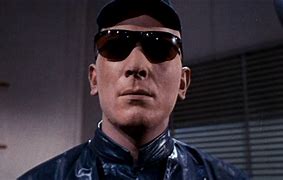
But some mysterious agents of Delphus come to Earth long before Connie goes anywhere. It appears these agents have been operating on Earth for some time, causing mysterious disappearances of scientists, but what we first see of them is eight women and one man, a tall guy with dark glasses and a dark cloak. Whenever one of the girls and Glasses Guy approach a solitary victim, Glasses Guy spreads his cloak over the victim, who just disappears. Even when I saw PLANET in my youth, I knew that this was a cost-cutting effect. Yet the way Margheriti films these disappearance-scenes, they're much creepier than the use of some optical image. In one of the attack-scenes, Glasses Guy botches things somehow, and the victim escapes, though he's been weirdly shrunken, causing him to fall into a coma. The woman with Glasses Guy then makes him disappear, though she doesn't have a cloak to bring off the effect. 

I'm not sure how it happens that Halstead, commander of a space station, gets assigned to investigate missing scientists, though in one scene he and his agents certainly act like they have police-powers. At one point, Glasses Guy (or a clone thereof) is sighted in a future-car, and agents give chase. The car cracks up and the driver disappears, but Halstead makes the scene in time to see that the car contains doll-sized, miniature people held in stasis within a suitcase. In addition, slightly later the authorities find the dead body of a Glasses-Guy, and discover that he has four arms, the result of skin grafts. The call goes out to find Doctor Nurmi.


 Somehow Halstead and two other officers track down two of the female Delphus agents and their leader (Moha Tahi). This confrontation scene is in equal measure both risible and symbolically significant, for the three girls show themselves to be judo-mistresses and hand the three guys a pretty tough battle. While the spies are being taken into custody, Connie arrives on Delphus and begins to encounter some weird phenomena, including an oddball doctor who tells her "your other half will soon be here." Back on Earth, Halstead tries to choke the truth out of Nurmi, but Halstead's superior reins him in. Nothing daunted, Halstead takes a contingent of men to Delphus to rescue Connie and destroy Nurmi's mad scheme, whatever it is. Nurmi gets to Delphus before Halstead and informs Connie that, in addition to somehow conquering Earth with his clones and his shrink-tech, he plans to be joined with Connie in a manner more surgical than sexual. In other words, when Nurmi isn't playing Frankenstein, he's a Moreau who works on himself, and he wants Connie's body only to create a perfect male-female hybrid. If you credit Nurmi with nothing else, he certainly has the courage of his convictions, for even though Halstead brings down his operation Nurmi does his best to take the space-soldier with him into oblivion.


I don't know which of the "Gamma Ones" was written first, but PLANET is the most detailed and feels most like the authors projecting their societal concerns upon a future-scape. The writers did this by creating two sets of oppositions. Halstead may sound as conservative as a Hebrew patriarch out of Leviticus when he rails against skin grafts as a threat to bodily autonomy. But Nurmi is entirely blasphemous in creating a race of perfect humans to people the universe, suggesting a god-complex-- though he might be the first such mad scientist who wanted to become "god and goddess in one body." And though Nurmi's female servants may be judo-trained marvels, none of them have any individuality-- which Connie, even in her rejection of ultra-feminism, certainly possesses. I'm not saying that it's entirely wrong to laugh at some of the movie's missteps, like the soldiers using acetylene torches to suggest ray-guns. But Margheriti, who had completed two Gothic horrors before PLANET, puts a lot of social content into this space-opera, as well as undermining a lot of the gosh-wow sci-fi nicknacks with uncanny, and sometimes apocalyptic, imagery. One might not want to think of PLANET, with its "wild" space-babes and square-jawed heroes, as quality sci-fi. But it's much more imaginative than most space-operas from any decade or nation.      


Friday, May 16, 2025

NIGHT OF THE SKULL (1974)


PHENOMENALITY: *uncanny* 
MYTHICITY: *fair*
FRYEAN MYTHOS: *drama*
CAMPBELLIAN FUNCTION: *psychological* 

SPOILERS SPOILERS SPOILERS


This movie, currently streaming as NIGHT OF THE SKULL, is one of the rare Jesus Franco directorial efforts not marred by his free-form wackiness.  At the same time, it's no more than a decent time-killer.

The film starts off introducing us to an English lord, Archibald Marian. For some reason he's torqued off at his relations, because he's reading aloud some faux-Biblical gobbledygook about God avenging himself upon a "perverse generation."  Archibald seems to have some fascination with the Classic "four elements" of Greek belief, and he rants about the elements being used to kill his enemies. However, there's a mysterious figure in a skull-mask lurking nearby, and this specter apparently takes inspiration from the Lord's yammerings. He knocks out the Lord and buries him alive, thus fulfilling the "earth" symbolism.


 Also living in the Lord's manor are his wife Cecilia, his illegitimate daughter Rita (Lina Romay), and two married servants, Rufus and Deborah. Though Rita has been allowed to live at the manor, she's been forced to accept the role of a servant. Later she will tell a constable that both Archibald and Cecilia used to beat her, and eventually this testimony is borne out. Other potential heirs to Archibald's fortune descend upon the manor for the reading of his will: his cousin Simon (William Berger) and his wife Marta, and somewhat later, his legitimate son Alfred (though possibly by another wife than Cecilia). During the reading, the lawyer reveals that Archibald left two wills: one in case he died a normal death, the other in case he was murdered. The first one divides the estate between everyone except for Rita, the second one leaves everything to Rita alone.                                                                                       


Cecilia doesn't take her disinheriting well: she comes into Rita's room and whips her just a few times (rather restrained for the often torture-happy Franco). The killer knocks out Cecilia and ties her up on the shoreline, where we're later told she was killed not by the waters but by exposure to the high winds, making this the "air death." Despite this second fatality, most of the characters continue to hang out around the manor while they're being interviewed by police or are bouncing off one another. A fire-death for Deborah ensues, but this doesn't keep Alfred and Rita from enjoying a possibly incestuous affair. The killer targets them too but doesn't leave either of them dead. Then Simon seems to give the game away to the audience, providing a "water death" by drowning his wife Marta in a bathhouse. But wait, then Simon is confronted by the Skull Killer, who takes off his mask and reveals that-- he's Archibald, who at some earlier time was assaulted by Simon and survived that attempt at murder but lost his memory. Then Archibald got back his memory and went through police training under the name "Brooks," so that he could enter the manor when he pleased. So then-- who's the Archibald who got buried alive at the outset, whose body was taken into custody by the officials?                               
I checked a few online reviews to see if anyone had commented on this lunacy but didn't see anything. However, it's possible that unlike me most of the reviewers won't give away endings even if they show that the director was just goofing around with no intention of delivering a basic formula effort, even if that's what SKULL appeared to be from the start. Crazy-ass Franco's normal methods of off-the-wall storytelling are signaled before the big ending, though, with a sequence in which a lady psychic tries to talk the dead patriarch but gets killed and has zero effect on the plot. Though the fragmented screenplay suggests that more than one murderer appears in the story, NIGHT OF THE SKULL is still a better title than the original NIGHT OF THE KILLERS. This is not in any way a giallo film despite the era in which it appears; it's an old dark house that includes a masked killer like the original CAT AND THE CANARY movie. Franco also may have been joking when he had the credits claim that SKULL was based on a CANARY all right, but one written by Edgar Allan Poe, which is of course nonsense. A comment on IMDB claims that at some point Franco confessed that he stole the plot from Edgar Wallace, but if so, that wild and crazy Spaniard must have put that Wallace work through his own personal mixmaster.   

Monday, May 5, 2025

THE GATES OF HELL TRILOGY (1980-81)


PHENOMENALITY: *marvelous*
MYTHICITY: (1) *fair* (2,3) *poor*
FRYEAN MYTHOS: *drama*
CAMPBELLIAN FUNCTION: *metaphysical*                                                                                                                                                 I saw all three of these haunted-house/zombie films separately but this was the first time I watched them together, to see if they justified their alleged connections to the Lovecraftian cosmos. While it's true that director/co-writer Lucio Fulci worked in some references to HPL, Fulci's emphasis on gore and the walking dead doesn't resemble much in that author's work. I didn't get a very favorable impression of this trilogy the first time around, and I didn't find too much more worth commentary this time either.                               

 CITY OF THE LIVING DEAD is the strongest offering, and the most Lovecraftian. In HPL's story THE DUNWICH HORROR, the residents of the fictional Massachusetts town of Dunwich are besieged by various evil phenomena, brought about by foul humans who open a gate to the world of the elder god Yog-Sothoth. In CITY, an evil priest in Dunwich sacrifices his own life in order to open the gates of hell and allow the living dead to enter the earth-realm. While the rural residents are suffering various weird phenomena, in New York a psychic named Mary (Catriona MacColl, who stars in all three of these movies) perceives the threat but is so overwhelmed that she's paralyzed and is believed to be dead. Fulci later follows up on this bravura opening scene by having Mary revive just after having been partly buried in a coffin. By dumb luck, reporter Peter (Christopher George) became interested in Mary's peculiar demise and happens to be at the cemetery when Mary revives, so that he's able to free her. She then dragoons him into helping her travel to Dunwich (supposedly built over what used to be Salem!) so that they can prevent the evil priest's handiwork. Fulci throws a variety of other characters, none of whom are as sympathetic as Mary and Peter, though I wondered where Fulci was going when he has a mental patient named Sandra confess to incest fantasies. But pretty much everyone is set up to be the victim of various gory deaths. They're well enough done but the only involving aspect of the story is the quest of Mary and Peter to stop a catastrophe. It helps that George and MacColl have better chemistry than MacColl has with her other co-stars.                                                                                   

  THE BEYOND recapitulates roughly the same scheme. In 1927, a diabolical painter creating a door to hell within a room in a New Orleans hotel (one of seven, though the characters all talk as though one is enough to unleash the living dead onto earth). A vigilante group kills the demon-worshipper but of course he's managed to set the wheels in motion. In 1981 ownership of the hotel is bequeathed to Liza (MacColl) and she attempts to fix up the building to make it a going concern. A woman with white eyes, seen in 1927 reading an occult book, appears in the hotel and workers start getting injured or killed. Then Liza meets Emily, a white-eyed woman with a guide dog. Is she the descendant of the 1927 woman? Who knows? In the end everyone's just being set up for a gory execution, and the only Lovecraftian element is the name of the aforementioned occult book-- which I'll come back to later.                                                                
Despite Fulci's public statement that he meant to give HOUSE BY THE CEMETERY a Lovecraftian vibe, I saw nothing reminiscent of HPL or of Henry James, whose TURN OF THE SCREW gets quoted at the film's conclusion. HOUSE is the most like a standard haunted-house tale, though I must admit that the "haunt" is not anything like your typical ghost. Lucy (MacColl) moves, along with husband Norman and small son Bob, to a Massachusetts mansion without knowing anything of its heinous history. The "rise of the dead" is limited to a strange girl-ghost-child who befriends Bob, and whom no one else sees. However, the killer lurking in the mansion and intermittently offing victims isn't precisely the walking dead. He's the former occupant of the house, the comically named Doctor Freudstein, and he has kept himself alive by harvesting blood cells from his prey. (He has a no-face look thar might remind one of the then-current slasher-killers, one of whom Fulci would essay in his 1982 NEW YORK RIPPER.) The victims this time are more sympathetic than those of THE BEYOND but their awful fates seem a fait accompli.
                                                                                                              As for the occult book mentioned in THE BEYOND, it's named "Eibon," and I have no doubt that Fulci or a co-writer got the name from some HPL story. However, there's a slight irony in Fulci's use of the name. The book was invented by HPL's fellow writer and correspondent Clark Ashton Smith, who gave HPL permission to name-check this particular magic tome in HPL's stories of his elder-god cosmos, probably because HPL had initiated the basic idea that Smith was emulating. Now, Smith's baroque fantasy-stories were at their most extreme never as gory as a standard Fulci film. But quite a few Smith stories deal with the same tropes seen in this trilogy: the menace of living corpses, described with considerable delectation, or of victims condemned to dwell in the twilight of an undead existence. But it's probably not likely that Fulci knew anything about CAS, so the confluence of zombies is at best a synchronicity.               

Sunday, March 2, 2025

ZORRO IN THE COURT OF SPAIN (1962)


PHENOMENALITY: *uncanny*, 
MYTHICITY: *fair*
FRYEAN MYTHOS: *adventure*
CAMPBELLIAN FUNCTION: *psychological, sociological*                                                                                                                          ZORRO IN THE COURT OF SPAIN starts rather slowly but soon shapes up into a decent little swashbuckler. Most of the movie's alternate titles seem to emphasize the titular masked hero swashing his buckles in Spain, so I've no idea why the English dub I saw claims that the action all takes place in "Lusitania," which in recent centuries usually connoted Portugal. All the names involved in the court-intrigue are almost certainly fictional, so the change wasn't made to offset political connotations.                                                       


As with some of the other "Euro-Zorros" around this time, being set in Europe raises the stakes from the more modest adventures of the California-based Fox. A new grand duke, brother of the previous and deceased duke, has challenged the widowed duchess for the throne of Lusitania. The duchess has gone into hiding with her allies, but for some reason she's separated from her small daughter, and one of those allies takes the little girl to Lusitania Capital (I'll call it) to hide her from the enemy in a monastery/orphanage. The Duke either lives in the Capital or close to it, doing various tyrannical things with the help of his main henchman Captain Miguel (Alberto Lupo), so this choice of locations doesn't seem like the swiftest idea. In due time the Duke and Miguel will get their hands on the kid in order to force the duchess to abdicate. In addition, evil Miguel has been pestering Marquise di Villa Verde to let him marry beauteous Bianca (Nadia Marlowa), despite the fact that Bianca is betrothed to marry the Marquise's son Riccardo (George Ardisson), also Bianca's cousin. Riccardo comes to the Capital just in time for all these events, having been to Mexico for training as a young cavalier (one of two major flippings of the usual Zorro-script).                                                 

     
Apparently, Riccardo and his factotum Paquito got some advance intel on the troubles in Lusitania, because as soon as he arrives, he's already got the whole Zorro idea thought out. He immediately plays the part of the jaded aristocrat with no interest in local politics, so as to allay any suspicions from Captain Miguel and his sister Isabella, who oddly is currently married to the Marquise. The father of Riccardo and Isabella have no interpersonal relations, though, so this may be a change made by a translator. Some Zorro-stories give the main heroine an interfering aunt, which may be where Isabella comes from, but she only has one scene relevant to the narrative and totally disappears from the latter part of the movie. Anyway, Riccardo's louche act alienates both his father and Bianca, but it works to allow the hero to listen in on the plots of his enemies and work to counter them as-- Zorro!                                                           

   
   The fight-scenes are passable and Ardisson makes an okay masked avenger, even though he gets more mileage out of the Riccardo role. But the most interesting change is that although the heroine goes through the usual process of rejecting Riccardo while going gaga over his costumed identity, this time Zorro marries the heroine in his non-costumed identity.    No rationale is presented, though possibly Riccardo does this to block Miguel from forcing Bianca to marry him. Riccardo, knowing that Bianca doesn't love his false identity, refrains from making her share his marriage-bed. But of course, once he rescues the little girl from the evildoers and gives the duchess the chance to oust the evil Duke, Zorro can unmask and the two enjoy connubial bliss. The villains are not very stylish this time, but the romance is much better developed than in the majority of B-Zorros. 

Monday, January 13, 2025

SERENADE FOR TWO SPIES (1965)


PHENOMENALITY: *uncanny*
MYTHICITY: *fair*
FRYEAN MYTHOS: *irony*
CAMPBELLIAN FUNCTION: *psychological*                                                                                                                                              SERENADE is one of the few West German Eurospy films that has a strong Germanic character, though Italy had something to do with the production. Most of the major characters are played by German actors, with only minor contributions from "names" like the American Brad Harris and Italian Tony Kendall, and even though large parts of the story take place in the United States, it's very much a European's treatment of "America as exotic locale." The rambling narrative even wanders from San Francisco to Nevada just so that the hero can contend with guys in cowboy hats.                                 

  The story begins in a farcical mode as John Krim, Agent 006 1/2 (Helmut Lange), gets his assignment, with lots of daffy references to James Bond and Goldfinger. But SERENADE isn't really a comedy with lots of joke-setups, but what I consider an irony, devoted to loosely satirizing the tropes of the superspy genre. Director/co-writer Michael Phlegar doesn't come up with a very pointed satire, but I have the impression that he was focused on inverting just one major superspy trope: that of the spy as a Don Juan who never gets tied down to one woman. To counter this favored trope, the story puts Krim more or less in the hands of the mystery girl Tamara (a radiant Barbara Lass). Is she an ally who keeps giving Krim romantic overtures, but still plays coy, or a foe working for the villains? She seems to want to vex and confuse the hero, and there's even an amusing scene in Nevada where Tamara dresses up like a cowgirl and lassos Krim, just to mess with him. Since Lass's Tamara is so central to the plot-- essentially a co-star to Lange's Krim-- I'm not giving much away to say that she's one of the good guys. But her real threat is not that she's going to murder him, but to marry him, and the goofy ending implies that Krim's going to get hog-tied by matrimony no matter what. A lot of spy-flicks loosely end with the secret agent bonding with his leading lady, so that there's at least the possibility of connubial bliss, but few if any really show the hero getting dragged to the altar.                                                                             

  There's also another duplicitous damsel whom Krim names "Goldfeather" because she never mentions her actual name. She shows up in his hotel room as a maid and delivers him an exploding breakfast roll (which is the most uncanny thing we get in the film). But it's not clear that she knew the roll was really a bomb, and later on she saves Krim from death, so maybe she's one of those bad girls who turns good due to the hero's sex appeal. It's almost impossible to follow who the villains are, and though they're said to be pursuing some sort of "laser rifle" tech, we never see so much as a prototype, so I think the script just threw in a laser reference because there was a laser in the GOLDFINGER movie. Though Krim doesn't have any secret agent devices, he can fight passably well, though an early sequence shows him running from a rumble with a bunch of garishly clad henchmen. Toward the end there's a hallucinatory scene in which Krim and a few allies seem to be standing around on the floor of a lake with no ill effects, shooting it out with enemy spies, but this is clearly just the director's brief visit to Surrealism Alley, with no relevance to the main story. I can't say I found SERENADE as funny as I think its creators thought it was, but I have to appreciate that this is one time the male spy doesn't get to be the cock of the walk-- though Goldfeather does get a pretty good look at an unclad Krim in his bathroom.               

YPOTRON-- FINAL COUNTDOWN (1966)


PHENOMENALITY: *marvelous*
MYTHICITY: *fair*
FRYEAN MYTHOS: *adventure*
CAMPBELLIAN FUNCTION: *psychological, sociological*                                                                                                                                                                                                                                        YPOTRON-- FINAL COUNTDOWN is only one of several titles for this multi-country production, but I might as well use the one appearing on my YouTube copy. The nonsense-word "ypotron" is tossed around several times in the film before the audience finds out what it connotes, and an English-language song even asks what the word means. I'll give it away here because it has consequences for the movie's phenomenality: Ypotron is an antiballistic weapon aimed at destroying America's Gemini space program, and it's the only marvelous item in the story, since the Bond-like hero only utilizes minor uncanny weapons like a lighter than dispenses tear gas.             
Argentinian star Luis Davila (billed here as "Luis Devil") had the misfortune to headline the dismal ESPIONAGE IN TANGIER, but his second and last time venture into the Eurospy genre was a charmer by comparison. We first see him in his character of tuxedo-clad Robbie Logan, getting shot several times by a rifle. But it's just a test of the bulletproof vest beneath his clothes, administered by his colleagues in the agency Kosmos, which is supposedly focused only on affairs related to space defense. Logan then departs for a vacation from spying in Acapulco, where he shows off his ability to charm assorted gorgeous women.                                                                   

  However, another agent brings Logan news that three of his colleagues were mysteriously slain while working security for the European missile-factory "Indra." In addition, Logan's informed that there's a possible threat to an old friend of his, Professor Morrow. Logan reminisces about how he was a captive in wartime, possibly by the Nazis since he mentions being tortured by an overseer named Leichman. Morrow somehow saved Logan's life but then disappeared from public sight for roughly twenty years. To repay his old debt, Logan drops his vacation and journeys to Morrow's home in Europe. There he has a meet-cute with Morrow's grown daughter Jeanne (Gaia "AVENGER X" Germani), whom Logan never met except for seeing a photo of her as a naked baby (which of course he tells her about to intrigue her). Jeanne calls her father to come meet Logan, but it just so happens Professor Morrow is kidnapped by hostile parties unknown.                                                                                   

 Thus far, everything in YPOTRON sounds like a regular old spy-flick. However, for once I won't go over the plot in detail, because director/co-writer works in a twist rare in the Eurospy world. Jeanne of course gets mixed up in Logan's attempts to find her father, and to sort out the villains behind the mysterious Ypotron project. A lot of Eurospy flicks barely establish the nature of the main villain, but in this movie, the Big Bad is, shall we say, "hiding in plain sight," and the twist actually has a little emotional resonance for both Logan and Jeanne. The script also works in a lady spy played by Janine "KISS ME MONSTER" Reynaud, but she turns out to be Logan's ally, so no bad girls here.                                                                                                     

There are a number of clever lines in the script and production values are pretty good, so director Giorgio Stegani did pretty well with what seems to be his only spy-film. In fact, whereas a lot of these cheap thrillers fall apart in the final act, Stegani provides audiences with a well-choreographed fight between Logan and a Big Brute henchman (Fernando Bilbao, who played a version of the Frankenstein Monster in a couple of Jess Franco flicks). But the aforementioned plot twist is the big distinction of YPOTRON.      

Friday, January 10, 2025

FLASHMAN (1967)


PHENOMENALITY: *marvelous*
MYTHICITY: *fair*
FRYEAN MYTHOS: *adventure*
CAMPBELLIAN FUNCTION: *cosmological, psychological, sociological*                                                                                                                                                                                                        I have to admit that on my first viewing of FLASHMAN, I didn't give it my full attention and briefly judged it to be no better than the majority of Italian-made costumed-hero films. Most of the Italian works in this genre are at best romps with a lot of silly formulaic action, like 1966's SUPERARGO, or terribly-executed junk like 1979's SUPERSONIC MAN. But though I don't doubt that FLASHMAN came about because someone wanted to produce a knockoff of the then successful BATMAN teleseries, this movie, despite having a very light touch, actually follows the better BATMAN comic books more ably than most of the TV episodes did.                                                                                                         

Prior to writing this review, I sorted out some of my thoughts on Bill Finger, the pre-eminent BATMAN writer of comics' Golden Age, concluding with the comment, "But I'd argue that even in his weaker stories-- and Finger did a lot of goofy, poorly conceived stories in addition to his quality fare-- he shows a greater, perhaps childlike ability to take the weirdest ideas seriously, in a spirit of uninhibited play." I don't know what the sole billed writer Ernesto Gastaldi thought about his FLASHMAN assignment. None of his horror or adventure scripts prior to FLASHMAN seem to have the "spirit of uninhibited play" that I find in this early Euro-superhero, so he might have just read some BATMAN comics or watched some BATMAN tv shows. But the central idea for the story-- beginning with a gangster-villain known only as "Kid" killing a scientist in England for an invisibility formula-- sounds like the sort of story that was par for the course in the comics.                                               What's interesting about FLASHMAN, though, is the atypical way the hero (Italian actor Paolo Gozlino, under the name "Paul Stevens") becomes involved in the villain's first robbery. The hero is under cover as an English bank teller while trying to track down a counterfeiting ring that's infiltrated the bank, and by chance Flashman is the teller whom Kid decides to rip off. After the robber absconds with his loot, Flashman is then delayed by cops who think he stole the dough. Flashman pretends to commit suicide by jumping from a high-story window-- presumably saving himself through sheer athleticism-- and then somehow finds his way to the villain's redoubt. Fully attired in a costume that resists gunshots, Flashman beats up Kid's henchmen. However, Invisible Kid (sorry) gives the hero the impression he's trying to escape in a helicopter and then sends the vehicle on a remote-controlled trip of doom. Flashman survives, of course.  But unlike so many other costumed-hero flicks from Italy (and Mexico, for that matter), he's suddenly in the unenviable position of not really having any way to track down the main villain.                                                                                         

                     
The hero's solution is IMO fairly novel. Knowing that the police suspect another bank-employee-- Alika (Claudie Lange), who's the head of the counterfeiting ring-- of being a confederate of Flashman's teller-character, Flashman resumes that disguise, shows up at the apartment of Alika while the cops are present, and gets both of them arrested. A bluff about whether the "other robbers" have the bank's money provokes Invisible Kid to invade the cells of both Alika and Phony Teller. An unlooked-for consequence of the meeting of Kid and Alika is that Alika tells him that his bank robbery career is a terrible use of his great powers. He listens to her and breaks her out, which leads to a complicated shell-game plot against a sultan of Lebanon-- which is fun, but I won't explore it further.                                                                                                   

There are a lot of fun tongue-in-cheek touches here that don't quite fall into the BATMAN show's evocation of "camp." For one thing, we learn that Flashman's secret ID is that of an English lord named Alex Burman. Only his butler and his oddball sister, clad in "mod" fashion, know his identity as Flashman, and the hero remarks to his sibling, "we have too much money and we're both trying to make our lives more interesting"-- her through fancy clothing, Flashman through crimefighting. Stevens fulfills this hail-fellow-well-met characterization admirably, particularly when he takes the time to repeatedly humiliate a thick-headed Scotland Yard cop (the film's comedy relief) who keeps resisting Flashman's beneficent intentions. The dopey cop is a bit of a bore, and the invisible villain isn't too interesting, but Alika is a mean bitch who's willing to commit flagrant murders to make her fortune. The climax includes some fun parasailing feats to conclude the film. And so ends the only Italian superhero film that I thought had a script worth a damn.      

Thursday, January 9, 2025

SEVEN MINUTES TO DIE (1969)


PHENOMENALITY: *uncanny*
MYTHICITY: *poor*
FRYEAN MYTHOS: *adventure*
CAMPBELLIAN FUNCTION: *sociological*                                                                                                                                                  This late entry to the Eurospy genre, co-written and directed by Ramon Fernandez, currently occupies the lower rungs of that category. I've often complained about how Eurospy movies often downplay the villains for whatever reasons, but SEVEN MINUTES TO DIE is unique in that I could hardly keep track of the villain's ID or his plot. I know that early in the movie he eliminates another agent and takes his identity and then plots to sell a list of undercover agents to a power hostile to the democracies.  US Secret Service agent Bill Howard (Paul Stevens, a couple of years after he starred in the superhero fantasy FLASHMAN) trundles around Europe, trying to locate the list and getting into a few desultory fights. (I slightly liked a scene where the hero is attacked on a dock by thugs dressed in judo-gis and headbands.) He encounters a few pretty women but doesn't romance them. There are two diabolical devices in the movie. Howard, escaping from pursuers in his car, releases an oil slick from said car so that his foes skid off a cliff to their doom. Later some enemy or other traps Howard and his secretary in a room with crushing walls, but he breaks out with the use of explosives (without causing harm to either himself or the secretary). Oddly, the photography's pretty good, but everything else about the movie is humdrum as hell.    

Wednesday, January 8, 2025

MYSTERY ON MONSTER ISLAND (1981)


PHENOMENALITY: *uncanny*
MYTHICITY: *poor*
FRYEAN MYTHOS: *adventure*
CAMPBELLIAN FUNCTION: *psychological*
                                                                                                                ***SPOILERS***                                                                                                                                                                                                                                                                                                          I didn't originally care much for MYSTERY ON MONSTER ISLAND, directed and co-written by Spaniard Juan Piquer Simon. However, when I compare MYSTERY to the movie for which Simon may be best known to Americans, the terminally dumb SUPERSONIC MAN, this low-budget "robinsonade" doesn't come off quite so badly.                                                                                                                                                                                                There's even some fun to be had imagining how this project might have come about. It might have started when Simon scouted some location and realized that he might use it for a "Robinson Crusoe" type of story. Maybe he had some particular affection for the public domain Jules Verne novel GODFREY MORGAN, but realized that Crusoe-type stories weren't all that salable in the 1980s. So Simon took the adventurous trajectory of the Verne book-- in which a young man of privilege went on a sea voyage to prove his mettle and had various island-adventures-- and added some fake monsters. It seems axiomatic that Simon or someone in his orbit chose the title to make moviegoers associate MYSTERY with the well-liked MYSTERIOUS ISLAND. Yet the thrust of the movie's narrative is very different, and I find the novelty of MYSTERY slightly preferable to any of the lackluster remakes of the 1961 Harryhausen film.                                                                                   
So as mentioned above, the novel concerns Godfrey Morgan, who goes off on various adventures, accompanied by a comedy-relief tutor named Artelett, said adventures being fostered by Godfrey's uncle, so that the young man can prove himself before he marries his beloved, the uncle's female ward. MYSTERY starts out pretty much the same way, except that in the film, the young fellow (now named Jeff and played by Ian Sera) is sent to a particular island by the uncle (Peter Cushing). Jeff goes in the company of the tutor (David Hatton) in advance of his impending marriage to the ward Meg (Ana Obregon), but in this case, some chicanery is signaled by the fact that the uncle has actually purchased the island in advance. In fact, in a plot-point that I assume isn't in the book, the uncle competes for the purchase of the property with another rich man, Taskinar (Terence Stamp). Taskinar, unlike the uncle, knows that there's a cache of gold hidden on the island, and so he means to have that booty no matter who else gets in his way. That includes Jeff, Artellet, and all the minions of the uncle.     

  By "minions," I mean not only the transparently phony monsters encountered by Jeff and Artellet, but everyone else that the two meet on the island. From a "Friday"-like native to a supposed French castaway named Dominique (Blanca Estrada), everyone's just an actor hired by the uncle to give Jeff the illusion of an adventure. This ploy doesn't make much sense-- certainly Jeff resents the deception when he finds out-- but by sheer chance, the life-and-death stakes become real when Taskinar and his crew of pirates invade the island for the gold. So even though there are no monsters on Monster Island-- all the dinosaurs being the creation of some "toymaker"-- the movie does conclude in a big brawl between Jeff's allies and the forces of Taskinar, and the story ends with the good guys' victory.             

This simple film's list of merits and demerits is almost equal. Cushing and Stamp have only a smattering of scenes, so obviously Simon only had the funds to pay the "big names" in his movie for a few days apiece. (Paul Naschy has some minor scenes as well, but I didn't bother looking for him.) Main character Jeff ought to be likable since he sincerely wants to prove himself, but actor Sera is just kind of bland. Maybe that's why he didn't have a very long cinematic career, with three of his appearances being in movies by Simon. One odd development is the revelation that Taskinar somehow suborned the actress playing the role of castaway Dominque, but I don't see that she did anything to help the villain's designs. She does make a play for the engaged young man, but that may have been her own private idea. Still, in the concluding brawl, Meg gets to fight Dominique, even though Meg has no idea that the other girl put the moves on her man. I frankly liked best the performance of David Hatton as the incompetent and effete tutor, because I thought he gave the one-dimensional character his all, which is more than I could say for Ian Sera. And lastly, though this is a compromised adaptation of the Verne book, I probably will never read the source novel, and so MYSTERY educated me in the broad outlines of Verne's forgotten venture into Robinson Crusoe territory.                       

Wednesday, January 1, 2025

BLACK SUNDAY (1960)


PHENOMENALITY: *marvelous*
MYTHICITY: *good*
FRYEAN MYTHOS: *drama*
CAMPBELLIAN FUNCTION: *metaphysical*                                                                                                                                                BLACK SUNDAY proves a more evocative title for Mario Bava's first directorial effort and his first pure horror movie than the Italian original, translating to "Mask of the Demon." I doubt that the words "Black Sunday" even appear anywhere in either of two circulating English translations, much less in the original Italian. But because Sunday is the day consecrated to Christian worship in that religious tradition, speaking of a "black Sunday" is a parody of something sacrosanct, as with the Satanic "black mass."                                                                                                                                                    Further, the evocation of "blackness" connotes the darkness of a Manichean world, where even the redemption of Christ seems nearly powerless. The famous opening scene of SUNDAY, taking place in 17th-century Moldavia, shows a band of witch-slayers resorting to extreme violence to put down a pair of Satan-worshipping witches, Princess Asa (Barbara Steele) and her lover Prince Javutich (Arturo Domenici). Asa's own brother condemns the duo to damnation, rather poetically calling the already slain Javutich "the serf of the devil." The slayers intend to burn both Satanists, but only after killing them with metal masks that are hammered into their faces. However, after both are slain, a sudden storm interrupts the ceremony, and everyone flees. It's not clear why the storm keeps the Moldavians from burning the bodies later. The most one can imagine is that the locals are too spooked to do so, and so they merely inter the bodies as quickly as possible. Javutich, complete with mask, is simply dumped in a grave, presumably unconsecrated. For Asa the witch-hunters are more elaborate. Her body is interred within a sealed coffin inside a deserted chapel, but with a cross erected over the coffin and a glass panel that supposedly allows the dead witch to see the cross if she tries to come back to life again. This fear is later justified when a legend relates that a hundred years later, Asa's tomb split open and a female member of her family the Vadjas mysteriously died.                                                                                 

 A hundred years later, Asa tries to resuscitate once again. and this time, she gets some help from two medical men journeying through Moldavia: Doctor Kruvajan and his young colleague Andrei. Nature, apparently controlled either by Satan or his dead servitors, seems to conspire to delay the two men, to lure them to the crypt, and then to cause Kruvajan to accidentally destroy the cross that binds Asa in her coffin. In addition, Kruvajan cuts his hand and spills some blood onto Asa's corpse. This doesn't immediately revive her, as would happen in some later Dracula films. But it apparently strengthens her enough that she can call Javutich out of his grave and make him appear to be a living man.                                                                                                                                                                                                                                                             Without playing down the impact of the opening scene, I found that the strongest horrific scenes were those taking place in the castle of the Vadjas, inhabited by the older Prince Vadja and his two grown children, Constantine and Katia. The latter is also played by Barbara Steele, and after Vadja relates the legend of the death of the young woman in the 1700s. Vadja fears that Katia will be Asa's next target. The dreary aspects of the castle are amplified by evil sendings-- a painting whose figures seem to change positions subtly, and the image of the Mask of Satan appearing in Vadja' wine-cup.                                                                                                                                                                                                Asa uses Javutich to trick Kruvajan into returning to the crypt. In a moment that seems like a homage to Poe's HOUSE OF USHER, Asa simply smashes her way out of her stone coffin and vampirizes Kruvajan to make him into her Renfield. However, Kruvajan's eminence as a doctor makes him even more helpful than simply a supplier of blood. Javutich, posing as a servant, seeks to attack Vadja at night, but the prince wears a cross and Javutich can't touch him. Under the guise of doctorly care, Kruvajan removes the cross, allowing Javutich to vampirize the older man. Later, Vadja himself is so overcome by the power of evil that he attempts to drink the blood of Katis. But since Asa has her own plans for Katia, Javutich kills Vadja and delivers Katia to Asa in her tomb. Apparently Asa still can't just leave until she changes places with the living girl, consigning Katia to death.                                                                                                                                                     The last third of Bava's film is the weakest, as the audience must follow young doctor Andrei around as he slowly puts the pieces together and calls upon the local priest for help. He encounters Asa, who has switched places with Katia to make her look like the corpse of the dead witch. However, Andrei sees through the deception and calls the locals to his aid. Soon Asa's body is getting burned as it should have been two hundred years ago, and Katia makes a full recovery Nevertheless, this "happy ending" still leaves quite a few people suffering grotesque demises, so in a broader sense, BLACK SUNDAY, while not a "win" for Satan, allows the fiend to score far more points than he did in a lot of other films prior to this one.