Showing posts with label John Gavin. Show all posts

Monday, April 3, 2023

Doris Day Emotes Mightily in ‘Midnight Lace’ 1960

Doris Day is stalked by an unseen villain in 1960's suspense film "Midnight Lace."


Midnight Lace is one of those film perennials, the "woman in jeopardy" movie genre. Doris Day has made several, Julie, The Man Who Knew Too Much, and Midnight Lace.

As far as Doris Day’s performance is concerned, Midnight Lace falls in the middle. Some critics and fans have raved over her performance, citing that Day should have been Oscar-nominated. Others have cited that her hysteria was over the top, like her turn as Julie. While Doris could have been reigned in a bit as the hysterical heiress, there are several striking scenes where Day is most effective.

In case you're wondering what the title of "Midnight Lace" means!
Doris dons this ensemble at a rather odd point in this 1960 thriller.

This is one of those movies where you turn off your brain and just enjoy the thrills. The story is filled with more red herrings than a smokehouse. Nearly every supporting character has a seemingly sinister moment that makes them a suspect. 

Some of the 1960 "modern" attitudes toward the crank caller feel more than archaic, even for the time. It's eye-rolling how the other characters, including the detective, who all seem to want to brush it off as a prank or the imagination of Day's Kit. My two hurdles with this film: Why does Kit hang on the line while she's being threatened and degraded, instead of just hanging up? It's over 30 minutes into this movie before the detective has the bright idea for the couple to get a new phone number. The other is the caller's voice, which we occasionally hear, that is high-pitched and disembodied. Unfortunately, it inspires hilarity instead of hysteria, since the voice sounds like Pee Wee Herman acting villainous!

Why doesn't Doris Day's tormented heroine just say, "Sorry, wrong number?"

Doris Day plays an heiress who has been married three months to a wealthy business man, Tony Preston (Rex Harrison). She seems to have no purpose but to shop and feel neglected, but is kind and pleasant. Tony's a hard working business man who is always begging off personal plans to take meetings. The contrived plot only has Kit picking up the phone when the crank caller rings. Kit also experiences various near-miss physical mishaps—construction beams crashing, elevators stalling, shoved in front of a bus, etc. By the last act of the film Doris' Kit is a movie diva mess.

It's worth nearly getting clobbered by a construction beam if you get to meet
John Gavin! Doris Day in 1960's "Midnight Lace."

Even the best of this genre can be contrived, and depend on a suspension of disbelief. Without giving away the story, the villain seems rather obvious, and the red herrings more than a bit fishy! It’s best to enjoy the excellent cast of pros, the atmosphere, and lavish settings. While not as cheesy as Ross Hunter's same year Portrait in Black, the story doesn't withstand scrutiny.

Doris Day & Rex Harrison play newlyweds whose bliss is being blown by a
threatening caller to the usually sunny Day, in 1960's "Midnight Lace."

Rex Harrison as the husband is smoothly professional, but it's hard to understand why Day's heiress would marry this man 15 years her senior, when he's not particularly attentive. And Day's reactions to her situation seem a bit naive for a woman nearly 40. Doris must once again be playing younger, as she's referenced that way a couple of times. Also sexist and eye-rolling is when Day's Auntie Mame-ish Myrna Loy makes a number of self-deprecating cracks about aging, when she's just three years older than Rex Harrison. So, what else is new in Hollywood?!

"Rex, if you're only 3 years younger than me, why am I getting all the 'old' lines?"

Myrna Loy plays Doris Day's aunt in 1960's suspense drama "Midnight Lace."

The same is true for Kit's neighbor friend Peg, played by Natasha Parry. She's 30ish and attractive in a Dana Wynter way. And who turns out to be her mostly off-camera sailor husband? Anthony Dawson, also 15 years older, who looks like Trevor Howard's corpse!

Anthony Dawson plays much-talked about, seldom-seen neighbor Peg's sailor hubby.
Odd couple, since she is played by lovely Natasha Parry, in "Midnight Lace."

On the other hand, there's John Gavin, at the height of his hunkiness as the construction manager next door. He's also rather dull, like a male Kim Novak.

John Gavin's construction manager seems taken with Doris Day's harried heiress
in 1960's thriller "Midnight Lace."

And what would a Britain-set mystery be without a pipe smoking detective played by John Williams? At 70, Herbert Marshall seems feeble as a business associate with spending issues, and who would die six years later. Roddy McDowall is once again the unctuous underling who oozes smarmy charm and snide threats. Hermione Baddeley plays the gabby pub maid, of course! There are many familiar faces in this film, which makes it more fun to watch.

John Williams as the British detective with the pipe, natch, in "Midnight Lace."

Doris Day gets the beauty treatment by Ross Hunter's fave cinematographer Russell Metty. Day's costumes, always a star in her movies from Pillow Talk on, are by Irene, one of the more subtle designers in Hollywood. Day’s clothes look sleek and classy. And the hats? Well, they are a product of their time.

There's some location shooting in London, but this hothouse thriller was filmed at Universal. David Miller, a solid studio director, does the best he can with the material.

This scene has a Hitchcock quality, where the blonde heroine senses imminent danger.
Doris Day as the heiress in distress, in 1960's "Midnight Lace."

As for Day, she resisted this role after Julie caused her great stress. But her producer husband Martin Melcher persisted. Day used her trauma from a physically abusive first marriage for her hysteria scenes. While some feel over the top, like the elevator scene where she has a moment that rivals “I’ll have what she’s having” from When Harry Met Sally, the rest feel realistic, like her final meltdown on the staircase. Some critics have accused her of being shrill, like Elizabeth Taylor in some of her more emotional roles. My thought: Is anger or hysteria supposed to sound pretty?

Is Doris Day's heiress off her beam or is she being harassed? Watch "Midnight Lace!"

Doris Day was a pro, but didn't enjoy this type of role, and never did again. Perhaps her fans agreed. While this film was moderately successful, Day's comedies before and after did far better at the box office. Still, Midnight Lace is mindlessly entertaining popcorn movie, and a glam treat for Day fans.

Here’s my tribute essay to Doris Day here: https://ricksrealreel.blogspot.com/2017/04/a-latter-day-doris-day-fan-fesses-up.html

Doris Day unnerved but unbowed, in the final moment of 1960's "Midnight Lace."


Tuesday, March 21, 2023

‘Thoroughly Modern Millie’ Silly Fun 1967

"Thoroughly Modern Millie," a '20s musical with the '60s biggest singing movie star!


That Thoroughly Modern Millie, a puffed up piece of fluff, was a huge hit in 1967 was rather amazing. Millie wasn’t from a hit Broadway musical, as often was the case in the 1960s. Perhaps audiences who wanted something more mainstream than Bonnie and Clyde and other ’67 gritty films flocked to Millie.

Julie Andrews is Millie, here before she gets her modern makeover.

Producer Ross Hunter couldn’t get the rights to Julie Andrews’ old Broadway hit The Boyfriend. So Hunter hired talent to cook up Thoroughly Modern Millie.  Ironically, wholesome Millie was Julie's last hit movie until a dozen years later, with husband Blake Edwards’ racy 10.

Thoroughly Modern Millie stars a diverse trio of leading ladies: Julie Andrews, at the height of her film stardom; Carol Channing, the toast of Broadway in the megahit Hello, Dolly; and Mary Tyler Moore, who just finished her run as the perfect TV wife on The Dick Van Dyke Show.

Mary Tyler Moore is Miss Dorothy, the latest boarder at the women's hotel.
She becomes besties with Julie Andrews' Millie in "Thoroughly Modern Millie."

Though Julie Andrews and Mary Tyler Moore are more than a tad past the age of playing ingénues, the leading ladies are both appealing, especially Julie in the title role. Julie is high-spirited and fun, in great voice and a game dancer. Moore plays the role of Miss Dorothy, the pampered princess, who arrives at the ladies’ hotel. Mary may seem stilted in the role, but apparently she wanted to gently spoof the sweet young thing role. There are some fun numbers, like Julie's opening title number that shows her transformation from goody girl to flaming flapper. The tap dance scene with Julie and Mary, to make the creaky hotel elevator run, is charming.

Bea Lillie as Mrs. Meers, who runs a women's hotel & white slavery ring.
She's flanked by henchman Pat Morita & Jack Soo, who would find fame in the '70s.

In another galaxy, there’s Carol Channing as the outrageous ex-showgirl, now-rich Muzzie Van Hossmere. Even though Carol’s only in a handful of scenes, with two numbers, her outrageous persona is at full tilt and the Academy saw fit to give her a Best Supporting Actress Nomination for 1967. While I've always had a low tolerance for Carol Channing’s charms, her “Jazz Baby” is an over the top camp classic. It’s as if Baby Jane Hudson made her comeback and was a smash.

I half expected to hear Carol Channing caterwaul "I've Written a Letter to Daddy!" 
But she sings "Jazzy Baby" and prances all over the set. Must be seen to be believed!

Finally, there’s British icon Beatrice Lillie, who plays the comic villain Mrs. Meers. She’s dryly amusing, as the henchwoman who runs a white slavery ring as well as the women’s hotel.

John Gavin spoofs his square-jawed looks good-naturedly as Trevor Graydon. The tall, dark, and handsome star really fills the bill here and then some! Gavin has gotten much criticism as acting wooden in Millie. Well, Gavin wasn’t the world’s most relaxed actor, but I’m surprised that people don’t get that his hero is supposed to be deliberately stiff, like Mr. Peterman on Seinfeld.

John Gavin's a good sport as the square-jawed hero in "Thoroughly Modern Millie."

James Fox is the surprise here as Jimmy Smith, who longs for Millie. I've only seen Fox in intense dramatic roles like The Servant, King Rat and Performance. Imagine my surprise when I saw he is not only dashing and adorable, but a most pleasant singer and dancer, to boot. Okay, so his singing was dubbed by Jimmy Bryant, who also provided the voice for Richard Beymer in West Side Story. But Fox looks like he’s having great fun. He really captures the high-spirited male ingénues of the early part of the 20th century show biz.

James Fox is a total charmer as Jimmy, the free spirit in "Thoroughly Modern Millie."

The film merrily mixes fun song and dance styles, and movie conventions from the era. But at two and half hours long, there’s so much padding that could have been cut. Apparently, Ross Hunter can be thanked for this. The producer liked to think big, while director George Roy Hill thought this was a light musical comedy. Hence, the superfluous numbers and Hunter’s insistence on an overture and intermission made Millie a “road show” event instead of a two hour film.

In "Thoroughly Modern Millie," our heroine mulls over her attraction to both 
John Gavin's dashing boss or James Fox's darling Jimmy.

For instance, Andrews’ Millie singing the “Trinkt Le Chaim” number at a friend’s Jewish wedding—which has nothing to do with the rest of the film. As sweet as “The Tapioca” may be, introducing Jimmy’s character and Mrs. Meers’ antics, goes on much too long. The later Harold Lloyd-type physical comedy scene with Andrews and Fox, while game, is also lengthy.

Bea Lillie as the comic villain Mrs. Meers. This is about how serious 1967's "Thoroughly Modern Millie" gets.

Some viewers will be sensitive and object to the subplot of a white slavery ring run by Chinese villains as rightly racist—who weren’t even played by Chinese actors, to add insult to injury. I took it as cartoonish camp and spoofing old movie serial tropes. Also, Julie's Millie gives up goals of independence to be an old-fashioned wife to rich Jimmy! However, I doubt high-spirited and outspoken Millie would remain demure for long.

As Miss Dorothy, Mary Tyler Moore when she first sees John Gavin's Trevor,
in "Thoroughly Modern Millie."

George Roy Hill, who loved period movies, directed Thoroughly Modern Millie. He brought a lot of research, skill, and style in his vision of this earlier era, much as he did with 1973’s The Sting. Unlike the film’s producer, the director thought of this movie has light, clever fun—which comes off well. Hill had just directed Julie in a commercially successful epic, Hawaii, so they worked well together, and it shows.

Julie Andrews has great fun as "Thoroughly Modern Millie," comically vamping here.

The mix of old and new songs blend together smoothly; costumes by classy Jean Louis are sleek and at times comical, as with Channing’s glitzy glamour. The new songs are by Jimmy Van Heusen and Sammy Cahn, plus “Jimmy” by Jay Thompson. Elmer Bernstein was bemused to have won an Oscar for his non-musical score—it was shoehorned in between all the songs, plus meddling producer Ross Hunter had arranger Andre Previn goose up Bernstein’s more era-appropriate score.

Carol Channing toasts the stars to a happy ending in "Thoroughly Modern Millie."

Given the background goings on, I’d say that Millie made a splash was almost a fluke, given that movie-goers tastes would quickly change. The next year, Julie Andrews’ Star! and 1970’s Darling Lili would bury her career as a top film leading lady. Compared to these latter two behemoths, Thoroughly Modern Millie is the model of simplicity in entertainment. Just remember Millie was a movie made over 55 years ago, about the Roaring Twenties!

Here’s my look at director George Roy Hill’s other period comedy-drama, The Sting: https://ricksrealreel.blogspot.com/2021/08/redford-newmans-star-power-sting-1973.html 

Carol Channing as Muzzie literally acts like she's been shot out of a cannon in "Thoroughly Modern Millie!"


Tuesday, June 29, 2021

'Back Street' 1961


Susan Hayward & John Gavin in "Back Street." Susie's vehicle all the way!

John Gavin's unhappy hubby oughtn't have let Vera Miles' virago wife take the wheel!


The ’61 remake of Fanny Hurst’s Back Street is the third retelling of the teary tale and a favorite of Susan Hayward fans. The first two starred Irene Dunne (’32) and Margaret Sullivan (‘41), so a case could be made for any of the three, as to who was the most noble Fanny Hurst film mistress.

This big screen soap is one of a string of glossy remakes created by glamour fan/producer Ross Hunter: Magnificent Obsession, Imitation of Life, Back Street, and Madame X. The first two were directed by Douglas Sirk, who gave his mainstream soaps subversive subtext. Back Street was directed by David Miller, who was skillful at directing veteran actors to best advantage, but was a straightforward studio director.

Susan Hayward dominates the third version of "Back Street" like a true movie diva.

Backstreet is the tale of a promising young woman with dreams of being a fashion designer, but whose life is altered by falling in love with a married man. In the original story, the woman is compromised by giving her life over as the other woman, and literally living a “back street” life as his mistress. In this update, Susan Hayward’s Rae Smith has her own flourishing career, but eventually agrees to be on call as the married man’s lover. John Gavin’s Paul Saxon is trapped in a loveless marriage to drunken shrew Liz, who wants to remain a rich wife to this department store heir. The main premise here is the film’s major weak point. The two illicit lovers are gaga for each other at first sight, yet he won’t divorce the wife for his children’s sake and the independent career woman runs to his beck and call at the drop of a hat. Even in this early ‘60s era, a rich couple no longer in love would just discreetly live separate lives and not upset the apple cart.

Susan Hayward & John Gavin's characters love is picture perfect in "Back Street."

But this is a Ross Hunter production, so suspension of disbelief is mandatory for his “suffering in mink” sagas. Such coincidences as the main characters running into each other at the most dramatically opportune times (like Hayward’s helping up Miles’ drunken character just as her husband runs over to assist). Or staring into department store windows just as the other lover happens to walk up, reflection in the glass. There are also lovers’ dramatic phone calls, with phones that conveniently match the color scheme of their costumes and décor! And the usual missed opportunities of lovers who can’t seem to get together, soap opera style.

This Back Street was a moderate hit and Susan Hayward’s most successful latter day starring role—though her guest role as Broadway barracuda Helen Lawson in Valley of the Dolls in ‘67 was her biggest all-time hit movie.

John Gavin & Susan Hayward make a handsome couple in "Back Street."

As Rae Smith, Susan is sympathetic and warm as the designing woman with big dreams. Hayward was 43 when Back Street was filmed and she looks lovely, as photographed by Stanley Cortez. Unlike her later ‘60s outings, Hayward’s hairstyles are simpler and look softer, and Susan looks sensational in Jean Louis’ clothes. As the wife from hell, Vera Miles gets to be glamorous, after her drab turn in Psycho. Jean Louis’ costumes for the two women are chic. Also interesting is that both women were cast against type: Susan made a career out playing tough cookies, whereas Vera Miles almost always played warmly classy in her career. Here they play opposites, and both are just as good at it.

Vera Miles, as the rich bitch wife, gets to look glam in Jean Louis outfits.

Susan Hayward sure looks much more subtle in Back Street than Lana Turner did in Imitation of Life. Both films are rags to riches tales, told over a number of years, But Susan doesn’t have that fuzzy-focused and shellacked look that Lana required. Both also shared a co-star in their respective Ross Hunter sagas—John Gavin. Gavin was a decade younger than Lana and 14 years younger than Susie. Tall, dark, and handsome, Gavin looked good opposite both of them. Both actresses were “playing young” in the early sections, and Gavin was given a spray of silver in his hair for the later scenes. Though the age difference was noticeable, it was far more common for aging male actors of the day—especially Gable, Cooper, and Astaire—to co-star opposite women often 25 years younger!

Susan Hayward, a rare chance to play glam, as a designing woman, in "Back Street."

In Where Love Has Gone three years later, Hayward would replay the playing younger bit, again as a WWII era woman in love, growing unhappier up to current day… and age! And that would co-star another young actor, Mike Connors.

If you’ve watched enough Universal TV shows and movies from the ‘60s and ‘70s, you’ll notice the back lot sets look familiar. Also, the huge picture window in Susie’s “country cottage” reminded me of Rock Hudson’s DIY mill dream home in All That Heaven Allows. The recreating of far flung locales, mixing location shooting with artificial back lot exteriors and soundstage interiors, was quickly becoming passé. Still, Hunter’s productions look fabulous, no matter how fake. The sets, costumes, furs, the jewels, hair and makeup, all are total glam.

John Gavin & Susan Hayward bump into each other, over drunken Vera Miles, in "Back Street."

Ross Hunter always gives his leading ladies great support with his favorite familiar faces. Though she’s the same age as Hayward, Virginia Grey plays Susie’s big sister in Back Street. Ross called Grey his “good luck charm,” and she appeared in many Hunter productions. One of MGM’s most beautiful starlets, Virginia never got to the next level, and I don’t know why. I will say, by the ‘50s, Grey’s bone thin appearance and heavy makeup made her appear much older. Note the scene where Virginia’s reading/writing letters to sister Susie, and her eyelashes look like awnings!

John Gavin & Susan Hayward have a most discreet moonlit dip in "Back Street."


John Gavin confirmed what seemed apparent in Imitation of Life. The “next Rock Hudson,” while pleasant enough in the lighter or romantic scenes, turned to stone in dramatic moments. As Paul’s life hits the crisis stage, with a crazy wife, Gavin goes deadpan. While Rock Hudson was no Brando in the emotional department, Hudson grew into a warm leading man. I’ve read that Gavin was resistant to appearing shirtless and uneasy in love scenes. Perhaps Gavin didn’t want the “Baron of Beefcake” label that Rock Hudson had to live down, or perhaps he was just inhibited. He certainly seemed that way emotionally too, on screen.

Director David Miller was no Douglas Sirk, but he does borrow his reflective imagery.

Other Hunter favorites are Charles Drake as Mr. Nice Guy who wants to marry Susie’s Rae, but she falls head over heels for a married stranger! Reginald Gardiner is her “acerbic” designer boss. Natalie Schafer plays a gossipy client. Hayden Rorke is a big client of Rae’s. They all play their parts well, within the stereotypes of this soap.

But it’s Vera Miles who gets to bust out and let loose in Back Street. As Liz Saxon, Vera gets to snap, snarl, screech, and wreak havoc as Gavin’s virago of a wife. Liz is a lush and also adulterous, too, but makes it clear that she’s in it for the long haul, and doesn’t want to be another ex-wife with a payout. A cardinal sin in any mid-century soap is a mother who hardly notices her children. And though she seems to play fast and loose herself, the minute she finds out that Paul is seeking comfort elsewhere, Liz is on the warpath. This gives Vera several big moments, sparring with her unhappy hubby, and later, Rae herself. After her drab role as Janet Leigh’s sister in Psycho, Miles makes the most of her flashy role.

Vera Miles, as John Gavin's drunken wife in "Back Street," is ready to rumble!

Back Street’s ending seems like a dead end to me, and probably seemed so in its day. But that finale, with Rae’s comfort derived from nobly sacrificing, was standard studio-era Hollywood, which was swiftly coming to an end. Hunter found that out later when the sentiments of Madame X didn’t make the grade

Today, Back Street can be viewed as “feel sad” fun or camp, or both. Either way, this movie is an exercise in mid-century Hollywood style.

Back Street fans! This movie finally comes out on Blu-Ray on 8/10/21.

For more: https://www.kinolorber.com/product/back-street-blu-ray

Like I said, "Back Street" is Susan Hayward's vehicle all the way!


Here’s my take on Susan Hayward’s further descent into swanky soap operas, Where Love Has Gone:

https://ricksrealreel.blogspot.com/2020/08/where-love-has-gone-1964.html

FYI: I put all the movie overflow on my public FB movie page. 

Check it out & join!  https://www.facebook.com/groups/178488909366865/

Tuesday, December 19, 2017

Imitation of Life 1959

Lana Turner and Juanita Moore as two mothers who team up in "Imitation of Life."

To my movie fan mind, Imitation of Life is really Imitation of Lana.
The 1959 remake is a soap opera as grand opera: every emotion is emblazoned, every scene is elegant pageantry, and the leading lady is an eyeful. Lana Turner’s glamorous face and figure mightily sold Imitation of Life, but ultimately, Juanita Moore was the movie’s heart.

FYI: I put all the movie overflow on my public FB  movie page. 

Imitation of Life, once considered merely a slick soap opera, has been massively written about since its release. The movie has more facets than those diamonds in the opening credits: stylish soap opera; camp classic; early depiction of racism; tabloid take-off on Lana Turner; or director Douglas Sirk’s signature film.
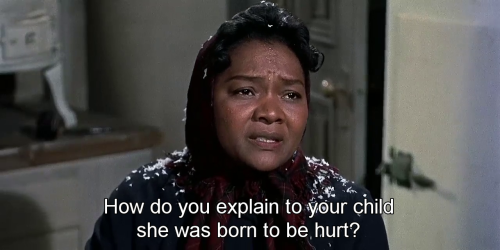
Juanita Moore as Annie Johnson, the heart of 'Imitation of Life.'

The major focus on Life has been its look at racism, with reactions that range from praise for its subversiveness to scorn for its saccharine sentimentality. My take is that Imitation of Life is a product of its time. For 1959, a film about a young woman trying to pass as white was daring, especially in the guise of a soap opera. The dual storylines of Imitation of Life reminds me of that song from Mary Poppins: “Just a spoonful of sugar makes the medicine go down!” Producer Ross Hunter cannily knew that audiences would flock to see scandalous Lana as superstar eye candy, which would make the tragic tale of a black maid and her daughter easier to swallow.
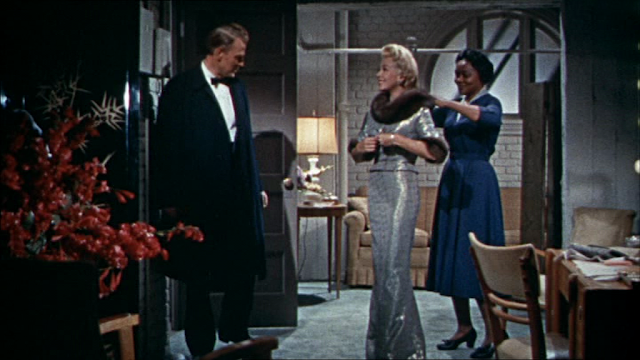
Lora's the star, Annie is still taking care of her!

Annie Johnson to Lora Meredith: “I like taking care of pretty things.”
For me, the first half of Imitation of Life is best. When the two women bond as they struggle to keep body and soul together, these are the film’s warmest moments. When Lora gamely does the flea powder commercial with the slobbering dog, it shows Lana at her most playful. The scenes with their young girls give Lana a chance to be vulnerable, and Juanita to be warmly appealing. Some have said that changing the dynamic between the two women’s characters, with the pancake business cut from the original, leaves their relationship lopsided. Why would Annie stay with Lora for so long? Why would Lora treat her any different than a maid? My thought is that Lora took them off the street when she saw Annie’s dire situation, and was grateful by how giving Annie was. The two bonded and created a home for their girls. Yes, it’s corny and dated, by today’s standards. Their relationship is like a ‘50s marriage: Lora brings home the bacon, and Annie’s keeps the home fires burning.
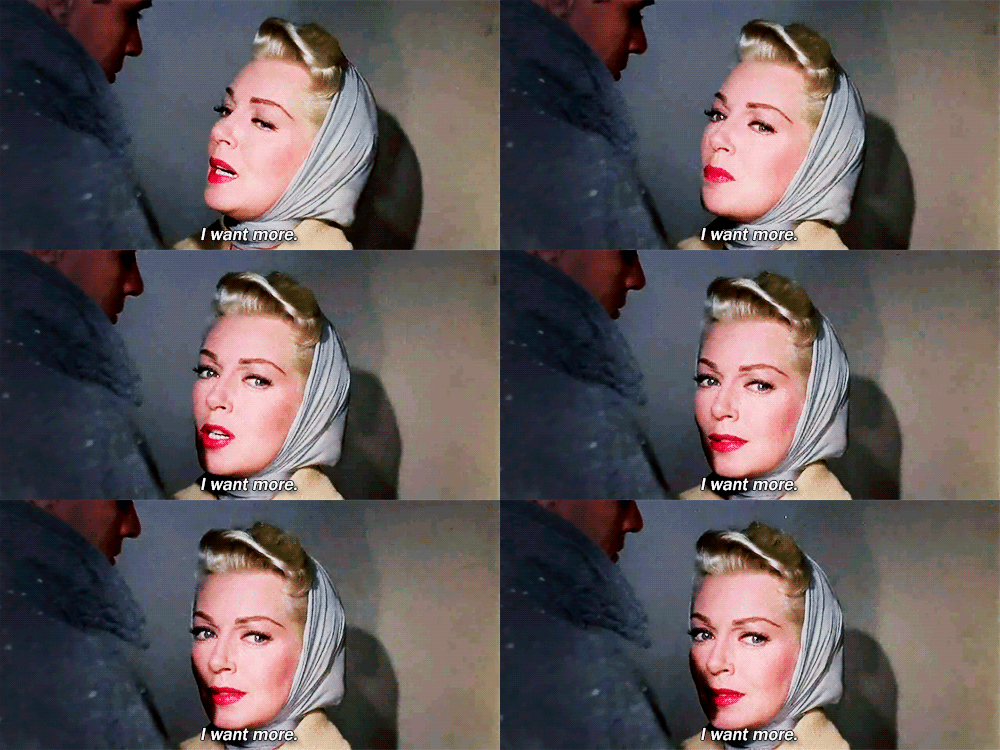
Lana is material girl Lora Meredith!
  
Lora Meredith: "I'm going up and up and up, and nobody's going to pull me down!"
Lana’s film career in the 1950s was basically a series of bombs, punctuated by crucial comebacks. Her last big hit was 1948’s The Three Musketeers. Turner then stayed off-screen for several years while married to tippler millionaire Bob Topping. When Lana left him, she came back to MGM, only to be stuck in a series of lackluster musicals and melodramas. Turner made her first comeback in 1952, in Vincente Minnelli’s The Bad and the Beautiful. Just as MGM rewarded their stars Liz, Ava, and Grace for movie hits by sticking them into formula flops, Metro did the same with Turner, casting her in more costume potboilers. MGM and Lana Turner parted ways in ’56. This led to comeback #2 in Peyton Place, based on a bestseller as scandalous as Lana’s own life. With her biggest hit ever, Turner turned her career around, and scored Lana her only Oscar nomination.
Lana’s biggest scandal occurred on Good Friday, 1958. The Reader’s Digest version: Turner had taken up with gangster Johnny Stompanato, and was now trying to cut him loose. Their violent quarrels climaxed one evening in the star’s pink bedroom. Lana’s 14-year-old daughter Cheryl tried to intervene. When that didn’t work, the girl returned with a butcher knife and fatally stabbed the hoodlum. What ensued was one of Hollywood’ greatest scandals and Lana feared that she’d never work again.
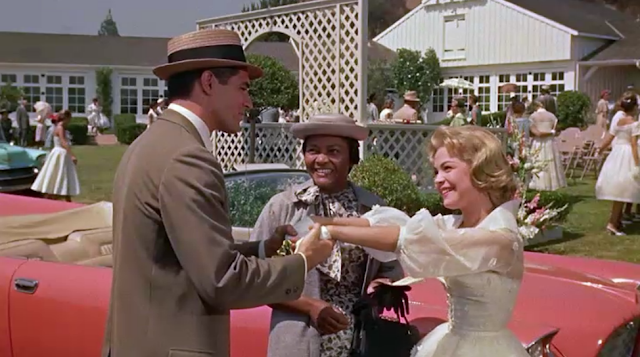
Steve comes back into the picture, adored by Annie, Susie, and Miss Lora!

Shutterbug Steve Archer to Lora: "My camera could easily have a love affair with you."
Enter Ross Hunter, offering comeback #3. Hunter, a producer who adored golden era glamour girls, took a chance on Turner. For a reduced fee and a large cut of potential profits instead, Lana agreed to star in a remake of Imitation of Life. The ’34 original had Claudette Colbert and Louise Beavers pairing up, to parlay the black woman’s secret pancake recipe into riches. As the ‘50s civil rights movement was under way, Hunter realized that a grinning black woman flipping pancakes would not go over big in ‘59. Audiences would also not find Lana peddling pancake syrup riveting, either. So, Lana’s Life re-cast her as an aspiring actress and Juanita Moore as the black woman who now heads up the home front with their daughters.
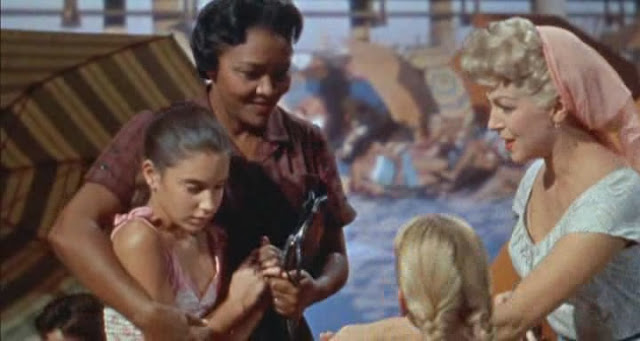
The opening scenes of 'Imitation of Life,' when adversity brings the mothers
and their girls together.

While the soap is super slick, the most substantial story is the struggle of the black mother and daughter. Imagine Imitation of Life without Annie and Sarah Jane. Life would be just another light weight Lana Turner soap opera. By the same token, 1950s Hollywood would hardly make a movie just about a long-suffering black maid whose daughter tries to pass for white.
Some critics crow that Douglas Sirk tricked Lana, using Turner’s star power while undercutting her storyline, to emphasize the supporting characters’ more compelling story. I think Sirk was far classier than that. Douglas Sirk’s work always depicted the comparison of what should bring his film characters happiness, but never does. In Imitation of Life, Lana’s Lora becomes a huge star, but that doesn’t help with troubles at home. With Annie and Sarah Jane, homeless in the movie’s start, now living large with Lora, but they are as miserable as ever. Sirk’s ‘50s films always questioned the post-war American dream and conformity that was part of the package.
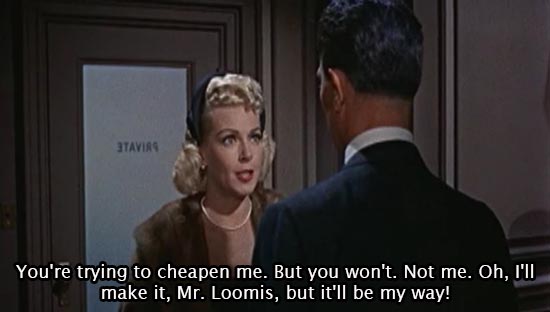
Lana as Lora, telling a predatory agent off. In real life, it wasn't so easy to say no
in Hollywood's 'golden era.' Or now!

Agent Allen Loomis to actress Lora: “I’m in a position to do something for you.”
Lana agreed to play the errant actress in Imitation of Life, but she thought it hit a bit close to home. Indeed, stories circulated that Cheryl had a crush on Turner’s lover, Stompanato. Life’s original storyline had a triangle between the mother, her lover, and daughter. So, Hunter softened this by casting squeaky clean Sandra Dee as Susie and good guy John Gavin as photographer Steve Archer.
More damning was the lack of Lora’s parental skills. In the film, Annie essentially raises Susie, while Lora’s conquering Broadway and cozies up with the prolific playwright. In real life, Lana turned daughter Cheryl over to her mother’s care. This and a platoon of servants ran Turner’s home, while Lana reigned in Hollywood and reveled in her love life. But after the Stompanato scandal, harsh scrutiny was cast on Lana’s fitness as a parent. Yet, she faced all this down on film, along with other comparisons to her personal life.
Lana’s Lora Meredith is a post-war widow at the film’s opening, getting a late start as an actress. This is a nod to the fact that Lana was pushing 40 here. When Robert Alda—Hawkeye’s dad!—as slimy agent Allen Loomis, takes Turner on as a client, he expects more than 10 percent from Lana.
Here’s Life’s hootiest line, agent Loomis to struggling actress Lora: "If the dramatist's club wants to eat and sleep with you, you'll eat and sleep with them. If some producer with a hand as cold as a toad wants to do a painting of you in the nude—you'll accommodate him—for a very small part."
Lana as Lora tells him off and throws back his mink from whence it came. I think Joan, Lana, and Ava could attest, with a couple of drinks under their belts, that it wasn’t always so easy fighting off the wolves at MGM!
When Lora comes home from the “business date” with the slime ball agent, she tries to put on a brave face, but collapses in tears, at Annie’s knee. Annie offers to make her a glass of hot milk! Somehow, I think Lana would have requested something stronger.
Later, Lora catches a break as a model for a flea powder ad. Amazingly, this leads to an audition for a pivotal part in a Broadway play. Sounds absurd? Maybe, but Lauren Bacall was spotted in a magazine ad for the Red Cross, by director Howard Hawks’ wife. From that came To Have and to Have Not, and Humphrey Bogart, too.
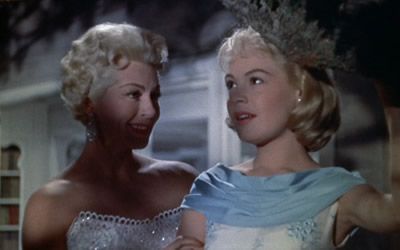
Lana Turner and Sandra Dee in a rare happy moment as 'Imitation of Life's'
mother and daughter Lora and Susie.

You can tell David Edwards is a playwright because he wears a cable knit turtleneck sweater. Lora’s audition is awful, made worse by her sparring over the playwright’s lines. But guess what? He likes her spunk, unlike Mary Tyler Moore’s Lou Grant! Lora not only gets the part, but wows audiences and critics alike. From there, a dozen years fly by, in one minute of montages, as Lora accepts bouquets and ovations. Thankfully, we are spared Lana Turner’s “acting” in plays that all seem to have the word “happy” in the titles. Lora becomes the playwright’s “protégé” in exchange for an empire, New York City. Still, like every movie character who’s ever desired fame and fortune, but once they climb Mount Everest… Hum a few bars of Dionne Warwick’s Dolls’ tune. That was never a problem for Lana Turner, who enjoyed every minute of being a superstar—minus the scandals, of course. Fortunately, Annie reminds Lora that she needs show business as much as it needs her.
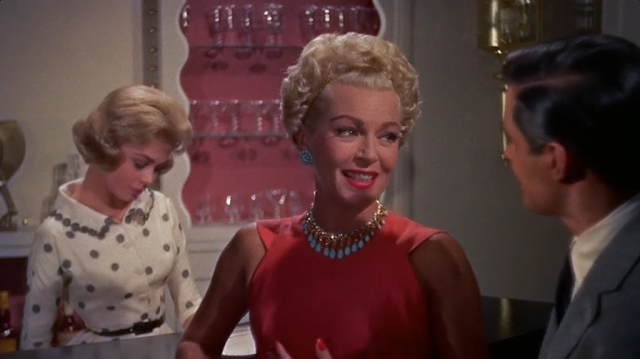
Trouble in paradise. Sandra Dee's Susie is not the enthusiastic bartender
that Christina Crawford was for her Mommie!

Like the real life Lana, Lora is a spend thrift who wants to give her daughter “everything I missed.” Lora doesn’t exactly miss much in the luxury department, either. Once Lora is a star, Lana is gorgeous in her Jean Louis outfits, while draped in one million dollars worth of jewels, on loan for Life. And Lora’s country home is gaw-geous, too, even with that mural passing as the picture window’s scenic view.
Lora’s latest dilemma is that she now wants to be taken seriously as a dramatic actress. In real life, Turner had to be talked into the few game changer performances she gave. You think Lana asked to play a hard drinking, floozy actress in The Bad and the Beautiful? Producer Jerry Wald wooed Turner into playing the mother of a teenager in Peyton Place, reminding Lana what it did for Joan Crawford in Mildred Pierce. And Hunter the diva whisperer soothed Turner’s Life jitters. In Imitation, Lora decides it’s time to do a serious play. Her playwright lover scoffs, "It's drama. No clothes, no sex. No fun." That would have stopped Lana right in her tracks! Naturally, Lora’s a hit, and takes her bows with hair pulled back, sporting a black turtle neck, with a grey skirt—you know, the typical social worker uniform.
Lora wants to finally relax, but then that hot new Italian director, whose name sounds suspiciously like Fellini, wants her in his next film. Off to Italy, the heck with a hiatus.
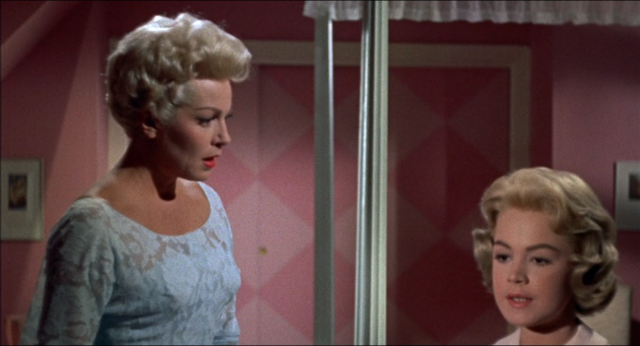
"Don't you act for me!" Whoops, wrong movie!

"You've given me everything a mother could but the thing I wanted most...your love!"
Meanwhile, Annie’s raised the girls, who are now teenagers. Photographer Steve’s back in the picture, with a touch of gray in his temples. Lana as Lora looks glamorously laminated, with shellacked hair, heavy makeup in every situation, with soft lighting and artful shadows. Lana was only 38 at the time, but two decades of drinking, smoking, and tanning took their toll. Though Turner had cosmetic touch ups later, it’s a jolt seeing 40ish actresses from the golden era looking much older than the plumped up pusses of today’s actors of the same age.
Lana’s got her game face on here, all posturing star insincerity some scenes, surprisingly authentic in others. Lora offer to give up Steve for her daughter’s sake reminds me of Faye Dunaway’s cry of “I’m not acting!” when Uncle Greg leaves Mommie Dearest. Here, Dee’s Susie cries, "Oh, Mama, stop acting!"
 

Annie Johnson: “It’s a sin to be ashamed of what you are.”
I’ve never seen Shelley Winters in her best supporting actress turn in The Diary of Anne Frank. But I think Juanita Moore should have won the Oscar that year in Imitation of Life.
Near the end of the film, Annie Johnson talks about her tight-knit community, and Lora replies she never knew that she had outside friends. Annie softly, but evenly replies, “Why, Miss Lora, you never asked.” The camera goes back to Lora, a bit taken aback. Touché!
The scenes where Annie and Sara Jane are in constant conflict over the daughter’s struggle about her origins are the film’s dramatic high points. How can a viewer ever forget the scene when Annie brings her daughter’s red boots to school in a snowstorm, and the classroom is shocked to find out that she’s Sarah Jane’s mother? Or their final scene, where Annie flies across the country just to see her “baby” one more time? That scene, where Annie promises never to bother Sarah Jane again, is beautifully performed by Moore and Susan Kohner. Annie’s deathbed scene, with both Moore and Turner matching each other in emotion, is heartfelt. Juanita Moore’s character is the voice of reason and reality, as all the other characters are assuming roles or personas in their pursuit of happiness. Juanita Moore rises to the occasion to bring Annie to life.
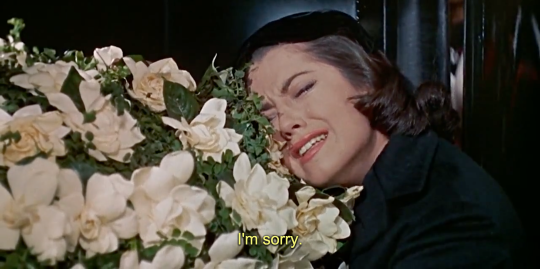
'Imitation of Life's' infamous funeral finale...better have a box of tissues handy!

Young Sarah Jane Johnson: "Why do we always have to sleep in the back?"
Susan Kohner gives an intense portrayal as the adult Sarah Jane. She can pass for white, but if she stays home, she’s on the sidelines of mainstream white society. Kohner’s mother was Mexican actress Lupita Tovar and father was white, agent Paul Kohner. Kohner’s sultry appeal is knowing, especially when she escapes from home to find work in night clubs, as opposed to living under Turner’s antiseptic abode.
The film’s most startling scene is when Sarah Jane runs off to see her white boyfriend. Sirk stages it brilliantly: The two meet on a dark, rainy street corner. When Frankie, played by Troy Donahue, confronts her, Sarah Jane is seen in reflection on a store front window. When he asks about her mother, towering over her, Sarah Jane shrinks back. The two then share the screen. Frankie’s voice rises when he says, “Just tell me one thing. Is it true? Is your mother a _____? Tell me. Tell me!” As she screams in denial, he gives a beat down that is shocking for a ‘50s movie, especially this genre. The soundtrack goes wild, as Sarah Jane crumples onto the street, against a wall.
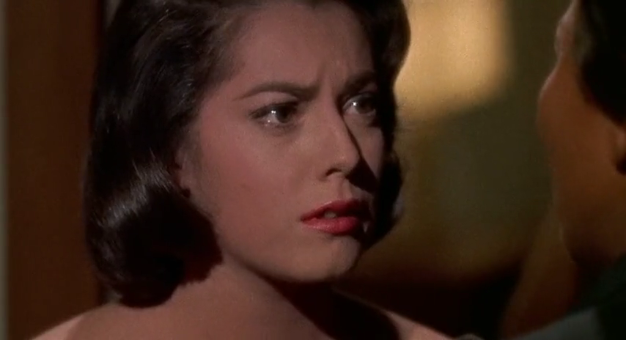
Susan Kohner, as Sarah Jane. Both Susan and Juanita Moore won Oscar nominations
 for their performances.

Sarah Jane Johnson: "I'm white. White! WHITE!"
Turner and Moore are backed by a strong supporting cast, but the two liabilities are John Gavin and Sandra Dee as Steve and Susie. For critics who think Rock Hudson was a wooden actor, try watching Gavin, a genuine block of wood. Hudson became a big star five years earlier in another Sirk film, Magnificent Obsession, with mature leading lady Jane Wyman.  Universal was obviously hoping the same would happen with Gavin in Lana’s Life. Rock, though not versatile, was a warm screen presence, and a huge fan of Lana’s. They would have had great screen chemistry, but Rock was now too big to appear alongside Lana. Another plus: Hudson was only four years younger than Turner, compared to Gavin’s 1l year difference.
 Imitation of Life was huge in Sandra Dee’s rise to stardom. I think Dee could be quite good. However, Dee’s persona, as dictated by Hollywood, was so dated and absurd that it makes Sandra very hard to take. Hyper, shrill, and at times, downright dippy—Sandra Dee was a cartoon of the American teenager. Sadly, she had a horrible personal life, suffered from drinking and eating disorders, and was cast aside by Hollywood when her brand of cute was out of date by the mid-60s.
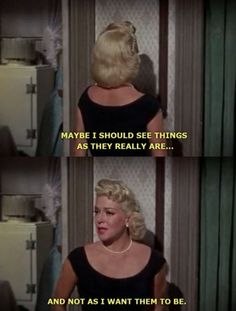
A star's dilemma. Maybe a director's, too?

Lora: “Maybe I should see things as they really are… and not as I want them to be.”
I recently watched Torch Song and The Opposite Sex, two ‘50s MGM films with mature actresses. Re-watching Imitation of Life after these two was like a thunderbolt. Anyone who thinks that Douglas Sirk is overrated, watch some of these other stodgy films from the same era. The difference is obvious. Sirk had an artist’s eye, was a natural storyteller, and skilled at subtly weaving in his point of view, under the guise of a soap opera. Sirk is also sly at conveying what’s unsaid: Lora still does business with the agent who put the blatant make on her; or how Lora rationalizes her going relationship with playwright David; or Sara Jane’s forays into the “nightclub” world.

Sirk, a German who fled Nazi Europe with his Jewish wife and came to Hollywood, looked at American life with mixed feelings. He never fit in the Hollywood scene and his work was looked down upon at the time. Amazingly, after Imitation of Life, his biggest hit, Sirk left Hollywood and filmmaking, retiring to Switzerland. Douglas Sirk died in 1987, but lived long enough to enjoy a renaissance in his work, beginning in the late 1960s. Unlike most of its residents, Douglas Sirk left Hollywood on a high, and left behind a lovely legacy.
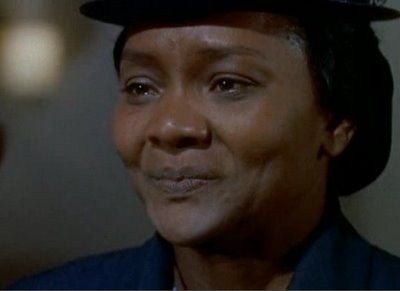
Juanita Moore, unlike Annie Johnson, lived a long happy life.
Moore died in 2014 on New Year's Day, at age 99.