Saverio Mercadante - Il Bravo
Wexford Festival Opera, 2018
Jonathan Brandani, André Barbe, Renaud Doucet, Rubens Pelizzari, Alessandro Luciano, Gustavo Castillo, Simon Mechlinski, Ekaterina Bakanova, Yasko Sato, José de Eça, Toni Nežić, Richard Shaffrey, Ioana Constantin-Pipelea
O'Reilly Theatre, National Opera House, Wexford - 24 October 2018
Wexford, if no-where else, continues to make a case for Saverio Mercadante. Falling somewhere between Rossini on one side and Verdi on the other, Mercadante has been overshadowed by two titans of Italian opera and that's a situation that is surely unjust. The world can unfortunately be unjust and essentially that is what Mercadante's Il Bravo is all about. The opera itself, pretty much obscure and forgotten, makes a good case for this sad reality.
The evidence so far in terms of the few opportunities we have had to see Mercadante staged, are that his 'hit rate' as the composer of around 60 operas surely couldn't have been lesser than that of Rossini or Verdi. Il Bravo in fact is musically much more adventurous than much of Rossini and certainly superior to early Verdi, Il Bravo coming in 1839 the same year as Verdi's debut opera Oberto. Or perhaps just a little more adventurous maybe, but certainly far enough away from the strict rules and expectations of the public to worry the critics and his audience of the time.
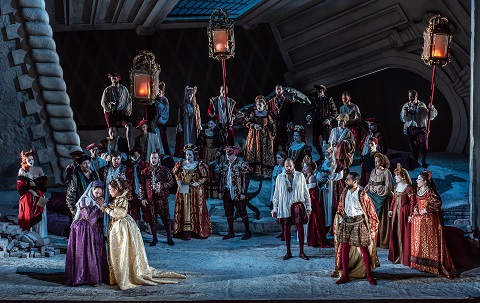
Where Il Bravo is perhaps a little over-ambitious however is in the nature of the drama and the plotting itself, although perhaps no more so than an audience would be accustomed to from Rossini and Verdi. The plot is perhaps too convoluted to detail, but as it is necessary to understand the impact that Mercadante is striving for, I'll make use of the Wexford Festival Opera's admirably concise early outline summary rather than attempt a full synopsis:
Set in 16th-century Venice, the Bravo of the title is a tormented character who long ago killed his wife in a fit of jealousy; unjustly accused of plotting against the state, he has been forced by the Council of Ten to become their secret hired assassin, while his father is held hostage to compel his obedience. The story also involves Pisani, a young man under sentence of banishment, in love with a girl whom he believes to be immured in Venice; Violetta, the girl in question, who has been under the protection of the Bravo since the murder of her guardian by a would-be abductor; and Teodora, a wealthy foreigner living in Venice, who turns out to be not only Violetta’s mother but also the Bravo’s wife, whom he had not killed after all.
All of the characters in Il Bravo are fighting against injustice done to them, usually by a higher human power or corrupt agency rather than fate or outrageous fortune. They consequently try to put their belief in truth and natural justice and are prepared to stand up for it, but are unjustly rewarded for their efforts. Some of the twists that lead to those conclusions however don't quite adhere to the same sense of reality or human response to situations. The disappearance of Il Bravo/Carlo's wife Violetta and her reappearance as Teodora with a daughter called Violetta is not only confusing, it's not really fully explained either, nor are the motivations clear why she is so glad to be reunited with him.
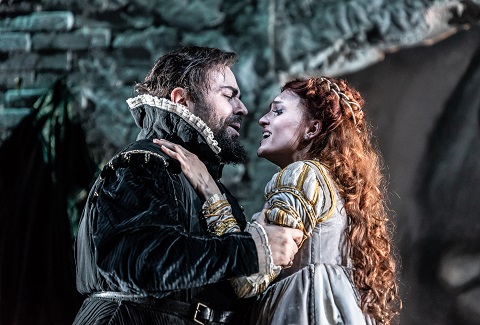
Dramatic contrivances go with the territory however and there's no denying that they have a tremendous impact. The final twist of Carlo discovering that his father has died, freeing him of his obligations as an assassin comes hot on the heels of Teodora's sacrificial suicide to free Il Bravo from his final unthinkable commission, and it's a real kicker, particularly in its musical delivery. Il Bravo is restrained in its use of big number arias, Mercadante permitting no unnecessary vocal fireworks but remaining rather dramatically attuned to the action musically and in terms of singing, allowing the drama to direct impact, with a few thunderous choruses thrown in for good measure. Rubens Pelizzari certainly lives up to the challenges of the title role of the assassin.
There are no bel canto extravaganzas or melodic flourishes either in the singing, but that doesn't make it any less demanding. Mercadante doesn't waste a scene in the opera and doesn't waste any characters. In another opera of its time Act II could be filler crowd-pleasing material but Mercadante keeps up the tension, scoring each scene for full dramatic impact. Nearly all the performers, with the exception possibly of Ekaterina Bakanova's Violetta, took time to find their feet, either too hesitant or too forced, lacking fluidity and barking our words. Under Jonathan Brandani's musical direction however, they soon warm up and the momentum of the work itself seems to carry them thrillingly along. Sometimes a little over-zealously, as is the nature of the drama where there is a lot going on and a lot of characters competing for attention but Brandini does well to reign them in and manage the powerful dynamic that is impassioned but controlled and alive to the drama.
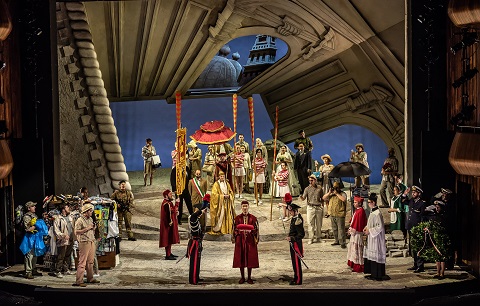
It's also vital that the stage production goes along with this dynamic and controlled passion to deliver the necessary impacts, and despite a few unnecessary touches, André Barbe's designs and Renaud Doucet's direction for Wexford is sympathetic and in touch with the heart of the work, and it's really quite impressive looking too. It's grand and spectacular in its creative abstraction of classical Venice, with all its pomp ceremonies and splendour. The setting is largely period, the dramatic action is 'operatic' in delivery, frequently in stand and deliver mode, but this may be the best way to present Mercadante, and it would be a mistake to try to make Il Bravo contemporary and 'relevant'.
There is a half-hearted effort made in this direction but it feels contrived and doesn't really add to the themes at all, consisting mainly of tourists walking along the same Venice locations, oblivious to the true history of the place and the nature of the kind of drama that once took place there, taking selfies with the Doge and buying souvenirs. Evidently Barbe and Doucet want to at least make a token effort to bring the drama closer to home in the present day, or at least a reminder of the idea of injustice persisting, which is certainly the case for the neglect of the operas of Saverio Mercadante. The performance on the 27th October was broadcast live and is well worth a view on YouTube or ARTE Concert.
Links: Wexford Festival Opera, RTE/YouTube
Umberto Giordano - Fedora
Teatro Carlo Felice di Genova, 2015
Valerio Galli, Rosetta Cucchi, Irene Cerboncini, Rubens Pelizzari, Sergio Bologna, Paola Santucci, Margherita Rotondi, Manuel Pierattelli, Alessandro Fantoni, Luigi Roni, Claudio Ottino, Roberto Maietta, Davide Mura
Carlo Felici Web Streaming - 24 March 2015
The spirit of Victorien Sardou weighs heavily upon Umberto Giordano's Fedora (1898). Adapted from Sardou's play, it has much in common with Tosca, even though Puccini's opera version of that work wouldn't come until two later. History has made judgement on the relative value of the two works and undoubtedly Puccini's particularly visceral treatment of similar romantic-historical material has ensured that the later work would eclipse not just Fedora but the only other well-known work by Giordano, the revolutionary drama of Andrea Chénier.
Unless you have a complete aversion to Puccini - and there are many in the opera world who are at least agnostic as far as the composer is concerned - it would be hard to argue that either of Giordano's best known works rates well alongside almost anything by Puccini, and not just Tosca. A fine production of Fedora by the Teatro Carlo Felice in Genoa (broadcast live from their web-streaming service) however gives us an opportunity to consider whether history, and the love of Puccini's admittedly more populist treatment of the subject, has been unkind to this particular work.

It might resemble Tosca in its dramatic format, but Giordano's approach to verismo opera is rather more purist. There are no familiar numbers, the music arising out of the drama, if not quite flowing in easy through-composition. There is only one real aria, a very short one ('Amor ti vieta di non amar'), but a famous one nonetheless, sung not by the leading lady of the title, Fedora, but by her lover Loris. The real problem with Giordano's treatment however is that it doesn't propose any significant distinguishing character of its own.
Giordano's music and approach to opera is unfortunately and all too apparently, no great advance upon the work of the undisputed master of Italian opera, Verdi. Puccini made his mark in his melodies and in storytelling that touches the heart in his early work and he even extend his techniques into impressionism and through-composition in his later operas, but on the strength of Fedora (and Andrea Chénier), Giordano might have the musical ability, but the chosen subject matter of his operas, and in particular the influence here of Sardou, don't really provide the kind of material that is going to break any new ground.
Although Giordano's musical approach to the subject doesn't really bear any comparison with Verdi, Fedora does however resemble the structure and nature of La Traviata more closely than any similarity with Tosca. It's a tragic story of a woman who falls for the wrong man (twice!), and because of actions in the past, is unable to find happiness and love, and is doomed to die a terrible tragic death in her lover's arms, believing that she cannot live with the betrayal. As melodramatic as the story is, it's typically well constructed for dramatic effect, getting straight to the romantic heart of the story, complicating it with some political involvement, and indicating early on that there are going to be tragic consequences later.

Set in St. Petersburg during the troubled late years of Czarist Russia, the tragic heroine here is the Princess Fedora Romazov. She is about to be married to Count Vladimir Andrejevich, but the first we see of the count is him being carried onto the stage wounded and dying. Suspicion for his murder falls upon Count Loris Ipanov, and to try to obtain proof, Fedora travels to Paris where she hopes to lure the Count into a confession. Unfortunately, when she learns the nature of the truth - that Loris did indeed kill Vladimir, but only because he was a dissolute wretch who seduced his wife - she really does fall in love with him. Their happiness together would be threatened if Loris knew of Fedora's connection to the Count, and indeed, Nihilist attacks on the Romanov family bring events and revelations tragically to their door.
Giordano's treatment of the subject is earnest, not overly distracted by the melodrama or seeking to overplay it (as you could accuse Puccini of doing in Tosca). One lovely touch, for example, is to set the key confession and revelation scene of Fedora's confrontation with Loris not to any great orchestral arrangement or with any kind of flair that would beg comparison with La Traviata, but rather setting it in contrast to a piano piece being played in the background at the Paris reception by an invited Polish musician Lazinski. It's wonderfully effective, as is the simplicity and placement of the beautiful short aria 'Amor ti vieta') in this act.
As fine as this is, there's still not dramatically or musically distinctive enough, but Fedora nonetheless remains a work that places big demands on its soprano and tenor leads (the role of Loris famously created by Caruso), and it can still be effective when it is sung well. If you want to see this work in its true Italian character moreover, you want to see it put on at an Italian opera company, and that's done rather well here in Genoa with Valerio Galli conducting the very capable Carlo Felice Orchestra and the principal roles well taken on the web broadcast performance of 24th March, by Irene Cerboncini as Fedora and Rubens Pelizzari as Loris. Technical problems prevented a viewing on the 21st of the principal cast of Daniela Dessì as Fedora, illness preventing her partner Fabio Armiliato from singing Loris that evening in any case. That's an indication of the kind of singers required for these roles, and the alternate cast didn't disappoint.
There's really only so much you can do with a drama like this however and Rosetta Cucchi doesn't really find any way to make it feel more relevant or contemporary. There is an attempt to frame the opera in flashback, an aged Loris seen at the beginning of each of the acts and at the conclusion. As such the production extends the scope of the drama to take in subsequent political upheaval that would have occurred in Loris's lifetime - silent scenes from WWI play out in the background at the start of the acts, but it's not to any great effect. The main part of the opera remains hard to distinguish from a production of La Traviata, with its period dress, ballroom scene and tragic finale. Attention to characterisation was strong however, and with good singing performances, this was a fine way to re-evaluate one of the many forgotten works of Italian verismo.
Forthcoming operas streamed from the Teatro Carlo Felice are BILLY BUDD on 17th April, CARMEN on the 8th and 12th May and THE MERRY WIDOW on 18th July.
Links: Teatro Carlo Felice Streaming