I'm fond of the '78 cartoon feature of Richard Adams' hailed novel, "Watership Down", so much so that a remake, even if in a promising, four-part miniseries format, seemed a shaky prospect. Nevertheless, I've indulged in the Netflix (linked-to-the BBC) experimental, CGI excursion, and for the most part, I've come away pleased.
For one thing, the new version (as with the '78 adaptation) employs an exemplary cast, with James McAvoy as Chief Hazel (the tale's Bilbo/Frodo equivalent); Nicholas Hoult as his brother, Fiver (a Sam Gamgee of sorts); Gemma Arterton as Clover; John Boyega as Bigwig; Daniel Kaluuya as Bluebell; Anne-Marie Duff as Hyzenthlay; Craig Parkinson as Sainfoin; Freddie Fox as Captain Holly; Jason Watkins as Captain Orchis; Ben Kingsley as General Woundwort; James Faulkner as the godly Frith; Taron Egerton as the legendary El-ahrairah; and Peter Capaldi as the feathered Kehaar (plus many more): a veritable who's who of contemporary, imagi/adventure-film veterans.
Though I had no doubt that each voice would match its assigned character (and yes, the alignment works in spades), the big test was whether the Noam "300: Rise of an Empire" Murro-directed/Tom "EastEnders" Bidwell-scripted structure would supply the earnest glue to keep its parts cohesive.
I'm relieved to report that the structure weaves well, capturing the essential, Orwellian/Tolkien-ish, warring splendor that's inherent in Adam's rich and rambunctious journey of life, death and tremulous travel, with all the good, bad and ugly contained.
To enhance the journey, the computerized animation is lush, realistic ... superior to its big-screen competition (and produced for about twenty-million bucks, though I'm presuming the cast's collective cost figures in). Still, for sentimental reasons, I prefer the lower-budgeted, '78 style, but then as most of my readers realize, I'm old school. (For the record, I've not seen the '99 - '01 animated series, so I can't judge its look or implementation for comparison sake.)
On a more obvious down side, there are times when this miniseries, as with other Netflix productions, carries on longer than it should. No big deal, I suppose. I like Adams' characters, so it's nice to spend extra time with them, but I believe it would have been better if the novel (the odyssey from a doomed warren to an anticipated, safe abode) stuck to a ninety-minute or two-hour scope.
On the plus side, Fiver's (let's-run-before-the-machine-invading-developers-kill-us) premonitions ooze the right, foreboding edge and a sense of constant, woeful threat flows throughout, due in large part to Federico Justid's Goldsmith-esque score. On the other hand, this version also numbs much of its "real-world" violence.
Now, I must confess, I never found the book or initial movie by any means carnage-ridden. (It's just that one doesn't expect bloodshed among the cute and cuddly.) Still, violence is an indubitable part of Adams' engraved mythology. Considering the Netflix connection, why the restraint? After all, the subscription source serves upfront brutality per its Marvel programs, not to mention unapologetic accessibility to shows like "Breaking Bad" and "Dexter". (Now that I think of it, the deprecatory BBC might be to blame for the mollification...only figures.)
Regardless of its sporadic shortcomings and/or miscalculations, "Watership Down '18" should (at the very least) grant greater exposure to Adams' book, which is superior to most examples of kiddie lit, perhaps because it was never designed as kiddie lit. Adams' vision took the fringes of young fluff and spread it into a fresh, exotic and identifiable world, which folks of all ages could learn from and enjoy. (The novel, if the truth be told, is an allegory for overcoming the often intense struggles that stretch from childhood to adulthood: something parents should promote, not shun from their young.)
Let's hope that, even though softened and superfluous on occasion, this revisionist edition still delivers a prosperous, pop-cultural impact and perhaps leads to adaptations of Adams' short-story offshoots. My hunch--it will, and all for the better. Even a watered-down version of "Watership Down" has got to be better than the general, "family" fodder folks are inspired (or should I say, forced?) to exalt these days.
Guillermo del Toro's "Pacific Rim" surprised a lot of people (myself included) by being more than a clobbering, CGI giant-robot fest and something driven by empathetic characters and engaging scenarios.
Four years after the mega-hit comes Steven S. DeKnight's "Pacific Rim: Uprising", which jumps ten years farther into the future, beyond the big "Battle of the Breach", leaving the saga to a new group of Jaeger-puppeteers and new, colossal threats. For all intents and purposes, the sequel (penned by DeKnight; Emily Carmichael; and Kira Snyder) exceeds the first film's wonderment and takes the concept to clever and refreshing heights.
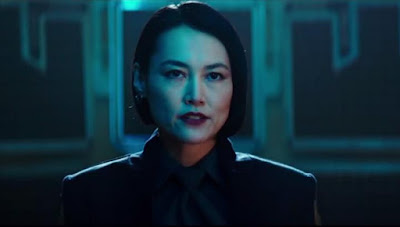
Though Charlie Hunnam's Raleigh Becket and Idris Elba's Stacker Pentecost aren't on hand for this outing, fans of the original film will be comforted to know that Mako Mori (Kinko Kikudi) has a significant, supporting role. Otherwise "Uprising'"s (new and old) cast consists of quirky but heroic Hermann Gottlieb (Burn Gorman); nervous and enigmatic Newton Geiszler (Charlie Day); supportive and alluring Jules Reyes (Adri Arjoni); demanding and determined Liwen Shao (Tian Jing); and resentful but capable Cadet Viktoria (Ivana Sakhno). There's also the film's leading lady, spunky and inventive Amara Namani (Cailee Spaeney); accompanied by the commanding, by-the-book Nate Lambert (Scott Eastwood, resembling his dad to a startling tee); and Petecost's sometimes freewheeling yet anguished son, Jake (John Boyega). The latter eventually leads the courageous way against the gigantic problems that await, at first struggling to find his mettle, but then embracing his cause with respectable gusto.
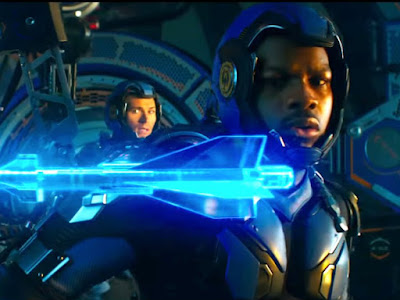
Young Pentecost's somber refocus is the script's steady motif, but his relationship with Lambert is also important, as well as his mentoring of Namani, who must prove herself every step of the way. There are rocky moments that rise from out the various intermingling, and things do get heated, but as del Toro's film taught us, teamwork is essential when it comes to monster fighting, or for that matter, any avenue of life. To its credit, "Uprising" doesn't forget this purposeful notion.
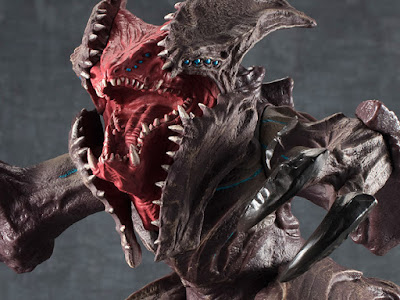
As the teamwork builds, we're fed plenty of thunderous flash, and as far as computerized calamity goes, many will find the results arresting and therefore, fulfilling. However, with hardware and monsters as massive as those depicted, nations would fall under their impetuous pounding within seconds, thus defeating the purpose of any Jaeger intervention. For better or worse, "Uprising'"s big, final battle occurs on congested, urban turf and for a period far too long to remain credible. The first film (and the same can be said of most Toho, DC and Marvel flicks) could be blamed for this approach as well, but "Uprising" hurls it to novel exaggeration.
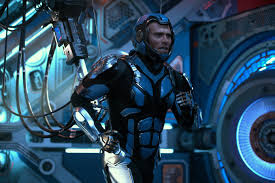
There are, however, quiet, philosophical moments that counter that exaggeration. They give the sequel a benevolent brush of "Ultraman" "Space Giants" and "Johnny Sokko", where sacrifice, bravery and honor were always at play. That "Uprising" makes use of these aspects designates it to a more special and human category than most of its building-breaking, cling-clanging competition.
The film also twists the kaiju threat in a unique way, so that it becomes a kind of "Real Steal" goliathon midway through. An air of mystery and betrayal shines through this plot device, though its resourcefulness might prove a hard act to follow.
Perhaps, in this respect, the next chapter should throw caution to the wind and dispatch a giant-monster battle royal to rival all others. The "Pacific Rim" technology could even reintroduce King Kong and Godzilla's mechanical counterparts. I sure wouldn't mind seeing those simulations in the brawling, Legends Films brew, and as far as extended universes go, that kind of crossover would guarantee ticket sales from here to Timbuktu.
I've said it before, and I'll say it again: "Star Wars" works best when it adheres to its John Carter, Buck Rogers and Flash Gordon roots. When it deviates from that, it becomes something other than the original intent: case in point, the prequel trilogy.
"Force Awakens" pleased many fans by recapturing the old, George Lucas feel (though some critics claimed perhaps too much so, becoming more of a "New Hope" remake than a veritable sequel) and "Rogue One" (though a deep, somber vision) dared to capture (and basically succeeded) "The Empire Strikes Back" mystique. All signs looked promising, therefore, for producer J.J. Abrams and writer/director Rian Johnson's "Episode XIII: the Last Jedi" to continue the recharged spree, but hints that things might go awry surfaced some months ago in a couple enigmatic trailers.
Is "Last Jedi" a fumble or on-course success? To be quite frank, it's a bit of both and neither, becoming an odd, unorthodox chapter that in one sense embraces tradition and in another, spits straight in its eye.
I won't spoil the plot, though many have speculated correctly as to what some of its elements might be, but I will surely confirm that it concentrates on Luke Skywalker (Mark Hamill), Ben Solo/Kylo Ren (Adam Driver) and Rey (Daisy Ridley). In this cozy, "family" affair (but don't hold your breath for a trustworthy reveal of Rey's lineage), we must come to terms with who's good, bad, and somewhere in-between, with various "surprises" installed in a somnolent attempt to give the memorialized "Empire" a run for its money. If the truth be known, this chapter is destined to break a few hearts, but when all else fails, we can at least count on the strength of its characters to snuff the discourse...right?
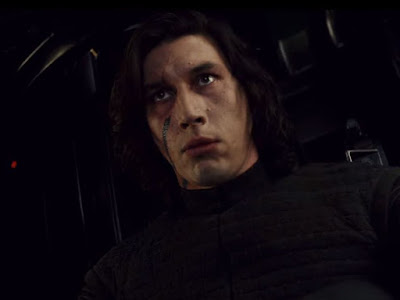
Alas, yes and no, and much of the blame goes to the new kids on the block. Rey is presented as far too perfect, too annoyingly preordained for us to empathize with her. Let's face it: Luke had a golly-gee, farm-boy, "I wanna make good against the odds" vibe that made him identifiable, but Rey is a blatant champion (and was pretty much so even in "Force Awakens"), leaving one little choice but to focus on the wayward Kylo, though he's not all that much better.
As "Force Awakens" villain, Kylo's temperamental and remorseful swings made him one of that installment's best features, but in "Last Jedi", his impetuous ambivalence has diminished. Ren, though still bad, has become downcast compared to his previous outing. Therefore, whether he champions the dark side or rejects it becomes of little dramatic concern or at best, confusing.
To make the film's character brevity even more agitating, Finn (John Boyega), who proved a respected underdog in "Force Awakens", is as monochrome as his young counterparts. (Man, it would have been swell to see him develop into something more than a something-already-close-to-better.) Though he does bumble some for tradition's sake, it's really his friend, Rose Tico (Kelly Marie Tran) who reinstates his air of levity. Alas, the duo's energetic escapades seem more disjointed than relevant to the plot.
Who then (if only for complexity's sake) rises to the occasion? Why, it's none other than good ol' Jedi Master Luke. He's not the guy we once knew, and yeah, he might possibly be the sorrowful last of his kind, but he's seasoned enough to make his moments shine, and contrary to his cameo in "Force Awakens", he's given ample opportunity to dominate the scenes in which he's featured.
Much of the credit for Luke's depth goes to Hamill, who layers his mature Skywalker with influential, Ben Obi Wan Kenobi contemplation, though with a threatening dash of fatherly Vader. Hamill has always been an underrated actor and for better or worse, forever linked to Luke, but in the case of "Last Jedi", his iconic presence sure does save the day...well, aesthetically, that is. (Again, I'm being respectful here not to give too much away.)
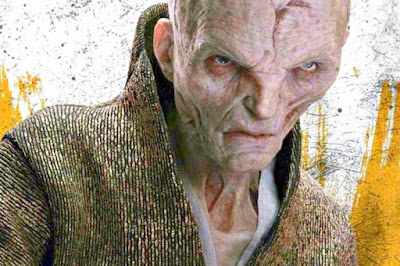
As expected, various established and more recent supporting characters revolve around our principles, like Supreme Leader Snoke (Andy Serkis); C3PO (Anthony Daniels); R2D2 (Jimmy Vee); Chewbacca (Joonas Suotamo); Poe Dameron (Oscar Issac); "DJ" (Benicio Del Toro); General Hux (Domhnall Glesson); Admiral Holdo (Laura Dern); Captain Phasma (Gwendoline Christie); Paige Tico (Ngo Thanh Van); and (maybe, just maybe) an adored, little, green guru from chapters past. In addition, we're given a heavy supporting appearance by Carrie Fisher as General Leia Organa, but most of the character nostalgia takes a backseat to the exotic locales; crimson trimmings; and fervent, spaceship roars. (On that note, where the hell is Billy Dee Williams? I've no real gripe in seeing a cutie-pie Porg occupy the Millennium Falcon, but gee whiz, wouldn't it have been cool if Lando Calrissian had sat in Solo's seat?)
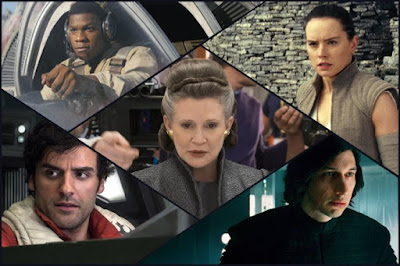
By the time the interminable credits roll, "Last Jedi" can only be taken as a lofty, ideological bridge between chapters, with the line between right and wrong, light and dark, Resistance and First Order blurred at best. It in no way reflects Edgar Rice Burrough's straight-and-narrow narratives, let alone Hollywood's classic, moral-based serials. In other words, it's not true-blue "Star Wars", but then (as the jaded would be quick to point out), what is anymore? (I'd argue that "Guardians of the Galaxy" comes damn close, but that's another topic for another time.)
Perhaps when viewed as part of the three-trilogy saga, "Last Jedi" won't seem so conspicuously cumbersome, but for now, it looks like Lucas' mid-trilogy, tried-and-true formula has been yet again trampled. Don't get me wrong: It ain't bad (not by a long shot), but it sure ain't what it used to be or could have been; and damn it all to hell, didn't Abrams and Disney promise to give us old-timers what we crave?
"Star Wars I-III" disappointed, not because it was a lousy saga. Au contraire, it's actually quite a sprawling epic (and a damn big moneymaker, at that). It's just that, well...somewhere in the hustle of things, it lost track of its roots.
"Star Wars", as the adventure was presented in 1977 by George Lucas, surfaced as a shameless homage to adventure tales gone by and the heroes who led them, namely John Carter, Buck Rogers and Flash Gordon. (As we well know, Lucas would have returned Flash to the big screen if only he had procured the rights.) With this, a "New Hope" presented a basic tale of good vs evil, unconcerned with murky Trade Wars or the unnerving shades of gray that characterized a villain we all knew would be uncompromisingly dark in his heart. As such, Disney's assigned director, J.J. Abrams, has assured us a new movie-serial style "Star Wars" with its seventh chapter, "The Force Awakens".
Has Abrams fulfilled the promise? The answer is yes and no, but his slight deviations on the basic elements doesn’t mar the splendor. It simply makes this
chapter (written by Abrams; the legendary Lawrence Kasdan; and Michael "Toy Story 3" Arndt) its own cool thing, which simultaneously looks to the past and the future. In this regard, we again have good and evil at odds, three decades after the epic Battle of Endor and the destruction of Death Star II, with new heroes leading the charge and supporting characters taking their sides accordingly.
Of course, as we've anticipated, it's old favorites who set the cozy pace: Princess/General Leia Organa (Carrie Fisher); Han Solo (Harrison Ford); Chewbacca (Peter Mayhew); and even Admiral Ackbar (Tim Rose). Luke Skywalker (Mark Hamill) is also in there, but essentially in concealed form, his presence felt throughout "Force Awakens", just as Spock's was felt throughout "Star Trek III": a warm-up, in essence, for the saga's predestined shape of things to come.
The acknowledgment of our past heroes helps keep this installment in check; for if there exists any remnant of the basic formula that distinguished the middle chapters, it's through these stellar stars, and its the new folks who redirect the saga into its spirited, sequelized stretch.
The newbies include desert-dwelling Rey (Daisy
Ridley); ace X-wing fighter Poe Dameron (Oscar "Ex Machina" Isaac); wise Lor San Tekka (Max Von Sydow); helpful Maz Katana (Lupita Nyong'o); and in-search-of-redemption Finn (John Boyega). They each figure into the plot, to some extent or another, the way the characters did in "New Hope", with a transported message prompting their actions.
Finn, in my estimation, is this chapter's most identifiable protagonist, though some would argue that Rey is more so, if only for her Skywalker similarities. Still, Finn is the one through whom we experience the adventure: the misguided guy who gets thrust upon this gallant ride after befriending the dynamic Dameron, who in his own right becomes a significant Solo stand-in. (On a speculative note, the following chapters will probably do a better job of fleshing out Finn and Rey, thus strengthening their significance within this yet expanding universe and for better or worse, tease at a potential romance.)
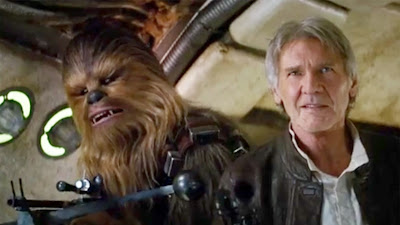
So, what exactly does our dynamic duo face (or rather, should I say, fall into)? Well, again it's a division of sides, with the freedom-fighting Resistance vs the multiplying "Neo-Nazi" First Order/Empire loyalists. We also learn that matters weren't definitively resolved at "Return of the Jedi'"s end,
with (and this is solely implied and never succinctly stated) ineffective leadership having allowed pockets of sovereign seekers to cause disarray (much as any typical terrorist group would when not kept under thumb).
Finn is wise, having shed his Stormtrooper shackles in the name of galactic freedom and stumbles upon Rey, who immediately takes to him, and from there their alliance fortifies for a shared cause and against a common foe.
There are a number of baddies in "Episode VII", including memorable supporting characters, like Supreme Leader Snoke (Andy Serkis); the staunch General Hux (Domhnall Gleeson); and the gleaming Captain Phasma (Gwendoline Christie), who make a strong visual (and sometimes dramatic) mark, but never dominate the plot.
The villainous beacon, therefore, is the heavily publicized Kylo Ren (Adam Driver): an often masked zealot with a most distinct light saber, who desires supreme, cosmic control. He's this segment's Ming the Merciless or Killer Kane; a counterpart to reality's hated Hitler and for the here-and-now, our would-be Darth Vader. He's hellbent on rekindling the Sith Lord's influence, and his impetuous temperament confirms this. Oh, and in case you're unaware, he's the son of...well, never mind; most of you've already caught wind of the startling revelation and outcome. Anyway, Ren's wayward presence is why Finn and Rey fight the good fight, though they require guidance along the way.
For such, they (along with the bad guys) seek the elusive Luke Skywalker, and with Solo, Chewy and the Millennium Falcon's help, "Force Awakens" starts to take shape, becoming at least on the surface, what Abrams projected: a thrilling quest story.
Unfortunately, the film doesn’t always make the best use of its
cast, opting (as the weaker chapters have) to emphasize organic window dressing instead of
extended characterization. Tekka's presence, for example, could have been expanded, and Dameron, though engaging when given the chance, should
have received much wider focus.
Though it may totter in its character balance, "Force Awakens" indubitably delivers the goods in visual glitz and not of the cartoonish CGI sort, either. This chapter is laden with old-school, heavy hardware and fast action, which earned it a PG-13: a warning to parents that such sleek intensity may be unsuitable for their coddled kids (sad, but true). Nevertheless, for those who savor movie-serial zest, "Force Awakens" should more than please and have most fans clamoring for more.
Also to its benefit, this chapter downplays the cutsey stuff. Sure, the adorable, snowman-shaped BB-8 is there to pick up the torch from R2-D2 (Kenny Baker, who in this instance "consulted" on the droid's movements) and fidgety but amiable C3PO (Anthony Daniels), but it's all within the proper context. When given their various moments, the three give the film that Disney-esque charm: apt since the franchise is now officially Disney stationed. However, they are more of a cheerful additive than a mawkish, Jar Jar Binks distraction.
At the end of the day, whether one labels it a hit or miss, "Force Awakens" is but another part in a progressing mythology. How this chapter will figure into the grand scheme is yet to be seen. (Remember, "Empire Strikes Back" wasn't necessarily praised as the best of the best upon release.) For the time being, and for the sake of launching a new start, the film now stands as the franchise's "new hope": a chance to avoid the disfavor paved by the prequel trilogy. It may also become, in the long run, another magnificent moment in space-opera history. For now, with the box-office numbers blasting through the roof and fan praise mounting, things look most promising.