Showing posts with label Ninjas. Show all posts

Wednesday, March 11, 2026

Serpent's Eye (The Year Of The Ninja Master #3)


Serpent's Eye, by Wade Barker
September, 1986  Warner Books

Man, this Year Of The Ninja Master series is perhaps the strangest in all men’s adventuredom, and I don’t mean that in a good way. Ric Meyers takes the simple, pulp concept of original series Ninja Master and turns it into a metaphysical head-scratcher that makes the bloated ninja epics of Eric Van Lustbader seem like fast-moving action extravaganzas. 

What I find humorous is that Meyers came onto Ninja Master because the original series author (Stephen Smoke?) turned in a second volume deemed subpar by Warner Books…well, why wasn’t another “Wade Barker” brought in to replace Meyers? Surely no Warner editor could’ve read this third volume of Year Of The Ninja Master (not to mention the first two!) and deemed it worthy of publication. My only theory is that the demand for anything ninja was so great in the 1980s that publishers were desperate for product. Even crazier is that there was another volume of this series, and four more volumes of another series, War Of The Ninja Master, all written by Meyers! 

Told in three “books,” Serpent’s Eye is notable because it’s the first book in this series to solely focus on Daremo, formerly known as Brett Wallace, the hero of the original Ninja Master series…and before that, we’re told, his name was Brian Anderson, which always makes me laugh because that’s the name of a guy I know from work, and he sure as hell is no ninja. The previous two books featured Jeff Archer, Brett Wallace’s former sidekick; Archer, who was taken through hell by his sadistic creator in the previous two books, does not appear in Serpent’s Eye

Rather it’s Daremo alone, and he is a far cry from Brett Wallace: confused, adrift, following instincts that he himself does not understand. Meyers gives us a protagonist who is more so a puppet, being pulled around on the strings of fate. There is a dreamlike, metaphysical texture to the novel that is more stupid than profound, because it is so at odds with what this genre requires. Often Daremo will “find himself” somewhere, like say Hong Kong, and have no idea how he got here – granted, Meyers explains this at the end of the novel, but at that point the damage is done. Even Pinnochio had more free will. 

What makes it crazier is that I had flashbacks to Traveler in that I now have no idea when exactly this series takes place. Okay, so the opening features Daremo drifting around in his “fate leads me” state, finding himself on the east coast, and sort of invisibly shadowing a ‘Nam vet named Scott Harmon who has the most bizarre character intro I’ve ever read: beating up some neighborhood prick who was putting razors in candy bars on Halloween night. WTF? Well, Daremo slips into the guy’s home and tells him all about himself and “recruits” him. 

Then Daremo puts together and entire team, and they all fly over to the Middle East(!?), and then they rob a bank in Iran, and then they fly out on the C-130 one of the guys in the team owns…and I mean they’re also armed with machine guns and rocket launchers here…and then we’re told that all this happens in 1979, right before Iran fell to the mullahs. (Talk about a timely read, folks!) 

Okay…so the series is set in the late 1970s?? Did anyone else know this?? 

But then Book Two opens and Daremo is suddenly in Hong Kong, again on the trail of the mystical Chinese ninjas who have been fighting him since Dragon Rising. I almost got the impression the Iran stuff was a dream, but I’m not sure. In fact, Serpent’s Eye opens with a vague bit of Daremo, gutshot and dying, sitting on top of the world and reflecting on his end, which lends the impression that everything that follows in the narrative is a death delirium. 

This section in Hong Kong is so tonally at odds with the rest of the series that I laughed. Meyers, perhaps flashing back himself – namely, to his days writing The Destroyer – retcons Daremo into a Remo Williams stand-in, and has his superhman martial arts warriror blitzing through the Hong Kong underworld as he chases down a high-level gangster who is sending assassins after Daremo. 

The action scenes are written in such a lazy, first-draft way that I came to the conclusion that the entire novel was a first draft. But otherwise this sequence is so similar to The Destroyer: lots of witty dialog, Daremo so superhumanly skilled that his safety is never in doubt. In pure Remo form, Daremo even manages to hook up with a beautiful American babe who happens to be here, serving as a hooker for the gangster Daremo’s searching for, and just like Remo, Daremo is superhumanly skilled in the lovemaking department, but has no actual “drive” to do the deed…and when he finally does do it (or does her, I guess I should say), it’s of course left entirely off page. 

The girl’s name is Michelle Bowers, and despite himself Meyers makes her a memorable character: a failed actress who has ended up a hooker in Hong Kong. A recurring joke has her wanting to tell Daremo why she became a hooker, and Daremo not being interested in knowing. Anyone who has read a Meyers novel will know that at some point Michelle will be captured, tied up, and degraded, and of course this happens in Serpent’s Eye, but with a different outcome than expected. 

Book three is almost tiresome in its lameness. More of a puppet than ever, Daremo needs to get into mainland China for reasons he cannot comprehend, and ends up hanging out with a traveling theater group that’s a Peking Opera type of affair. Eventually this builds to a low-rent psychedelic affair where Daremo climbs this high mountain, beset by gods the entire time – and I forgot to mention, but Daremo often meets and converses with gods in the course of the book. 

SPOILER WARNING: Skip this paragraph, but I’m noting it here for my own sanity whenever I get up the courage to read the next book and need to remember what happened in this one. Anyway, it is revealed in some of the laziest bullshit-first draft writing ever that “Daremo” has actually been Scott Harmon all this time, ie the ‘Nam vet introduced in book one of Serpent’s Eye, and I guess he’s been Daremo in the previous two books? The real Daremo all along has been “The Figure In Black,” ie what we thought was the villain, but has really been Daremo guiding his puppet Scott Harmon along the path…which explains why Harmon was so confused as to his own objectives and whatnot. Not only does Harmon die at the end of the book, but so does the superhumanly-powerful Chinese ninja that has been a plague since the start of this series. “He died” is literally and lamely how Meyers describes this major series event, showing absolutely no ability nor desire to draw out the dramatic import – and folks I kid you not, the novel ends with Daremo laughing happily on this big mountain in China. 

End spoilers. Serpent’s Eye was super stupid, and overlong at 244 pages, but if the entire series was more like the sub-Destroyer section in book two, Year Of The Ninja Master would at least be worth reading. But man I think I’d be more willing to read The Miko before I take the plunge and read the next – and thankfully last – volume in this series.

Thursday, August 22, 2024

The Ninth Dragon (Sam Borne #1)


The Ninth Dragon, by E.B. Cross
June, 1985  Pinnacle Books

This obscure late-era Pinnacle paperback was the first of two novels featuring Sam Borne, a secret agent for the mysterious US outfit “The Committee.” But then, Sam (as author E.B. Cross refers to his protagonist) isn’t just a secret agent: he’s also a ninja and he’s a world-class actor who trained with some royal thespian school in England. Sam Borne seems to act mostly in the capacity of assassin for the shadowy intelligence agency The Committee…an agency which remains a mystery for the entirety of The Ninth Dragon, but we are often assured they are devoted to preserving world peace, and Sam is often sent out to kill bad guys. 

At 280+ pages, The Ninth Dragon is clearly intended as a standard thriller and not a men’s adventure novel, yet the trappings are mostly the same. Only the narrative tone is more reserved – despite featuring some outrageously lurid material – and the pulpy conceits are less pronounced. For example, that Sam Borne is a ninja hardly even matters in the story, and the “American ninja” stuff could be entirely removed from the book and not make a difference. There is no part where Sam dons a ninja costume, wields a ninja sword, or does anything ninja-like; we’re just often reminded that he “trained as a ninja” for a few years in Japan after ‘Nam, making him an expert “in the dagger and the dirk” and also learning all the standard ninja tricks. Ninja tricks of which he does not use a single one in the course of The Ninth Dragon

I’m assuming “E.B. Cross” is a pseudonym, but I could be wrong. What’s funny is how much the word “crossed” is used in the book. It’s almost like an in-joke. I’m not exaggerating…one could make a drinking game out of the number of times we’re told “Sam crossed the room,” or “Sam crossed back to the other side of the road,” or etc. It’s used a lot, and just made me laugh. The dry, reserved tone also has me suspecting “Cross” was British. The book has that same polish I find in British pulp, lacking the gut-level impact of American pulp; as evidence, all of Sam’s sexual conquests occur off-page, and female exploitation is kept to a minimum. Everyone also speaks more like British people than American, though Cross does acknowledge this in the novel, having Sam reflect to himself at one point that when in a foreign country and speaking English to natives, he unintentionally slips into a formal, British style of speech. 

Cross sprinkles Sam’s background throughout the narrative, but it’s so sloppily done. For example, we don’t even learn until nearly 150 pages in that Sam’s mother was Japanese and his dad was white, an American airborne soldier killed in action in Korea, and Sam was raised from infancy in foster care in Japan. You’d think the fact that our hero was of mixed descent would be slightly relevant and relayed to the reader a little earlier. But then, we never do get a real picture of this guy. The vague backstory is almost ludicrously undeveloped; occasionally Sam will think of the training “his ninja masters” gave him, and we’re briefly told that he spent some time in the mountains learning the ways of the ninja…okay, but why? Is that just standard Committee training? Even more ludicrous is the off-hand comment that Sam is “among the world’s best actors,” given his training in acting in London, which is even less elaborated on than the ninja stuff. 

But then, Sam doesn’t even do much to acquit himself as a world-class assassin, either. Folks, over the course of the first 114 or so pages of The Ninth Dragon, Sam Borne flies to Hong Kong…and is fitted for a new wardrobe courtesy some local tailors who have been hired by the Committee (which always remains off-page, by the way). Sam also tours Hong Kong with a pretty young woman who has been sent by the Committee as his local contact…and he spends more time trying to provoke her anger, then sends her off at the end of the day. Even James Bond in the original Ian Fleming novels would do more than that in 100+ pages! But man, I don’t exaggerate when I say that a lot of The Ninth Dragon is given over to travelogue material about Hong Kong, or Chinese customs, or sundry other things that you wouldn’t expect to read about in a pulp paperback about a superspy ninja. 

Really though, this is all Sam does for the first quarter-plus of the novel. Wait, he also leaves his latest girl in the lurch; the novel opens with Sam on vacation after the latest assignment, where he’s been banging some chick he picked up and reading a whole bunch and etc while he enjoys some down-time between assignments. Then he gets the summons from the Committee and he takes off while the girl’s down at the local market, and she catches him while he’s trying to make a quick getaway, leading to her throwing a hissy fit and chasing him. From there it’s to Hong Kong where Sam gets fitted for clothes and then manages to pick up some lady at a bar, but as mentioned above the naughty stuff is left off page. 

Meanwhile, as if from an entirely different book we have the lurid doings of Dr. Sun Sun, an obese and overly disgusting drug kingpin based out of Vietnam. Sun Sun is in fact an American, an officer who went rogue during Vietnam and now runs a drug empire, his servants exclusively midgets and his fields worked by American POWs. In other words it’s Colonel Kurtz from Apocalypse Now as played by the main Harkonen guy from David Lynch’s Dune. The midgetsploitation in this book is beyond belief; even the first-page preview is a glimpse of the climactic battle, in which Sam takes on these midgets in the tunnels beneath Sun Sun’s compound in Vietnam. We’re told these midgets came with the compound; trained for tunnel warfare by the VC, they now work for Sun Sun, but there’s no chief midget henchman, which seems a curious miss on Cross’s part. 

Indeed, the novel really focuses on just three characters: Sam Borne, Doctor Sun Sun, and Honey Pot (a Fleming name if ever there was one), a lovely Vietnamese lady who is with Sun Sun because he has her siblings in bondage or something. Otherwise there are no other characters who rise to the surface; even the American POs who toil in Sun Sun’s opium fields are faceless cardboard cutouts who do not have subplots of their own. The only time we see one of them is in a horrific sequence where Sun Sun’s midgets capture a POW who tried to escape, and Sun Sun “operates” on him, recording it all on video – gruesome stuff, like slicing off the guy’s scrotum. And, uh, feeding the bits and pieces he cuts off to the horde of rats who live beneath the compound. There is a definite lurid element to The Ninth Dragon, some of it kind of shocking at least when compared to the overall dry tone of the book. 

Speaking of Honey Pot, her intro is also lurid; she’s required to watch as a snuff flick is filmed on the compound; Sun Sun enjoys filming all of his sadistic deeds, and we’re treated to a long bit in which Cross recounts the orgy that ensues, which is followed by a guy putting a noose around the neck of each girl in a sort of Russian Roullette game. Here though we get our indication of Cross’s overly dry tone, as despite the insanely sordid proceedings, he recounts it all in a bland, placid narrative tone. The author is more concerned with Sam Borne’s errant observations on Asian culture and customs. The sadistic stuff really comes out of nowhere, and all of it features Sun Sun, who is himself a very Bond-esque villain, an arrogant blowhard given to grandiose speeches. 

E.B. Cross doesn’t do much to exploit his own setup, though. I mean, he’s got an obese psycho ex-‘Nam officer who heads his own drug empire, staffed by a legion of killer midgets, and he’s up against a superspy who happens to be a friggin’ ninja. Anyone who just read that sentence could probably come up with a better book than E.B. Cross has. The Ninth Dragon is more of a pseudo-Bond thriller, complete with the motif of the gabby villain with delusions of world domination. Even the cliched stuff where Bond will temporarily be caught in the villain’s trap is repeated here, twice: first when Sun Sun hooks Sam to a harness and tosses him out of a ‘copter in mid-air as “training,” then toward the end of the novel when he puts Sam in a human-size champagne glass that slowly fills with water. (Seriously!) 

Worse yet, Sam Borne doesn’t do much to prove his ninja badassery. He doesn’t even get into a fight until over a hundred pages in, where he takes out a group of Russians in Hanoi. His “thespian” setup is also poorly developed; his cover has him posing as a drug-runner based out of Harvard who hopes to get a job with Sun Sun’s organization, and this entails sitting around and being bullied by the brother of the latest chick he’s picked up here in Vietnam. Sam does fairly well for himself with the ladies, like a true sub-Bond, but as mentioned it’s all off-page. Well anyway, for reasons never even much explained, Sun Sun learns of Sam’s duplicity, thus resulting in the various traps he soon puts our hero through…meaning that we never even get to see Sam’s “world-class acting skills” put to the test. 

The finale is similarly muddled. For one, Sam falls in love with Honey Pot after some (you guessed it) off-page hanky-panky, and the final confrontation with Sun Sun is almost an afterthought. That said, it does at least involve those rats again, but otherwise it’s handled a lot more quickly than I would’ve assumed. Instead, more focus is placed on Sam and Honey Pot escaping the compound with the rescued POWs, taking on the underground army of midgets – a bit that includes the memorable mental image of Sam blowing scads of midgets to pieces on full auto. But yes, Sam does all his fighting with guns in this one…seriously, I almost think the “American ninja” stuff was grafted on by Pinnacle because they were trying to catch on to the fad. 

I was mightily unimpressed with The Ninth Dragon, but Sam Borne returned in the following year’s The White Angel, another paperback original, published by St. Martin’s Press instead of Pinnacle, so I figure I’ll go ahead and read it anyway sometime.

Monday, February 27, 2023

Lion’s Fire (The Year Of The Ninja Master #2)


Lions Fire, by Wade Barker
April, 1985  Warner Books

If you’re looking for an ‘80s ninja fest with guys in black costumes jumping through the air and slashing at each other with swords, then you’ll likely be disappointed in this second installment of The Year Of The Ninja Master. But if you’re looking for a quasi-mystical excursion into unfathomable prose, plus a lot of travelogue about Isreal, then chances are you’re gonna love it! 

But man, it’s becoming increasingly hard to believe that this is the same Ric Meyers who wrote the awesome Ninja Master #2: Mountain Of Fear. (On the other hand, it is easy to believe it’s the same Ric Meyers who wrote Book Of The Undead #1: Fear Itself.)  With this four-volume sequel series, it’s as if Meyers wanted to drop the pulp action of Ninja Master and go for more of an Eric Lustbader vibe. And as I think even my six-year-old kid could tell you, that was a mistake. I mean I can appreciate that Meyers wanted to do more than just a sleazy cash-in on ‘80s ninja action, but at the same time that’s exactly what I want this series to be. Instead he’s gone for a strange, almost surreal vibe, a very dark one, and in the process has dropped the entire “ninja vigilante” setup of Ninja Master

Anyway, it takes us quite a bit of time to learn this, but Lion’s Fire takes place two years after first volume Dragon Fire. The setup for The Year Of The Ninja Master appears to concern the former Brett Wallace, the hero of the previous series, now calling himself “Daremo” and on the run from his former friends while waging war on some shadowy ninja overlord sort of group that is behind world events. Or something. But Ric Meyers is one of those men’s adventure authors who wants to write about everyone except for the series protagonist; in truth, Daremo only appears on a handful of pages. The true protagonist, as with Dragon Fire, is Jeff Archer, now sometimes arbitrarily referred to as “Yasuru” (Japanese for “archer”). This series could more accurately be titled The Year of the Ninja Master’s Student

Meyers took poor Archer through the wringer last time, hitting him with a crippling nerve disease (that caused him to shit himself repeatedly!) and then having him beaten up throughout the book. So in the climactic events of Dragon Fire, a South American shaman-type localized Archer’s nerve disease in his left arm, so now Archer goes around with a limp left arm and must fight one-handed. It soon becomes evident that Meyers is inspired by the various “one-armed swordsman” movies in ‘70s kung-fu cinema; despite only having one arm, Archer is of course more deadly than most everyone he meets, and there are lots of parts where he takes on several opponents who understimate this one-armed guy. 

The action picks up in Isreal, and will stay there for the entire narrative. Archer doesn’t even appear until about a hundred pages in – as with the previous book, this one’s a too-long 287 pages – and the protagonist of the first hundred pages isn’t even anyone we’ve met before, but a sexy Israeli female cop by the name of Rachel. Meyers introduces sleaze to the series with an opening in which Rachel picks up some dude on the road – not knowing or caring that he happens to be a Muslim terrorist – and takes him back to a cabin for some sexual tomfoolery. After which a crying Rachel cuts her own thigh. The lady has some mental turmoils, and we learn that this “pick up a guy, screw him, then cut her thigh” thing is a recurring schtick for Ms. Rachel. 

The reader can’t help but wonder what any of this has to do with ninjas. It gets even more involved with Rachel getting in a firefight with some terrorist-types and her colleagues getting wiped out. There’s also the revelation of a plot involving nuclear armageddon. It’s all like a different series. Occasionally we will have murky cutovers to Daremo, who himself is in Israel, surrounded by an “army of dead” who exist in his mind – the ghosts of everyone he has killed. There is an attempt at pseudo-Revelations imagery with talk of a “Hooded Man” and metaphysical confrontations of the Lion taking on the Dragon and etc, etc. I mean it’s all very weird, and on a different level than the previous series. 

Oh and adding to that Biblical vibe, we get a lot of stuff about the Biblical Rachel. I mean a lot of it. And a lot of incessant travelogue about Isreal. We also get that Meyers staple of a female character being depredated; Rachel is captured and tortured by terrorists who grill her for info. And yes of course this part features the recurring Meyers motif of the female character being gagged. However she’s saved by the “cloaked one,” Daremo himself, who somehow is drawn to Rachel and has been shadowing her…if I understood all the metaphysics correctly, it’s because Rachel’s estranged husband is like a nuclear scientist or something, who might be part of that nuclear attack subplot. Also, there’s a wildly unbelievable reveal toward the end of the novel of who has been posing for the past several months as Rachel’s husband. 

On page 87 the actual protagonist of the series shows up: Jeff Archer, standing there along the road in Israel with his limp left arm and getting a ride from Rachel. Somehow he’s become fluent in Hebrew since the last volume. Meyers really goes to some odd places with these two characters. Essentially, they fall in love over the span of a few days – but it’s a cosmic sort of love…one that actually entails them being able to speak to each other telepathically. Yes, read that again. A little past midway through the book the two are sending each other their thoughts and communicating mentally and it’s…well, it’s just lame. While the sex is mostly off-page, there is infrequent action, with Archer displaying his one-armed skills against various opponents. A memorable action scene occurs in a “harlot” encampment. 

But where is Daremo, aka the protagonist once known as Brett Wallace? He’s here and there. He mostly appears for a few pages intermittently, getting in weird pseudo-apocalyptic battles with the Chinese ninja who was posing as Brett Wallace in the previous volume. This villain even has his own quasi-Biblical name: The Figure In Black, and as described he sounds like the second-wave version of Snake-Eyes, from the mid-‘80s: the one in the black costume with the visor over his eyes. This is exactly how the Figure In Black is described. He almost kicks Daremo’s ass in a desert battle, and the intimation is that he is the representative of the ninja world order that wants Brett Wallace/Daremo dead. 

Speaking of which, on page 225 Rhea and Hama show up, aka Brett’s former girlfriend and colleague, respectively. As we’ll recall, in Dragon Rising Hama was retconned into being this guy who hated the hell out of Brett Wallace and Jeff Archer, resenting these white guys from infringing on Japanese-only ninjutsu. He continues acting in the role of villain here, blindly following the whims of ninja tradition, which demands that Daremo be killed for disrespecting the clan. Meanwhile Rhea just stands around blinking away the tears and not doing anything else – a far cry from the tough ninja-babe she was in Ninja Master. These two get in a quick fight with Archer – who is again fighting in place of Daremo – and here Archer shows off some surprise skills with his limp left arm. Regardless, it’s annoying because this entire Hama-Rhea subplot just comes off as a nuissance. 

But then, the entire plot of Lion’s Fire is a nuissance. Meyers really goes hard for the metaphysical stuff with Archer and Rachel suffering some sort of mind-explosion that cancels out their short-lived telepathic abilities, there’s that lame and unbelievable reveal of who’s been posing as Rachel’s husband, and the book ends with everyone in the exact same place they were in at the start: Daremo is still off in the shadows, hiding from everyone, Archer is obediently pursuing him – and fighting for him, and Rhea and Hama are duty-bound to kill them both. 

Surprisingly, there was another four-volume series after The Year Of The Ninja Master, this one titled War Of The Ninja Master. Hopefully these later volumes drop the pseudo-mysticism and get back to the vibe of the original series. Even Vengeance Is His was better than this!

Thursday, April 21, 2022

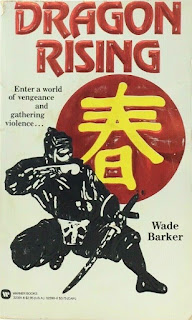
Dragon Rising (The Year Of The Ninja Master #1)


Dragon Rising, by Wade Barker
January, 1985  Warner Books

It’s not noted on the cover or in the book, but this is actually the first volume of The Year Of The Ninja Master. The first page does state that this is “The Year Of The Ninja Master: Spring,” so I guess Warner was using seasons instead of numbers to differentiate the volumes of the series. At any rate this is the followup series to Ninja Master, with Ric Meyers serving as “Wade Barker” for the entire four-volume series (as well as the four-volume series that followed this one, War Of The Ninja Master). 

Dragon Rising takes place “two years, almost to the day” after the final installment of Ninja MasterOnly The Good Die. Meyers refers to that volume, as well as many other volumes of Ninja Master, throughout this novel, so it would certainly help to have read that earlier series before reading this book. Curiously though Warner Books makes no mention of Ninja Master on the cover or back cover, etc. The title on the back cover states that “Brett Wallace is the Ninja Master,” but otherwise there’s no mention that hey, this is a sequel to an eight-volume series we published a few years ago. Also the publisher has clearly packaged this sequel series differently; gone are the action-focused cover paintings of Ninja Master, replaced with a fairly generic “ninja silhouette” cover theme by Gene Light. Also this novel is a good hundred pages longer than those earlier books; each volume of The Year Of The Ninja Master and War Of The Ninja Master comes in around 280 pages. The print’s pretty big, though, so we aren’t exactly talking a Russian epic here. My take from this is that Warner was trying to cater more so to readers of Eric Lustbader’s The Ninja than to readers of, say, The Executioner

However Dragon Rising makes for a pretty frustrating read for anyone who enjoyed Ninja Master, as the “heroes” of that previous series spend the entire friggin’ novel trying to kill each other. The close-knit group who took on scumbag psycho killers in the earlier books are now mortal enemies; Brett “Ninja Master” Wallace has become a psychopath, his student Jeff Archer has been cast adrift, Brett’s gal Rhea is now a spurned woman who cries all the time, and cook Hama is revealed to be a “judge” whose job is to monitor Brett for the ninja family that trained him…and to kill Brett for dishonoring the family. I don’t remember anything about Hama from the other volumes, but he did feature prominently in Only The Good Die, so my assumption is Meyers used that final volume as his springboard for The Year Of The Ninja Master. Because as it turns out, the events of that final volume – which featured Brett and team taking on a trio of vigilantes who were killing innocents in addition to criminals – really messed up hero Brett Wallace. 

Now he is plagued with nightmares, in which he sees himself shooting the lawyer who was the boss of those vigilantes. There’s a definite horror vibe to this novel, with lots of visions and nightmares, and even a metaphysical bent that becomes more prominent. There’s even a veritable cockroach attack in the final pages, not to mention the appearance of the Aztec lord of the dead. But then a very dark vibe permeates the book. This is not a fun read by any means. Our heroes from that earlier series are truly messed up now; fighting their own demons in between fighting each other. Jeff Archer takes the brunt of it, riddled with a disease called “Huter’s chorea” which causes him to go into frequent seizures in which he is reduced to rolling around on the floor while he spouts gibberish and pisses and shits himself. Oh and there’s no cure…he’ll just get worse and worse and then lose his mind. So it’s like Meyers was just really in a bad mood when he wrote this one and decided to take it out on the characters. 

And they really do try to kill each other throughout the novel. Hama and Rhea will try to kill Archer (as Meyers refers to Jeff, so I’ll start doing the same) even when he’s in the hospital…there’s a part where Hama’s about to chop Archer’s head off even when Archer is convulsing on the floor (once again shitting himself…there’s even more of a “shit your pants” fetish here than the average William Crawford novel). And meanwhile Brett Wallace has become a terse cipher who realizes he enjoys killing and getting away with it. It’s like the characters have nothing in common with their earlier incarnations. Hama here is a stubborn defender of the clan, and also it’s revealed that he and Archer basically hate each other…this before the developments of the plot cause them to start trying to kill each other. Rhea meanwhile is also affected; established as a ninja babe in the earlier books, here she basically does nothing but cry over Brett…or help Hama try to kill Archer. But then, Meyers has never seemed to know what to do with Rhea. He seems to prefer female characters who are tied up and subjugated (as Rhea herself was in the final volume of the earlier series), and it’s kind of hard to do that when the female character in question is supposed to be a “born ninja.” So Meyers basically just keeps Rhea off-page so he doesn’t have to deal with a strong female character. For this volume, at least. 

I mentioned in my review of Only The Good Die that the finale was a bit off-putting, as it featured Brett Wallace torturing one of his enemies to death. Again Meyers has used this as a springboard, as we learn that Brett was very affected by his encounter with the Gun Club (ie the trio of vigilantes), given that he realized their modus operandi wasn’t much different from his own. We’re to understand that Brett’s increasing sense of loss over this has led to a rift in the “Wallace school,” with the four characters now opposed. Ultimately we’ll learn that the breakdown is this: Brett himself has embraced his dark side, uncaring how his former friends feel about it; Archer has been cast aside, loyal to his sensei Brett, but shut out by him; Rhea too has been shut out by Brett (we learn that Brett told Rhea to stop sleeping with him months ago!); and Hama has resolved to “judge” Brett for dishonoring the clan and thus execute him. Rhea will go along with this, given that she was born into this clan and represents it just as Hama does. 

The only part in the novel that seems reminiscent of Ninja Master is a fun early sequence where Brett, dressed up like a gas station attendant, pulls off a daring dayling hit on a mobster. As ever Meyers excels in featuring unexpected weapons; Brett makes his kill with a sharpened credit card, which he hurls like a throwing star. But even here the darkness descends; Brett makes his escape in a sewer tunnel, chased by a pair of Mafia goons, and kills them sadistically. But when one of them starts crying in fear as he dies, Brett realizes what he has become. There is a surreal texture to the entire novel; this sequence climaxes with Brett wandering around a desolate part of San Francisco, where he randomly comes across a pedophile about to rape a little girl. Brett almost casually kills the guy…and then wonders if he imagined the whole thing. After this he realizes that he has become a “magnet;” it was a million to one chance that he would come across a pedophile in action, so Brett reflects that now sick people find him so as to be killed. 

After this though the novel becomes a steady beating in which Archer becomes the main protagonist and goes through various levels of hell. This starts in another off-putting sequence where Rhea, Hama, and Archer finally put aside their hatred of one another to confront Brett in his dojo. There they find the Ninja Master waiting for them in full ninja gi, complete with black goggles hiding his eyes – and he immediately goes on the attack. Like literally trying to kill them. Rhea in particular he seems to relish in beating unmerciful, and trying to kill her even when he’s in the middle of combat with Hama or Archer. Curiously though, he keeps using Chinese styles, which is odd for a man trained in Japanese ninjutsu. Just when the reader can’t take anymore of this, the real Brett Wallace magically appears – turns out it wasn’t him in that ninja gi – and fights to defend his former friends. It all ends with everyone practically dead, Brett and the fake Brett taking off, and the dojo burning down. 

The narrative picks up eight months later and Archer’s in a special hospital or somesuch, and we learn that it’s been a hard road to recovery for him. Plus he finds out he’s contracted the apparently-fictitious Hunter’s chorea. The cop who appeared in Ninja Master #6 interrogates Archer, trying to pin the dojo fire and “deaths” of Hama and Rhea on him…and then meanwhile the real Hama and Rhea show up in Archer’s room that night and try to kill Archer. Man, it’s a real beating to read as these former friends try to kill each other. As mentioned, Hama even prepares to chop off Archer’s head when Archer goes into one of his pissing-and-shitting-his-pants seizures. But Archer manages to convince the two to let him go, as he claims to know where Brett Wallace is. 

Here Archer becomes the main protagonist of the novel. And here too I picked up some bad flashbacks to the latter volumes of Jason Striker; a South American setting, ninjas, amnesia, mysticism (complete with visions of Aztec gods), and more shit-yourself escapades. (Shitscapades?) Archer goes through Mexico and on down into South America, at this point the novel becoming a travelogue. The chorea attacks him in waves, and there’s lots of stuff of him abruptly drooling on the floor as he, you guessed it, pisses and shits his pants. Curiously Meyers never notes that Archer washes his pants afterwards, but whatever. At length Archer finally reaches his destination: El Salvador, where Archer has figured out that Brett Wallace might be located. 

At this point the “ninja” stuff has been lost and it’s as if we’re reading the average ‘80s action novel; it’s all about Contras and Sandanistas and guys with M16s wearing camo. Archer runs afoul of various rebel groups and whatnot, at one point nearly dying (while suffering yet another shit-himself “spaz out,” naturally), and he comes to amid a pile of corpses. Eventually he stumbles upon another group of rebels – and among them is a white man with sandy hair and dead eyes who is none other than Brett Wallace. Yet we readers know that Brett Wallace is no more; something Ric Meyers dwells on, which I’d forgotten, is that Ninja Master #1 (which wasn’t even written by Meyers) established that “Brett Wallace” was originally named Brian Williams. This was his birth name, and he only became Brett Wallace after returning to the US as a ninja to gain vengeance. As such, Brett Wallace was just another disguise, and it’s now been dropped. 

The former Brett Wallace now refers to himself as “Daremo” (and presumably will for the rest of this series and the next). This is Japanese for “Nobody.” Archer learns this when the American commando working with the rebels informs him that “the new guy,” ie Brett, is named “Dare Moe.” However there’s a problem with this. I studied Japanese in high school and spent a semester of college in Japan, and while I’ve forgotten a lot of the language I still know Japanese pronunciation. Daremo is pronounced “daahrey mo.” There’s absolutely no way an English speaker could mishear “daahrey” as the English word “dare.” And yet this American commando, Frank Bender, states that the new guy’s first name is Dare. Anyway this is a minor quibble – I mean we’re talking about a surreal ninja yarn – but it still bugged me. 

Even here though there is no emotional reunion between student and sensei. Daremo is a cipher, and doesn’t even seen touched that Archer has traveled all the way to El Salvador to find him. Hell, Daremo doesn’t even seem much bothered by the whole Hunter’s chorea thing. There’s even more ‘80s-style action combat here, as Daremo, Archer, and Bender get in various firefights. Also the mysticism becomes more pronounced, with Archer stating that he and Daremo “share the same nightmare.” In fact Archer suspects that the Hunter’s chorea was intended for Daremo, but Archer got it instead. The two will occasionally go into seizures, victims of metaphysical psychic attacks. And also Daremo is determined to find an ancient Aztec temple called Milarepa, where he thinks he will find the answers to what is going on. 

There is a horror element to Dragon Rising, particularly in the last quarter. After surviving several hellish battles, Daremo and Archer arrive in the remote Milarepa location. Meyers delivers memorable horror-esque moments here, like terrorists in hoods and infrared goggles hiding beneath cockroaches, and coming out from under them with AK-47s blasting. There’s also a creepy bit where the two ninja heroes must wade through a tunnel of cockroaches. Milarepa is this hellish place where terrorists, led by a white man and woman, use sound wave technology to brainwash and train recruits. Lots of splatterhouse-type stuff here, with people being ripped apart and tortured and whatnot, and meanwhile Archer gets laid by the lady in charge of the operation. But it’s more repugnant than sleazy (plus Meyers doesn’t elaborate on it at all), with the girl smiling afterwards, “I’ll think of you during the abortion.” 

The horror vibe gets stronger as Daremo and Archer, inspired by yet more Aztec god visions, hack and slash their way to freedom. Despite all the violence, though, this isn’t a very gory novel, as Meyers usually doesn’t get into the grisly details. Instead he peppers the action narrative with a lot of martial arts terminology. Given that we’re at the end of the novel, Rhea and Hama magically appear, having tracked Archer here…and so too appears the mysterious “fake Brett” ninja from earlier in the novel. After another battle between him and Daremo, the ninja escapes – the representative of a Chinese clan that has vowed to destroy the “Brett Wallace family.” Apparently the gist here is that all the festering bad blood among Daremo, Archer, Rhea, and Hama has been due to the psychic attacks from these Chinese ninja, or something. 

At novel’s end Daremo feels reborn, though there is absolutely nothing redemptive for him in the climax, at least nothing the reader experiences vicariously through the narrative. All of his former friends are out cold: Rhea and Hama knocked out during the melee, and Archer again suffering from his various medical misfortunes. The chief priest of Milarepa however claims that he can cure Archer, though Archer will need to stay at the temple for quite some time. Presumably Archer, Hama, and Rhea will return to the series at some point, but so far as Daremo’s concerned it’s so long to the old crew, and he rushes off to his new destiny alone. We’re informed that the season of “Summer” has now begun, which wouldn’t you know it is the subtitle of the following volume. 

I continue to struggle with Ric Meyers’s narrative style. He creates effective imagery, but at the same time doesn’t properly exploit it. At times the novel almost comes off like a screenplay, with little insight into the motivations or reactions of the various characters. It’s basically a lot of flat declarative sentences with little emotional content. And also Meyers still POV-hops like crazy, going in and out of various character perspectives with zero warning. What I mean to say is, no line breaks or anything to let the reader know that we’re suddenly in someone else’s thoughts. Actually as I read Dragon Rising it occurred to me that what I dislike about Meyers’s style is that he seems to write with the assumption that the reader knows what he is thinking; there isn’t much attempt at bringing anything to life or explaining anything, so that we readers feel we are missing out on a portion of the story. 

Overall this one was cool if you like ‘80s ninja action mixed with splatterpunk horror, but the outline-esque writing style kind of ruined it for me, and the storyline of these former friends trying to kill each other left the bitter-sour taste of defeat in my mouth.

Monday, March 21, 2022

Ninja Master #8: Only The Good Die


Ninja Master #8: Only The Good Die, by Wade Barker
May, 1983  Warner Books

Once again I’ve taken years to get back to the Ninja Master series. This final volume is courtesy Ric Meyers, who after Ninja Master wrapped up spun hero Brett Wallace and crew out into two ensuing series: Year Of The Ninja Master and War Of The Ninja Master. Initially it seemed to me that Meyers was just rewriting his previous volume here, with Brett up against a trio of psychopaths, but as it turns out Only The Good Die is a bit more complex…and muddled. 

Maybe it’s my new contacts, which require me to wear friggin’ readers to even see the words on the page, but this time I found Meyers’s prose a bit too hard to follow. Some of his sentence structures I thought were a bit awkward, particularly in the action scenes, which often pulled me out of the moment. In fact I get the impression that he wrote Only The Good Die on a tight turnaround. The plot is also as jumbled, opening as it does with a trio of psychopaths killing some poor young girl (a recurring Meyers staple if ever there was one – that, and jamming an s&m rubber ball in the mouth of the girls before their torture). But then this ghoulish opening incident is completely ignored until very late in the novel. The result is that the reader keeps wondering who the hell those three psychopaths were and how their story ties in with the novel itself. 

So serial killers torturing and then offing young women is a thing with Meyers; that’s been established in every other book of his I’ve read. This installment opens with three separate chapters in which three separate women experience brutal fates: in the first, and most squirm-induing, a young black girl in New York is abducted by those three psychopaths and driven off to her death. In the second, a successful businesswoman in New York is pushed in front of an oncoming train. And in the third, a young Japanese girl is burned alive when a gang war breaks out in a New York club, the place being set on fire in the melee. Nothing connects these three atrocities, and Meyers does his best to confuse readers by next jumping into another seemingly-random chapter, where a bald and muscular Chinese dude barges into an apartment filled with New York lowlifes and starts beating the shit out of them. 

Eventually we’ll learn that this is Hama, the cook “at the Rhea Dawn in Sausalito,” ie the Rhea who is the Japanese beloved of series protagonist Brett Wallace. Not that Brett still bothers to show up, though. Instead, Hama seems to be the star of the show, next wading into another group of gangsters, these ones Chinese triads, in a Manhattan movie theater. Meyers here indulges in his own interest in martial arts cinema, with mentions of the Shaw Brothers and Japanese samurai movies. And finally, on page 60, the Ninja Master himself appears, slipping out of a hole he’s cut in the film screen with his ninja sword and taking out the triads who have gotten the better of Hama. At length we’ll find out that the young Chinese girl killed in chapter three was Hama’s niece, and a vengeance-minded Hama headed for New York without informing anyone. Brett, Rhea, and Brett’s student Jeff Archer quickly followed him. 

This is the setup. But it’s a clunky first quarter before we figure out what the heck is going on. And really, Meyers just turns the tale into a series of extended action scenes. Brett and team get in frequent clashes with various street punks, to the extent that you keep wondering what the point of it all is. And Brett too seems to wonder what the point is. For there is a muddled mystery at the heart of it all – the gang wars, the Triad club-burning in which Hama’s niece was one of the victims, and even those opening murders of the three women are all somehow connected. But this isn’t Agatha Christie we’re talking about. Instead the vast majority of Only The Good Die is comprised of Brett Wallace engaging a seemingly-endless series of New York punks in bloody combat. 

But the helluva it is, I found the action scenes so awkwardly handled. I constantly found myself having to re-read certain passages to determine what was going on. Maybe it’s just me, though. Meyers does include some fun stuff in the narrative. Brett kicks one guy in the crotch and we learn afterward that the guy’s “private parts looked like three-alarm chili.” And there’s a long sequence where Brett battles a “street mob” in a tenement building that’s very reminiscent of Able Team #8, only minus the auto shotguns and drug-mutated street punks. Brett hacks and slashes his way through an endless horde of punks, using a variety of ninja weaponry. In this sequence Brett learns that the punks aren’t just after him, but given that they’re members of rival gangs they’re trying to kill each other at the same time. There’s a crazy bit where Brett kills several of them in sixty seconds while they are occupied with fighting one another: “They were all biodegradable punks on a one-way trip.” 

Meyers introduces a nursery rhyme conceit to Only The Good Die, with occasional mentions of “The Butcher, The Baker, and The Candlestick Maker,”’ as well as “Jack jumped over the candlestick” and such. In fact the first-page preview would have you believe the Butcher, Baker, and Candlestick Maker – ie the three psychopaths in the opening sequence – will be the main villains of the tale. While that ultimately proves true, it isn’t until very late in the novel that we learn how it connects. And for that matter, this too is muddled, as it turns out the villains with nursery rhyme nicknames are really just underlings in this crazy army, not the leaders. For example the “Baker” turns out to be a psycho chick who gets off on being tortured, and who has lured Brett into this long tenement battle…again, it’s all very hazy and jumbled, but apparently “the Baker’s” bosses learned about this “Oriental” avenger who wiped out the Triads (ie Hama – though they think Hama is really Brett…or something), and this tenement attack has been staged to entrap him. 

I’m assuming in the ensuing series Meyers further elaborates on Rhea and Jeff; the former only has one memorable scene here, and the latter doesn’t do much except get shot (in the chest!). Rhea’s bit has her using “saimin jutsu” on a detective, a sort of seductive hypnotism which has the cop slackjawed at Rhea’s beauty and thus giving up confidential info to her. But for all this empowerment Rhea ultimately suffers the same fate as most other female characters in a Ric Meyers novel: she’s caught toward the end of the book, tied up, and shipped off to an “elegant sexual torture chamber,” which made me think of the swank sex chamber in the groovy film version of The Adventurers. And yes, a rubber ball is shoved down her throat when she’s tied up. I mean it just wouldn’t be a Ric Meyers novel if one wasn’t. As for Jeff Archer, I honestly thought he was killed in the finale; he gets shot in the chest and that’s the last we see of him, before Brett quickly exposits in the final chapter that Jeff’s seriously wounded but will recover. 

Meanwhile, the Candlestick Maker turns out to be aligned with the Black Liberation Army For Social Terrorism (which totally shouldn’t be confused with BLM); this group of black terrorists has taken credit for the nightclub fire that killed Hama’s niece. This entails another extended action scene, but one with a bit of a TNT flair, as Brett faces attack dogs in explosive vests in a TV studio. His sort-of companion here is Tommy Gun Parker, a mountain of muscle-type who is fond of wielding Mac subguns in each hand. While they start off as enemies, Parker being one of the thugs hired to kill Brett, they ultimately develop a sort of Lethal Weapon relationship of bantering. But speaking of Tommy Parker and Meyers’s sometimes-confusing prose style, check out this excerpt and tell me if you too think it’s a bit hard to follow what’s going on: 


Things wrap up in an estate outside the city where the three freaks from the opening paragraph finally return. And it turns out they aren’t psychos in the purest sense; indeed, they’ve been hiring “homicidal psychopaths” to do their dirty work in the city. And their dirty work is cleaning up the streets. These three men have suffered their share of misfortune due to rampant crime and have decided to go outside the law to restore law and order. To this end they’ve started a variety of gang wars, hoping to use their homicidal psychos to stir shit up. Of course, the resulting loss of innocent life is just seen as collateral damage. These are the guys who capture Rhea in the finale – despite her being an asskicking ninja babe in her own right – but Brett and Jeff are there to save the day. The final sequence is very odd, as Brett wants the main killer to suffer horribly, and tortures him via drowning. Overall a strange, somewhat off-putting way to finish off the Ninja Master series. 

A year or so later Brett Wallace was to return in Year Of The Ninja Master, also published by Warner. Since I took so long to read Ninja Master I think I’ll dive into the first volume of that next series posthaste.

Monday, July 13, 2020

Israeli Commandos #3: The Kamikaze Assignment


Israeli Commandos #3: The Kamikaze Assignment, by Andrew Sugar
No month stated, 1975  Manor Books

I really enjoyed this third volume of Israeli CommandosAndrew Sugar follows sort of the same vibe he used in The Enforcer, focusing more on suspense and tension than outright action, but it’s all done very well. The characterization is a notch above the genre average, and there’s also a little bit of development for the overall series storyline – shame, then, that there was only one more volume to follow. Plus, there’s a part where our titular commandos are attacked by ninjas! 

Our protagonist this time is Dov Abrams, who starred in the first volume; Sugar seems to have developed the template of Abrams featuring in one volume and Gershon Yelinga, another Israeli Commando, featuring in the next – Yelinga was in the previous volume and mentioned in the first one, but we don’t hear a thing about him this time. I assume though he’ll return for the final volume. Otherwise Abrams is the central character, and he’s much more likable this time, less hot-headed. The plot also takes advantage of Abrams’s status as a famous heavyweight boxer – as we’ll recall, he’s known as “The Israeli Muhamid Ali,” which is just wrong on so many levels.

While Abrams is the central character, as with The Enforcer there are recurring characters who add to the storyline. For one there’s The Major, Abrams’s taciturn spy boss. There’s also Abrams’s boxing trainer and his entourage of sparring partners and the like. Most importantly there’s also Ronit, Abrams’s famous model girlfriend, Abrams being one of the few ‘70s men’s adventure protagonists with a steady girlfriend. Ronit gets to take part in this installment’s mission; there’s a humorous part later in the book where she informs a surprised Abrams that she’s suspected for a long time that he’s a secret commando for Israel, as it wouldn’t take a genius to figure out why he’s always calling for matches in unusual locations – locations which turn out to experience heavy terrorist-blasting action soon thereafter. Abrams wonders if this means that Ronit too will eventually be drafted into the commando network, but unless Abrams figures into the next novel we’ll never find out.

Abrams and Ronit are on vacation in the South of France and enjoying some fine dining when a pair of local racists come over and start badgering Abrams for being a famous Jewish boxer. This leads to a nice fistfight in the street, with even Ronit getting in on the act. This will serve as our only action sequence until much later in the novel, though. In fact this one might have the least action yet in the series, but as stated this doesn’t take away from the enjoyment factor. While I found the previous two volumes a little patience-trying, The Kamikaze Assignment moves at a fast pace and keeps you turning the pages. And as the title suggests, this one takes place in Japan; per The Major, a Japanese explosives expert with radical leanings has offered the PLO some newfangled guidance systems for mini-atomic warheads or some other such Maguffin, and Abrams’s mission is to head on over to Tokyo and get one of the prototypes before they can be shipped to Iran…and be used posthaste on Israel.

Abrams’ only cover for going to Tokyo is to challenge an upstart Japanese boxer, one who is well below him on the boxing totem pole…sort of like Apollo Creed challenging Rocky Balboa in the first Rocky. It is of course a highly unusual move, and further casts doubt on Abrams’ entire cover identity; both Ronit and his coach reveal later in the book that the only possible way Abrams could even want to challenge this guy was if it was because he needed to go to Japan on some sort of “secret” commando mission. As I say, the novel at least ends with Abrams’ entire team being aware of his secret operative status, which promises further series developments – something Sugar was known for in The Enforcer.

But one thing Sugar doesn’t bring to this series is the sleazy and lurid vibe of The Enforcer, which was almost fixated on breasts and nipples and the like, with hardcore sex scenes in the earliest volumes. Israeli Commandos is comparatively tame. Abrams’s few sex scenes with Ronit all occur off-page, and she’s barely exploited at all. I mean what the hell? This could potentially have something to do with the fact that Andrew Sugar supposedly became a woman sometime in the mid to late ‘70s; way back when I reviewed The Enforcer #1, a few people left varying comments that Sugar was really a woman, or that he was a man with a wife and kids, etc. Around 2012 I was briefly in touch with a guy who had met “Andrea” Sugar and who told me he’d been called as a witness in a trial Sugar had put together against Clint Eastwood, claiming that the Dirty Harry flick The Enforcer infringed upon Sugar’s series of the same title! This was in the late ‘70s and of course the trial was thrown out.

But anyway, this person told me that Andrew Sugar had become “Andrea Sugar” shortly before the trial, and made for a “handsome woman.” He didn’t know anything else about Sugar and was only called as a witness on the artistic aspect of the case, as he himself was a writer. What I found most curious is that nothing else was ever published by Sugar after the trial; the last thing credited to him is the 1979 Manor paperback The Cult Breaker (which curiously features a Clint Eastwood lookalike on the painted cover!), and so far as I can tell there’s never been anything by an “Andrea Sugar.” Prior to “the change,” Sugar had been fairly prolific (and always published under his own name), so I wondered why he would’ve stopped writing even if his gender had changed. I was going to do a post about this on the blog at the time, but just never got around to it, so these two paragraphs will have to suffice.

So off our heroes go to Japan, where Sugar doesn’t beat us over the head with the cultural differences or arbitrary travelogue stuff. The flight over begins the suspense and tension vibe that will continue for most of the novel, as Abrams is summoned to the cabin of the 747 and informed a bomb’s been discovered onboard. Abrams has been called because it’s known by the public at large that he grew up dismantling bombs and stuff, just part of the daily life of being a kid in postwar Israel. He defuses the bomb in a nicely-done scene, only for one of his entourage to die regardless, thanks to some cyanide in a mixed drink. Later at the airport there’s a bomb in a briefcase; at this point Abrams knows one of his people is a traitor, and of course it turns out to be some minor character we’ve never met before.

It’s more on the suspense tip as Abrams and entourage are hooked up with a training facility outside Tokyo, but his concern is how to get off the premises without their police security detail not seeing them. Abrams’s lack of training for the upcoming match – ie, the very reason the world thinks he’s even here in Japan – becomes humorous (intentionally so), and serves up another reason for his coach in particular to suspect that Abrams is here for another reason entirely. And here come the ninjas – one night Abrams and his group are roaming the camp grounds when Japanese men in black suits bearing swords come out of the shadows and attack them, leading to a taut action scene where Abrams and his boxer pals defend themselves with their fists. It’s not until later that Abrams is told they are ninjas, which he’s never heard of. The various attacks make Abrams suspect there are two different factions trying to kill him, and he turns out to be correct, but the main threat centers around the Eijiro Electronics headquarters, owned by the radical who plans to sell his missile tech stuff to the PLO.

There are interesting scenes throughout, like a late-night soft probe Abrams makes on Eijiro, where he discovers the grounds are guarded by giant mastifs in addition to high-tech sensing devices. Sugar brings something else to the series that he did The Enforcer: a theme, something you don’t often find in the men’s adventure world. The theme is “Israelis are born survivors,” and Sugar successfully displays it throughout, from Abrams’s childhood familiarity with defusing bombs to the various members of his entourage willing to put their lives on the line for Israel. It’s especially displayed in the taut (but brief) climax, in which a battered, beaten, and bloody Abrams gets in the ring with the Mike Tyson-esque Japanese boxer, about the only thing fueling Abrams his fiery will to survive.

The action doesn’t really pick up until Abrams and team make an attack on a terrorist hideout, a very well-done scene which has them setting up some oldschool tricks like wiring up a door so that it electrocutes whoever touches it. The biggest action scene is on the night of Abrams’s big match; he rightly suspects it’s the only day the police guard won’t expect him to try to sneak off the training compound – given all the attacks on his life, Abrams has been placed under 24-7 police guard. They hit the Eijiro facility, wiping out hordes of terrorist scum, with Abrams delivering brutal justice with a .357 bast to Eijiro’s face.

This is where most novels would end, but Abrams still has a heavyweight boxing match to attend! Even though his right arm has been so injured he can’t use it and he’s got shrapnel wounds on his ass. In a half-daze he’s driven to the arena, where he demands that his coach give him some painkiller shots and stitch up his ass wound, insisting that he can still fight. I thought Sugar would have the fight called off, but it really happens – and not to blow any spoilers, but it is very much in the Mike Tyson mode, as Abrams has that Israeli fire in him and basically destroys the dude, using just his left hook, in a couple seconds.

So if this is the last we’ll see of Dov Abrams, it’s at least a bad-ass way to go out. As mentioned there’s a lot of opportunity as Abrams’s entire entourage is now aware of his being an Israeli Commando, with the potential that they’ll now be able to help him out on his future assignments. But it seems that Sugar developed a revolving protagonist setup for the series, so I suspect this will indeed serve as our farewell to this particular Israeli Commando. Overall though, The Kamikaze Assignment was a lot of fun.

Thursday, January 23, 2020

Book Of Justice #2: Zaitech Sting


Book Of Justice #2: Zaitech Sting, by Jack Arnett
February, 1990  Bantam Books

Luckily the second volume of Book Of Justice is better than the first. Interestingly this one’s copyright “Justice Enterprises,” whereas the first one was copyright Mike McQuay. I assume though he also wrote this one, as well as the ensuing two volumes: the “about the author” bio at the end of the book presesnts a fictional history for fictional “Jack Arnett,” implying that Arnett was once involved with global intrigue but now lives the life of a beachcomber. His age is given as 42, which I believe would correlate with McQuay’s age – McQuay died just a few years later, of a heart attack, at the young age of 45. (I say “young” because Im 45 and I sure don’t feel old!...At least most of the time.)

We meet William Justice and his trusty team as they’re plying the waters outside Haven, the island republic Justice heads up. There’s some business about a near-revolution in nearby Cuba and Justice has some background with the man behind the failed revolution, Marto Chavez. Currently Chavez’s people are escaping Cuba on a boat that’s just entered Haven waters. Jusitce, on a yacht that’s secretly loaded with heat-seeker missiles and various other weapons, communicates with the captain piloting the Hind helicopter that’s chasing the refugees. Sardi, Justice’s turban-wearing right-hand man, implores Justice to seek peace. Meanwhile Bob Jenks, the brawny former Federal agent, insists Justice “blow the fuckers out of the sky.”

Instead Justice does what no men’s adventure protagonist should ever do – he bides his time, indecesive. He reaches what he thinks is a détente with the Cuban captain…who only pretends to fly away, but then turns back and opens fire on the ship of refugees. Finally Justice orders the Hind destroyed via those heat-seekers, after which he and his comrades board the refugee boat and gun down the surviving Cuban soldiers in cold blood. Meanwhile the refugees have almost all been massacred; lots of grim stuff here, with mentions of dead kids and even Jenks moved to tears by the sight. A bit too dour, I think, for this particular genre. Oh and throughout Kim, the hotstuff Eurasian babe who acts as the Smurfette of Justice’s main crew, goes around in a hot pink string bikini with a Wild West-style .45 strapped to her shapely thigh, blowing out the brains of surrendering Cuban soldiers with her AR-15.

Meanwhile Chika Stark, a half-Japanese lady who has also come to Haven to seek refuge, has troubles of her own: a pair of sadistic CIA goons corner her in her apartment, kill the teen girl Chika has befriended, and then tell Chika they’ll murder more innocents if Chika doesn’t come quietly with them. Apparently she created something the CIA now wants for American security, and they’re royally pissed that she “sold out” to the Japanese, apparently offering them the device. This brings Justice into the plot; while deep-diving to look at the refugee corpses – more dour stuff that seems like overkill at this point, though presumably it exists to show us how Justice gets “emotionally involved” with the people he tries to save – Justice witnesses the two goons trying to kill Chika when she jumps off their boat in an escape attemtp. Justice breaks the neck of one agent and watches as the other kills himself; we’re only like 40 pages into the book and there’s already been more action than last time.

But then, McQuay clearly wants to shoot higher than “just another men’s adventure series” with Book Of Justice; there are various subplots about politics on Haven (some local rabble-rouser named Caido Lienard wants to run against Justice as boss of the island republic), investment banking, and a muckracking Haven reporter named Stromberg who wants to get the goods on Justice. Unfortunately, rather than coming off like a big suspense series, I just found it all tedious and tiresome. Justice already has a large enough entourage, we don’t need extra stuff about yet more characters. Again, this is why ‘70s men’s adventure novels were so much better – they were just more primal, sticking to their sole lone wolf protagonists. Of course there were exceptions to the rule, but for the most part ‘70s men’s adventure was more streamlined. Zaitech Sting almost needs a Cast Of Characters page for the reader to keep up.

McQuay was a veteran of Gold Eagle and brings that imprint’s distrust of the CIA to this series; after digging up the corpses of the agents he killed (seriously, the first quarter of this novel is almost ghoulish, with several scenes of Justice either looking at or searching through dead bodies), Justice determines they were working for the US government. So he heads to the White House and, amid much televised hulabaloo, reveals the charred, mutilated bodies of the CIA agents to the TV cameras – which happen to be broadcasting the event live. Oh and I forgot to mention, but either McQuay bet on the wrong horse or just decided to set this series in an alternate reality, as it’s revealed that Dan Quayle is President! But then Haven’s already been presented as an island nation with UA status, so technically this series is alternate reality. Oh and to bring it all home – none other than Donald Trump is mentioned on page 53! And to bring it even further home – CNN gets mentioned in a negative light, pushing the fake news that “William Lambert” (aka the name the rest of the world knows William Justice by) is a terrorist, con artist, and general bad guy.

Eventually we meet this novel’s main villain, a Japanese dude named Shirishata who heads up a family-owned business and employs sadistic means to achieve his goals. He wants the “organic computer” Chika has designed, a computer that mixes technology with nature and runs off biochips. He sends his sword-wielding goons after Chika on Haven, resulting in some heroic sacrifice courtesy Chavez. Oh and meanwhile Kim gets friendly with Lienard, the Haven rabble rouser who challenges Justice to become “CEO” of the island republic; they even have a sex scene that’s so off-page we only learn anything even happened via casual dialog. However McQuay will occasionally try to exploit Kim’s ample charms, with her traipsing around Justice’s fortress HQ in skimpy, nipple-revealing clothing, but honestly it comes off like half-assed catering to genre demands, with little of the impression of sleazebaggery I demand in my pulp writers.

The saddest thing about Zaitech Sting is that it has the potential for pulp greatness, but squanders it for a good 170 or so pages (the book runs to a too-long 200 pages)…and then, in the final several pages, we have Justice, Kim, and Jenks fighting actual honest to Zod ninjas in Japan. And it’s straight out of MIA Hunter #4, too: all you’ve gotta do is point your machine gun, depress the trigger, and veritable hordes of the sword-wielding crazies will just fall dead at your feet. Anyway all this happens after Justice has gone through the trouble of finding out who Chika is – this courtesy Kim, who hacks the CIA database (Haven hacking!!) and learns that Chika was working on an “organic computer” via a molecule that could render “biochips” a thing of reality and thus throw the current geo-political-corporate landscape into riot. Now she’s been taken by Shirsihata, who lives in a castle surrounded by armed men and tons of ninjas. The plot finally kicks in gear as Justice and comrades fly over there and HALO jump into Shirishata’s domain.

Even here though McQuay can’t be content to dole out “just another action series;” while the bullets start flying in Japan, we have these interminable cutovers to Haven as the election goes down, “William Lambert” versus Caido Lienard, with Sardi handling it all given Justice’s disinterest in the whole matter. After a passionate speech about the good “Lambert” has done for Haven, Sardi succeeds in winning the election for his boss. Occasionally we’ll cut back over to the good stuff, with Justice running around in “black camous” and wielding an M-16/shotgun combo, blowing away ninjas left and right. McQuay slightly gets into the gore, with descriptions of “brainpains blowing out” and the like. But even here, while they’re getting shot at, Justice and Kim find the opportunity to discuss “all this killing,” and for Justice to allay Kim’s concern that perhaps Lienard might be a better leader for Haven, given his promise of peace. Justice quashes this, though, saying that Haven needs brutal warriors like Kim and Jenks and Justice and the others – the world is out to get Haven, and it needs defenders.

So concerned is McQuay with all this stuff that, when Justice finally confronts main villain Shirishata, who is holding a sword to captive Kim’s throat, McQuay barrels through the denoument in a single, unsatisfying paragraph: Justice goads Shirihata into attacking him, stops the blade in midair with his bare hands, and breaks the bastard’s neck with a single kick. Lame!! From there it’s back to Haven, where a defeated Lienard comes across Justice as he’s breakfasting by the sea and pulls a gun on him – a gun which Justice learned about when Lienard came to the island years ago, and which Justice secretly had broken. (Guns are forbidden on Haven, by the way – except of course for soldiers like Justice and his crew, which is about as New World Order as you can get…) Anyway Justice in his omniscience knows that Lienard was sent here as a mole by the French, his purpose to wrest control of Haven from Justice and turn it over to his evil French masters. Instead Justice offers Lienard a new mission: to become a triple agent, an inside man with the wily French government.

And here mercifully Zaitech Sting ends; impossibly, the next two volumes are even longer, with the final novel in particular appearing to be a veritable doorstop of a book. I think my greatest issue with Book Of Justice is that none of it’s very interesting…the characters are not likable, and Justice still seems more like “Mr. Malibu” than the cold-hearted killer he’s constantly proclaiming himself to be. I mean folks he even gives his followers the occasional pep talk with a hug. Also, given that it’s now the ‘90s, computers have entered the fray, so we get a lot of stuff about Kim hacking the CIA database and delivering all sorts of exposition about it. All of which is to say that Book Of Justice has more in common with the “suspense thrillers” that eventually cluttered bookstore shelves, and less in common with the men’s adventure yarns of the ‘70s and ‘80s, though given the ninjas it’s clear McQuay was trying to merge the two genres.

Wednesday, October 9, 2019

Ninja Master #7: The Skin Swindle


Ninja Master #7: The Skin Swindle, by Wade Barker
March, 1983  Warner Books

I didn’t expect to take three years to get back to the Ninja Master series – I also didn’t expect to only do one post this week, but the stomach flu wiped me out last week. Anyway this penultimate volume is courtesy the same mystery author who gave us #3: Borderland Of Hell and #5: Black Magician, delivering for the most part more of a martial arts thriller than a ninja yarn, one that goes very heavy on the sleaze.

Now folks there’s good sleaze and bad sleaze, and sorry to say, but The Skin Swindle is bad sleaze. The type of sleaze you just don’t want to read about. That cover of the whip-wielding babe and the back cover copy had me expecting a lurid entry in which Brett “Ninja Master” Wallace waded into the world of mafia-backed porn or whatnot, but man…well, the author instead focuses on the “kiddie” portion of that illicit market, making for a not very fun read. Not very fun at all! There are some subjects I think shouldn’t be broached, and this would be one of them…it’s for the same reason I’ve still not read the fifth volume of RykerThe Child Killer.

But then, Ninja Master is known for pushing boundries. The previous volume, courtesy main series writer Ric Meyers, already featured little kids getting murdered by sadistic serial killers. So I guess at this point putting them in porn movies is just the next logical step. It’s just not the sort of thing I look forward to reading, and it’s the sort of thing that makes me wonder about the author – though I suspect this might be one of those times where the author has his tongue in cheek. I mean The Skin Swindle opens with an outrageous take on the “casting couch” cliché, only in this case it’s a seven year-old girl who’s servicing the sleazebag producer, all while her mother happily watches on. 

Luckily the author doesn’t go full-bore with the details on the various acts involving children in the book, but we do get a damn lot about it…of course, leavened with the occasional condemnation of such despicable acts! It’s stuff like this that always makes me suspect (or at least hope) that an author’s being ironic, particularly given that the opening casting couch bit directly leads to a fairly explicit sequence of Brett going down on his casual girlfriend Rhea, she of the “eternally erect nipples.” Still though, The Skin Swindle makes for a very unsettling read, “irony” or not, and thus it was by far my least favorite volume of the series…even the slow-as-molasses first volume was better. 

Well anyway, the mystery author enjoys referring to his previous volumes, giving the series a bit of continuity; Brett’s sidekick Jeff Archer, who proves to be irritatingly useless this time around, boasts about their having trounced the bad guys in Borderland Of Hell. The author also stays true to his version of Brett Wallace, delivering a more relatable character than Meyers’ version; this Brett enjoys the occasional drink, spends most of his time in various restaurants, and likes to blast “Steely Dan’s new album Gaucho” in his fancy sportscar. The Steely Dan appreciation was also noted in previous volumes, I believe. And more importantly so far as the series goes, this Brett Wallace is more of a martial arts superman than a ninja, content to kill people with everyday household objects instead of the exotic weaponry of Meyers.

Brett’s read about the sadistic porn industry in a series of articles published in the LA Times, and when he gets to the mentions of the kiddie flicks his fury is activated. He tells Rhea he’s going to get into it – she stays off-page for the rest of the novel – and rounds up young Jeff Archer to come along. Why Brett takes Jeff is a mystery because in this author’s hands Jeff is a complete loser. He runs Brett’s martial arts studio but proves incapable of fighting anyone in the course of The Skin Swindle, constantly getting knocked out or abducted. The expectation that he’ll provide the customary “comedic sidekick” role is also dashed, as Brett and Jeff are seldom together on-page.

Instead, Brett’s partner for the most part is the crusading journalist who wrote those porn articles: “Sam” Loring, who of course turns out to be a mega-hot and mega-built blonde named Samantha. The expected Brett-Sam conjugation doesn’t occur until late in the narrative, and as usual with the author it’s fairly explicit. Sam has a bit of personality but for the most part the author just uses her to regurgitate exposition about the porn industry. Brett presents himself as a freelance journalist from a major Japanese news conglomerate, looking to write a book on the subject. Sam agrees to show him around the sleazepits of Los Angeles, informing him that you can get practically any sort of magazine if you know the right people to ask.

It all just goes on and on with only occasional action. Brett’s learned via Sam that there’s a “King” of the industry, a guy behind all the snuff flicks and kiddie flicks and whatnot, and soon enough random thugs are coming out of the woodwork to waste Brett for poking his nose where it doesn’t belong. But yet in every single case Brett just kills these goons and never stops to interrogate them – like even simple “Who sent you?” sort of stuff. I mean it’s great the action’s there and all but still, Brett comes off kinda stupid. He knows there’s a mysterious figure behind the industry, one whose existence is almost a legend, and clearly it’s this dude sending out the thugs…and Brett could work his way backward from them, but never considers the idea.

Brett again displays his bizarre talent for using random objects to kill; he doesn’t take out as many people this time, and the violence is for the most part bloodless, other than the occasional mention of blood or brains. He kills with chopsticks, quarters, a mouth pellet, a knife, a blowgun, the pole of a street sign, and even a ninja sword which has been modified so that it hides inside his “ninja belt.” For the most part each “fight” is over quick and features Brett outmatching his opponents to absurd degrees. There’s never any sense of danger for him, so the author has to resort to placing Jeff and ultimately Sam in danger, as they both find themselves about to be the unsuspecting stars of a snuff flick.

But Brett disappears for too many portions of the narrative, with the author focusing on Cedric Gregg, the “king” of Hollywood’s illicit underground industry. He’s one of those criminal masterminds who just goes around killing any underling who has displeased him. We get arbitrary scenes of him killing such and such a porn-world figure, usually for having slipped evidence of Gregg’s connection to the industry. There’s a lot of squirm-inducing stuff with Gregg cavorting with his favorite passtime: young boys, one in particular whom Gregg is trying to woo with a new print of The Empire Strikes Back. It’s really all beyond outrageous so far as the kid stuff goes, and the author does himself no favors with having some of the child “actors” talk like veteran professionals: “I think this chick and I both know why we’re here,” as a ten year-old “star” of one of Gregg’s films says of his seven year-old costar.

Brett’s also not the most proactive of men’s adventure heroes in this particular volume. Early on Sam tells him of a woman she’s met whose daughter was taken by the lady’s estranged husband and put into porn flicks – the law, by the way, is humorously incapable in The Skin Swindle, with the vague explanation that “payoffs” allow the sleazebags to make their movies without any legal or punitive repercussions. Anyway Sam’s concocted a plan for this lady to visit a notorious “producer” and give him a b.j. in his office, something the producer expects of all his female guests, whether she be adult or child. After the oral servicing the producer’s schtick is that he goes off into his private restroom to clean up, and leaves the woman/girl in the office alone. Well, Sam says this lady can pretend to be someone else, do the oral job, then look through the producer’s files while he’s in the restroom and find the address where they’re keeping her daughter.

I figured Brett would come up with some augmentation for this plan…but instead he tells Sam to make it happen, then he and Sam wait in a diner for the lady to call them after she’s gotten the address! It’s like that throughout; Brett spends at least 30% of the narrative in various restaurants or diners, one of them a dive frequented by kids who are looking to get picked up by adults. (No, it’s not a pizza parlor!!) After checking the grungy place out – and the grizzled owner of the joint, by the way, steals the entire book with his acidic temper – Brett sends Jeff back, to pose as a teenager looking for a sugar daddy! This of course leads to yet another moment in which Jeff is abducted and Brett has to save him.

Oh, and the whip-wielding cover babe does finally appear; we see the makings of one of Gregg’s snuff flicks, and the babe is in full s&m getup and whips some manacled dude to bloody ribbons, then slits his throat. She factors into the finale, an outrageous snuff-kiddie-Nazi exploitation extravaganza which is to feature Jeff and Sam in supporting roles against their wishes, but curiously she is the only person Brett decides not to kill. The author even goes out of his way to have Brett explain why he doesn’t feel the need to kill her (she’s powerless in the scheme of things, or something to that lame effect).

The novel ends with Brett and Jeff heading back to San Francisco and Sam certain that she’ll “never forget” Brett. And this was it for the mystery author; Ric Meyers wrote the next volume of the series, which was to be the last. After which Meyers, still posing as “Wade Barker,” brought Brett and co. back for two ensuing series, which ran for four volumes each: Year Of The Ninja Master and War Of The Ninja Master.