Showing posts with label Terence Fisher. Show all posts

Monday, July 31, 2023

MASK OF DUST (1954) on TPTV podcast


 Talking Pictures TV just posted their new podcast with the schedule for August and I contributed with a little bit of info about Hammer's racing movie MASK OF DUST aka A RACE FOR LIFE (1954), directed by Terence Fisher. 

You can listen to it from around the 55 minute mark.

mask of dust, a race for life, poster, hammer

mask of dust, a race for life, poster, hammer

mask of dust, a race for life, poster, hammer


Friday, January 14, 2022

FRANKENSTEIN CREATED WOMAN (1967)

Frankenstein Created Woman, Italian Poster, Susan Denberg, Peter Cushing
Following Cinepunked’s first live stream discussion between Robert JE Simpson and David L Rattigan about all things Hammer (“In the Grip of Hammer”) yesterday, I decided to rewatch Frankenstein Created Woman again. 

The discussion is still available on YouTube and was an utterly enjoyable goodhearted chat between the two about their personal fascination with Hammer Films as well as about the fandom those movies generated. There was lively audience participation in the form of chat messages that the two picked up and elaborated on. 

In the context of this movie they mentioned that it’s often criticised for not featuring enough of Peter Cushing but that it never bothered them personally. 

Must admit that I also never took note of that before though this rewatch made me notice that he did indeed spend possibly less time on screen than in other outings, however, this production is notable for introducing us to a range of other truly memorable supporting characters (including Susan Denberg’s gender bending meat-cleaver swinging Christina) that it actually would have been a shame to lose time with them in exchange for more time with Cushing’s character so it’s probably fair to say that even though from a purely time on the screen perspective there was indeed less Cushing in this film than in others of the series but what we did get was more than sufficient for this particular story. 

Part of the discussion also focused on their desire to explore Queer Hammer more and of course this movie is quintessentially queer whether it is the overt gender transfer between Christina and Hans (Robert Morris) or the more implied charmingly doddering bromance between Frankenstein and Thorley Walters’ Dr. Hertz. 

So much to appreciate in this, one of Hammer’s most unusual productions. If only they’d have gone even further and also included that wraparound bandages bikini style outfit that was used in the film's poster and promotional material for Susan Denberg…. 

Really glad that this discussion made me return to Frankenstein Created Woman again and hope that there will be more similar live streams to follow. 

 Below samples of some German and US lobby cards for this film as well as the recording of the live stream. (Best to watch it directly on YouTube though to properly read the parallel chats between the audience members.) 


German Lobby Cards:

Frankenstein Created Woman, Lobby Card, Germany, Susan Denberg

Frankenstein Created Woman, Lobby Card, Germany

Frankenstein Created Woman, Lobby Card, Germany, Susan Denberg

Frankenstein Created Woman, Lobby Card, Germany, Susan Denberg

Frankenstein Created Woman, Lobby Card, Germany

Frankenstein Created Woman, Lobby Card, Germany

Frankenstein Created Woman, Lobby Card, Germany, Susan Denberg

Frankenstein Created Woman, Lobby Card, Germany, Susan Denberg

Frankenstein Created Woman, Lobby Card, Germany, Susan Denberg

Frankenstein Created Woman, Lobby Card, Germany, Peter Cushing

Frankenstein Created Woman, Lobby Card, Germany, Susan Denberg

Frankenstein Created Woman, Lobby Card, Germany, Susan Denberg

US Lobby Cards:

Frankenstein Created Woman, US Lobby Card, Susan Denberg

Frankenstein Created Woman, US Lobby Card, Peter Cushing

Frankenstein Created Woman, US Lobby Card, Susan Denberg, Thorley Walters

Frankenstein Created Woman, US Lobby Card, Thorley Walters

Frankenstein Created Woman, US Lobby Card, Susan Denberg

Frankenstein Created Woman, US Lobby Card, Peter Cushing

Frankenstein Created Woman, US Lobby Card, Peter Cushing, Thorley Walters

Frankenstein Created Woman, US Lobby Card, Susan Denberg

Available on Amazon:


Saturday, October 25, 2014

Four Sided Triangle (1953)


Given that Hammer’s official YouTube channel has made some of their lesser known and previously only difficult to get a hold off early black & white productions more readily available, it is pretty pathetic that I haven’t spent a few sleepless nights yet in front of the screen in my endeavor to plug a few more of my holes in my Hammer filmography.

Time to change this…..
(Spoiler Alert: Please continue reading only after watching the film first.) 

FOUR SIDED TRIANGLE was Terence Fisher’s first Sci Fi movie and some of its concepts indeed seem to predate some of their later Frankenstein flicks (e.g. CREATED WOMAN).

In a pastoral English village, Robin (John Van Eyssen who is better known as (HORROR OF) DRACULA’S Jonathan Harker) and Bill (Stephen Murray), two friends since childhood, are collaborating together to create what was apparently going to become a prototype for Star Trek’s replicator. They are assisted by Lena (Barbara Payton), a childhood sweetheart who has just returned back from a stint in the States, and makes up the third (and later on also forth) side of their triangle.

Payton’s character is potentially the most interesting one in this movie as she is so decidedly off-centre, yet the film seems to treat most of her later decisions with the utmost normality.

We first see her in a flashback playing knights and lady with the boys and clearly already favouring Robin. Following a lengthy stay in the States she meets up with Dr Harvey (James Hayter), the narrator of this film, and proudly proclaims that she intends to spend all her money and subsequently “die in some reasonably unmessy fashion”.

This is quite possibly one of the most casual suicide declarations ever filmed and even more shocking as we never seem to get a proper idea why she considers herself such a failure and disappointed with life. What a way to get introduced to a character!

Meeting her old friends again, however, seems to give her a fresh purpose in life and she acts as their assistant and quickly rekindles her mutual infatuation with Robin, leaving Bill just longing after her.

Most of the research work is depicted as taking place in a laboratory that could easily have also been used in both the Universal or Hammer Frankenstein productions. Where at first the goal was to replicate inanimate objects, duplicating life is the obvious next step, especially given that Bill comes up with a plan to copy Lena giving him at last a chance for some quality time with her artificial twin but leading the viewer with a few more choice head-scratch moments with regards to her dubious decision making skills.

Not only does she readily agree to volunteer without batting an eyelid for this untested replication process. Her artificial twin (called Helen) is a carbon copy even down to her emotions for Robin yet out of some misdirected sense for – yes, for what exactly? it is never clear - , she decides to marry Bill, only to attempt to drown herself. To make things even worse, she subsequently believes that getting her memory wiped just so she can forget about her real true love is indeed a good idea (“an empty mind and a new beginning”).

And never during any of this do we get a feeling that this is anything else but common sense decision making! Any single one of those decisions is actually beyond creepy so not emphasizing that creep factor in the movie and making all those actions appear downright normal is in the end an awfully wasted opportunity and a missed chance.

This could have become a proto-Cronenbergian Mind Fuck but just ends up being a very average and mercifully short production based on a preposterous idea. Even a potentially disturbing surprise ending is solved amicably, unlike the literary original that appears to have gone just this extra bit further with regards to the final outcome.

William F. Temple’s original story was adapted to the screen in collaboration by both Terence Fisher and Paul Tabori, a Hungarian author who on top of writing some English language pulp fiction novels wrote a number of screenplays as well and was also involved with Terence Fisher’s next film, SPACEWAYS, yet another early Science Fiction movie by Hammer.

Whereas most of the talent in this film was just at the beginning of their careers, sadly 26-year-old Barbara Payton was already approaching the end of hers.

Once an up and coming potential Hollywood Star she was a true-life Femme Fatale and after having made the rounds through a number of her leading men and nearly being responsible for the death of one of them following a vicious brawl over her, she was deemed toxic in Hollywood and reduced to shooting the likes of BRIDE OF THE GORILLA.

Going to Bray was meant to be a new start for her. FOUR SIDED TRIANGLE was filmed from August – September 1952 and shooting on her second Hammer film BAD BLONDE/THE FLANAGAN BOY started right afterwards on September 25.

Alas, there was little else to come for her careerwise. She fell into a vicious spiral of alcoholism, drug abuse and homelessness, was at one stage reduced to sleeping on park benches and ended up selling her body. She died much too young at the age of just 39 as a result of heart and liver failure.

Though it’s easy to blame the Hollywood system for her downfall, it must also be said that there are ample examples of normal folks out there pressing the self-destruct button out of their own volition.

A cover story in CONFIDENTIAL magazine published an exposé: “How I went from a $10.000 a week movie queen to a $5 party girl!”

In her memoirs I AM NOT ASHAMED she wrote choice nuggets such as:

"I went out with every big male star in town. They wanted my body and I needed their names for success. There was my picture on the front pages of every paper in the country... Today I live in a rat infested apartment with not a bean to my name and I drink too much Rose wine. I don't like what the scale tells me. The little money I do accumulate to pay the rent comes from old residuals, poetry and favors to men. I love the Negro race and I will accept money only from Negroes. Does it all sound depressing to you? Queasy? Well, I'm not ashamed."

Having long been out of print and commanding high prices, the book was re-published a few years back (and is still available cheaply for the Kindle) as well as a biography about her, KISS TOMORROW GOODBYE, named after one of her films. I hope to review these books a bit more extensively in the near future but you know me: I may also just vanish again for a while from the blogosphere.

In the meantime: Do check out the movie. After all it comes free courtesy of Hammer’s YouTube channel. It may just be an average production overall but with the Frankensteinian vibes and some off-beat moments courtesy of one of Tinseltown’s most miserable real life stories, this is worth a quick glance.


Monday, December 20, 2010

Hammer what ifs and if onlys

by Matthew ConiamI first watched Blood From the Mummy’s Tomb on the 23rd of December, 1983. I was ten years old, and by the time 1984 rolled round I’d seen it at least twice more. Since then it’s become a regular Christmas ritual, and I’ve often written about my uncertainty as to the ratio of objectivity to nostalgia informing my conviction that it is by a comfortable margin the best film Hammer ever made in the nineteen-seventies.
But could it have been even better? It was very nearly considerably different. I’m not sure how much difference it would have made to the end product if director Seth Holt had lived long enough to supervise the final cut: it's to Michael Carreras’s credit that the film never overtly betrays the presence of a substitute director.
What is regrettable, however, is the loss of Peter Cushing in the central role of Professor Fuchs. Not because there’s much wrong with Andrew Keir, Cushing’s last minute replacement when he left the film to tend his ailing wife: there isn’t. But all Hammer fans know that a Cushing performance adds to any movie. It's partly that he spells Hammer like no other actor, and his presence is so reassuring a symbol of continuity in the studio’s output, a fixed point in the studio's fifties, sixties and seventies incarnations. It’s such a shame he wasn’t able to lend that presence to this one. Had he done so, I think we’d all be calling the film a masterpiece.
.
I suspect all Hammer fans have their own list of what ifs - not just the might have beens and the nearly weres, but also the if onlys, where our imaginations run wilder even than that of James Carreras looking at a picture of Victoria Vetri and a rubber dinosaur.
As well as the Hammer films that really did nearly star Cary Grant, Brigitte Bardot and Vincent Price there are those which were never even considered but of which I dream all the same: Barbara Steele in The Vampire Lovers, for instance.
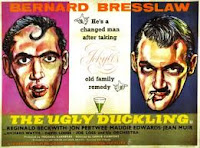
But no fantasy casting can seem as odd today as the genuine what if prospect of Bernard Bresslaw as the Creature in Curse of Frankenstein.
The irony has been noted that Christopher Lee owed his Hammer career to the very thing that had stood in his way as a leading man hitherto: his slightly otherworldly demeanour and his considerable height. But how much stranger that those same characteristics might have made a horror icon of Bernie! All the studio were looking for when casting the role, when Bresslaw was top of their list, was physical suitability, and Bresslaw would certainly have fit the bill in that department. Separate his features from their association with goonish comedy roles in the Carry On series and they start to seem surprisingly appropriate too. Bresslaw was soon to appear in Blood of the Vampire, written by Jimmy Sangster, and he was certainly no stranger to Hammer, for whom he appeared on a number of occasions, most notably as a comic Jekyll and Hyde in The Ugly Duckling.
But still, how strange to speculate on what might have happened - both to Bresslaw's career and to Lee's - if the original casting had prevailed! Might Bresslaw have become an international horror star? Probably not - he could never have played Dracula.
.
Then there are all those unrealised projects, the famous posters for movies that were never made: Victim of His Imagination, Nessie, Vampirella or of course my personal favourite, Zeppelin Vs Pterodactyls. And imagine if The Hound of the Baskervilles had rung the box office bell a little more resoundingly, and Hammer had responded with a whole series of richly coloured, horror-tinged Sherlock Holmes movies. That, surely, is a prospect to savour: imagine Hammer’s take on The Speckled Band, The Devil’s Foot, The Sussex Vampire, The Creeping Man...
This what-if game can get mighty infectious!
.
Returning to Blood From the Mummy's Tomb, though, I can't help thinking that we can justifiably curse the fact that Valerie Leon's was a one-shot performance for the company, and in particular that she was never cast as a vampiress.
Critical consensus has never been too effusive about her performance in Blood, but time has rightly made an icon of her all the same. None of the studio's other starlets was so genuinely spooky, so weirdly sensual and ethereal, an effect accentuated by her transfixing eyes and eerily melodious voice.
I don't know and will never understand why her performance is so consistently underrated, or how it didn't lead to other starring roles for the studio (or, indeed, any studio: it's her only ever movie lead). How did she never get to play a vampire? Think of her in Adrienne Corri's role in Vampire Circus, Anoushka Hempel's in Scars of Dracula, even, dare I say it, Martine Beswick's in Dr Jekyll and Sister Hyde? Leon had a very special quality that was tailor-made for horror films, that went far deeper than mere gorgeousness and physical majesty, the only attributes that were tapped in her more frequent appearances in British comedies.
.
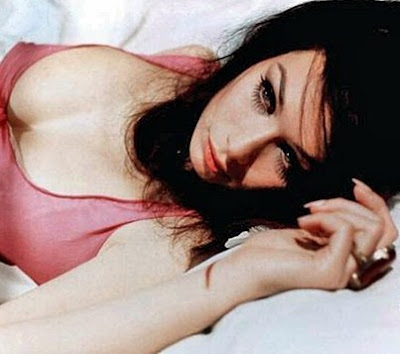
But the Hammer what if my imagination grapples with most often is one that was all set to become reality, and yet remains almost completely unimaginable: Lust For a Vampire directed by Terence Fisher.
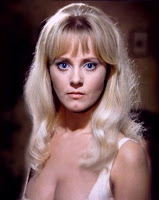
The first, Bray-era classics with which Fisher's name is synonymous seem a world away from the later, more brazenly exploitational films of the studio’s final decade, of which Lust For a Vampire is so emblematic. It's hard placing Terence Fisher and Yutte Stensgaard in the same universe - the idea of them collaborating on the same film is just ridiculous.
And yet, but for a twist of fate, not only would the film have starred Cushing in Ralph Bates’s pervy headmaster role, but it would indeed have been directed by Fisher, who was signed and ready before being forced to pull out after breaking his leg in a traffic accident.
I just can't begin to imagine how the film might differ with Fisher at the helm, what he would have chosen to play up or play down, how he would have handled the script's emphasis on softcore eroticism, if he would have attempted to reign in some of its more absurd or excessive contrivances or just rolled with them, and what his working relationship with Fine and Style would have been.
I don't have many bad words to say about Lust as it exists: it seems to me one of the most unfairly maligned of the later Hammers. But still, Fisher's version is one I'd give anything to see, and an unfortunate loss to the studio's filmography.
.Ready when you are, Mr Fisher...
.
What unrealised Hammer projects most excite your imagination? If any readers would like to submit their own favourite what ifs and if onlys in the comments, please do so!

Monday, September 6, 2010

The Phantom of the Opera (1961)

At the time Hammer filmed The Phantom of the Opera, the subject had not yet been overkilled through musicals or countless other adaptations. Over the previous decades there had been a small number of other films made based on Gaston Leroux’ novel – most notably Lon Chaney’s famous silent movie from 1925 and Arthur Lubin’s 1943 production -, but time was ripe for a new interpretation and the folks at Hammer were hoping to do for the Phantom what they had previously done for Dracula and Frankenstein and to introduce a new generation to this classic monster.

The production was ambitious. At one stage Cary Grant was even being courted for the lead which could have opened up a whole new audience for Hammer movies. In the end, it was Herbert Lom who accepted the part and brought a lot of class to his role. His acting is very reminiscent of Christopher Lee’s in The Mummy. In both cases we have classic examples of actors overcoming the limitations of a facial mask and demonstrating an incredible acting range that lesser actors without the hindrance of the special makeup can’t even begin to reach. Lom’s mellifluous voice just adds to the subtle range of emotions he is able to display for this role.

Perhaps not unusual given the subject matter, but not very typical for a Hammer movie, The Phantom of the Opera is a very musically oriented production. An original opera based on the life of Joan of Arc was composed for this film by Edwin Astley, lengthy excerpts of which are shown throughout the movie. The cinematography is often stunning. The picture is saturated in full, rich colours and makes the movie not just a feast for the ears, but also for the eyes. Trouble is, however, that it just ain’t very horrific as those lengthy musical interludes, beautiful as they are, just end up distracting from what little horror there is in it. It seems that by aiming this film at a slightly different and more main stream audience, Hammer ran the risk of alienating its loyal fan base as this has little of its usual horror set pieces and also only a small number of Hammer’s regular team of players. Apart from Michael Gough - who as often the case with his roles relishes chewing as much scenery as he can as the truly despicable Lord Ambrose d’Arcy - and Michael Ripper – surprise, surprise in a cameo part – there are few familiar faces.

The film proved to be Edward De Souza’s first major screen role. His next was in Kiss of the Vampire before he became a successful actor in a range of different TV series. Here he convincingly, though not very memorably, plays the part of the bland hero who needs to save Heather Sears’ character out of the clutches of Michael Gough’s lecherous Lord and to ensure that Lom’s Phantom does not cause all too much damage.

Sears as the heroine is terribly miscast. She sure isn’t the type who could infatuate three men all at the same time. Certainly not with that bird’s nest of a hair cut. Sears’ singing voice was dubbed by opera singer Patricia Clark.

The most memorable scene involves future Dr Who Patrick Troughton as a disgusting rat catcher who freaks out some ladies of the night who were visiting the Opera (that atypically is not located in Paris)…. just to be killed by a dwarf (Ian Wilson) through a stab in the eye.

Also look out for Thorley Walters and Miles Malleson.

Overall, this is an interesting and beautiful movie that nevertheless ends up a bit of a failed experiment when it comes to delivering the goods as a horror production with splendid opera scenes aplenty that do, however, drown out most of the action.


Monday, May 17, 2010

The Stranglers of Bombay (1959)

After a while spent travelling and focusing on other projects and articles for other websites and magazines, it is now time to start digging into my pile of unwatched Hammer movies, primarily the three Icons sets that I recently obtained.

First on my list: The Stranglers of Bombay.

Now call me shallow, but the first thing on my mind when I started watching this was: “Black and White? What the hell?”. Somehow I was expecting a story filmed in the lush colour tones of Hammer's Gothic horrors or other Adventure movies. Yes, I am aware that – although the company made their mark with colour movies – they have a large selection of black and white films in their back catalogue as well. Black and white, however, for me was always associated with their Hammer Noirs, their psychological thrillers or war movies and I generally associate their foray into adventure cinema with colour productions. I do suspect that economic reasons may have deterred them from using their usual cinematographic choice.

Still, not a biggy, as I do like black and white in general and Arthur Grant's stark contrasts make this a very enjoyable (if unusual) choice for this viewer.

Next thing on my mind was: “Ah..... Guy Rolfe” followed by memories of seeing him at one of Don Fearney's events just prior to his death. To my utter disgrace I hadn't at the time been consciously familiar with this actor, but when he strolled into the Cine Lumiere building it became obvious that we were in the presence of a man just oozing charisma. Resembling a latter day John Carradine, Rolfe's gaunt features and tall stature, even when walking on a stick, commanded a presence that resulted in a lot of the event's visitors respectfully moving aside to make way for him.

It was clear to me from then on that eventually I would just have to make myself more familiar with him, especially when I subsequently noticed that I had of course already seen him as Mr. Sardonicus and as Andre Toulon in some entries of the Puppet Master series as well as in Hammer's excellent Yesterday's Enemy.

Still, The Stranglers of Bombay had eluded me up till now. Rolfe gives a fantastic performance as Capt. Harry Lewis, an expert in Indian Affairs working for the East Indian Company who is trying to expose the realities between the mysterious disappearances of hundreds of locals and the continuous attacks on company caravans. Whereas he suspects the workings of the Thugee cult devoted to the Goddess Kali, his superiors ignore his findings and force him to research on his own.

Rolfe – tall, dark and handsome - makes for a convincing leading man not without some small personal issues. It is fun to see him constantly talking over his wife who doesn't seem to be able to get a word in edgewise no matter how much she wants to express her support.

Rolfe heads a list of actors that are second string only in relation to their overall recognition in the Hammer canon but first rate in terms of acting quality. So look out for George Pastell as a Kali High Priest and Marne Maitland as the Indian Patel behind the Cult's exploits. Allan Cuthbertson, familiar from scores of TV appearances, makes for a convincing arrogant officer who only sees the truth when faced with his own death.

Hammer's only exposure to Glamour here comes in the form of Marie Devereux in a silent role as one of the Cult's female accolytes and practically bursting out of her top.

When Hammer failed to obtain the rights to John Masters' novel The Deveivers, they simply based their script on the memoirs of Major General Sir William Sleeman who was primarily responsible for bringing the Thugees' reign of terror to an end. As such they had the veneer of a factual approach though I doubt that historical accuracy was at the top of their mind with this picture, especially given that the main character's name was not even identical with that of its historical model.

Still, though some of the scenes, as usual with Hammer, had to be cut upon its release, the censor seemed to have let them get away with quite a lot probably because of the historical pretense. As such we see scenes of men being blinded, murdered, cut and tortured while Kali's followers ecstatically look on. One sequence that you could not expect in modern movies any more features a real fight between a mongoose and a snake. Not sure whether no animals were harmed in the making of this film. Biggest WTF moment comes when one of the Cult members not only joyfully looks forward to his own hanging, but willingly jumps into the noose before the hangman has a chance to do his job.

Terence Fisher is the ideal man to head this production, combining the more gruesome elements of the story with a sense of more epic adventure. Hard to believe that all of those scenes of the Indian subcontinent were filmed in Bray's own backyard.

What is highly unusual about this film is not only its exotic set up (Thugees were rarely ever given centre stage in a movie before), but also its bleak approach to the subject matter. When Lewis gets stone walled he may ultimately be able to expose the cult, but fails to prevent a single attack and instead is faced with a freshly dug mass grave and a prime villain still at large.

Indeed if there is one thing that may drag this film down a bit, it is the rushed and rather unsatisfactory ending. A character who previously had no compunctions about killing his own brother all of a sudden shows remorse when he recognises a necklace our hero wears and helps him escape. And though the major villain of the piece then sees a heavy suspicion fall upon himself, he is far from being outed and able to continue his rule of terror for a while.... and likely for a sequal that may have been hinted at but never came to pass.

One certainly wishes that more thought could have been spared for a more conclusive finale to an otherwise interesting film.

Go see it.... in Strangloscope!


Tuesday, April 6, 2010

The Stranger Came Home to Bray


by Matthew Coniam
.
Time has been reasonably kind to The Stranger Came Home since its release in 1954: what seemed at the time to be just another middling British support thriller has gained something from its association with the later Hammer films.
With a few more - or more bizarre - plot twists it could almost play as the anticipatory cousin of the black and white psycho thrillers Jimmy Sangster wrote for the company in the sixties, beginning with Taste of Fear in 1961. Likewise the presence of Hollywood leading lady Paulette Goddard at the top of the cast - in truth nothing more than the latest in the ongoing practice of securing the services of a fading Hollywood name to ease US distribution through Robert Lippert - gives it a touch of class, and seems to bring future echoes of The Nanny, Fanatic and The Witches.
And, though it finally fails to follow through on it, the film does have a slightly more sinister feel to it than the average crime programmer, and benefits from a rather creepy lead performance from William Sylvester, a good actor and later star of Devil Doll (1964) and Devils of Darkness (1965).
Pleasing, too, to see the Hammer team in early formation: Sangster (as production manager), Fisher directing, Carreras Jr writing and producing, Phil Leakey (getting a chance to do a nasty scar!) in the make-up chair, and Molly Arbuthnot and Len Harris on board as well.
.The plot, sadly, is not bad but simply not surprising enough to stand comparison with the later Hammer thrillers. It has a very intriguing premise - man believed dead returns home after three years to unmask his would-be murderer - and the development is no less than satisfactory, but there are no shocks in the revelation: the guilty party could be any one of the main suspects - and is. And that's that. A last-minute surprise could have made a perfectly decent little thriller into a major sleeper. (And Paulette is rather dowdily photographed and costumed throughout the movie, never sporting anything even resembling the hairdos and costumes seen in either of the posters reproduced here, bearing the film's American release title.)
But what does make the film of considerable interest to the Hammer afficionado is the extensive photography in and around Down House (doubling as the characters' own house, as was often the Hammer way), giving viewers several clear looks at Bray studios as it was at the time, including some bits of architecture oddly familiar from the later Hammer horrors.
. This all prompts a thought. Even after Hammer had converted the ballroom into a soundstage, and erected the second stage annexe, they continued to make regular use of the house itself: before the stage conversions in 1953 they routinely shot in the ordinary rooms of the house. And it was in this environment that Fisher and the other regulars 'learned' the Hammer style. In other words, how much of that personal style for which Fisher is justly renowned - the economy of visual construction, and mathematical precision of shots - was born of necessity, dictated by the limitations of planning and shooting in the confined spaces of Down House?

Friday, March 26, 2010

Frankenstein Created Woman behind-the-scenes shots

Adrian Salmon just alerted me through his Bloody Hell of Brit Horror Group of this wonderful (but silent) clip showing behind-the-scenes, well, scenes of Peter Cushing on the set of Frankenstein Created Woman, reading his manuscripts, getting his hair done, giving Susan Denberg a peck on the cheek, discussing the shots with director Terence Fisher and Thorley Walters etc. A more detailed description of this clip can be read on the Pathe website where this was first posted.

Some more Cushing related clips can be found here.

PETER CUSHING

Monday, February 15, 2010

Wings of Danger (1952)

Wings of Danger is probably one of the least Noirish Hammer Noirs. In actual fact one of the only Noir aspects is that this was filmed in BLACK and white... but so were tons of other productions in its time regardless of genre. And it has a hero experiencing a mental blackout which is a typical Noir motif but the one instance it occurs in this production it is clumsily handled and smacks of a cheap trick by writer John Gilling (also the director of Hammer classics such as Pirates of Blood River, The Scarlet Blade, The Brigand of Kandahar as well as The Plague of the Zombies, The Reptile and The Mummy's Shroud) to get the plot moving along.

This is a pretty straight forward thriller set very unusually in a rural airport in Guernsey depicting the unravelling of a ring of counterfeit smugglers.

Directed by Terence Fisher in one of his first Hammer assignments (The Last Page/Man Bait and Stolen Face are all from the same year) this is a straight forward story with a few nice lines of dialogue that makes up for an enjoyably short 70 minutes running time.

Nothing particularly memorable but worth checking out especially for the Hammer Fans interested in seeing more than just the usual Gothic horrors that the company is generally associated with.

Friday, January 9, 2009

Man Bait/The Last Page (1951)

Man Bait is one of those Hammer Noirs that had much more effective and lurid titles in the States than for their British releases. In the UK it was more widely known under the more obscure title The Last Page that was in a way referring to the fact that this film had a very unusual setting placed primarily within the confines of a second hand book store.

Based on a play by thriller writer James Hadley Chase this film focuses on a blackmail attempt gone wrong, leading towards a murder chase against the innocent manager of the store.

It is a fast paced and entertaining production directed by Terence Fisher in his first assignment for Hammer so in that regards this is indeed a key film for the production company. It is also of importance as it brought Hammer’s James Carreras together with Robert Lippert, thus ensuring a lengthy relationship that helped see the release of their films in the US.

The actual plot is more than convoluted and forced (SPOILER ALERTS): We are expected to believe that shop assistant Ruby Bruce (Diana Dors) is so naïve to make a date with a guy who she catches stealing a book (Peter Reynolds). When she accidentally rips her blouse on a shelf and then very very briefly snatches a quick innocent kiss from her boss (John Harman) we are then to believe that she does not find it the slightest bit weird that her new boyfriend (who she had hardly exchanged ten words with) demands she blackmail the boss. The boss of course does not fire her or bring her to the attention of the police as he threatens. Nay, not even when his frail wife dies of shock when receiving a letter about the non-incident does he do what anyone with half a brain would do and instead fires more than the demanded sum at the Dors character. Even worse, when she accidentally gets killed herself (I told you this was getting convoluted), he doesn’t simply relate everything to the police but instead goes running for no apparent reason bringing all suspicions on himself.

At one time this film saw its release as part of a Double Feature with Bad Blonde. Strangely enough Diana Dors was presented as a new “introducing” actress, yet already had been in film for about five years with a dozen movies to her record. It was, however, this production that established her name in the US. Dors would later re-appear for Hammer in Children of the Full Moon, an episode for the TV Show Hammer House of Horror. Quite interesting to see that she was therefore associated with Hammer’s earliest productions as well as with their last ones, though never with their classic phase.

Phil Leakey provided the Make up; Jimmy Sangster is again listed as the Assistant Director.

In short: Forced plot, but fast and entertaining and at least of important historical value for Hammer.

Sunday, May 13, 2007

The Curse of the Werewolf

The Curse of the Werewolf was one of the first Hammer movies I ever saw at a tender age and that got me hooked on Hammer. I had watched it repeatedly over a couple of years, though admittedly this was a good while ago and it was more than time for a re-evaluation. Lately I had read about it being overrated and lacking in action, so when I finally put the disc into my player I was somewhat reluctant. Would I still feel the same about the film as in my youth? Or would it be yet another one of those memories that were better left untouched and simply kept as nostalgia.

I shouldn’t have worried. Curse still satisfied my lycanthropic cravings and remains an excellent film.

What is quite obvious is its very distinct three act structure. Act 1: The scenes at Count Siniestro’s (Anthony Dawson) court, the incarceration of the beggar (Richard Wordsworth), the rape of Yvonne Romain’s character and birth of Leon, the character doomed to become a Werewolf. Act 2: Leon’s childhood, the discovery that he is indeed a werewolf. Act 3: Leon as an adult played by Oliver Reed, his involuntary killing spree and final death.

Of those three acts the first and the last are by far the most memorable and horrific. The scenes of debauchery at the court, the humiliation and animalisation of the beggar and the rape of the mute servant girl still don't pull any punches. And the werewolf transformations and killings are classic iconic scenes. True, some may think that the second act may be dragging a bit, yet the scenes in it are ultimately essential in making us getting to like Leon and his family and thereby creating a more tragic climax.

Though it takes nearly an hour until Oliver Reed appears in his first proper starring role, he does give his all and it is a tremendous, haunting performance by the young actor that clearly put him on the map.

Interestingly enough we are not given the more traditional reasons for why the transformations occur. There is no other werewolf in the picture who may have bitten Leon or anyone else in his family. Instead any one of a number of possible reasons for his affliction are indicated: Was it the rape by someone who deteriorated to sub-human levels? Or the fact that the mother survived for months alone in the forest by living a quasi-animal life? Or because he was born out of wedlock on Christmas Day? Or maybe because he had to battle strong inner demons? This untraditional approach leaves a very satisfying mystique about the character.

The film was based on a novel by Guy Endore, The Werewolf of Paris, in which the action takes place in France whereas the Hammer adaptation transferred it to Spain.