Showing posts with label Colombia Pictures. Show all posts

Thursday, February 11, 2010

Taxi Driver (1976)


Taxi Driver
Director: Martin Scorsese
USA 1976
113 min
Starring: Robert De Niro, Jodie Foster, Albert Brooks, Harvey Keitel, Peter Boyle and Cybill Shepherd, among others.

What happens when a crazy person with a sleeping disorder and a contempt for humanity roams the hooker filled city streets night after night in a yellow cab?


Thursday, November 5, 2009

Night of the Demon (1957)

Spanish film poster.
[Correction: Italian film poster.]


Night of the Demon aka Curse of the Demon
Director: Jacques Tourneur
United Kingdom 1957
95 min
Starring: Dana Andrews, Peggy Cummins, Niall MacGinnis, Athene Seyler and Liam Redmond, among others.

"Dana Andrews said prunes
gave him the runes"
 - The Rocky Horror Picture Show (1975)


Friday, May 22, 2009

Platinum Blonde (1931)


Platinum Blonde
Director: Frank Capra
USA 1931
90 min


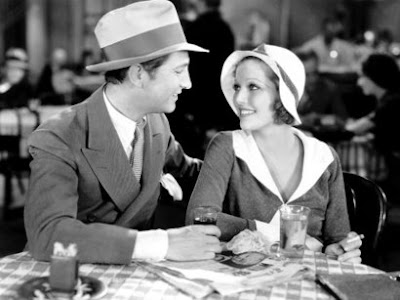
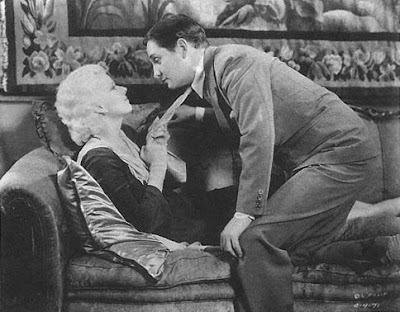
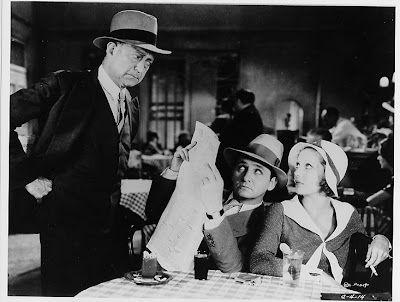
Like many other 1930's and 1940's comedies, the main character is a news reporter. His name is Stew Smith (played by Robert Williams, who tragically died three days after the release of the film by appendicitis, just when his career started taking off). Smith is a wise-cracking, slightly annoying but charming fellow, who one day covers a scandal story involving the socialite family Schuyler. Of course, the family has a beautiful charming daughter who catches his eye, Anne (Jean Harlow). After some Capraesque gnabbing, they fall in love and elope quite spontaniously. The marriage is not approved by the refined Schuyler family, and breaks the poor heart of Stew's colleague Gallagher (beautiful Loretta Young), who is secretely in love with him.
Now, isn't that a promising plot?


Stew in the centre of his colleagues' attention, keeping eye contact with his best friend Gallagher.


As if this wasn't enough, the newly weds soon realize that they both have taken for granted that the other person would assimilate themselves with their lifestyle - Stew finds it crystal clear that Anne will move to his apartment and live on a reporter salary, while Anne thinks it's obvious that Stew will learn manners and live in the family's mansion.
Eventually, of course, this causes some problems for the couple.


Scene: The wonderfully artistic waterfall scene with Stew and Anne. How could one not fall in love?


Scene: I won't wear garters!


Platinum Blonde is a pleasant triangle drama with great actors in every role. (I've said that a lot lately, haven't I?) I haven't seen a lot of pre-code Capra yet (something I definitely will do something about), but I must say that this film had a very different ring to it than other Capra productions. I had expected a more escapistic tone in it (after all, 1931 was the beginning of the Depression), but instead Platinum Blonde turned out to be more of a solid romantic drama/comedy. (Why is he so hard to categorize?)
But maybe I'm just imagining. The important thing is that it was a great film, and to this date I haven't yet seen anything signed Frank Capra that I didn't love.

It's also funny to see similarities between Capra's movies. How about the leading man here being called "Cinderella Man" in the newspapers? Or the scene where the leading man and a butler have fun with echoing halls? Yes, I think you're with me here. (Check here.) A director making references to himself is always amusing.


There are some interesting trivia for this film, aside from the unexpected death of the leading man. (Think how cinema history could have looked like under different circumstances... Perhaps Robert Williams would have played Nick Charles instead of William Powell? Rhett Butler or Sam Spade?)
The title of the film was originally "Gallagher", but was changed to Platinum Blonde to boost Harlow's career. I always thought the title was kind of weird, since the plot hasn't anything to do with platinum blonde hair except that Harlow has it. Talk about changing the point of focus with that title switch.
I also read that, at the time, the critics totally hated Harlow's performance, mocking her and stating that she ruined every scene she was in. Maybe her laid back acting style was too modern for the contemporary audience (or at least for the all-knowing critics).

I guess we can be happy that critics see the film in a totally different light today, because it deserves to me approved - it works very good, even over 75 years later.
(But am I the only one who thinks that Stew rushes into fights a little too easily? Makes the character, who otherwise is so relaxed and happy-go-lucky, seem very unstable. What does he hide?)


Quotes:

Stew Smith: Yeah, I know those bluenoses. Their ancestors refused to come over on the Mayflower because they didn't want to rub elbows with the tourists... so they swam over!

Dexter Grayson: Where were you yesterday?
Anne Schuyler: Oh, Stew and I went for a long ride. Dexter, is there any finishing school we could sent him to?
Dexter Grayson: Yes - Sing Sing!

Stew Smith: Say, I interviewed a swell guy the other day: Einstein. Yeh, swell guy. Little eccentric, but a swell - doesn't wear, doesn't wear any garters. Neither do I, as a matter of fact.

[Anne showing Stew into the library]
Stew Smith: What country is this library in? Miss Schuyler, how about car fare back to the front door, huh?


Tuesday, March 31, 2009

Mr. Smith Goes to Washington (1939)


Mr. Smith Goes to Washington
Director: Frank Capra
USA 1939
129 min


Holy Mackerel! This is a great film.
James Stewart plays the role of Jefferson Smith, a naive and hopeful man who, by the spineless governor of his state, is appointed to fill a vacancy in the US Senate. Unfortunately he collides with political corruption and gets dragged through the mud in the press.


Mr. Smith is the head of the Boy Rangers, and sees now his chance to start a national boy's camp and comes up with a legislation to authorize a federal government loan to buy a piece of land for that business. The loan will then be paid for by the contributions of the boy's camp's members. Donations starts to pour in immediately by mail.
The corrupt government, however, has other plans for that particular piece of land, and tries to make Smith their ally. When he still wants to go through with his plans (with the help of Clarissa Saunders, played by the adorable Jean Arthur) the government instead tries to smear the name of Mr. Smith. They ridicule him in the newspapers and come up with lies about his intentions of the boy's camp to get him out of the Congress.


Jim Taylor and Senator Joseph Paine.


Claude Rains plays Senator Joseph Paine, an old-time friend of Mr. Smith's father. He is torn between his personal feelings for Mr. Smith, and the will of his political boss Jim Taylor (Edward Arnold), who helped him to be successful in politics, and quickly could make him powerless. You can almost not recognize Rains by appearance in this role, and the only different thing is that his hair is white and he's got spectacles on his nose.


As the beautiful daughter of Joseph Paine, Susan, Astrid Allwyn steals the two scenes she appears in. The first of those, were she meets Mr. Smith and "turns the glamour" on him, making him so nervous that he drops his hat about three times, is very amusing.


Senator Joseph Paine and his daughter Susan finds Mr. Smith very amusing.

From the telephone scene with Astrid Allwyn and Jean Arthur.


Scene: Saunders finds Mr. Smith in despair by the Lincoln monument.

"It's a forty foot dive into a tub of water, but I think you can do it."


Mr. Smith Goes to Washington caused a lot of angry feelings around the country by Washington insiders, who thought they were pictured in a false and negative way. One of the real Senators even walked out from the screening he attended in disgust. But on the opposite side the film was rejected by fascists, nazists and communists in Europe for showing that democracy can work.
Director Frank Capra got anyhow letters years afterwards buy people being inspired by the film to go into politics.


The at first cynical Saunders is inspired by Mr. Smith's enthusiasm and energy, and soon finds herself falling for him.

From the filibuster scene.


The last line in this film might be one of the best ones ever, spoken by Jean Arthur:


Clarissa Saunders: [shouts] Yippee!


A couple of nice film posters.

Thursday, March 12, 2009

Cary Grant (1904-1986)

"Everybody wants to be Cary Grant. Even I want to be Cary Grant."


Cary Grant - the famous lover and gentleman. Always sophisticated, sarcastic, well-mannered and upright with an accent hard to place (being born in England and living in America). Named the second greatest male star of all time by AFI (placed between number one Humphrey Bogart and third place James Stewart). Having starred in legendary films like The Philadelphia Story (1940), His Girl Friday (1940), Hitchcock's Notorious (1946), To Catch a Thief (1955) and North by Northwest (1959).
It is now his time to appear in a post specifically dedicated to him.


Born Archibald Alexander Leach in Bristol, England 1904, Grant had a difficult childhood as an only child in a middle-class family. When he was nine his father placed his mother in a mental institution. The reason for her insanity began with a never overcome depression after having lost an earlier born child. Grant did however not know until he was in his late twenties that his mother was still alive and institutionalized, since being told as a child of nine that his mother had gone away on a "long holiday" at a seaside resort.


When Grant was 14 he was kicked out from school. He lied about his age and forged his father's signature to join the "Bob Pender stage troop", following the comedy troop on tour to the United States. In the group he was a stilt walker for two years. When the group was heading back to England, Grant stayed to perform on stage. He appeared in several stage shows, still under his birth name Archibald Leach.


After some success in light Broadway comedies he had chosen a stage name: Cary Lockwood, after a character he had recently played.
In 1931 he signed a contract with Paramount Pictures, but they wanted him to change hos stage name. "Cary" was alright, but "Lockwood" had to go. After having looked through a list of preferred surnames he decided on "Grant". The initials CG had worked fine for two other great movie stars, Clark Gable and Gary Cooper. Cary Grant was therefore born.


In 1932 he played opposite Marlene Dietrich in Blonde Venus, and the year after his career rose when playing opposite the curvy Mae West in She Done Him Wrong and I'm No Angel. The two West-Grant films from 1933 were successes - She Done Him Wrong was nominated for a Best Picture Academy Award and I'm No Angel was a financial success - and saved Paramount Pictures from bancruptcy. The film studio was in other words more than delighted with Cary Grant, and cast him in several more pictures.


Cary Grant and Mae West in She Done Him Wrong (1933).


Cary Grant on a cigarette break in 1934.


Cary Grant was now on his way to become one of the box-office favourites of all time, leaning more and more toward screwball comedy:
In 1937 he starred in The Awful Truth opposite Irene Dunne (directed by Leo McCarey, director of Marx Brothers' Duck Soup from 1933)
In 1938 he was playing for the first time opposite Katharine Hepburn in the screwball classic Bringing Up Baby, and two years later once again in George Cukor's The Philadelphia Story, also with James Stewart.
1940 he played Rosalind Russell's ex-husband in His Girl Friday.
1942 in The Talk of the Town with Jean Arthur and Ronald Colman.
1944 in the Frank Capra morbid comedy Arsenic and Old Lace.
In 1952 he starred in Monkey Business with Ginger Rogers and Marilyn Monroe.


Cary Grant and Rosalind Russell in His Girl Friday (1940).


Cary Grant, director George Cukor and Katharine Hepburn.


Scene: Cary Grant uses the word "gay", probably for the first time in film history when referring to a homosexual, in Bringing Up Baby (1938). It is said that Grant forgot his real line and improvised that line!


Even though Cary Grant is mostly connected with comedy, he got to show his acting talents being thriller film genius Alfred Hitchcock's favourite actor. Beginning with Suspicion (1941) opposite Joan Fontaine, he moved on making three more Hitchcock films:
Notorious (1946) with Ingrid Bergman and Claude Rains.
To Catch a Thief (1955) with Grace Kelly (later Princess of Monaco).
North by Northwest (1959) with Eva Marie Saint and James Mason.


Cary Grant as Roger O. Thornhill in North by Northwest (1959).


The silhouettes of Alfred Hitchcock and Cary Grant.


By this time, at the height of his success, Grant began to tire of making movies. He made a romantic suspence-comedy with Audrey Hepburn in 1963, Charade, but that would be one of his last films. When he had his first daughter in 1966, aged 62, he stopped making movies and instead became a father full time. During the years to come he refused job offers from directors like Howard Hawks, Billy Wilder and Stanley Kubrick.


Ingrid Bergman and Cary Grant. Aren't Swedish women the greatest?


Grace Kelly and Cary Grant in later years.

Cary Grant was married five times between 1936 and the year of his death by cerebral hemorrhage in 1986. In 1970 he received an Honorary Academy Award for life time achievement.

Interesting trivia is that Cary Grant donated his entire fee for The Philadelphia Story (1940) to the British war effort, and his fee for Arsenic and Old Lace (1944) to the U.S. war relief fund. That was $150 000 respectively $100 000.


Film clip: Cary Grant's speech at the Academy Awards. What a great man he was.


Personal quotes:


I think making love is the best form of exercise.

I've often been accused by critics of being myself on-screen. But being oneself is more difficult than you'd suppose.

I pretended to be somebody I wanted to be until finally I became that person. Or he became me.

My formula for living is quite simple. I get up in the morning and I go to bed at night. In between, I occupy myself as best I can.

Divorce is a game played by lawyers.

I improve on misquotation.

To succeed with the opposite sex, tell her you are impotent; she can't wait to disprove it.


Cary Grant by caricaturist Al Hirshfeld.

Monday, February 23, 2009

The Man From Laramie (1955)


The Man From Laramie

Director: Anthony Mann
USA 1955
104 min


He came a thousand miles to kill a man he'd never seen!

That's the tagline to the movie poster above, which explains the plot in broad outline.
Will Lockhart (James Stewart) arrives in Coronado, a little western town, to unload some supplies he's delivered to storekeeper Barbara Waggoman (the pretty girl-next-door Cathy O'Donnell). But delivering supplies is not Lockharts real intention - he is going to find the man who sold the Apaches the guns that killed his brother. And that man is going to pay in blood.


Will Lockhart and his eccentric partner Charles O'Leary (Wallace Ford).


But Lockhart seems to tumble across all other trouble there is - first he is blamed for trying to steal salt from the Alec Waggoman's estate (the cattle baron played by Donald Crisp), gets his mules shot and his wagons burnt down from his spoiled son Dave (Alex Nicol), and later on finds himself accused of killing the latter.
It all becomes a kerfuffle, and it gets no easier when he gets work on the Waggoman rival's ranch, the Half Moon owned by the strong and harsh woman Kate Canady (Aline MacMahon).


And, of course, a little love story takes place between engaged Barbara Waggoman and Will Lockhart, but a very subtle one. In fact it's a surprisingly non-cheesy one.


Scene: Will Lockhart arrives at scene of his brother's death.


This is a surprisingly "un-westerny" western. The plot is deeper than just a man starting gunfight to avenge someone, and the film is really absorbing. The characters are also well-made:

Will Lockhart: The man who seeks an unknown man to avenge his brother. (Alas, a classis main character in a western.
Alec Waggoman: The cattle baron who built his empire, the Barb, with his own hands, but when getting older realizes that he has to appoint an heir.
Dave Waggoman: Alec's only son, but too spoiled and ill-tempered to entrust the ranch.
Vic Hansbro: Working for Alec and keeping an eye on Dave so he doesn't get into trouble. Wants to take over the ranch he feels he deserves.
Barbara Waggoman: Engaged to Vic, and cousin to Dave and niece to Alec.
Kate Canady: Alec's rival and lost love. Owns a ranch called the Half Moon. A woman who has earned her wisdom from live herself.
Charles O'Leary: Will Lockharts partner in chrime. Appears here and there.

As you can see, this set-up promises a lot of drama and complication, not to say tension.
The Man From Laramie is a great and entertaining western I'm sure you'd like to see. Even if you don't like westerns, see it for James Stewart!


Quotes:


Alec Waggoman: I'm Alec Waggoman of the Barb. What's the reason for this?
Will Lockhart: Ask your son!
Alec Waggoman: I'm asking you.
Will Lockhart: All right, go out to the salt lagoons, and you'll see twelve dead mules and three burnt wagons. They belong to me!
Alec Waggoman: Nobody asked you to come here.
Will Lockhart: Well, I'm here, Mr. Waggoman, and I'm gonna stay here and this town better get used to the idea!

Will Lockhart: This is the most unfriendly country I've ever been in. Why is everybody so touchy?
Barbara Waggoman: It's a one man country and Alec Waggoman's the man.

Will Lockhart: [having a wound dressed] Have you done this before?
Kate Canady: I've patched up bullet holes in places I wouldn't like to mention.

Will Lockhart: You're nice to look at.
Barbara Waggoman: But I'm not even pretty!
Will Lockhart: Well, I guess I have seen prettier girls in dance halls, but... you're sort of beautiful, I should say.
Barbara Waggoman: That's the kindest thing anyone has ever said to me!

Will Lockhart: Where'd an Indian get a rifle like that?
Frank Darrah: He don't say. I don't ask.


Theme song: Jimmy Young with The Man From Laramie, 1955.