Showing posts with label spells. Show all posts

Sunday, 14 September 2025

Pergamino Barocco Kickstarter!

Uncountably many years ago, I was kicking around a selection of weird old woodcuts from alchemical manuscripts, and got the idea to write up a Baroque (in the sense of elaborate, symbolically fraught, and ideologically opposed to a simplifying tendency) set of spells based on them. Paolo (Lost Pages) aided in design and publishing and lo, the original Pergamino (scroll) was born.

With newly acquired levels in bookbinding, Lost Pages has put out a Kickstarter for a new edition that is accordion-bound, like a real folding scroll. We've made our goal and have already got new content planned: a couple of new and reworked spells, material for the back of the accordion such as a magic system based on historical Baroque-era mnemonic devices.

Curious fact: the first one of these spells I personally used in a campaign was the Appeal to the Seven Worthy Elders, which my players bought at a magic market in the Fey Paths.

Check out the promo video here:


Saturday, 1 April 2023

Hex Crawl 23 #90: Greatest Goat Of All Time

 One hex northwest, four north of Alakran.


Another dwelling of goats, very similar to the habitat described in hex #47 -- and rather than bore you with bleating, here is the tale of the greatest goat from the Game of Bronze campaign that took place in this world.

The Gnomes are a strange folk who wander far from their wet and chilly island, even unto Wahattu and Alakran. Their magic, even their approach to the spell-conventions of wizardry, is abnormal and absurd. Thus it was that the gnome wizard of our acquaintance conceived of a wish to ride about on a magical goat. By composing an homage and mockery of the paladin's prayer for a loyal mount infused with the myths and runes of his icy home, he summoned a Wise Goat of a size suitable to ride. 

Spinning Forth - Summer 2007This Goat is summoned through a variant of find steed which, apart from finding a celestial goat of 13 WIS, act differently when he goat is reduced to 0 hp. It appears to die, but can be resurrected as the same goat by casting the spell again on its body, or at least the hide and bones. In this way the goat willingly can provide a meal for its master and friend.

Thursday, 29 July 2021

Empirical Data on Spell Levels?

You know these researchers who published a paper in PLOS ONE are massive nerds. Because the paper determines how hard people think it should be to produce various magical effects. Spell levels by democracy!

D&D spell levels have remained amazingly constant over the different editions of the game -- even when they shouldn't -- so we can see that level in the game is equal parts arbitrary choices and game effect considerations, rather than how much counterfactual power it takes to actually engineer the change.
Most of these effects are available in the more developed form of AD&D and its followers. To wit:

Conjure: 3 (Monster Summoning I; arguably, conjuring a normal frog is more of a cantrip power)

Cease: 6 (Disintegrate)

Transform: 4 (Polymorph Other)

Split: 8 (Clone)

Stone: 6 (Stone to Flesh)

Invisible: 2 (Invisibility)

Big: 1 (Enlarge)

Teleport: 5 (Teleportation)

Levitate: 2 (Levitate)

Color: 0 (Color cantrip, Unearthed Arcana)

The correlation between these numbers and the intuitive numbers?  A not very impressive r = .43, which means that if you know one of two spells has a higher D&D level, it is only 65% likely it will also have a higher intuitive rank.
This brings us to why spells in D&D from earliest editions to 5th have the level they do, if it's not through some magical model of energy. Yes, it's play balance. Making a frog-sized chunk of most creatures disappear from their anatomy would be more lethal then calling a frog-sized creature into being, even a poisonous one. The same magical physics go into turning a friend and a foe invisible. Merely doubling the mass of a person doesn't have the same delightful possibilities as creating a second, exact duplicate of them. 
AD&D spells, as I've noted before, were not always well designed in the level assigned them. There has been a curious conservatism where spells tend to keep their levels and are more likely to be redesigned to fit their level in power, than to be reassigned level, although some exceptions (like Tasha's Laughter in 5th ed.) can be found. I'm sure this can be backed up by reading Delta's individual "Spells through the Ages" posts, although that scholarly compendium is maddeningly lacking in post tags or a search tool. As an example, Shatter was re-balanced as a damage spell rather than item destruction, which although situational, was quite powerful at the right time. Sleep in fifth edition also had its power curve smoothed out -- not so encounter-ending at early levels, not so useless at late. And Meteor Swarm earns its 9th-level slot by doing five times as much damage as the 3rd-level fireball, as opposed to the AD&D spell whose average damage was not very impressive compared to the average 63 points an 18th-level caster could deal out with a fireball. 
Still, fifth edition has its shares of third-level wizard spells that are nowhere near as useful as the old standards Dispel Magic, Haste, Fireball, and Lightning Bolt, joined by the new wonder-kid on the block, Counterspell (thanks, Wizards). The best that can be said for a Sending, Leomund's Hut, or Phantom Steed is that the wizard memorization economy allows some room for them, and they can be prepared for a special need regardless. Their utility goes up the more the campaign shifts away from toe-to-toe combat and into travel and politics. In that sense, they seem vestigial only as much as difficult travel, communication with allies, and other logistical considerations are brushed over in campaign development.

Monday, 12 September 2016

My Precious Dungeon Walls!

Dungeons preventing teleport, passwall, and other magical ways around or through walls have been a design cliche since Undermountain. It's been so endemic that Bryce Lynch gives special kudos to designers who don't fall for it. But what, exactly, are they afraid of?

The hypothetical cheater who uses spells to get to the last room of the dungeon must first find the last room of the dungeon. In a sprawling underground maze this is nearly impossible. If you're just using it to get through a locked door, that's the equivalent of a knock spell, and nobody legislates against those.

But let's say you've found the last room of the dungeon, either because it's bloody obvious (top of a tower, sealed chamber in the middle of the maze with the Gallstone of Four Parts) or because you have scried it out with clairvoyance, wizard eye or the like -- another tool type often suppressed by cautious adventure designers.

Let's even forget about the mechanical possibility, in a teleport spell, of having a fatal or disfiguring targeting error happen.

What do you think is going to happen when that teleporting or flying or dimension-dooring wizard gets there? A wizard, alone? Passwall and mass teleport are more of a problem (I don't allow them in my game). But without intelligence on the dungeon, again, they're just shots in the dark.

A better explanation of the obsession with fettering knowledge and movement spells lies in a clash of game design principles.

For incremental game design, everything is a matter of quantity, hit points and resources are worn down bit by bit, and a fair fight can be gauged.

Catastrophic design, though, allows for sudden winning moves, daylight frying the all-powerful vampire, a poisoned shirt killing Hercules. Balance here is non-linear, hard to judge. Discernment, avoidance, and preparation are more important than the toe-to-toe slog. Death is sudden, not gradual. Characters with a spell can kill a maze just like characters with a mirror can kill a basilisk.

The struggle between these two views, one "fair" and one "real," determines any given gaming experience. Another front in the war: turning undead vs. anti-turning medallions.

But even if you commit to the incremental way, "can't" is still the uglest word. Recently I made a try at fixing"you can't move." The obvious fix for "you can't teleport" is for the wizard's lair or whatever to be guarded by a chaotic teleportation zone that dumps you in a random location in the dungeon or even another plane of existence.

You can turn the undead? Fine, but the undead can also turn you. "Can," not "can't" if you please.


Sunday, 29 May 2016

Kill Six Billion Demons

The webcomic Kill Six Billion Demons (K6BD) starts absurdly: a bulky masked figure from nowhere crashes Allison's first nervous sexual tryst in her college bedroom, pursued by spiny fiends who decapitate him and bear away her boyfriend of three weeks -- but not before the masked one can implant a regulation-issue Power Macguffin of the Chosen One in Alli's forehead and tumble her across dimensions into a sordid hub-city of the multiverse.

If you haven't read the comic but are intending to, it might be best to stop now  with this review and head on over, if you've got a few hours to spare. The setting that ensues is probably best appreciated through the revelations of the story itself. Spoiler warnings apply more to the details of this world than the "hero's journey" chassis of the plot. If that doesn't faze you, read on.


Gradually, through art dark and luminous, punctuated by enormous teeming panoramas, we see the many orders of angels, devils, humans, demigods and stranger sorts in this universe of 777,777 worlds. Through exquisitely stylized dialogue and accompanying didactic texts, we learn the rules, stories and power relations that our heroine must navigate - at first as a screaming, near-catatonic wreck, but gradually gaining confidence in the role she is to play. Currently the series is finishing up its second book and, if the schematics of the plot tell true, there is a great deal of ground left to cover yet.

The setting calls to mind a Planescape built on Empire of the Petal Throne instead of D&D. A wholly original mythos nonetheless mingles recognizable names and themes from Buddhism (Mahayana and Zen alike) and Near Eastern mythology. Deftly balanced with the cosmic ponderousness of angels, gods and worlds in the balance we find sardonic and self-aware touches. These mainly come from Allison's foothold in the mundane, and from a wisecracking blue-masked imp she acquires, Cio, who fancies herself a writer of fanfiction, Allison her Mary Sue.
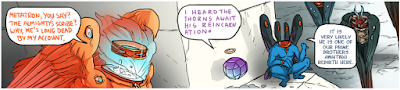
Rhombicubooctahedra make the best angels
The comic's creator, "Abaddon" (Patreon), has a strong eye for systems of magic and metaphysics, expressed in vigorous visual metaphors. Cio works magic by way of paper: a business card that marks an unwilling pact onto the recipient, a wall of giant paper dolls, an origami flying mount. The system of binding demons involves a hierarchy of colored masks and human-added names: the fewer names a demon is bound by, the more powerful. Landscapes are more often than not dotted with the towering, frozen or ambulatory, bodies and husks of expired gods and angels. This is a fallen cosmos where God is dead, and lowlife and oppression are everywhere. Perhaps not by coincidence given our heroine's sexual jitters, her first otherworldly destination is a lurid bordello district where desires worse than carnal lust are evidently slaked.

As far as gameable content, an official RPG for the setting is in development. In the meantime, I've worked up an old-school compatible set of spell adaptations for paper magic, adding a few effects not shown in the comic.

Paper beings are AC as unarmored, take double damage from fire and cutting weapons, none from blunt, cold or piercing. Spells are cast with appropriate paper materials and a rhymed couplet containing the numbers five and two.

Caster level
1: Paper servant. Paper doll becomes "seen" servant with 1 HD that acts as unseen servant, can become invisble from a particular vantage by turning sideways.
2: Paper planes: Fold (1 round) and throw a paper plane dart up to 30', never missing, doing d6+1 damage. Can repeat once n a row per caster level above 2.
3: Calling card: Caster always knows the location of a card engraved with his/her name, 1 day/caster level.
4: Paper wall: Dolls multiply and grow forming a whirling wall of 20 2 HD 5-foot paper soldiers up to 10' across or 30' long.
5: Origami mount: has 5 HD, up to 3 human sized persons can ride, flies at 18"
6: 52 card pickup: Sharpens and scatters a pack of cards through a 30' x 30' area, doing 4d6 damage, minus one d6 for every 2 points of armor protection.
7: Paper oracle: Pose a question with up to 4 answers, folded finger oracle over 1 round chooses the most correct one.

Thursday, 10 December 2015

Interesting Buffs Are Visible Buffs

I've had enough experience now with the spell lists of D&D and with creating my own distillation and derivative to notice something. Prayer and Bless, spells that give mechanical bonuses to friends' die rolls, are boring. This is usually masked by the existence of more useful spells at their levels, so they are rarely memorized. But working them out for my own game,where B-list spells become useful due to the no-duplicate-spells rule ... yeah, there's still something tepid about mechanical bonuses.

Is it that spell-casters would rather strike with their own effects than throw buffs on friendly characters? Not really. Enlarge and Haste shimmer with awesomeness. In my own campaign, the lowly Shield spell conjures forth a short-range, moveable force shield that gives +5 AC,maximum 20, versus attacks from one direction. This has been most welcome.

No, the real problem is that bonus-giving spells are abstract, intangible, bloodless. They exist in the rules, not in the world that characters can see or interact with. Look at the difference between:

* A Bless spell that gives you +1 to die rolls for a given time .... and one that sets a guardian angel over you, who lets you re-roll one die affecting you at any time.

* A Strength spell that gives you +4 to the stat ...and a Strength spell that lets you bend iron like lead, lift half a ton overhead,  and wield a huge improvised weapon for d12+4 damage.

* A whammy that gives your sword a +2 enchantment ... or a mojo that makes it crackle with red fire for d6 extra damage, or glisten with arctic cold for+2 to hit and damage.

"Hey, but healing gives back abstract numbers - hit points -and it's highly desired!" That's true, but the exception proves the rule. Character types that do nothing but heal are derided as boring to play even if they're valuable to the party. Fortunately, the above examples give a formula to improve any boring effect:

Make it concrete. Make it material.

By creating a visible thing, rather than just tweaking a stat, you make it interesting. Let's apply it to boring, by-the-numbers healing.

* A healer who spins silk casts and bandages from her fingers like a laid-back Spider-Woman.
* A healer who blesses food to have healing properties, with the catch that there must be a different kind of food or drink in the feast for every 2 hp healed.
* A healer who needs to wash you in water for light wounds, a bath for critical wounds, and full Baptist immersion for the strongest effects.


* This dude from 3rd edition. He's great at regenerating limbs. If you're injured but not maimed, he'll grow you a new limb which you can use until the old one gets better, at which point it falls off.

One thing you'll notice about all these is that their presence in the material world starts sparking off ideas for creative uses, advantages and disadvantages, just like the Force Shield beyond giving an armor bonus can also be used to stop a door or carry a load. If something only affects the rules level, there is only one use for it. A big part of the old-school philosophy is letting things exist and work in analog simulation space: descriptive problem solving instead of (or at least in addition to) skill rolls. Making buffs (and magic item and monster effects) visible works with that.

Monday, 13 October 2014

Misheard Spells


Flay Marrow
Nasty save-or-die spell created by insensitive necromancers.
 
Whiz or Die
Creates the sudden urge to urinate in a bladder-having creature. Experienced adventurers know it's more than a prank. 


Char Monster
If you can't persuade them, envelop them in a pyrocaust.

Ice Dorm
Briefly fashionable pinnacle of the brief misheard spells fashion, creates a habitation out of five walls of ice complete with ice beds, ice benches and ice bar fully stocked with ice bottles, ice glasses, and vodka.

Wall of Ire
A curtain of red, snarling faces that forces all crossing it with Animal intelligence or above to save or cringe back.

Phased Oar
Allows you to make an oar that phases into the ethereal plane and back in a minute. Invented around the time when the misheard spells fad was rapidly reaching exhaustion point.

Colors Pray
A rainbow blast of seven prismatic hues, each one having the effect of a random cleric spell from the 1st (red) through 7th (violet) level lists, and whether reversed or not also being random. Usually hurts people, but you never know.


Sunday, 20 October 2013

Kicking the Cleric Out of the Niche

Here and here are Talysman's posts where he hates "niche protection." It's a question of who-can-do-what in a role-playing game. I agree that the rules should be based on a view of what characters can do that has its own integrity, not manufactured to create some outcome at the player level.

And yet - especially when it comes to magic - there's such a variety of plausible ways of doing things that we can't help but choose among systems. In that case, why not choose wisely? As I argued a while ago, a good game will strike a balance between making a given skill set useful while not making it strictly necessary.

One example: the cleric. Many experienced players, depending on their D&D-like system, consider the cleric to be an indispensable member of the group. Let's look at the most extreme version of this, in AD&D, where it is easy to get a cleric who starts with two first level spells(1 bonus spell due to 15+ wisdom), almost always Cure Light Wounds.

So you get a slightly less effective fighter with one less hit point on average, worse attack and limited weapons, BUT:

Average HP restored from those two Cure Light Wounds: 9
Average HP of a first level fighter: 5.5

That's right, a character who not only fights in their own right, not only turns undead and can do miscellaneous other things with spells, but provides a force multiplier in the course of play (assuming damage is not taken in huge lots) equal to almost two fighters.

The decision in OD&D and B/X to not give clerics ANY spells until 2nd level in hindsight seems reasonable, although Labyrinth Lord climbs down from this with 1 spell at 1st level and so on. Even without bonus spells this is still a pretty nice force multiplier, that lags behind the fighter's hit dice at middle levels but perks up with the ability to cure serious wounds and raise dead at higher. The choice, still, is not ideal; between a game where clerics have to prove their gumption by spending their first level as a sucky fighter who can turn undead, and a game where clerics are seen as mandatory to the point where people will play them even though they don't really want to.

I've seen first-hand in my gaming group the dismay with which players face the prospect of adventuring without a cleric (my 52 pages version has a healing power that likewise is a pretty big force multiplier). The obvious fix is to do what I did with wizards to stop the "sleep/magic missile" fixation; allow only one example of each spell to be cast a day. Because my system lets spells become available at every character level, I could even give a very minor healing spell at cleric character level 1 and the Cure Light Wounds equivalent only at cleric character level 2.

This might be the last major change to the 52 Pages, but I think it achieves the goal of letting clerics feel useful at Level 1, but not indispensable at higher levels. Hell, I might even give them their at-will turning back.