Pages

Showing posts with label John Jenkins Designs. Show all posts

Tuesday, 29 December 2015

Latest Additions: October Show Acquisitions

Another collecting year very nearly over and what better way to round it off than with a couple of posts highlighting some additions to my own collection

First up, a delightfully posed WW1 sniper by JJD to add to my, as yet still very small, collection of his figures. This particular figure will take his place in my WW1 diorama, just about to take refuge in a somewhat wet shell hole ready for his next shot


Going back a little further in time, an ensemble of half a dozen Austrian figures from the Seven Years War that I picked up at the 2015 Birmingham Toy Soldier Show in October. Thanks to Barry at Piers Christian who was selling them off at a significantly discounted price. I couldn't pass up the opportunity of giving my Prussians something to shoot at as they pressed their advantage at Leuthen


Finally, a figure I bought recently from Sierra Toy Soldiers in California, a retired hitler figure, and one of several I have now, from K&C. He is one of a number of retired figures I bought at the same time, about which more in the next post


Happy Hunting!

Sunday, 30 August 2015

Saturday, 25 July 2015

John Jenkins Designs: July Germans


Just the one entry for JJD this month, a dramatic depiction of a rather spectacular fall from grace for a WW1 German pilot in the shape of this crashed Eindecker!

New July Releases!
Knights Of The Skies


The tactical, technological and training differences between Germany and the allied forces, ensured the British suffered a casualty rate nearly four times as great as their opponents. The losses were so disastrous that it threatened to undermine the morale of entire squadrons.
Royal Flying Corps (RFC) pilot training was often cursory, especially in the early days of the war. Many recruits had only 2 to 3 hours of flying instruction before being expected to fly solo. Men were often sent to France having logged only 15 hours in the air. 8000 young men died in Britain during flight training, which means that more died from accidents and equipment failures than from enemy action.
Most RFC pilots lasted only an average of about 3 weeks once they arrived at the Western Front. Those who weren't killed, wounded, or taken prisoner might be posted out because of "nerves". Flying was extremely stressful and dangerous. Those who lived through the first few weeks acquired skills that helped them live longer or even survive the war.
RFC pilots were not allowed to use parachutes, although the men who were up in observation balloons had them and often used them to escape an attack. Towards the end of the war, German pilots were using parachutes.
According to H.A.Jones' War in the Air, a study of the UK's Royal Flying Corps in WW1, the amount of time a pilot could expect to fly before becoming a casualty (killed, wounded, or psychiatric) was a low of 92 hours in April 1917, and a high of 295 hours in August 1916. Note, in particular, that a much higher percentage of pilots became psychiatric casualties (modern-day PTSD) than would otherwise be expected (as high as 25% of all casualties), due to the radically higher stress of combat flight. Given that a typical combat flight lasted an hour or two at most, with an average number of mission at less than 1 per day, a pilot would last at least 4 weeks before becoming a casualty, to as many as 5 months.


Happy Hunting!

Friday, 24 July 2015

John Jenkins Designs: June Germans


WWI - German Army

Although Germany was slow to develop its own tank force, there was a need to produce a range of methods aimed at neutralizing the effect of the Allied armour. This included concentrated charges, armour piercing bullets, individual field guns in a close combat role, and finally anti tank rifles.
Sharpshooters or snipers were often used to pick off tank crews or their accompanying infantry after the initial damage had been done by the other weapons.


Knights of the Skies

The Fokker E.III was the main variant of the Eindecker (monoplane) fighter aircraft of World War I. It entered service on the Western Front in December 1915 and was also supplied to Austria-Hungary and Turkey.
The E.III was the first type to arrive in sufficient numbers to form small specialist fighter units, Kampfeinsitzer Kommandos (KEK) in early 1916. Previously, Eindeckers had been allocated singly, just as the E.I and E.II had been, to the front-line Feldflieger Abteilungen that carried out reconnaissance duties. On 10 August 1916, the first German Jagdstaffeln (single-seat fighter squadrons) were formed, initially equipped with various early fighter types, including a few E.IIIs, which were by then outmoded and being replaced by more modern fighters. Standardisation in the Jagdstaffeln (and any real success) had to wait for the availability in numbers of the Albatros D.I and Albatros D.II in early 1917.
Fokker production figures state that 249 E.IIIs were manufactured
Developed in April 1915, the Eindecker ("Monoplane") was the first purpose-built German fighter aircraft and the first aircraft to be fitted with synchronizer gear, enabling the pilot to fire a machine gun through the arc of the propeller without striking the blades. The Eindecker granted the German Air Service a degree of air superiority from July 1915 until early 1916. This period was known as the "Fokker Scourge," during which Allied aviators regarded their poorly armed aircraft as "Fokker Fodder". The Eindecker was based on Fokker's unarmed A.III scout (itself following very closely the design of the French Morane-Saulnier H shoulder-wing monoplane) which was fitted with a synchronizer mechanism controlling a single Parabellum MG14 machine gun.
Anthony Fokker personally demonstrated the system on 23 May 1915, having towed the prototype aircraft behind his touring car to a military airfield near Berlin.
Max Immelmann scored his first victory flying the "Eindecker." Scourge of the air during the winter of 1915, the Fokker E.I was the first aircraft armed with a synchronized, forward firing machine gun. German pilots were ordered not to fly it across enemy lines for fear the Allies would capture the secrets of the synchronizing gear. Followed by the E.II, E.III and E.IV, the Eindecker was underpowered and slow but could out turn most of its opponents.
Allied aviators who faced it called themselves "Fokker Fodder" The Eindecker ruled the skies until the Nieuports and SPADs were developed.

Sunday, 31 May 2015

Latest Additions 3: Leuthen

Quite a few posts ago I made a passing reference to the fact that I hadn't written a latest additions post in a while and that I was going to be writing three in a row. Well, the third one never came, or at least not on time! Here it is, quite a lot later than originally scheduled. The subject matter of said post is the Battle of Leuthen diorama range produced by John Jenkins Designs

I've been debating whether to buy pieces from this range for some time. Up until the time when I finally decided to take the plunge and do so, I had just one piece from JJD, a WW1 German armoured car from his Knights of the Skies series. So pleased was I with this purchase I made an effort to look a little more closely at some of his other productions and I'm very glad I did

The images included here show the diorama pieces for the display together with some of the Prussian figures needed to occupy the impressions cast in to the base. As a consequence of my particular collecting whims I haven't [yet] bought any Austrians to man the walls of the besieged church and at the time of posting I have bought just one box of all of the Prussian sets. In order to complete the Prussian side of the diorama you need to buy a number of duplicates and I will say more about that later

For those who might not know, John's diorama series has been based on a painting showing one of the main episodes in the battle


The battle itself was fought during the Seven Years' War between the forces of Prussia, under Frederick the Great, and Austrian forces under the leadership of Prince Charles Alexander of Lorraine and is counted amongst Frederick's greatest victories over a force many times greater than his own. The following images provide some basic factual details as well as a brief summary of the sequence of events leading to the Prussian victory
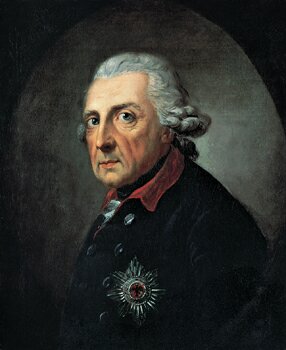

Frederick the Great


An interesting and far more detailed take on the battle can be found here


And so to the images of the display currently sitting on a shelf in the hobbies room, aka Dad's Den. I've taken the liberty of adding a few scenic items from John Gittin's range, partly to reflect the painting and partly to add a little bit more visual interest to the scene

The overall vista showing quite clearly I trust the winter birch, winter shrubs and 'plastic' snow that I've added. The snow has been added for the fairly obvious reason of wanting to disguise, nay hide, the gap between the bottom of the structural features and the diorama base that they are standing on


I'm sure you will all agree, John's take on the painting shown at the top of the post is first rate and his portrayal of the Prussian grenadiers absolutely first class. His figures are dynamic, well painted and extremely good value for money

As I said earlier, in order to complete the Prussian element of the diorama, should you be interested in doing so for yourself, you will need to purchase duplicates of certain sets. With John's kind help, here is a complete list of the sets you will need and a photo that will help with placing the figures correctly

LEUT-01  x  2
LEUT-02  x 2
LEUT-03  x  2
LEUT-04  x 1
LEUT-05 x 1
LEUT-06 x 3
LEUT-07  x 2
LEUT-08 x 1
LEUT-09  x  1
LEUT-11 x 1   NCO
LEUT-12 x 1   Officer

LEUT 10, 10A and 10B are the two wall sections and the entrance. The base is LEUT 100


One word of warning, John's website is currently showing low stock for a number of the above sets and LEUT 12 is SOLD OUT! You may still be able to get hold of it via your local dealer, and if you are in the UK then the sole dealer for John's fabulous figures is Grey Goose Collectables

I have just ordered the duplicate sets that I need and am very much looking forward to taking receipt of them next week

And finally, you might be interested in taking a look at this AV clip detailing the main events of the battle, courtesy of The Art of Battle


Happy Hunting!