Showing posts with label rules. Show all posts

Friday, 29 May 2026

Undead Programming and You!

The only thing an Undead will do of its own volition is defend itself from an aggressor.
The spirit binding the corpse prefers to do nothing. The only higher priority is staying attached to the corpse, since unattached spirits are almost immediately dragged back into hell.
To prevent this they tend to strike first and fight with vicious desperation. The animating spirit would do anything to stay out of hell, and if that means sending your soul down in their place so much the better.

A Necromancer speaking with the Voice of the Dead can override this instinct and force the recalcitrant spirits into following simple orders. This is largely because the ghost knows that the Necromancer can quite easily shuck them from the corpse and reanimate with another spirit who will be more than grateful to leave eternal damnation.
Sadly for black magic enjoyers, the spirits animating the ungrateful Dead can't (or won't) understand complex orders. The swirling ectoplasms are endlessly spiteful and just kinda dumb. All personality and intelligence burned away by hellfire and pitchforks or, depending on your faith, broken by eternal solitary confinement in the metaphysical equivalent of a black room with padded walls.

Hence the classic Necromancer growls of "Attack this", "Move there", "Follow me" and of course "Go forth and kill all that live!". This removes the chance of things going wrong via an overcomplicated and/or a cunningly misinterpreted command, especially when you're in command of a horde.

Experienced Necromancers know that you can expand this exactly one step further with an "else".
"If I point, attack what I'm pointing at, else follow me." That sort of thing.
More complicated instructions are, alas, beyond the abilities of the Dead. GoTo's and Nested IF statements have historically run up against a hard barrier of confusion, stupidity, and the feigned incompetence of the Damned.


i have no idea what he just told me to do oh fuck oh fuck


What I Thought You Thought I Meant


When you first Raise or Subjugate the Dead to bring them under your control, you give them a simple if-then-else command.

For standard dungeon operations this is usually along the lines of "If I am attacked, kill my attacker, else follow" so they trail along and defend you if necessary.

The trouble comes when it's time for more complex orders or changing orders at speed. This could be due to a trap, player shenanigans, an ambush, plans failing to survive contact with the enemy, whatever.


Reprogram:
- You get one command per round. A second command takes an Action.
- A command can target an individual minion, all of a certain type of Dead (eg. all your zombies), or everything in earshot. 

So say you've been ambushed by some generic bandits.
You're a Necromancer with three skeletons, five zombies, and a giant undead crab. They're all still set to follow you unless you're attacked, but you want the minions to run in while your crab stays back to defend your squishy body.

You huff a Last Breath and have choices like -
- Command "All minions, attack my foes!" and start casting a spell, you can call the crab back with your free command next round once the spell has gone off.
- Use your free command to say, "All skeletons, attack their archers!" and use an Action for a second command, "All zombies, attack the sword guys!" You can't cast a spell this time, but at least you've got crab protection.
- Just say "Crab, attack anyone who gets close, else stay in front of me!" and start shooting over its shell. The rest of your Dead should shuffle in to attack if the baddies return fire, right?

Notice that you don't have to be that specific. "Attack the sword guys" is perfectly fine, and I'm not going to do some monkey's paw stuff with "harr harr technically you said attack the caster so now your skeletons are attacking YOU harr harr". The limitation is on micromanagement rather than how well you can word the command.

Note that if you've got prep time (like you've scouted the big bad boss in the next room and it hasn't seen you yet) you can easily spend a minute or two programming all your minions in advance so you don't have to waste time reordering them in the heat of battle.


we are experiencing a high volume of calls right now

Side note: The Voice of the Dead

Raising new Dead, subjugating existing Dead, or commanding Dead under your control requires one key component - the Voice of the Dead.

This is gained by breathing in the Last Breath of a sapient creature. Necromancers carry glass vials for this very reason, harvesting the Last Breath of a recently killed foe (or sacrifice) at the moment of death, then stoppering it to save it for later use.

A single vial is good for a few minutes of the Voice of the Dead, but makes you talk in a death metal growl that burns the throat. The Dead can't hear you otherwise.

This is, by the by, why vampires and liches and stuff make great Necromancers. They're always speaking with Voice of the Dead.


My table traditionally refers to a vial of Last Breath with extra blood and chunks as a "wetty"


Y tho

Micromanagement!

The Necromancer, among other things, can be a Minion Class. Raising an army of the damned is what players expect, and why wouldn't they?

My other Minion Classes are Halfling (one big minion), Goblin (1 minion/level) and Ratman (minions = level²).
The difference with the Necromancer is that there are no hard limits. Necromancers don't have an upper bound beyond "how many can I raise at once?" and "how many can I keep alive?" and "how many can I reasonably fit on the marching order sheet?".

My intention here is to make the difference one of control.

You can have an arbitrarily large horde, but actually managing them in a combat situation is hard.
You don't have fine-grained control unless you're willing to spend all your time yelling orders from the back rather than casting spells (which is perfectly valid Necromancer behaviour, I may add - also true of sports coaches).
This isn't a real issue if you only keep a few minions at a time, since you can order individual minions to do different stuff as the need arises.
Problems start to occur when you're bringing in a horde of the Dead and can't do much more than a Necromantic select-all.

Of course having a horde of zombies with you will also have noise implications on the Underclock, but this command/reprogram thing is more about adding a bit of friction in combat or otherwise under time pressure.

real heads know

Implications

This works great if you've got an army of the Dead. Just set and forget! "Kill everyone in the village", "prevent anyone from entering the graveyard" or whatever, no questions asked.
Plus they'll keep doing it forever unless you go over and change their orders yourself. No big deal if you forget to do that, you're leaving your mark on the world!

It also explains why armies of the Undead tend to have a fair few living Necromancers in there. 
If you're the head honcho you could technically do it all yourself and just send all your dead into battle, but it means your enemies can fairly trivially kite your troops, hide behind shield walls and barricades, or bait them into pit traps. Having Necromancer lieutenants around to micromanage individual units gives you way more tactical flexibility when the Living try that nonsense.

This happens to be why tomb guardians often only seem to come to life once you've claimed the ancient treasure. Some Necromancer once commanded, "if someone touches the amulet, kill them! Else pretend to be a pile of bones" and never came back.

It's often why senior Necromancers like to have a particular room where they hang out in the dungeon.
It's the only place where their orders are juuuust right. It would be really annoying to reset the commands on all the arachnoid bone-constructs lurking above the throne room who have been ordered to drop down when they hear the words "Now, my pretties!!"


Go forth and kill all that live!


Friday, 28 February 2025

Another Underclock

I've been using Arnold's Underclock since about 5 minutes after that blog post dropped. It's great!

Trouble is I do miss the "oh shit there's something here RIGHT NOW that we have to deal with!" aspect of random encounters. So, as is my way, I've decided to nest other peoples' ideas into one thing and pretend like it's a new thing.


This is my Underclock. There are many like it but this one is mine.


Fusion: Underclock AND Overload

I mean Arnold did say "I like overloaded encounter dice. I like the Underclock more".


In summary:
  • The players roll a 1d6 Encounter Die each exploration turn and mark off that many squares on the Underclock (left to right).
  • The Encounter Die is overloaded so it always does something, but it's usually some sort of Clue.
  • If they land on a monster face it's a classic Random Encounter. The clock keeps ticking.
  • If they reach the end they have an Encounter with the local faction. Reset the clock.
Simple enough right? 1 in 6 chance of a Random Encounter every time, plus it eventually builds up to a guaranteed encounter they can prepare for.


Alertness

But what is "Alertness", I hear you ask?
This represents the organised dungeon denizens seeking you out.

The DM rolls the Alertness Die if you did something to attract attention.
Cause a ruckus, let foes escape alive, blow up a door, set off an alarm, knock a skeleton down a big well even though a wizard told you not to, that sort of thing.

The Alertness Die result marks off squares back up the Underclock towards you, reducing the time horizon until you get that guaranteed encounter.

If this overtakes your position on the Underclock, they get the jump on you with a surprise round!


The Alertness Die starts at d2 and increases a die size per encumbrance tier. 
The highest encumbrance in the party counts, because stealthily slipping through shadows doesn't matter when Sir Stabbington is stomping close behind in heavy armour and carrying a sackful of jingling treasure.

There's also the fact that sleeping in a monster-infested cave is generally a bad move, but sometimes you've got no other choice.
The Alertness Die permanently increases by one step if you sleep (in modern parlance, take a Long Rest) in a dungeon.
This resets if you leave the dungeon and spend a night on the surface.

The DM can always bump it up a level or two if you're habitually going around making extra noise. Dragging a handcart full of loot around, escorting a gaggle of kids who think it's a museum trip, wielding a singing sword who won't shut up, etc.

Local Faction

As for what the "local faction" is, this is whatever organised foes are mostly likely to be around.

This will be the Goblins in the Goblin Lair, the Necromancers in the Skeletal Hoard, the Magnet Eaters in the Technodungeon, etc etc.
In a Megadungeon you might have different local factions across a dungeon level, like Goblins in the west and Ratmen in the east.
If there is no such group, like it's an abandoned wizard's tower or forgotten tomb, this is the Mythic Underworld itself trying to eject you by means of whatever the most defining beastie is inside it. In the Antediluvian Manse it's Cataclysm Ghosts. In the Cretan Labyrinth, it's the Minotaur.

The main thing is that the players should be able to make an educated guess at what's coming for them so if the Underclock is close to running out they can make plans for ambushes, fortifications, hiding places, or fun rooms to lure their enemies into. 

Of course if the PCs are on good terms with said local faction, this could be a perfectly charming little social encounter! Yet another good reason not to murder everyone you meet.


Mêlée à Trois

There is every possibility that the players can land on a square that has a monster face and has already been marked off by the local faction.

In this case there's a random encounter and a faction encounter simultaneously.
Get chaotic! Even the random encounter is Goblins and the faction is Goblins, make up a reason why these Goblins hate each other nearly as much as they hate intruders!


Overloaded Encounter Die

Finally, the Encounter Die itself.
The players always roll a d6 and it goes like so:
  1. Clue: Spoor
  2. Clue: Tracks
  3. Clue: Traces
  4. Noise
  5. Special
  6. Special

Clue

These are all ways of giving the players an idea of what sort of beasties live around here, as in the original overloaded "Percept (clue, spoor)" result or Shadowed encounters on the OG Underclock.

Clue: Spoor means the creature is very close. It could be stalking you. This will be growls, shadows rushing past at the corner of your eye, still-steaming shadow effluent.
Roll a random encounter, describe the spoor, and lock it in. Next time they hit a Random Encounter it will be with that creature. Lasts until they hit the random encounter or roll a different Clue.

Clue: Tracks means the creature isn't close, but it's been here recently. This will be footprints, slime trails, clawmarks, dropped scraps, a recently devoured corpse.
Roll a random encounter, describe the tracks (and decide where it is, within a few rooms). If the players follow the tracks they can find the creature and surprise it! If they ignore the tracks, no further effect.

Clue: Traces is just evidence of the creature being around here somewhere. This will be shed fur, graffiti, a molted exoskeleton, an old nest.
Roll the encounter die and describe the traces. No further effect.


Noise

An errant sneeze, an accidental clang of the shield against a wall, an unseen femur cracked beneath your tread. Whatever it is, you've made enough noise to attract attention.

Everyone checks their current Encumbrance (in case someone has been mysteriously lax), then the DM rolls the Alertness Die.


Special

These are dungeon-specific results to give a pinch of dungeon-specific flavour.

By default (ie. common dungeon and/or if I haven't prepared something in time) these are:
5. Doors: Open doors swing closed, and closed doors become stuck this turn.
6. Lights: Light sources flicker and dim, you can barely see this turn.

In a spoopy dungeon they could be:
5. Fear! Save or drop everything and run screaming back the way you came - Save again in each room, you stop running when you finally succeed.
6. Bats! Swarm of bats puts out all light sources, those without a light Save or take 1d6 damage.

In a crashed spaceship they could be:
5. Magnetic Pulse! All metal objects (including you, if you're in metal armour) are stuck to the ground this turn.
6. Null Gravity! Everyone's floating in zero-G this turn.

Add a couple of fun effects and the dungeon will hopefully be memorable! Especially if you are...


A Victim of a Series of Accidents

If I roll a Special result that triggers an encounter, do both happen?
Can I land on a random encounter and roll a clue simultaneously?
If the Encounter Die hits a random encounter AND a Noise result, resulting in the local faction surprising me, am I fucked?

Yes.
Very very much yes.

It's up to the DM to work out this particular admixture. The more chaotic the better!


Discussion, However Brief

So basically this sub-system retains the time pressure "oh shit let's plan ahead"-ness of the Underclock with the surprising "oh shit ITS HERE!"-ness of the random encounter roll.

When the Underclock is getting close to finishing, it's probably a good idea to be extra super quiet (so they don't get the drop on you) and prepare for whatever's going to turn up (by setting up your ambush and waiting out the last few dots on the Underclock).
This won't always work of course, there's always the risk of a Noise result giving the baddies an ambush opportunity, but most of the time it's reliable...

The intelligent monsters being a guaranteed eventuality and the wandering monsters being an occasional occurrence should give each dungeon its own special flavour and its own sense-memory for my poor benighted players. After all, what's the point of invading the Goblin Caves if you never actually see a Goblin?

Most importantly the systems interlock in a way that will surprise me too!


Plus I get to update my Marching Order sheet to make the Underclock a bigger deal.

I even updated the Fleeing Table! Find it here.


Sunday, 6 October 2024

Speech Impediments - For When PCs Remember a Language They've Never Spoken

We've all been there.

The party is confronted with an otherworldly horror uttering guttural chants, or behold a mysterious elven monolith covered in curling runes that twist before their eyes, or stand enraptured before the song of an ancient angel from a forgotten heaven, or receive an email from the marketing department.

Then one of your players hits you with the "oh wait that's one of my languages!" and you have to let them speak to whatever it is.

In regular D&D where you pick Languages during char gen, this happens when it turns out someone has been able to speak Gnomish or Celestial the whole time.

In my game this happens because my players insist on rolling Languages any time they come across a new creature that shows even the tiniest glimmer of sentience. This is why several characters apparently speak fluent Eastern Lowland Gorillese.
This is really very silly but it's fun enough to keep (a la the secret fourth option in this post).

What's the "solution" to this "problem"?
They obviously know the language, but given the fact that they've never even mentioned that they can speak it in months of adventuring it must have been quite a while since they did that exchange trip to the eighth circle of hell.
But they're totally fluent of course, but uhhh... how do you say...


I'm a Bit Rusty

The first time your character speaks a language that they haven't previously spoken in-game, they're rusty.

Roll 1d30:

RollResult
1Can only speak in single syllables
2Tourist phrasebook content only - "two beers please", "which way to museum?" etc.
3They understand you but are always offended.
4Words that start with a vowel only.
5One word sentences only.
6Absolutely always alliterate.
7Words that start with a plosive only
8Must "speak" by describing emojis.
9Swear words only.
10Must speak way too loudly.
11Can only speak in quotations and metaphor.
12Sentences must be spoken in reverse order
13"Snake Snanguage" - all words start with the first two sounds of that language.
14Unable to use pronouns (I/you/he/her/it/etc)
15Unable to speak in present tense
16No verbs
17Speak in Haiku
18Can only write it, not speak it.
19Only know numbers
20"G" and "J" must be pronounced with a soft "zh" sound, as in treasure or casual
21No nouns
22Last letter of one word must begin the next word.
23One must refer to oneself as one, and instead of "we" or "they" must state the number of people in the group (eg. "One was with Four when someone robbed Two house")
24No adjectives
25All phrases must be an innuendo, if you know what I mean
26All sentences must be noun-verb-object
27Must stand on one leg while speaking
28Overly formal, everyone must have a title, no contractions, etc etc
29Every noun must be described by an incongruous and/or false adjective.
30Can speak the language but only in a cartoonish over the top accent.

When you speak that language you must abide by the rolled limitation.
This represents your character pausing to think, forgetting words, getting tones wrong, using the wrong conjugations, and other such issues with dredging up the language you haven't used in a long time.
Failing to do so means you've said complete gobbledegook and nobody understands what you just said.

In subsequent sessions it's all come back to you and you are completely fluent.
Presumably you quickly brushed up on some refresher notes, or beseeched the Horrible Green Owl to reinstate your streak.

Specialists, of course, are always fluent from the get-go. Skills are their whole deal after all.


Wednesday, 28 August 2024

Investments and Business Ventures: Yahtzee Edition!

You've been adventuring for months. You're on that sigma grindset. You want to make your money work for you.

Wine, women and song? Loser talk! 
Real winners have a system that works for them. It's not gambling, it's entrepreneurship!
The only way to lose is not to play!


Get in on the ground floor!

State your business, declare your stake, and choose your investment risk.

Stable: 1d6
Risky: 2d6
Wild: 5d6

At the start of every session you are at the table, roll your dice.
Odds decrease, evens increase. Sum them up and your stake changes by the percentage.

Example:
I have a stake in a Risky business. I roll a 3 and a 6. My stake increases by (-3+6) = 3%.


Market Forces!

Take a risk and reap the rewards! 
You're not a gambler! You're a market enabler! You're a job creator!


Doubles:
Roll doubles to gain a special extra effect. Obviously this is only possible at Risky or Wild levels!

1s: Bankrupt! Get ready to cast Sorrowful Zoom Call. Your business has been wound up as a going concern. Sackville-Baggins & Associates is ripping the copper wire out of the walls as we speak. Return to the business location within a reasonable timeframe and you can get half your stake back from the liquidation.
2s: Franchised! There's a branch or outpost of your business in the local area! If not right here then in a conveniently nearby town of your choice! Next time you may reroll one die.
3s: Financial Turbulence: The financial gods declare you to be more risky than hoped. Next time you roll at +1 risk level. If already at Wild, roll an extra d6.
4s: Surprise Merger! Your business and another player at the table's business have merged against the advice of the CMA! Each business affects the other, so if you're not there you get the result of their roll. If you're both at the table, decide whether you roll separately (affecting each other) or together (at a risk level you decide). PLUS your next roll has "roll 1 extra, drop 1".
5s: Local Disruption: -10% value you say? At least, you say?? The DM places a nominally single-session dungeon nearby (monster lair, 5 room dungeon, etc) which has caused this terrible turn of events. Clear the dungeon within a reasonable timeframe and you get to make it up with an extra business roll at the end of the session.
6s: Huge Profits! To the moon baby! Infinite profit is possible in a finite system! Your stake gains an additional +1d100% value!


Yahtzee(tm) Dice(tm)

This isn't a mere startup, it's a moonshot! Your employees are NPCs and those 20 hour days are the price of success! Let's go CEO! Let's become a centicorn!

Yahtzee Hands:
Roll yahtzee dice sets to get extra special extra effects. Yahtzee hands are only possible at Wild level, but you already knew that because you are a seasoned investor!

None: 
Chance. All dice and doubles apply as normal.

3 of a Kind: 
Critical Hit! Double your percentage gain/loss. Double effect is doubled too (ie. bankruptcy grants quarter value on return, huge profits return 1d200% value, etc)

4 of a Kind: 
Brand Power! Everyone in the local area knows the business by name. There’s a significant amount of merch and you’re basically a living colonel sanders. Your business roll adds a permanent additional 6.

Full House: 
Blessed by the Invisible Hand! You got a triple AND a double! Choose to ignore or double the effects of each dice set.

Small Straight (4 in a row): 
Capitalist Questing Beast. The DM places a monster out there which will give you a permanent additional 6 if you kill it. Go forth!

Large Straight (5 in a row): 
Anointed by the Invisible Hand! Every time you roll for your business, you can reroll any number of them and take the new result.

Yahtzee (5 of a Kind): 
Global Domination! 10x value! There is a branch of the business in every large town you come across! Bankruptcy is now impossible - treat a Bankrupt result as +0% value.


PS. Imagine updating your investment rules and realising that they were last created a decade ago.

Friday, 21 July 2023

Bad Weather after Judgment Day

The world has ended and the weather is fucking terrible.
Oh it's not as bad as a decade ago, when the poison storm of a Gas Front would sweep through and turn your body into even more poison, but you still don't want to be caught out in this new weather. It sucks.

These are 6D weather tables a la WWCD.
Roll a d6 and move the weather in that direction. If it would go back, go forward.
If you reach the edge, stop if you hit an X. Otherwise reverse course.

Weather can have Outfield effects (ie. what happens during each 4 hour Watch of travel) and/or Encounter effects that kick in during smaller timescale activities like chats or fights.

And so -

There's very little white Clear weather in the Spring, so you're usually looking at green Haze or purple Rain with a chance of intermittent brown Sporestorms.

Spring

Clear: Rare but occasionally occurs after the rains. Clear skies and clear sinuses. A mercy.
Outfield: Travel +1 Hex and remove any Exhaustion.

Hayfever Haze: Sneezing and coughing and trying not to rub your tired red eyes because the pollen is everywhere. Nevertheless this is generally the best you've got for travelling weather.
Outfield: Gain 1 Exhaustion

Metamorphic Rain: Like a nice warm shower which is lovely until you see what it's doing to your skin and your clothes. Absolutely do not get it in your eyes. Whorls in your flesh where the droplets pulled your skin with them, your axe-haft is growing leaves, your axe-head is looking at you.
Outfield: Exposed equipment gains a Notch.

Spore Storm: Fat chunks of fungal matter bloom across the landscape, soon bursting to release a choking fog thick with spores. You can barely see through the smog, but that's ok because the hallucinogenic visions are really starting to kick in.
Outfield: Gain 1 Exhaustion and Save vs Doom to avoid taking 1 Wisdom damage.
Encounter: Slowed, and crit/fumble range increased by +4.

Thorn Warning: The air fizzes with static and the sky is covered with a low ceiling of unbroken cloud. The Growth is coming. Animals flee only to be snatched into the sky by the thing (things?) that live up there.
Encounter: Within a few minutes of killing something it's lifted into the clouds by sticky threads. If you stop to loot or butcher a corpse, 1d10 Cloudfinger tendrils soon follow.

The Growth: Feel the soil, feel the loam, let yourself go to heal the world with the blood that is turning to sap inside your veins. Kneel down and kiss the Earth and take it into you. Heal the world with your soft embrace.
Outfield: Take 1 Constitution damage per Watch as your body converts to plant life.
Goblins are not immune, but they become big mushrooms instead and retain their consciousness within the fungal mycelia.

Real life example! The weather was Clear then went through the Warning and a brief Summer Storm. Luckily for them, they were in a dungeon when The Hive occurred.
Summer has plenty of white Clear hexes, which leads to cloudless summer skies which can last for days at a time..


Summer

Clear: Warm and bright, silver clouds covering the worst of the sun. In the summer these warm days can stretch for weeks.
Outfield: Travel +1 Hex and remove any Exhaustion

Insect Heat: Hot days buzzing with lazy insects and bumbling bees. Comfortable long days of sunshine and joy and strolling by the hedgerows and falling asleep only to find that you've got a whole day left. Too hot for heavy armour though, I'll tell you that much.
Outfield: Gain 1 Exhaustion if wearing Heavy gear.
Encounter: Clouds of biting flies are attracted to any bloodshed. Dead creatures attract a cloud of flies that Slows anybody nearby. Take Bleed damage even if you Stay Down.

Summer Storm: After the sticky days, a smell of petrichor followed by the lashing rain. Cool and fresh and so very beloved by plants, you could swear that the grass is growing high and lush before your very eyes.
Outfield: Half Overland speed.
Encounter: Ranged attacks at -4

Heatwave: Absolutely stinking hot. Too hot to think, practically too hot to breathe. A real bastard of a day, but the bugs don't seem to mind.
Outfield: Gain 1 Exhaustion, 2 if wearing Heavy gear.
Encounter: Anyone in Medium or Heavy gear is Slowed.

Swarm Warning: Wispy cirrus clouds high overhead and a subtle crackle as metal zaps against metal. Flying insects fizz and pop, flash-fried by the electricity that makes your hair stand on end, only to be devoured by the smarter kind of beetle who knows to stay in contact with the ground.
Encounter: Hitting metal with metal causes a spasm of static, making the victim(s) Dazed for a round and making them drop held objects.

The Hive: They're inside you you can see them under the skin crawling inside you where did they come from why are your pores getting larger and larger and the glimmer inside is shiny and they're all so shiny and crawling and scuttling and they are nice they are friends they are part of you this is how it should be
Outfield: Take 1 Strength damage per Watch as your flesh becomes home to thousands of insects.
Goblins become hollowed out with seeds, and beloved by pollinating birds.

Autumn is very changeable and very rarely Clear, but at least the red doom weather is always preceded by a Warning, and so often swings away.

Autumn

Special: In Autumn the weather brings abundant Forage, trivially gathered. Every traveller gets one ration of the appropriate Forage per Watch if they want it, and falls deeper into the dreary malaise of Autumn if they eat it.


Clear: Damp moist air and clear bright skies. Rare but beloved. A welcome but short-lived respite.
Outfield: Travel +1 Hex and remove any Exhaustion

Melancholy Mists: You sigh and you yearn for purpose. There are better things beyond the mists. Lives lived with meaning. Unlike yours. Your goals and dreams are a bit silly really, not the sort of things that other people would care about. Still, travelling weather if you care to try.
Outfield: Gain 1 Exhaustion.
Forage: Fat berries grow on the thorny bushes, eating them sustains you but makes you lose yourself in painful memories. Eating them deals 1 Cha damage.

Forgetful Rain:  A sustained drizzle that falls with a white noise susurration that makes your mind wander. At least the rain-fruits are out, withered but tasty, and they make you think about other things.
Outfield: Double chance of getting lost and/or crashing your vehicle.
Encounter: Ranged attacks at -4. Those in the rain are Slowed.
Forage: Trees bear withered fruits, which fill your belly and fill your mind with fog. Eating them deals 1 Int damage.

Unmaking Rain: Proper rain, this. Sheeting down with a wild wind that tears at clothes and hair and rips the seams and unties the bindings and shivers the nails out of the shingles. Get caught out in this and you'll get home naked, your clothes in rags.
Outfield: Half overland speed. Exposed equipment gains 1 Notch.

Tired Warning: The sort of sustained drizzle that doesn't get you wet but somehow soaks through your clothes. The grey sky overhead flickers with cloud lightning, the low rumbling warning of what's to come.
Encounter: All creatures are Slowed.
Forage: Tubers and ground fruit swell from the soil, which fill you up yet leave you hollow. Eating them deals 1 Wis damage.

The Soft: The clouds are soft and inviting. Childhood home. A parent's arms. Skin like crepe paper. Older better times. Crinkling fingers. Times before. No worries at all. You wobble. Bones like cartilage. A soft fall. So much to be done. What were you doing? Oh yes, that.
Outfield: Take 1 Dexterity damage per Watch as your body becomes unmoored from your mind. Eventually your body moves on its own, your skin feels soft and crinkles like paper, your joints bend strangely around your rubbery bones. You will spend the Autumn tending the plants in calm harmony, until your body softly shuffs to the floor, a bag of loam. Goblins instead merge onto the side of a tree, and tend the area with tentacle-vines with goblin minds.
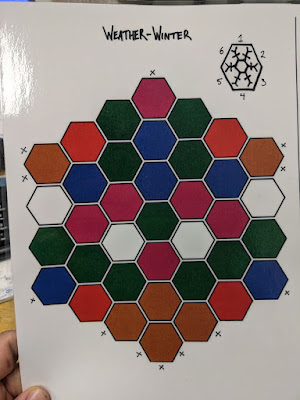

Winter has snowfall broken up by Mushroom Slush or Clear days.
It's very possible to get caught in an interminable Blizzard at the bottom of the table though.


Winter

Special: Snow builds up over time, so several types of weather only affect you if the previous weather was marked as Snow.
You also need Cold Weather Gear, which counts as an Oversized item and can be broken like a splintered shield to cancel damage from one attack. If you don't have it, take the Frostbite effect.


Clear: Bright and cold, the air cool in your lungs without stealing your breath. Clean and fresh and sparkling, you can see for miles.
Outfield: Travel +1 Hex and remove any Exhaustion

Snowfall: Long nights leading to little days of calm white snowdrifts. By the time you leave your house it's starting to get dark, snowflakes following behind to fill your footsteps.
Snow.
Outfield: Gain 1 Exhaustion if the last weather was Snow.
Frostbite: Take 1 Dex damage.

Mushroom Slush: Sleet that melts the snow to black ice and cakes you with a thin layer of slush, not soaking in so much as piling on, making you feel shivery and clammy at once. Worse, the fungus. A hardy strain of swift-growing mycelium lives under the warm snowy blanket. Exposed by the sleet, it will try to evade the slush by climbing the closest tall warm thing and making a home there, filling pockets and bags with uninvited slime.
Outfield: Gain 1 Exhaustion if the last weather was Snow. Gain an Oversized item called "Slush Fungus" - getting rid of it requires a wash in warm water or chucking affected gear out into Snow to kill the slime.
Frostbite: Take 1 Dex damage.

Blizzard: Complete whiteout. A death sentence to travel through.
Snow.
Outfield: Gain 2 Exhaustion if you're not resting in Comfortable conditions. Food cannot heal you or remove Exhaustion during the Blizzard.
Encounter: Slowed. Ranged attacks at -8.
Frostbite: Take 1 Dex damage and Save vs Doom or freeze to death.

Thundersnow: Hail and snow, flickering with flashbulb lightning. The dense white blanket surrounds you and gently softens the faint sounds of thunder.
Snow.
Outfield: Gain 1 Exhaustion if the last weather was Snow.
Encounter: Hitting metal on metal causes a lightning strike! Victim(s) must Save vs Blast or be blasted back and take 1d6 lightning damage.
Frostbite: Take 1 Dex damage.

Mirror-Vine Sunshine: The winter snow tamps down the growth waves and the warnings, allowing the most tenacious mutant plants to shoot up over the winter. Foremost of these are the Mirror Vines which emerge from the snow covered in their searingly bright silver-leaved new growth, reflecting extra light onto their leaves while they've got the chance.
Outfield: Double chance of getting lost/crashing in daylight.
Encounter: Increase fumble range by +2.
Frostbite: Take 1 Dex damage.


Mechanics


How to use:
At noon and midnight, roll 1d6 and move the weather in that direction. If it would go backwards, go forwards instead.
If you're at the edge, stop if you hit an X. Otherwise reverse course.

Simple right?

If you've got a Ranger equivalent, let them roll weather in advance so they can be all "hmm the rain will turn to fog by midday". In my game this can be a group Bushcraft roll.

The main penalty for walking around in the nasty weather is Exhaustion.
Each point of Exhaustion gives you -1 AC and +1 Encumbrance, but you can get rid of it all by having a break with food. An army marches on its stomach after all!

Sometimes the weather rots your gear, giving a Notch.
A Notch decreases a weapon's damage die, or reduces AC by 1. This generally only affects armour when hiking around because I assume weapons are sheathed.
Notching other gear is on a case by case basis but I assume that most stuff is in a bag if you're not using it.

Weather effects are on this spreadsheet too -
Post-Apoc Weather


Daylight:

One last thing - daylight is based on season, which is another reason why winter travel is grueling.

A day is 6 Watches long, with each Watch being 4 hours.
In Spring and Autumn there are 3 Watches of Day, 3 of Night.
In Summer there are 4 Watches of Day, 2 of Night.
In Winter there are only 2 Watches of Day, 4 of Night.

I absolutely cannot be bothered to make it more granular.

At night you'll want torches or something because you can't see very far and could get lost or crash your wagon.
For more, see -
Hexcrawl Rules

And a minor aside to that one last thing -
Initiative is side-by-side: At the start of each round, both sides roll initiative, highest goes first. Reroll each round.
If the PCs have enough light they win ties.
If they have not enough light they lose ties.
If they have no light they always lose.

So they'll always win ties in the day, but at night it's down to torchlight.


Weather-Based Encounters

And of course a last important thing - Encounters!
Each weather type has its own kind of monster that only shows up when it rains or whatever, hopefully setting up some foreshadowing from a wizened old crone saying "watch out when the summer storms sheet down, my boy, or the clicking eels will getcha..."

Roll 2d6 down and 1d6 across for a result.
You'll notice that it's the classic (?) array of Encounter - Lair - Spoor - etc.

Number 8 is a Weather Special which gives an Encounter with the relevant beastie, or more often some unique weather-based effect.
Number 5 is Weather Effect which is generic, but has a chance to change the weather! Woe betide the party who thought they could travel through the Warning and finds themselves caught in thorn weather.

What mysteries lie in the Drudge Wastes??

Discussion

The only change I've made to the gimmick since its inception is to make it player-facing and make the "forward" direction a bit more likely, to add a little more consistency and predictability for players looking at the weather sheet.

Mechanically I want weather to be a consideration but not onerous. Atmospheric in both senses of the word. Interesting but not a gotcha. But still, if you get caught out in it unprepared you'll have a bad time.
Same with predicting the weather - have it out on the table and let people plan for what's coming (although they will have to work out the colours, of course).
Originally I was all "he he he, they will have to learn that Doom Weather is guarded by a Warning" but honestly it's better to be player-facing when possible, especially since they can see the red next to the blue and go "hmm.. In wonder if red is bad".

Materially it also has to consider the fact that I'm always going to have PCs cycling in and out of the game each session, so it isn't going to be satisfying if you only missed a session and now you're taking 1d4 Drip damage per round because you missed your chance to buy an Umbrella from the Brollymen or whatever.
Plus I cycle to work every day and always have my wet weather gear on me just in case, so I imagine that someone whose only job is adventuring would at least have some sort of medieval festival poncho on them at all times.

Generally per season - 
Green is the Standard Weather, travelling weather but probably sucks shit.
Purple is Rain of various horrible sorts. Can you tell I'm a Brit?
Brown is the seasons's Storm, awful to be in but you can push through if you desperately need to.
Blue is an electrical Warning, heralding the arrival of the worst kind of weather. Tends to be good travel weather if you're willing to risk it.
Red is Thorn Weather. In the past this killed you instantly, today it merely takes your mind.
White is Clear. The only Good weather with a capital G. Straight up clear skies and far horizons.


One Last Thing

Don't forget to vote for Barkeep on the Borderlands!


Saturday, 25 March 2023

Bracklings - A Seasonal PC Class

The true Brackling is a huge horse-chestnut the size of your chest, but most people look at their face when they talk to them. A hard wooden face like a theatre mask or a Green Man, but moving as though in a stop-motion movie. Fluid, expressive, and animated on twos.
Their arms and legs are a thick mass of thorny vines winding around whippy wooden stems, a living hedgerow or shrubbery. Indeed many birds, bugs, and crawling beasts might live amongst a Brackling, and there are at least a few species which have adapted to life in a Brackling over any other home.


They have a short and seasonal life.

In the Spring a Brackling's thorny limbs are skinny and covered with countless flowers, hopefully meeting with other Bracklings in a cloud of pollen. This is the Brackling mating period, and the genderless (or more likely twice-sexed) Bracklings seek to share their pollens far and wide.
The flowers themselves are most often rose-shaped in a variety of colours and patterns, but they also tend to really like bulbs like daffodils, tulips, and crocuses. Bracklings can even take cuttings of particularly lovely flowers and incorporate them into their forms, which is used to show that they have taste, refinement, and a good potential for hybrid vigour. Having a flower arrangement of foreign flowers in your foliage is pretty sexy.

The pollen can also be weaponised. This is great fun for most Bracklings, who feel that it's amusingly uncouth to force another creature to breathe in their gametophytes and choke on them. It's a useful trick! The thick cloud of allergenic pollen slows their foes and makes it hard to see the Brackling in the billowing mist.


In Summer the Bracklings grow thicker and bushier. Their stem-bones are strong and covered with crinkled bark, their vines turning a rich ochre.  Woody branches grow from their core and out from their shoulders, and without careful pruning they can begin to lose their person-shape!
This is a time for prideful Bracklings to groom themselves into fanciful topiaries, and to tend to the birds and beetles who are attracted to the sweet fruits that grow from their branches.
More slovenly Bracklings will just let it all grow out, becoming a sort of tall walking shrub, home to the less savoury type of insect and the more rambunctious kinds of bird.

In any case, this is the age when a Brackling learns to control its plant-body better, growing into interesting shapes, self-pruning, and consciously directing their vital energies.
Their fruits come in many shapes and sizes. Most people assume that their fruits look like apples, but this is actually fairly rare. Bracklings tend to prefer blackberries, pears, or pomegranates.
The ripest fruits are plucked easily from the stem, and as the Brackling walks over fertile ground they unconsciously pluck these soft squishy fruits and stamp them into the ground with their step.

Amongst the sweet fruits of a Summer Brackling are a few of a more rare lustre - fruits containing the latent life-essence of a Brackling. These wriggle and writhe with barely contained vital energies, a proto-Brackling formed before it should be formed.
If planted these fruits will immediately grow into a frenetic Brackling-Ling, all flailing limbs and unfettered life, brambles clawing as it desperately clings to existence.
If eaten by another the fruits contain incredible vitality, healing wounds and restoring the spirit - at the morally ambiguous cost of eating the pre-unborn.

If unplanted and uneaten they get stamped into the earth anyway, so why not use them for some useful end...?

Come on bruv at least get the shears out


In the Autumn the Bracklings begin to lose their leaves and are soon bare, shameless of their nudity. Their twigs have the tough and yielding whip-like tension of green wood.
The rushing sap-mind that once embedded in their fruit seeds is slowing, but has nowhere to go but within. Their mind, and the minds remembered by the minds before, slowly well into their consciousness. Old knowledge to be reexamined. Ancient memories recontextualised for a new age.
Their control of their own body is far more impressive. They can mould themselves into other forms with some small but focused effort. The bone-deep casual confidence of ancient sires making it easy to slip into this or that social group.
This makes it far easier for them to blend in with other creatures' societies, but they may reject this and take on various beastly forms. This is the twilight of the lifecycle, and given their imminent mortality there are many Bracklings who find it easier to just root down and watch the world go by.

Their thorns, which have grown jagged and tough, serve as vicious weapons. Stories tell of criminals who, having cornered a seemingly unarmed person in an alleyway, discover that their wood-masked quarry is more than they bargained for.


In Winter the Brackling must finally die.
The natural fate of the Brackling is to find a safe place, root into the ground, and pass on their legacy.
The great conker-core nestles to the ground surrounded by the dry thornbush of the Brackling's body, and splits open to reveal a smaller fist-sized seed nestled in the fluffy innards.
The seed stirs, gathers the cottony fluff around itself, and awakens into the winter world.
This newgrown Brackling knows all of the old one's memories like stories told over and over by a grandparent. A new person with old knowledge.
It's maybe as tall as a shinbone, light as a feather, and knows that it if it survives the winter it can tell those stories to its siblings whose seeds still slumber beneath the cold earth.
Small and light as it is, the Cotton Brackling is not defenceless. It's light enough to float on a breeze, its body beneath the fluff is thin enough to fit through the smallest crack, and under the winter coat it hides impressively sharp fluff-fletched spears which it can shoot a surprising distance.
Plus, importantly, it can pilot the corpse of its dead sire like a horrible corpse-mecha. Cotton Bracklings must make their own decision. Some prefer to fly free on the breeze, unburdened by the thorny shrubbery that was once their parent. Others take their parents' empty shell with them for practical reasons - you can't carry much when you're the size of a toddler and nearly lighter than air. It's a bit morbid but very convenient.

But hatching from your parent's heart is not the fate of all Bracklings. There are those who decide to hold onto their own self, their own existence, rather than pass on their body and soul to the next generation.
These hulking beings are known as Crone Golems. They grow huge and twisted, barrel-chested and sharp. Lumbering tree-beings with a grip that can crush stone.
The stillborn Brackling in their core feeds poison through their mighty bodies, emerging in blood-red sap that drips from their sharp and evil thorns.
They will die in the Spring, of course, but for now they are a fearsome monolith of bark and bramble, a terrifying force of nature.


As for the seeds that were planted in the Summer, they slowly grow underground and sprout in late Winter with only the vaguest memory of their parent.
For those whose parent stayed in place throughout the Autumn, they will grow up into a little grove of new-sprouted siblings and be regaled by tales of the past by the Brackling which hatched from their parent's core. 
If their parent wandered, the newgrown Bracklings emerge alone with far-flung siblings and, if they're lucky, a particularly driven elder sibling who will backtrack along the sense-memories of their sire. A travelling seed-bard who finds their buried brethren and tells them tales of the previous years.
The most unlucky, and the most shamed, are those who were born of a Crone Golem. The memories of their forebears lost, the chain of generations broken. Forever marked by the will of a being who had barely been born before they had to choose how to die.


---


The intention is that in gameplay, these folks cycle through the classic dnd class archetypes before ending up as a weird new class. AC tank fighter in Spring, then a sort of healer/summoner in Summer, then thief in Autumn, and finally in Winter they're a whole new class that's a thorn-flinging flying horror or a massive unkillable Grootish motherfucker.

---

And so... to rules.

Brackling

HP: 1d6, minimum 4 at 1st level.
Saves and Exp Track: As Specialist
As a fairly delicate class, you have a base AC of 8.

In Spring you are surrounded with pollen and good vibes. This gives you +level to your Charisma score, or cancel it to activate your 10' radius Pollen Cloud. Creatures in the cloud choose on their turn: Slowed or take -1 to hit per Brackling level.

In Summer you have fruit hanging from your branches. You have many, but you have one golden juicy fruit per level per day. Your fruits may be gifted or thrown. Gifted fruits heal 1d6 if eaten straight from the branch (this takes an action, either yours or theirs). Thrown fruits create a Fruitling who lasts for a 10 minute Turn when thrown onto good soil, or a round per level otherwise. It attacks at random in a 10' range with great whomping branches for 1d6 damage and a bonus to hit equal to your level.
Your bushy body grants +2 AC.

In Autumn a Brackling can send down their roots, take an hour, and assign themselves +1 per level to their Skills. They can also grow themselves into new forms during this time, with brack-wolves, brack-ponies and even brack-monkeys known. Their long jagged thorns grant a spear-ranged 1d6 damage unarmed attack, no matter what form they choose.
If you crit with this attack it activates Blossom Fall - a sweet-smelling rain of petals which extends the crit range of all in 10' by +1 per your level. During Blossom Fall you always act before initiative is rolled.
Your whip-thin and wiry body gives you +4 AC.

In Winter they must choose whether to become a Cotton Brackling who can pilot their dead sire, or a Crone Golem who is strong but must inevitably die.
- The Cotton Brackling can fly but can't carry much when they do. The only real weapon they've got is a ranged thorn attack which does d4 damage, or they can pilot their parent who has no special abilities but can at least carry a weapon.
When piloting your parent's corpse you have +4 AC, or otherwise +0 AC.
- The Crone Golem is huge and lumbering. Your Hit Die becomes a d10, rerolling your max HP as soon as you transform. You deal 1d10 damage with your crushing fists, and the red sap deals a point of Bleed per successful hit - affected enemies take 1 damage per round of Bleed Damage unless they skip their turn.
Your twisted and bark-coated body gives you +6 AC.

In Spring the Crone Golem dies permanently, but a Cotton Brackling grows into its Spring form and continues the cycle.