His skillful defensive troop dispositions, coupled with the bravery and tenacity of his dismounted men, allowed the Union I Corps, under Maj. Gen. Reynolds, time to come up in support and thus maintain a Union foothold at strategically important positions. The importance of Buford's leadership and tactical foresight on July 1 cannot be overstated in its contribution to the eventual union victory
Showing posts with label Commanders. Show all posts
Showing posts with label Commanders. Show all posts
Friday, 15 October 2010
John Buford
His skillful defensive troop dispositions, coupled with the bravery and tenacity of his dismounted men, allowed the Union I Corps, under Maj. Gen. Reynolds, time to come up in support and thus maintain a Union foothold at strategically important positions. The importance of Buford's leadership and tactical foresight on July 1 cannot be overstated in its contribution to the eventual union victory
Friday, 8 October 2010
General Ewell
Managed to finish the Corps stand to represent General Ewell of II Corps. The model of Ewell is a officer figure from Warrior miniatures, the trumpeter and standard bearer are both Peter Pig. Must admit that the Peter Pig horses are not my favourite, probably the only downside to an otherwise excellent range.

Next up some pre-painted tents that I picked up on EBay, nice little models and I'll definitely get some more.

Next up some pre-painted tents that I picked up on EBay, nice little models and I'll definitely get some more.
Friday, 17 September 2010
Ramseur's Brigade
Ramseur's is the second brigade I've managed to finish in Rodes' Division. I also managed to paint up Rodes himself as well as the divisional artillery. Ramseur's is a small brigade of only 5 stands and consisted of the following regiments.
- 2nd North Carolina
- 4th North Carolina
- 14th North Carolina
- 30th North Carolina
The figures are all Old Glory apart from the command & artillery which are Peter Pig. The figure of Rodes is from Warrior miniatures.
This week at the club I managed a quick game of Fire and Fury with Jon. It was a quick run through of the rules with 10 brigades a side. It's been about 10 years since I last played these rules but they quickly came back. Suffice to say the newly painted unit syndrome occurred with both the last union and confederate brigades painted being severely man handled by their opponents.
Saturday, 11 September 2010
Andrew A. Humphrey
When Meade assumed command of the Army of the Potomac just before the Battle of Gettysburg, he asked Humphreys to be his chief of staff, replacing Maj. Gen. Daniel Butterfield, who was considered to be too close politically to the previous commander, Maj. Gen. Joseph Hooker. Humphreys declined the opportunity to give up his division command. His new division immediately saw action at Gettysburg where, on July 2, 1863, Sickles insubordinately moved his corps from its assigned defensive position on Cemetery Ridge. Humphreys' new position was on the Emmitsburg Road, part of a salient directly in the path of the Confederate assault, and it was too long a front for a single division to defend. Assaulted by the division of Maj. Gen. Lafayette McLaws, Humphreys' three brigades were demolished; Sickles had pulled back Humphrey's reserve brigade to shore up the neighboring division (Maj. Gen. David B. Birney), which was the first to be attacked. Humphreys put up the best fight that could have been expected and was eventually able to reform his survivors on Cemetery Ridge, but his division and the entire corps were finished as a fighting force
Robert E. Rodes
Rodes’ division sat idle for the remaining two days of the battle.
Sunday, 5 September 2010
David Birney
As Birney watched the few survivors of his division gather about him on Cemetery Ridge, he whispered to one of his officers, "I wish I were already dead". Birney assumed temporary command of the corps after Sickles was grievously wounded by a cannonball, despite having received two minor wounds himself.
Edward Johnson
In 1863, following the reorganization of the Army of Northern Virginia to compensate for the death of Stonewall Jackson after the Battle of Chancellorsville, Johnson was promoted to major general and given command of the "Stonewall Division" in Lt. Gen. Richard S. Ewell's Second Corps. He was summoned back from medical leave to take the command.
By May 1863, Johnson had recovered enough to lead his new division in the Gettysburg Campaign. He still required a heavy hickory stick to move around on foot (and was known to use it against men he believed were shirking battle), giving him the nickname "Old Clubby" by his men.Johnson arrived at the Battle of Gettysburg on the evening of the first day, July 1, 1863. In a move that is still controversial, Ewell did not take advantage of Johnson's division and attack Cemetery Hill immediately that evening, when it might have been decisive. Johnson then controversially declined to attack Culp's Hill that same evening, for which he had a discretionary order. Johnson's division was the primary force that attacked Culp's Hill on the second and third days, suffering considerable casualties assaulting this impregnable position multiple times with no lasting success.
By May 1863, Johnson had recovered enough to lead his new division in the Gettysburg Campaign. He still required a heavy hickory stick to move around on foot (and was known to use it against men he believed were shirking battle), giving him the nickname "Old Clubby" by his men.Johnson arrived at the Battle of Gettysburg on the evening of the first day, July 1, 1863. In a move that is still controversial, Ewell did not take advantage of Johnson's division and attack Cemetery Hill immediately that evening, when it might have been decisive. Johnson then controversially declined to attack Culp's Hill that same evening, for which he had a discretionary order. Johnson's division was the primary force that attacked Culp's Hill on the second and third days, suffering considerable casualties assaulting this impregnable position multiple times with no lasting success.
Tuesday, 31 August 2010
Smith's Brigade
The smallest Brigade in Early's division at only 4 stands. Also a picture of the 2 pieces of artillery attached to the Division. Not too sure if I got the carriages the right shade of green but I like the look of them.


I managed to finally base up the cavalry. Just need to purchase some dismounted figures and a horse holder. They will take on the role of Hampton's Brigade. Most of the figures are Lancashire apart from the command from peter Pig. Size wise they match up well, though the Peter Pig horses are more chunky.

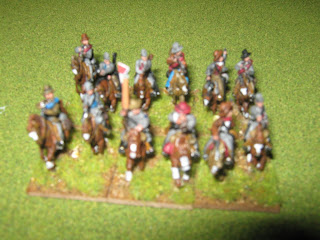
Finally 2 Divisional Commanders representing Early and Birney. These models are both from Warrior miniatures, nice figures and match in well with the others.

I managed to finally base up the cavalry. Just need to purchase some dismounted figures and a horse holder. They will take on the role of Hampton's Brigade. Most of the figures are Lancashire apart from the command from peter Pig. Size wise they match up well, though the Peter Pig horses are more chunky.
Finally 2 Divisional Commanders representing Early and Birney. These models are both from Warrior miniatures, nice figures and match in well with the others.
Tuesday, 24 August 2010
Daniel Sickles
Gettysburg was to mark the effective end, of Sickles's military career. Meade had ordered Sickles's corps to take up defensive positions on the southern end of Cemetery Ridge, anchored in the north to the II Corps and to the south, the hill known as Little Round Top.
Sickles was unhappy to see a slightly higher terrain feature to his front, the Peach Orchard. Perhaps remembering the beating his corps took from Confederate artillery at Hazel Grove, he violated his orders and marched his corps almost a mile in front of Cemetery Ridge. This had two effects: it greatly diluted the concentrated defensive posture of his corps, by stretching it too thin; and it created a salient that could be bombarded and attacked from multiple sides. Meade rode out and confronted Sickles about his insubordination, but it was too late. The Confederate assault by Longstreet’s corps, smashed III Corps and rendered it useless for further combat.
Monday, 23 August 2010
Jubal Early
Early commanded a division in the corps of Lt. Gen. Richard S. Ewell. Approaching Gettysburg from the northeast on July 1, 1863, Early's division was on the leftmost flank of the Confederate line. He soundly defeated Brig. Gen. Francis Barlow's division (part of the Union XI Corps), inflicting three times the casualties to the defenders as he suffered, and drove the Union troops back through the streets of the town, capturing many of them.
During the second day at Gettysburg, Early assaulted East Cemetery Hill as part of Ewell's efforts against the Union right flank. Despite some initial success he was repulsed due to the arrival of Union reinforcements.
On day three, Early detached one brigade to assist Maj. Gen. Edward "Allegheny" Johnson's division in an unsuccessful assault on Culp's Hill. Elements of Early's division then covered the rear of Lee's army during its retreat from Gettysburg on July 4 and July 5.
Subscribe to:
Posts (Atom)