Showing posts with label Sword People. Show all posts

Jun 14, 2012

Mead Hall - River Jarl Steading (7)

There is a skald's song that starts out "Mead Hall, Mead Hall - Home of Heroes Brave and Tall!"  And it has, indeed, been a home for many heroes over the years.  If there is a Steading of Storm King barbarians that fits the stereotypes that Westroners believe in - it is definitely Mead Hall.
Interior of Mead Hall, preparing for the nightly hero's feast
Mead Hall is structured with a great hall at the center of the settlement, surrounded by huge long houses in a double thick circle around the central hall, and then small plots of artisans, craftsman, and houses of huscarls, etc, out to the edge of the central settlement (which is about a mile across, a little over three miles around the perimeter).  It is all protected by a very tall wooden palisade, and a deep ditch, and a wall of spikes outside the ditch.

The great hall (itself properly referred to as Mead Hall, the rest of it referred to simply as The Steading) is home to the Jarl, his (extended) family, huscarls, women, travelers, wandering warriors, and lots and lots of skalds.  The favorite past-time in Mead Hall is to have warriors go out on adventures, and then come back and have skalds sing of them.


The Jarl and his men, enjoying the tales of the skalds
The current Jarl is Snorri Halftrollsson.  His father, old Halftroll, was the Jarl before, and ruled the hall for some four decades, before being killed on a hunt for giant wooly boar.  Snorri has a wife, and a dozen proper children, not to mention a large number of young women attached to the settlement, who all have children with the curious Snorri twinkle in their eye.  His band of Huscarls numbers close to three hundred, although at any one time more than half of them will be out on adventures, or viking raids.  Snorri's favorite skald, named Alvin Lyremaker, often sings a series of sagas that compare Mead Hall to the great hall in the Storm King's castle at Windkeep.
Windkeep - home of the Storm King
What is commonly known, but not talked about, is that Snorri's sister, perhaps showing more of the troll side of the family, from old Halftroll, is a witch.  She lives in a hovel, outside of the steading, in a marshy place beyond the poorest of peasant farms, but frequently comes into Mead Hall for the nightly feasts, in disguise.  She has a long and burning hatred for Snorri, his men, the steading, and most things from the world of men.  She scorns the religion and culture of her fathers, finding even the worship of Helgor (the Black Chieftain) to be too close to the family of the Storm King.

Instead, this witch, Heizelnag, chooses to worship the demigoddess of the underworld, Noxecatt, a foul creature related to the pantheon of the Westroner Church (the three Goddesses).  In the understanding of Heizelnag, however, Noxecatt is actually a daughter of the Old One deity, the Earth Weaver.  Sufficient understanding of the nature of the Earth Weaver is not known, so that this can be confirmed, however it is suspected among some of the Archivists at Parn Tandalorn. 

Many a hero from Mead Hall has come to a dark, grisly ending due to the magics and summonings worked by Heizelnag against all those allied to her brother, Snorri.

The writeup of the Roaming House of the Elkmen King was originally an adventure location that was part of this article.  It was part of the Week of Adventure Locations, but has been removed to make its own article.

Jun 8, 2012

Bright Iron Fastness - River Jarl Steading (3)

The current Jarl of Bright Iron is called Garret Fingolsson.  His name is a curious one for a Storm King barbarian - since it includes a Westroner first name, but it was the name his father (Fingol the Just) gave him.

Old Fingol Olavson (called Trollbane in his youth) was visited by wandering priests of the Order of Brother Rudiger.  It was in his youth, shortly after his father, Olav, died.  In order to secure the Steading, young Fingol had to fight and kill his father's brothers (one of which was nicknamed Ymir the Troll, which is where Fingol's nickname of Trollbane came from).

After this family feud was over, however, a traveling Brother of the Order of Brother Rudiger had come out of the Shadow Woods to the east.  Single handedly, the traveling priest had crossed the Blood Veldt, surviving the Sword People, and had come to Bright Iron to preach the virtues of hearth safety and home protection for the poor and down trodden.  The message resonated with Fingol, and he converted from the faith of his fathers (reverence for the Storm King), to this new strange religion of the Three Goddesses.  In so doing, he also began to mimic Westroner culture and Westroner ways.

Fingol waged war on his neighbors who sought to wipe out his ways, and his people that abandoned the old culture.  In this he was not only relentless, but also quite successful.  His smaller but persistent fleet had waged war on the many trading vessels from Seawyrm, an he also raided the Orc Clans to the south east of Bright Iron.  He held an uneasy peace for many years with the woman warriors from the steading of the River Raven.  The money and treasure that his successful campaigns won him were spent on building a large, fine castle of pure white stone, brought from far south on barges up the Greywater river.  This castle, in stone, is unlike the steadings of the other River Jarls, and more closely resembles a fine stone castle of a wealthy Westroner barony.  Naming it Bright Iron Fastness, it his spiry towers toped with sharp peaks made of the curious Bright Iron, or star metal, that is found in some of the quarries in the area.
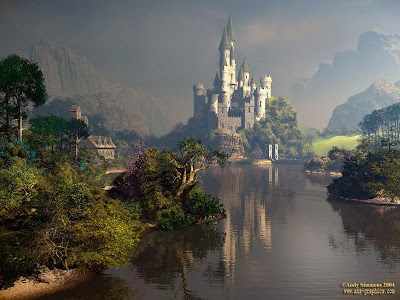
Bright Iron Fastness - with its towers skytopped in star metal.
This is the world that Garret Fingolsson was born into, and now rules over.  His is a curious mix of traditional Storm King culture, with some of the behaviors, values, and trappings of more typical Westroner culture.  Officially, his "court" speaks Westron, and writes all official documents in Westschrift.  Unofficially, many of the common people (and some higher up on the social scale) speak Destrikking.  Few remain, however, who can read and write the Ainark Runes.

Garret actually tries to foster the home and hearth life style that is common to the Order of Brother Rudiger, which means supporting agriculture and homesteading more than blood feuds and viking raids.  He has a strong fyrd, however, with a loyal corps of huscarls, that are constantly engaged in warfare against the Orc Clans, and occasional freebooters from the other Storm King steadings.

Immediately southeast of Bright Iron, just on the outskirts of the tended agricultural lands under the protection of Jarl Garret's fyrdmen, lay the lands of the Stone Houses.  The Stone Houses are curious round structures, long since out of use by their original inhuman builders, made of stacked stones.  The are similar to a Broch, or round house, that is built by some of the distant Storm King barbarians, however the roofs are all long since rotted off, and some of the stone walls are crumbling. What is curious about the structures, is that they are built for giant beings.  Larger than an ogre, whomever it was that first peopled these stone houses must have been of a great stature, perhaps 15 feet tall?  The typical stone house (as pictured below) has a first story that is partially underground, and then usually two more stories above that, and a peaked roof.  Sometimes the roofs are present (when they were made out of slate or other stone) and sometimes they are long gone (when they were made out of material that would have rotted with age, such as wood or thatch).  The typical structure is approximately 70 tall (at the peak of the roof), and about 80' across the base, at ground level.  Of course, there is variation, so some exist that are taller or shorter, and either bigger or smaller around.

For a long time, back before the Elves retreated to the Seely realms, the early humans in this region would commune with the spirits that haunt the stone houses, learning much from them.  Then they began using the stone houses as hallowed places of the honored dead - depositing chieftains, warriors and shamans among the stone buildings, and decorating them with fine implements and ornaments made of all types of fine metals.  The number of ghosts and spirits in the area grew and grew.  For generations, however, it has been avoided by most people, reputed to be a place of horrible fetches and liches, and other undead beings.
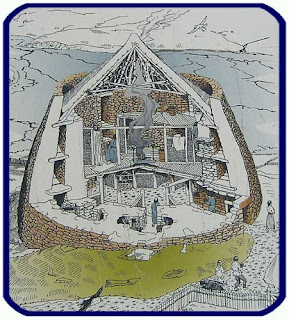
Cutaway of a Stone House - for scale, consider the inhabitants to be 15' feet tall.


During the reign of Fingol, those in the steading that were stubborn about giving up the reverence of the Storm King and his court were slowly identified and either forced to adopt the religion of the Church (of the Three Goddesses), or they were driving out of the steading.  A large number of traditional skalds (bards) and priests of the Storm King (even joined by worshipers of Helgor, the Black Chieftain) sought refuge and shelter among the Stone Houses.  Some of these were infected by the otherworldly beings living there, and became a particularly ghastly type of undead being known as a Helgorfiend. These beings are enraged when confronted by living people (human or otherwise), and will attack viciously (even suicidally) on sight.  They will attempt to bite the poor victims, and in so doing have a chance to convert them to Helgorfiend as well.  Stats will come in a future posting.

This Steading is very close to the area, in the Sildur Reaches, known as The Scorch, and it has some ties to the men of this holding.  Very important ties.

Jun 6, 2012

Seawyrm - River Jarl Steading (2)

Seawyrm is the northern most steading of the River Jarls along the Upper Greywater River.  It is still a long way short of the edge of the Destriel Mountains, so the Upper Greywater is quite broad and wide by the time it reaches the shore where Seawyrm is constructed.

The walled town is the seat of the Jarl, Scrimjar the Axe.  Scrimjar has been the Jarl for 48 years, and comes from humble beginnings.  Previous to his reign, the Trondvar clan ruled Seawyrm.  Scrimjar was born as a thrall, to poor serf parents, but rose through the fighting schools to compete in the warrior contests that Seawyrm is known for.  As he got more and more popular, his number of followers (and his monetary winnings) grew.  He eventually had enough to buy his (and his family's) freedom from serfdom, and joined a freebooter dragonship crew to go on viking raids up and down the Upper Greywater river.  Having returned from such a journey as the leader of his ship's crew (and several other liege ships), Scrimjar got into a dispute with the elder Bjarne Trondvar, and it came to a fight of honor, where Scrimjar slew Bjarne's chief huscarl (Holvin Heigvarson), and then Bjarne himself.  Since he has been the ruler of Seawyrm.

Riverfront of the Steading of Seawyrm

The city is known for two things - first, the steep, and strong, walls facing the east.  More on these follows below.  Second, the city is also known for the fleets of dragon ships that it is home to.  Many of these river wolves ply their viking trade up and down the river, and even down into the Greywater itself.  It is not an uncommon report that tells of Seawyrm dragon ships reaching even the Great River.

One of the reasons for the raiding and trading that the dragon ships of Seawyrm are constantly at is because the city has almost no agriculture to boast of.  Almost every household in the walled steading (which has a population of approximately 2500 regular citizens - about a third of which are out of the city at any one time on viking expeditions) boasts some small garden for minor root vegetables and herbs, and it is not uncommon to have some of the northern shaggy goats of the region living on the nearly flat thatched roofs of the peasant houses.  In the trade districts of the city, more common slated and planked roofs are common, but among the commoners (and even some of the trades people) the thatched roofs (and their goats) are common.  It is a source for dairy, and occasionally meat, for a city that has little access to regular agricultural land.

The reason for the steep walls, on the eastern (land facing) side of the Steading is because of the Sword People.  These tribes of vicious and primitive savages are found mostly to the east, across the open plains between the Upper Greywater and the Shadow Woods.  These plains are known as the Blood Veldt.  The Sword People are a simple, bloodthirsty culture of savage barbarians that live in crude tribal groups (with simple shelters of sticks and skins that they erect), and make their basic economy by hunting the wooly rhinos of the Blood Veldt, and the herds of giant reindeer.  Occasionally, and all too frequently, they will have some sort of religious frenzy where the young warriors of the tribes will go on a blood frenzy, traveling in random directions, and slaying any and every living thing they come across, leaving the dead just to rot.  This is where the name Blood Veldt comes from...
Sword People

A curious encounter in the area are the rare Lionman warriors, up from the south of the Great River, who decide to go on a vision quest.  They do this, by traversing (alone, usually, but sometimes with specific companions) the plains between the Upper Greywater and the Shadow Woods for months at a time.  Only senior, experienced warrior shamans can do this, because they must be able to deal with hordes of Sword People that might attack them.  Given the nature of their questing, they do not seek long-term company (unless the companion is one that they decide, from their forays into the spirit world, that they must stay with) but a Lionman warrior would serve as a stalwart against a band of Sword People warriors, if a traveler (or band) encountered them on the lonely plains.

Located nearby is the village of Aderbak - the site of the Princess of Roses, Location 2 in the Week of Adventure Settings.