Showing posts with label MarxBros. Show all posts

Groucho-Chico-Harpo At the Circus!

It's a good month for us Marx Bros fans this December, as Warner Archives have just released a brand new 4k restoration (albeit on 1080p BD) of At the Circus, which we're told has been made from "the best preservation elements."  Hopefully it doesn't prove to be one of the last releases from Warner Archives, because there's still more Marx Brother films that haven't made it to HD (not to mention so many other WB catalog titles).  But for today, let's just enjoy this.
Admittedly, 1939's At the Circus is post-peak Marx films.  This is them on the decline, but early enough in the decline that it's still plenty of fun.  This doesn't contain any of their best, wittiest work, but the brothers are still cheerfully game.  The routine of Chico keeping Groucho off the train because he doesn't have a badge feels like their earlier material, and Harpo is working with a new animal in practically every scene, culminating in him riding a live ostrich!  And the scene in the circus midget's house is classic 30's comedy.  The circus itself isn't particularly funny, but it's at least making the effort with big, elaborate production numbers, including a large orchestra, an elaborate trapeze act and they even shoot Margaret Dumont out of a cannon... at a rampaging gorilla!
What more could you possibly want?  Romance?  Well, that's this movie's weakest point.  People always knock the love stories in Marx Brothers movies, but it's particularly soppy here.  Their attempt to turn "Three Blind Mice" into a romantic duet called "Two Blind Loves" has to be the worst song in any of these movies.  But this is also the movie where Groucho sings "Lydia the Tattooed Lady," one of his most beloved songs of all time.  And Harpo's musical number is one of the studio's most ambitious arrangements... although it certainly hasn't aged well in terms of racial representation.  I often mistake this for being the one where they get into blackface (it's not... that's A Day At the Races), but apart from that single detail, it definitely feels like a fairly successful attempt to recapture the success of "All God's Chillun' Got Rhythm" in the best and the worst ways.  ...II suppose the gender politics of Florence Rice adopting the role of Kenny Baker's tamed horse in the big reprise is a little eyebrow raising as well.  Welcome to the 30s!
So Warner Bros first released At the Circus on DVD as a double-bill with 1938's Room Service in 2004, both by itself and as a part of their 5-disc Marx Brothers Collection boxed set.  If anybody ever releases Room Service in HD (hopefully, one of these days), I'll circle back around and give it fuller coverage.  But in brief, Room Service is the theatrical adaptation originally written without the Marx Brothers' personas in mind, though they reverted at the last minute.  It co-stars Lucille Ball and Ann Miller and has some funny bits, but is another of their generally weaker films.  It's a flipper disc, and the Room Service side features the fairly fuzzy 1.33:1 transfer you see above and optional English, French and Spanish subtitles.  Extras include the trailer and, as Warner often throws in with their films from this period, an unrelated Our Gang short called Party Fever and a short Looney Tunes cartoon called Daffy Doc.
2004 Warner Bros DVD top; 2025 Warner Archives BD bottom.
So, returning to At the Circus, we're starting with a 1.31:1 transfer, which the new 4k scan widens to 1.37:1, while pulling out to reveal a little more picture along all four sides.  The DVD just had very light, sporadic print damage, but that's been cleaned up on the BD - note the white spot above Groucho's head or the black spot in front of Chico's chin, both of which are only on the DVD.  The DVD is a little clearer than the Room Service transfer, but still soft compared to the new blu.  It also has minor edge enhancement, which has since been cleaned up.  Detail is crisper and film grain is visible, although a little faint compared to what would surely be possible on a proper UHD disc.  In short, it's a solid upgrade, with more noticeable improvement than some of the early Paramount ones.

Both discs offer the original mono audio in 2.0, but the blu bumps it up to DTS-HD.  Both discs also offer optional English subtitles, though only the DVD also offers French and Spanish.
Jitterbug Follies
2004 Warner Bros DVD top; 2025 Warner Archives BD bottom.
There's not a whole lot for special features.  Both disc include the trailer, the Our Gang short Dog Daze and the MGM Cartoon Jitterbug Follies, featuring Count Screwloose and JR the Wonder Dog.  For the record, the fullscreen shorts have not been remastered and seem to have been copied as-is from one disc to the other, as you can see above.  The blu-ray then goes one small step further, though, adding the vintage Leo Is On the Air radio promo, which highlights many of the film's songs.

So it might've been nice if they'd sprung for an expert commentary like they did for some of the other Marx Bros films.  But apart from being a little light on special features, this is a very satisfying upgrade, and my fingers are crossed for more.

A New Day At the Races

It's been a while since we've had a Marx Bros HD upgrade, but Warner Archives has come through.  I was beginning to worry.  They'd only upgraded one - the most famous - film from their impressive 2004 boxed set.  A Day At the Races is the Marx Bros' second movie after they made the move to MGM, so they're still riding high, and the budgets are clearly still rising.  And yes, that means instead of Zeppo we get a pair of "straight" romantic leads that the Marx Bros have to aid.  All us true fans of course miss Zeppo, but you can't deny Allan Jones has got a better singing voice.  But what's also lost is some of the sharp wit.
Of course classic moments (the Tootsie Frootsie ice scream sketch) and famous one-liners ("either he's dead or my watch has stopped") originated here.  Groucho still has some first class moments, and the brothers explode a medical examination into pure chaos not once but twice.  But it also drags, and not just during the love scenes.  It starts to feel like we're trading the big production values on the race track, with big crowds, live horses and cars flying down the tracks for the intricately rehearsed comic touches of their previous work.  It's just the start of an infamous dip, but you start to feel it here.  That said, though, A Day At the Races is still a totally zany, wild ride.  But if I were introducing somebody to the Marx Bros, I wouldn't start with this one.
Oh, and I guess that's for two reasons.  Interestingly, you see, the blu-ray has added a new content warning at the start of the film, not present on the DVD, which reads, "[t]he program you are about to see is a product of its time. It portrays ethnic, racial, gender and other stereotypes and biases that existed in our society at the time this program was made. While such portrayals do not represent Warner Bros. Discovery and its affiliates, this program is being presented in its original form in order to reflect the existence and history of these stereotypes and biases."  Well, this movie's from the 30's, so it's surely not on the cutting edge of gender theory, but there's only one reason this is here.  Yes, this is the Marx Bros film where they get into black face.  It's just one scene, but it's part of what is probably the most ambitious musical sequence in any Marx Bros film (it was nominated for an Oscar).  It was probably actually intended to be progressive - the brothers platforming and performing with a whole cavalcade of black performers - but yeah, giving modern audience a head's up is probably the right idea.
1) 2004 Warner Bros DVD; 2) 2024 Warner Bros BD.
Warner's DVD starts out at 1.33:1, which their new scan subtly corrects to 1.37:1, gaining tiny slivers of extra information along the edges.  Warner's new transfer, which doesn't say so on the case but is apparently based on a new 4k scan of "preservation elements," is a shade or two brighter and distinctly clearer.  What were ones smudgy, compressed hints at film grain are now clear, edges are sharper and fine detail that was previously too soft can now be made out.  Highlights maybe peak a little too much for my tastes, but this is a real leap forward from the DVD, as opposed to some previous Marx blus, where the upgrade was more subtle, if not outright difficult to discern.  A Day At the Races is now a proper HD movie and all the more absorbing a watch for it.

Both discs have the original English mono, bumped up to DTS-HD on the blu, with optional English subtitles.  The DVD also had French and Spanish subtitle options, which the blu has dropped.
Warner's DVD was surprisingly loaded, too.  Marx Bros expert Glenn Mitchell provides a generally interesting, educated audio commentary, but it's prone to constant gaps of dead air.  They're short at first but last for full, extensive scenes in the back half.  I was starting to wonder if there isn't actually more silence than talking in the track.  But when he's participating, he's good.  Then there's the roughly half-hour doc, On Your Marx, Get Set, Go!, which I've already covered on my Marx Bros documentary page.  It's good.  There's also a fun radio promo for the film and a short audio clip of an Allan Jones song cut from the film.  It's actually catchier than the ones in the film, and they probably should have used it in the nightclub scene instead of the one they did.  And there's the trailer and a couple extras not related to the film: a short Robert Benchley film called A Night At the Movies and three short, vintage cartoons.

And everything from the DVD has been carried over to the blu, even the cartoons and stuff.  And there's one more, new extra: another song cut from the film.  It's a Groucho song called "Hackenbush."  This is not the version from his Hooray for Captain Spaulding album or the one he sung on TV with the nurses later in life.  This one's better than both of them and sounds like it's taken from a live performance, as an audience can be heard laughing and applauding the song.  So it's the only new extra, but it's a treat, even if you thought you'd heard it on Youtube already.
That still leaves four films from The Marx Brothers Collection trapped in SD.  And those were all exclusive to the boxed set, so we'll have to hold onto them for a while longer.  But hopefully not forever.  The DVDs combined the last four films into double-feature discs, so maybe they'll do that on BD, too; and we'll get to complete our collections in this lifetime.

Warner Archives Treats Us To A Night At the Opera

There's been a lot of concern this year about the death of Warner Archives, or even physical media releases in general, from Warner Bros.  Justified concern.  There was the closing of the Warner Archives shop, the lay-offs, Jerry Beck's Tweet, even the Warner Archives podcast wrapped up in April.  It's grim times.  But for now, at least, the Archives are marching on; and this week, they've just released one of my most anticipated titles, the blu-ray release of The Marx Brothers' A Night At the Opera.
1935's Opera is the Brothers' first MGM film.  And I'm not going to repeat the most constantly explained shift in styles between their Paramount and later films.  But what struck me during this latest watch is how much straight leading man Allan Jones mixes in with the Marxes.  Sure, it's Thalberg's plan that the Brothers get involved with the young couple's struggles and champions their goals as their own.  But here Jones is also moving towards them, taking on the Zeppo role, hiding inside Groucho's trunk with Chico and Harpo, wearing their ridiculous bearded disguises with them and gleefully partaking in their over-the-top feast in steerage.  And I wonder having the straight man get his hands dirty is part of why this film is often held up as high as their Paramount classics, as opposed to their dwindling later films.  It just leaves you with a little extra feeling of more good will engendered in the classic Marxist anarchy.
And if you're in an indulgent mood for musings that struck me during my latest watch, maybe you'll also allow me to point out that this film has an awful lot in common with Friday the 13th part 8: Jason Takes Manhattan.  Both films promise a big NY adventure in its title (the titular night at the opera is at the Met), but don't actually arrive until the final act.  Instead, both films start with a brief prologue before spending the bulk of their time running around causing chaos on a ship that's slowly drifting towards Manhattan.  The parallels continue but get less helpful: both films center around a pair of young lovers who are only free together once they've escaped the villains' relentless pursuits, both films have characters who put on elaborate musical performances on their respective boats (remember J.J.?), both films have radio broadcast scenes, romantic rendezvouses scheduled and disrupted in staterooms, characters going overboard... but seriously, it is surprising how much of this movie is really about stowing away on an ocean liner.  It's practically Monkey Business part 2.  But when they finally do get to wreck havoc on Il Trovatore, the opera does make for an impressive showcase finale.
Warner Bros first released A Night At the Opera as a special edition DVD in 2004, separately and as part of their impressive Marx Brothers Collection boxed set, which bundled up all of their MGM films up to and including A Night In Casablanca.  As of this writing, those are the only two of those seven films that have made it to blu-ray.  In fact, this film was originally a part of the Criterion Collection, spine #31A in their laserdisc line.  I no longer have that one, but I still have the DVD box, plus of course Warner Archives new blu, which was just released this week.  Oh, and no, the long lost Italian footage hasn't been found; it's still missing.
2004 Warner Bros DVD top; 2021 Warner Archives BD bottom.
But I am happy to report that this is a new transfer, not just the same old master slapped onto an HD disc (which, honestly, I wouldn't've been unhappy with).  It may well be from the same source, but it's a new transfer.  We've widened from 1.33 to 1.37, which reveals little slivers along the top and left, but does more to undo a horizontal pinch.  But most notably, it's a much clearer, sharper image.  In terms of HD, yes, now we've got a sharper image with fine film grain instead of smudgy compression artifacts.  And the image has been cleaned of debris and noise.  Look at the white spot on the porter's neck, or the vertical slit under the painting, disappear between the third and fourth captures.  And those edges.  What once was grungy looks fresh and new again.

The original mono track has also been bumped up to DTS-HD.  Both discs offer optional English subtitles, though the DVD did also have French and Spanish subs, which we've lost.  Sorry, foreigners!
And the extras? Extras are great! Both discs include a gap-filled but otherwise enthusiastic commentary by Leonard Maltin, who'd originally written the liner notes for the Criterion laserdisc.  And there's a nice, roughly half hour documentary.  I've already talked about it in my Marx Brothers' documentaries post, but I'll reiterate that it has a variety of fans, writers and experts speaking on it, and a great interview with star Kitty Carlisle.  There's also a brief, television interview with Groucho, the trailer, and a couple short Warner Bros films from the period.  In fact, the DVD had two - a comedy and a travelogue - and the blu adds one more (another travelogue).
So maybe this isn't quite the home video event that the Animal Crackers restoration was; but this is a film that we've desperately needed on blu, and Warner Bros did a first class job.  Let's hope they never stop.

The Film Preservation Society Has Too Many Kisses For Us All

There's a new blu-ray label on the scene, called the Film Preservation Society.

"Yay!"

They're focusing on all 460+ Biograph films directed by D.W. Griffith between 1908 and 1913.

"Oh.  Well uh, good luck to them."

Their first release is the long lost cinematic debut of Harpo Marx!

"Hey now, why didn'tcha say so?"
Yes, from my inner monologue to yours: what we have here is Too Many Kisses, the 1925 silent film where audience's caught their first glimpse of a Marx Brother on the silver screen.  Yes, this is the one we saw a clip of ("this recently unearthed footage, long thought lost by even the most ardent Marx Brothers fans") in The Unknown Marx Brothers.  The FPS has restored the entire film from a print scanned at The Library of Congress.  But fans should know, the aforementioned clip comes dangerously close to showing Harpo's entire on-screen performance.  He's in other scenes, but mostly as an extra, with only about a minute or so to flex his comic talents, and his character feels like a last minute inclusion.  This is really a romantic comedy starring Richard Dix (Cimarron).  If it weren't for the fact that Marx historians have been writing about Too Many Kisses for decades, I'd've said this film would be better marketed towards Thin Man fans, as William Powell has a much larger, showier role as the film's antagonist.
Dix is a millionaire playboy who's sent to Basque by his father to set up a business venture, and more importantly, stay out of trouble with the ladies.  Of course, that falls apart almost immediately, as Dix falls for a local young woman who's already somewhat betrothed to local captain of the guard, Powell.  So expect lots of silly humor about the eccentric locals, sweet vows of love, bitter duels, wacky miscommunication and of course swooning women.  Even for its time, I'd say it was easy, predictable fare.  But it's charming if never hilarious, briskly paced (although, as ever with silent films, subtitles instead of intertitles would've helped immeasurably) and still plays better than something like Holidate.  Harpo's son, Bill Marx, was enlisted by the FPS to compose and perform the score, and I was wary of nepotism torpedoing this film's potential... especially when I heard this was his first silent soundtrack. So I was actually pleasantly surprised how nice it turned out and how well it interplays with the action on screen.
2020 Film Preservation Society BD.
Presented here in 1.38:1, TMK was shot in 35mm, but only a 16mm reduction print survived to be scanned in 2k in 2020.  But for a film believed lost for decades, I think viewers will be pleased and impressed with how clear and strong the image is.  Grain is a little soft for 16, but generally well preserved and authentically filmic.  Clearly a lot of care has gone into removing print damage, steadying the frame and generally turning this into an image modern audiences can sit through comfortably.  Scene-appropriate color tinting was back to the picture.  But, still, one thing annoyed me, and I took some shots from the restoration featurette to get a better handle on it.
from the restoration featurette
The scan was given to the FPS by the Library of Congress, who then could only work their "digital magic to make this thing look like it was almost 35mm" (their phrase) on what was provided.  So if we notice a little imperfection, we can give them the benefit of the doubt that it could've originated on the LoC's end.  We can certainly appreciate the little white flecks of damage that have been cleaned away here.  But there seems to be some slightly awkward edge enhancement going on, even on the left (which, admittedly, we don't know to be a raw shot from the LoC... it could already be partially restored by the FPS at this point).  But it's exasperated in the final frames on the right.  The shadow of Harpo's arm in the second shot looks like it was underscored with a thick black crayon, which your eye is drawn to even more thanks to some light haloing.  Or the left side of Frances Howard's face in that night scene.  And in those shots it's not so troubling, but it flares up all throughout the film, and can be distracting when some insignificant detail on a background character's clothing is suddenly the blackest black on screen.

I don't know.  I don't want to make too big a deal of it.  It's not a huge problem, and considering the scarcity of proper film elements, some tweaking could be said to be a necessary evil.  But I guess I was expecting this to be one of those "show the industry how it's done" moments, but instead it feels like just another new outfit of enthusiasts finding their way through it and taking a few too many liberties along the way.  I mean, the audio is lossy, too.  Come on.
But this'll cheer you back up.  FPS have provided some fun extras, the most noteworthy of which is The House That Shadows Built, a 1931 Paramount promotional film celebrating their 20th anniversary.  It's full of trailers and snippets of their then upcoming movies.  But what stands out is their supposed clip of The Marx Brothers' next feature, Monkey Business, is actually a five-minute scene from their stage play I'll Say She Is.  This footage has been seen before, in whole or in part in various Marx Brothers documentaries and features, but FPS has restored it so it looks better than ever, and now in its full 47-minute context.  If you'd prefer, they've also included the option to just watch their segment by itself.  Then there's the aforementioned restoration featurette, which covers not just Too Many Kisses, but all the Griffith shorts they've been working on.  It's only five minutes, but gives some great insight into their work.  And if they've got your interest, they even included one of those restored shorts (1910's A Child's Impulse).  Finally, they include an excellent, 16-page full color booklet with multiple writers contributing lots of great information about all three films on this disc and their restorations.
I hope I wasn't too harsh on these guys.  All told, this disc is a little treasure and I hope this is just the first in a long history of releases from the Film Preservation Society.  But before the next one, maybe they could solicit a few tips from Arrow, Vinegar Syndrome or even Paramount's home video department, since their logo's on this disc, too.  They wouldn't let something go out with lossy audio, no subs and, well... maybe they would let a little digital tinkering through their door.  But you see my point.

You Could Do a Lot Worse Than A Night In Casablanca

So this is my first ClassicFlix release - it's always great to introduce a new label to the site.  Not that they're brand new.  For a good decade, ClassicFlix was an independent competitor of Netflix, renting DVDs of: you guessed it, classic films by mail.  Then, in 2017, they became a boutique label licensing and releasing films on home video.  Their latest release is 1946's A Night In Casablanca, one of the surprisingly many Marx Brothers movies that were still in need of decent HD releases.
Apparently, A Night In Casablanca was at one time intended to be a pretty direct parody of Casablanca.  But what we've got here, funded by the brothers themselves, barely resembles the 1942 classic outside of the general location.  Rather than a gin joint, we're at a hotel, where the managers keep getting murdered under mysterious circumstances.  Things get so desperate, they employ Groucho, a conman who winds up getting romantically entangled with one of the murderers.  The plot, such as it is, follows a post-war Nazi who's hidden treasure somewhere in the hotel.  As was the norm in these films, there's a young romantic couple who serve to tie the Brothers into the rest of the story (Chico and Harpo decide to help them just because they seem nice), but they're so side-lined here they practically disappear until the finale.
Groucho's one-liners aren't quite in top-form, but we still get a fast-paced send-up full of amusing comic set-pieces and yes, musical numbers.  This film feels very tightly edited, scenes seem to end before their last line and our femme fatale just gets to sing a short snippet of her big song, the one announced in the opening credits.  It seems like the filmmakers lacked a little faith in the material and decided the only way to save the film was to cut, cut, cut!  And they may've been right.  A few plot points probably held together better in the rough cut, but for the most part, the breakneck pace works in the brothers' favor, restoring a bit of the madcap feel of their earlier work, albeit with an obvious slapdash bent as well.  At least until the climax where dogged stuntmen pursue a real airplane with various cars and hectic high-jinks, when we see finally where the film's money was spent.  Overall, it's not one of the Marx's best, but it holds up as more consistently entertaining than most of their tail-end features.
A Night In Casablanca was released on DVD by Warner Bros in 2004, in part of their impressive 5-disc, nine film The Marx Brothers Collection boxed set, which is still the best way to see those eight other films.  But in the last year or so, it started appearing on blu in other countries, including France and Germany.  And now, by way of ClassicFlix, it's arrived in the US, and we can only hope all the remaining Marx Bros' films are soon to follow.
2004 WB DVD top; 2020 CF BD bottom.
My first observation is that appears to be the same master Warner Bros used bumped up to HD (and presumably the same on the French and German blus), which isn't a bad thing, since WB's scan was quite attractive.  And it's not like they haven't made any changes.  For one thing, the aspect ratio's widen from 1.33:1 to a probably more correct 1.36:1.  Part of that is a very slight un-squishing of the image, making it a little tall.  And the other part is that they're now showing a tiny bit more around the edges of the frame - although there are a handful of shots where I wondered if they revealed too much.  For example, in that shot of Harpo dueling above, is that the edge of the set we see along the top?  But it was very rare when I even questioned anything that was revealed, and it's never overt enough to be distracting, and definitely no reason to miss out on the HD bump, which makes the image immediately sharper and clearer.  Grain is soft, which you'd expect from an older master, but it's everything you'd expect in the jump from DVD to BD, if not an all new restoration.

Warner Bros included the original mono track in Dolby Digital with English, French and Spanish subtitles.  ClassicFlix dumped the foreign language options but kept the English subtitles (despite any online reports to the contrary), and bumped the audio up to DTS-HD.
You wouldn't expect much by way of extras for this movie, but happily there's more than none.  Warner Bros just featured two vintage WB shorts, which they were in the habit of including with their classic films at the time.  The idea was that they were replicating the feel of how films of that time played with such shorts before the film in the theaters, which makes me wonder if these two actually ran with A Night In Casablanca back in '46.  They're certainly both '46 films.  One is a silly Joe McDoakes comedy called So You Think You're a Nervous Wreck?, and the other's Acrobatty Bunny, a Bugs Bunny cartoon.

Anyway, ClassicFlix doesn't have the shorts, but does have a few bits actually directly connected to A Night In Casablanca.  First, and most excitingly, they have an audio recording of the Marx Bros trying out material for the film live on stage, as they were wont to do.  The best part about it is that most of the material didn't make it to the final film, so they're essentially deleted scenes.  ClassicFlix has also scared up the trailer, a stills gallery and a series of radio spots, some of which get include new gags by the Marx Brothers and get pretty bizarre.  There's also a collection of ClassicFlix bonus trailers, including one that plays on start-up.
It's a little crazy to be getting this while their most famous film, A Night At the Opera, and many of their other big hits remain relegated to SD.  But hey, I'll take it!  Especially since, with each iteration, my appreciation of this notoriously post-retirement film increases a little bit more.

Marx Madness Part 2: The Documentaries!

I bet you didn't see this coming as the second part of my Marx Brothers post!  I actually had the idea to do a post on Marx Bros. documentaries on DVD before Universal announced their new blu-ray set, so when I saw that included a new doc, too; I decided to sit on it and wait.  So now we've got one more for the pile, and in HD even.  Yes, today's post is for the serious fan.
Up first is The Unknown Marx Brothers, released on DVD in 2000 by Winstar Home Entertainment.  This is one of a series of Unknown documentaries, including The Unknown Jimmy Durante: The Great Schnozzola, The Unknown Peter Sellers and The Unknown Jonathan Winters: On the Loose, all of which you could buy separately or together in a box set.  The Marx Brothers one was made long before the other three, however, in 1993, and it's a pretty solid, well-put together documentary on the Brothers.  It gives us all the essential biographical details with lots of pictures, rare clips, and interviews with many of their family and peers.  One drawback is that it relies a little too heavily on the narrator to just tell us everything that happened, like a lecture, with the interviewees just popping in like soundbite interjections to confirm what the narrator told us.  It helps, though, that the narrator is Leslie Nielsen.  The other drawback is that the score seems to have been made with an old Casio keyboard in "trumpet" mode; it's really chintzy.
But The Unknown Marx Brothers definitely fills all your basic Marx Brothers documentary needs, telling us all the standard stuff, like where their names come from, their jump from Paramount to MGM, etc etc.  Considering we didn't have any available up 'till this, it was very welcome at the time, but still holds up well today.  And what sets this one apart is that it spends more time on their television work than their films.  Really long stretches are dedicated to You Bet Your Life, and we almost spend more time on Harpo's beer commercials and Chico's failed television pilots than their famous films.  I guess that's the "Unknown" angle of the film.

Not that the DVD is anything amazing in terms of quality.  It's fullscreen and interlaced, and has some weird stuff going on in the overscan area of the right-hand side.  But otherwise, for an old DVD, it's fine.  Picture quality dips and varies as they include clips from a variety of old sources, but their original footage looks fairly decent apart from the interlacing.
One thing you may've heard, if you're familiar with this film at all, is that the VHS is considerably longer than this DVD version.  Well, I've never owned the VHS to do a proper side-by-side comparison, but I'm pretty sure the difference is in this DVD's rather unique "Zoomlinks" gimmick.  Throughout the film, when they show clips from the brothers' films and shows, a Zoomlink graphic is appears on the bottom corner of the screen.  If you press enter on the remote, you're taken to a much longer clip of that scene than is seen in the documentary proper.  If you prefer, you can also watch the documentary straight through and then watch all the scenes separately under "Outtakes" in the DVD menu.  I would assume the VHS just leaves all the longer takes in the film since you can't do that sort of Zoomlink thing with VHS technology; and so I don't think you're actually missing out on anything with the DVD version.
The next documentary to hit DVD was Inside the Marx Brothers, which you could buy by itself or as part of a 5-disc(!) DVD set called The Marx Brothers Collection.  Not to be confused with The Marx Brothers Collection Warner Bros later put out (and which we'll come to), this set doesn't include any of their films; it's all just "extras."  The main feature is this documentary, which is disc 1, and which is also really for completists only.  It came out on Passport Video and I believe was made just for the label; it's pretty cheap. Basically, an uncredited narrator tells us all the biographical basics in between long stretches of clips from the footage and public domain television material.  The only real interview in this is Steve Stoliar, Groucho's secretary and archivist, who tells a lot of the famous stories.  There are also clips from Ann Miller (she was in Room Service and is this documentary's highlight) and Groucho's grandson; but I can't tell if they were shot for this documentary or were just pre-existing footage.  It isn't terrible, because the clips are still funny and the information's thorough enough for a passable film.  But if you own many of the other releases, Miss Miller may be the only part worth skipping to, and she only talks for a minute or two.
Another full-screen disc, another interlaced transfer.  A lot of the clips are from low quality sources, and it's all about what you'd expect from a low-quality cash grab.  But we've got to talk about the other four discs!  What the heck is on them?  Well, for one thing, about enough stuff to fill two DVDs.  I've never seen a DVD set spread so thin, with most discs running under an hour.  One has the pilot for You Bet Your Life, another has two failed pilots for Chico and Groucho shows, and one has a collection of trailers and odds and ends.  Disc 4 is just some of their radio shows.  It's under an hour of audio only!  There's no way this set needed to be five discs, but they were clearly trying to make an impressive looking box.  Worse still, all the discs (except, at least, the documentary itself) have an ugly watermark over all the footage!  The content itself isn't bad... I mean, it's only thanks to this box that I still have the trailers for the Paramount films since the new blu-ray set inexplicably decided to drop them, and the TV stuff is still cool to own if you're a superfan.  Just go in with tempered expectations, because we're definitely in the public domain budget zone here.
That's an actual, live parrot in his hands there
In 2004, Warner Bros put out a terrific box set, the other Marx Brothers Collection, which included all of their post Paramount films (except Love Happy, I guess, if you want to count that).  The first couple especially had a lot of great special features, like commentaries and vintage cartoons that would've played in theaters before these movies back in their day.  And the set includes two half-hour docs, which are practically one documentary split into two: Remarks On Marx and On Your Marx, Get Set, Go!  All the same people are interviewed on both, including Dom DeLuise, Carl Reiner, and some people who worked with the brothers in their day.  These are quite good, and the first one covers a lot of the Marx Brothers' basics, like their names and origins.  They also, however, focus a lot on the films they're packaged with: A Night At the Opera and A Day At the Races, respectively.  But they're quite good, and combined with the the new Paramount one, almost make a full, career-comprehensive doc.
I'm a little disappointed to note that these are interlaced, too.  2004, newly created and released by a major studio?  This should not be.  But I guess they're just extras, so less care was taken.  Again these are fullscreen apart from the interlacing, look fine for standard def.  If Warner Bros ever gets around to releasing the later Marx films in HD, I hope they fix these docs up, though, because they're pretty good and unique in the depth they go into on Night and Day.
Next we come to the rarest and best of the Marx Brothers documentaries, The Marx Brothers In a Nutshell.  This came out in 2004 courtesy of a label called Direct Cinema, and unfortunately they must've only printed a short run of these, because they almost immediately went out of print and started selling for triple digits used on Amazon and EBay.  It's a 1982 PBS television doc that I used to own on laserdisc, from Image.  The DVD runs about three minutes longer with a little cutting room floor bits re-instated.  Unlike Unknown and Inside, this doesn't put all its weight on the narrator, because it's chock full of great interviews with family members, friends and collaborators, plus celebrity fans like Woody Allen, Robert Klein and Dick Cavett.  It is a little overly clip heavy, which was more valuable when it was originally created, because fans weren't as likely to own or be able to directly stream all the films at will, like today.  Now, you kinda wish they'd spent more time with the interviews and rare footage than the long segments you've seen dozens of times before.  So it's the best made film, and has the most quality interviews, but it's not leaps and bounds better than Unknown.  We are still basically telling the same anecdotes and playing clips of the same famous lines over and over again across all these documentaries, after all.
This film's presented in a rather unusual ratio of 1.47:1, making it slightly letterboxed and no, it's not anamorphic.  I think it's actually horizontally stretched from regular full-screen.  The blacks are rather crushed and milky.  And yes, it is interlaced.  This is not a high quality release, especially when you think of the prices it commands.  It looks like somebody put in some effort to make this transfer look good, but that somebody didn't really know what they were doing.  It would be great to see this film restored properly for HD, possibly as an extra in a new boxed set of the MGM movies - hint, hint, Warner Archives.
And finally, of course, we have Hollywood's Kings of Chaos, the new documentary found in Universal's new blu-ray set of the brothers' five Paramount films.  It mostly interviews the critics who did the audio commentaries in that set, but also includes Harpo's son (who's in a lot of these) and Dick Cavett again.  It does a good if standard job covering their biography, and goes over their Paramount years, but then conspicuously jumps over their later films, coming back around to the end of their lives.  Like I started to say earlier, if you pair this with the two mini-Warner Bros docs, it adds up to a pretty thorough and rather full documentary, and you'll get all those when you buy the movies, as opposed to having to seek one of the other docs on their own.  You won't have the best, but it's probably enough for most viewers.
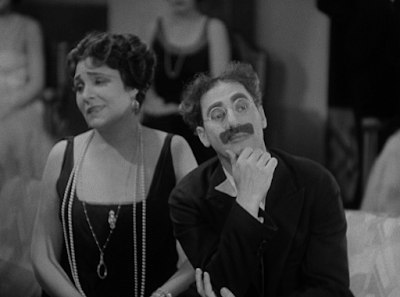
This one's in wide 1.78:1 (except for the film clips, for which it shifts to 1.35 fullscreen) and in HD on blu-ray.  So it has the distinct advantage of being the only really high quality presentation of a Marx Brothers doc, and the only one that'll look nice in your big, widescreen home theaters.  Heck, it's the only one without an interlacing problem.  Hopefully, however, it won't be the last.  But until them, this may be the only one AV enthusiasts are willing to even look at.
Honorable mentions also go to:

Time Marx Is On, a 2006 UK DVD of a 1997 television program about the Marx Brothers from Delta Home Entertainment.  It's not really a documentary; it's a single interview with Groucho talking about his life, taken from an older television appearance on The Dick Cavett Show, with clips of his work edited in.  Running under an hour, it's basically just a slight re-edit of that one Cavett episode made to look like a documentary.

An Affectionate Look At The Marx Brothers, a 2008 UK DVD from the grey-market label AG Plate of a 1960s Canadian television special where two comedians host clips from the brothers' films.  It also runs under an hour.

The Marx Brothers TV Collection, a 2014 3-DVD set from Shout Factory.  Unlike the other two this is actually a high quality release, and collects a massive ton of their rare television appearances.  It's like that 2003 Marx Brothers Collection, only a million times better.  The only reason I relegate it to an "Honorable Mention" is because it isn't a documentary at all, just a terrific collection of rare Marx Brothers stuff.  And for a limited time, if you bought it directly from Shout, it included a bonus fourth disc with even more.
If you're a real Marx lover, Nutshell is the one to track down.  More casual fans can content themselves with just the Warner Bros and Universal docs that come with the movies themselves, which again, when combined, tell their life stories pretty thoroughly, too.  You can get Unknown pretty cheap, though, and that's a good watch, with the supplemental bonus of including a lot of their off-beat TV stuff, too.  I wouldn't even bother with Inside the Marx Brothers, unless you're of a completist and going for the whole box set, where those old pilots and scraps are more compelling than the documentary itself.  But then definitely get Shout's TV Collection first.