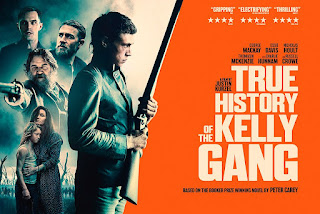
As a boy, young Ned (played superbly by Orlando Schwerdt) quickly learns the harsh realities of life. His father (Gentle Ben Corbett) is often either drunk or absent, leaving his mother Ellen (Essie Davis) with little choice but to prostitute herself, sleeping with Sgt. O’Neill (Charlie Hunnam) of the Queen’s Colonial Army just to make ends meet. When Ned’s father dies in prison (arrested for a crime actually committed by Ned), Ellen “sells” Ned to outlaw Harry Power (Russell Crowe), who tries to instruct the reluctant boy in the finer points of killing and stealing.
After serving time himself (for shooting and wounding Sgt. O’Neill), a grown-up Ned (George MacKay) returns home, only to find his mother has hooked up with American horse thief George King (Marlon Williams). What’s more, Ned’s younger brother Dan (Earl Cave) is King’s accomplice!
At first, Ned rejects the criminal lifestyle embraced by his family, only to become an outlaw himself when he’s pushed too far by British Constable Fitzpatrick (Nicholas Hoult), who threatens to arrest Dan and Ellen while at the same time insulting Ned’s new girlfriend Mary (Thomasin McKenzie). Joined by Dan as well as good friend Joe Byrne (Sean Keenan), Ned spends his days one short step ahead of the law, and is only too happy to shoot every colonial policeman that crosses his path.
Stylistically, The True History of the Kelly Gang is positively electric, with director Kurzel bringing plenty of 21st century flash and flare to this story of 19th century outlaws. Shoot-outs are filmed on the fly with handheld cameras, and some of the music used throughout, composed by the director’s brother Jed Kurzel, has a very modern feel. The film also does a fine job recreating the time period in which its set, and walked off with three AACTA Awards (the Australian equivalent of the Oscars) for costumes, hair & makeup, and production design.
As the title character, George MacKay effectively portrays both the reserved Ned who initially wants nothing to do with crime, and the madman gunning down colonial policemen (at one point, Ned even cuts the ear off one of his victims as a souvenir). Throughout the movie, Ned Kelly proves to be a complex character, and MacKay does a wonderful job bringing his seemingly conflicting nuances to the surface.
Matching MacKay every step of the way are Essie Davis as Ned’s feisty, no-nonsense mother; Russell Crowe as the savage Harry Power; and Nicholas Hoult as the slimy Fitzpatrick, whose methods of enforcing the law often cross the line (he goes so far as to hold a gun on a baby to coerce information out of the child’s mother).
The True History of the Kelly Gang does get a bit too frantic in the second half, when Ned is in full-blown outlaw mode (matching its lead character’s state of mind, the pacing becomes frenzied, even confusing, jumping from one sequence to another so quickly that we occasionally lose our bearings). Fortunately, it doesn’t spoil what came before it (Ned’s childhood and early adulthood are handled brilliantly). An Australian western with plenty of punch, The True History of the Kelly Gang is well worth a watch.
Rating: 7.5 out of 10
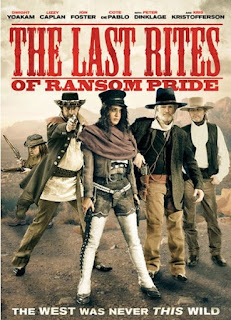
When outlaw Ransom Pride (Scott Speedman) is gunned down in a Mexican village, his girlfriend Juliette Flowers (Lizzy Caplan) tries to make good on her promise to lay his body to rest on his family’s homestead. But Ransom’s remains are being held by Bruja (Cote de Pablo), and she’s refusing to turn him over.
So Juliette strikes a deal: she’ll lure Ransom’s brother Champ (Jon Foster) to Mexico and turn him over to Bruja in exchange for her lover’s body.
Despite the objections of his father Early Pride (Dwight Yoakum), a Reverend who was once an outlaw himself, Champ agrees to accompany Juliette, though the two will face a number of challenges before reaching their destination, including a pair of hired guns (Jason Priestley and W. Earl Brown) sent to kill Juliette by Early’s former partner Shepherd Graves (Kris Kristofferson).
There’s a hell of a lot of style on display throughout The Last Rites of Ransom Pride, with Russell pulling out all the stops; random images flash across the screen, often jarringly so (sometimes there are even brief clips of future events mixed in), and the action shifts from one timeline to the next without warning (though he’s killed in the opening scene, Speedman’s Ransom turns up occasionally in black and white flashbacks).
The characters are an odd bunch, though a few of them, including Caplan’s Juliette and Yoakum’s Early Pride, are damned interesting. Yoakum is especially strong as the drunken Early, a former Confederate guerrilla who still mourns the death of his wife, which he blames on his youngest son Champ (she died giving birth to him). There are also a few colorful side characters that drop in and out, including Bill Mankuma’s Sergeant and a sideshow dwarf played by Peter Dinklage.
In the end, though, it’s a case of too much glitz and not enough story, making The Last Rites of Ransom Pride yet another entry in the very crowded “all style, no substance” category.
Rating: 5.5 out of 10
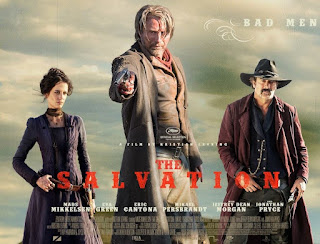
The year is 1871. Having avenged the murder of his wife (Nanna Øland Fabricius) and son (Toke Lars Bjarke), Danish soldier turned American settler Jon Jensen (Mads Mikkelsen) finds himself a wanted man.
The newly deceased slimeball who killed his family, an outlaw named Paul Delarue (Michael Raymond-James), was the brother of Henry Delarue (Jeffrey Dean Morgan), a former Cavalry officer and the most powerful man in the territory. After taking his anger out on the residents of the small community of Black Rock, Henry Delarue orders the town’s Mayor (Jonathan Pryce) and Sheriff (Douglas Henshaw) to find his brother’s killer. DeLarue has promised his now-widowed sister-in-law, a mute known only as “Princess” (Eva Green), that the man who gunned down Paul will soon be brought to justice.
With Jon’s back against the wall, he and his brother Peter (Mikael Persbrandt) make a stand against the tyrannical Delarue, leading to a showdown of epic proportions.
The opening scene in which Jon is reunited with his wife and son is immediately followed by their murder, getting The Salvation off to an incredibly tense start. From there, director Levring never lets us off the hook, delivering one blood-soaked encounter after another, often with the innocent serving as victims. When the sheriff doesn’t find his brother’s killer quickly enough, Delarue shows his displeasure by gunning down several citizens of Black Rock in cold blood.
Mikkelsen is outstanding as the grieving husband and father who has no problem exacting a little frontier justice, and Morgan is equally superb as the villainous Delarue, whose penchant for violence makes him a formidable foe. The supporting cast is good, with Pryce turning in a nuanced performance as the Mayor who does what Delarue tells him. But it’s Eva Green as the mute Princess (her tongue was cut out by Native Americans when she was a child) who steals the show; a late scene, where she also betrays Delarue, is one of the film’s high points.
While it doesn’t exactly bring anything new to the table, The Salvation is so damn good at what it does deliver that you won’t want to miss it.
Rating: 9 out of 10