Showing posts with label GNW. Show all posts

Saturday, 18 December 2021

An episode from the Great Northern War

This scenario was set somewhere in what is now western Russia close to the Baltic states.  A Swedish force is heading eastwards hoping to defeat the nearest Russian force and then advance on Narva.  The Russians are aware of the Swedish advance and have told their army commander to slow the Swedish advance, avoid a major action and wait for a second army to join him from the south.  This will give the Russians an overwhelming advantage and ensure the destruction of the invading army.  Unfortunately for the strategists at army headquarters, the commander of the northern Russian army, having seen the size of the Swedish force, has decided he has sufficient strength to beat the Swedes on his own (and of course not have to share the glory).  We used our own version of the Pike and Shotte rules, together with the factors from the Last Argument of Kings Black Powder supplement.  The figures are 40mm home casts from the Prince August moulds which were passed on to me by Alasdair a good number of years ago.

The battlefield

The constricted nature of the battlefield did not allow the Russian commander sufficient space to make full use of his superior numbers.  In the event, his superiority was not as great as he thought as a third brigade of Swedish infantry was on its way.  The total force available to the Russians were 15 battalions of infantry and 7 units of cavalry with two medium guns.  For the Swedes, they started with 8 battalions of infantry, (soon raised to 12), 6 units of cavalry, (all small, whereas the Russian ones were standard) and 2 light guns.  The Swedish leaders and army were generally of a better quality and the units hit harder in the melee, but were weaker in terms of musketry.

The battle began with the Swedes advancing their cavalry, with the intention of driving off the opposing horse and threatening the flank of the Russian infantry line.  They were helped by some rather feeble attempts to advance by the Russian cavalry (they failed nearly all their command rolls), though the infantry on the Russian left did manoeuvre into a position to fire in support of their cavalry if they were charged.  Disdaining the infantry support, the Russian right wing cavalry commander led forward his leading cavalry unit against the Swedes.  He was soundly beaten and as his men routed from the field, he was carried away with them.  Disaster was averted only by the infantry which fired a volley at the leading Swedish cavalry regiment, inflicted such damage that they fell back through their supports, disordering them.  This second unit was also swept by musketry fire and routed, allowing the victorious infantry to advance into the clearing and block any further Swedish cavalry attacks.

The left wing Swedish cavalry ready to charge

Seeing that the Russian infantry had advanced in support of their cavalry, the Swedish right wing cavalry commander decided to save the unit charging the Russian cavalry by ordering a spoiling attack against the infantry.  The cavalry involved were not impressed by this order, especially as the Russian infantry proceeded to fire a very effective volley which inflicted heavy casualties.  They were even less impressed when the cavalry they were protecting failed to drive off their opponents and were held in the melee.  The Russians then managed to get another regiment of horse up in support and this help swung the second round of melee in the Russians favour, pushing the Swedish cavalry back.

Contact on the Swedish right


The Swedish cavalry take heavy casualties as they charge home

The Russian cavalry push forward

It was at this point that the third brigade of Swedish infantry arrived and the Swedish commander decided to reinforce his left and directed them to advance down the clearing and drive back the Russian infantry which had inflicting casualties on the Swedish left wing cavalry.

Led by the Guard battalion the infantry move forward

Meanwhile, in the centre, the Swedish infantry brigades were advancing.  Ignoring the fire from the Russian artillery, they were halted by some very effective musketry by the Russian infantry.   Indeed, some of the Russian infantry became a little over-enthusiastic and advanced on the enemy.  This proved their undoing as a Swedish volley, followed by a charge sent the Russians back in rout.


The Russian infantry has advanced a little too far and is about to be charged by the Swedish infantry

On their right, the Russian infantry were making use of the wooded knoll to position themselves to give converging fire on any Swedish units advancing on the main line.


The main Swedish advance

On the Swedish left, the Guard had driven back the leading Russian infantry unit, but another had stepped forward to take it's place.  A couple of volleys from this fresh unit caused the Guards to afll back to rally, but fresh Swedish units were available to push forward.

The Swedish advance continues on the left

Elsewhere, Swedish fortunes had ebbed.  The right wing cavalry needed infantry support to advance, but the infantry centre was beginning to falter under the continuing effectiveness of the Russian musketry.  They found it difficult to advance quickly enough to close rapidly with the enemy and use their melee superiority.  

Although they had taken heavy punishment, the Russians had inflicted some loss on the Swedish force.  If nothing else the Swede's confidence would have been lowered by their failure to drive off the Russians.  So a Russian victory, they had slowed the Swedish advance and given time for the southern force to march to the area.  The level of losses may take some explaining, but the Russian commander had already identified a couple of brigadiers who would provide convenient scapegoats.


Final position in the centre


Saturday, 30 May 2020

Action during the Livonian campaign

Following on from the AWI last week, our more recent skype game features another collection which has been overlooked for some time, the 40mm semi flat GNW armies.

I set the scenario in the early years of the Great Northern War, meaning the Russians had some raw troops, (approximately 60% of the infantry and 50% of the cavalry), but made 25% of the Swedish infantry raw to balance things out a little.  A Swedish force commanded by General Axel Lindstrom has been carrying out operations to the east  of Riga and is now returning.  Russian forces are gathering to surround it and blocking the route west is General Shapishnikov's corps.  The Swedes need to break through the Russian force to avoid encirclement.
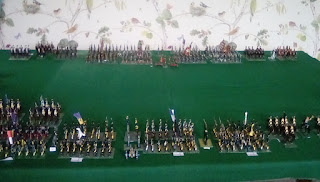
The initial deployment
I laid out the troops as shown in the photo above.  What cannot be seen are the two woods on the flanks, which narrowed the field.  Prior to the game I gave Steve the opportunity to redeploy his forces (the Swedes) if he wished.  He therefore massed all his cavalry on the right wing.


To the left of the cavalry were two brigades of  infantry, each of 4 battalions and a light gun.  The cavalry consisted of four regiments of cavalry in two brigades.

Shapishnikov also had two brigades of infantry, though these had 6 battalions each.  There were also 5 regiments of dragoons in two brigades, the weaker, (of only two regiments), being on his left flank.  In his centre he had two field guns.  
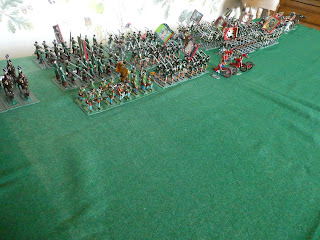
Shapishnikov's force

The Swedes had the initiative and began to advance, at least the infantry did,  the orders to the cavalry seem to go astray.  This gave the Russian left wing cavalry commander a chance to get more manoeuvring room.  As the Russian dragoons on the left swept forward, the commander of the adjacent infantry brigade began to redeploy to extend his front.  On the opposite flank, the Russian dragoons also advanced, hoping to pin the opposing Swedish infantry brigade back.

The proximity of the Russian dragoons seemed to galvanise the Swedish cavalry commander.  His leading brigade charged, eliciting a spirited counter charge from their opponents.  Brave as the Russians were they were unable to deal with the more experienced Swedish troopers and in no time at all they were streaming back in rout.

The Russian dragoons rout
Although defeated, the Russians had inflicted some casualties on their opponents, a delay in following up by the Swedes allowed one of the Russian dragoon units to rally and an infantry battalion to move up to the dragoon's flank to add some support.

On the opposite flank, the Russian dragoons had also advanced.  Their less experienced brigadier had allowed the units to become separated and their attack on the left hand Swedish infantry brigade went in piece meal.  With the garrison regiments in the rear, the experienced infantry leading the brigade dealt with the dragoon attack without any difficulty; driving the horsemen back in disorder.  However, although costly, the dragoon attack had forced the Swedish infantry to halt and this opened up a gap between them and the infantry brigade to their right.

The attack on the Swedish left
 This right hand brigade had advanced steadily and was now nearing the Russian lines.  As it did so the fire from the Russian guns became more effective, inflicting increasing casualties.  To their left the second brigade had to halt again as a second series of attacks were launched by the Russian dragoons.  Once again they failed to break the Swedish line, but again the advance was delayed and as the dragoons fell back they exposed the leading line of the infantry of the right hand infantry brigade which had advanced behind them.  These infantry began firing volleys which swept through the Swedish ranks, once again delaying the advance.  Lindstrom directed the light artillery to assist the embattled brigade  and ordered the reserve cavalry brigade forward to reinforce the attack on the Russian left.


An overview of the battle.  At the top of the photo, the Swedish left is about to be attacked again by the Russian dragoons.  In the foreground the Swedish cavalry is pursuing the retreating Russian left wing dragoons and the reserve brigade is moving up in support.

The leading Swedish cavalry brigade now charged again.  On the right, they caught the defeated Russian dragoons before they had rallied and swept from the field.  In the process they lost a good number of casualties and had to pause to rally.  The second unit charged the infantry which had supported the remnants of the Russian dragoons.  They had been 'softened up' by a volley from the infantry of the right hand Swedish brigade and offered little resistance to the cavalry and routed.  Once again however, the Swedes suffered sufficient casualties to force them to pause to rally.  

The Swedish cavalry break the Russian line
This was galling, as they had nothing in front of them other than routing Russians, the Russian infantry line was 'in the air'.  Lindstrom ordered the reserve cavalry to move round the first brigade and then wheel and attack the Russian centre whilst the first infantry brigade pinned them with a frontal attack.  On this occasion, the normally excellent Swedish staff system failed and the order to Brigadier Wallender was delayed, giving the Russians just enough time to get an infantry battalion in position to oppose Wallender's attack.

In the centre, the Swedish infantry charged home.  The leading regiment disposed of their first opponents easily and moved forward to take on the second line.  They, although a garrison battalion, proved tougher opposition  and although forced to retreat, rallied behind the regiment supporting them.  Glaz, the Swedish brigade commander, ordered a unit to take on the Russian artillery as their fire was proving a problem.  This attack proved a disaster as the close range canister decimated the Swedish ranks and forced them to fall back to rally.  With his attack now beginning to falter, Lindstrom needed some help from his second brigade, but they were struggling.

The Swedish attack on the guns fails
The unit on the right of the right hand Russian infantry brigade was led by Colonel Archibald Fraser, who had served in the Russian army for more than a decade.  he had drilled his men relentlessly and emphasised the need for effective musket fire.  This day his men excelled.  Their fire cause two Swedish units to fall back to rally.  Encouraged,  the rest of the brigade pushed forward, the left of the rear line wheeling towards the centre increasing the pressure on the Swedish right.  Lindstrom, in desperation, attempted to block this attack with one of his garrison battalions, even though it was sorely needed to support the attack.  Their fire did indeed halt the Russians and a charge completed the job.

The garrison battalion pushes back the Russians

However, behind the defeated Russians was another infantry battalion and a volley from them drove the Swedes back.  Lindstom received news from Wallender that the Russian infantry volleys were preventing him charging home.  Gathering the remains of the first cavalry brigade, Lindstrom led them in a desperate charge against the Russian right.  Although they managed to smash through one infantry battalion, they were unable to break a second and had to retreat.

Accepting defeat, Lindstrom began to pull back his weary infantry, covering their retreat with the remains of the cavalry.  For their part the Russians were too battered to pursue.

A close run thing.  The quality Swedish troops threatened to smash their opponents in no time, but with losses mounting, momentum slowed.  A few crucial order failures and some excellent Russian musketry proved decisive. 

Sunday, 29 September 2019

Sagasu : A GNW scenario for Pike and Shotte

This week we return to the Great Northern War using the Prince August figures.  A coalition of forces is besieging a Swedish garrison in the port of Sagasu on the Baltic coast.  The Swedish command has organised a relief force of 3 brigades of infantry and 1 of cavalry to raise the siege.  For their part the Russian, Saxon and Danish besiegers have begun to construct defences against such an attack.


An overview of the battlefield, Swedes on the left, the Danish defensive work between the woods and the Saxon camp on the right.

The Danish brigade had suffered heavy losses and had been re-organised into 4 under strength battalions.  They had almost completed a redoubt covering the approach to Sagasu from the south, but the northern face was unfinished.  In the camp are a brigade of Saxon infantry and a field gun.  To the west, a brigade of Saxon cavalry.  Once all the Saxon units are activated the coalition commander can start to roll for the arrival of the Russian infantry brigade, which will appear to the east of the camp.

The 'Danish' redoubt
The Swedes arrive one brigade at a time, the order determined by the Swedish commander before the game starts.  Victory conditions are straightforward; for the Swedes, breakthrough and raise the siege, for the allies prevent the Swedes breaking through.

Initiative lay with the Swedes, but their first move was cautious,meaning the Danes had a chance to fire a volley before the inevitable Swedish charge.  However, the Danish fire inflicted little damage, unlike the Swedish response which disordered the Danes facing them.  Encouraged, the Swedish infantry charged home losing a few more casualties to the closing volley.  Against the odds the Danes managed to hold the defences and prolong the melee.  Other Swedish units now began to move to assault the sides of the redoubt whilst the much lauded Swedish cavalry entered the field.

The Swedish attack
Back at the Saxon camp the sound of the musketry roused the Saxon forces.  Not all responded immediately but as they did the infantry marched out to support the redoubt and the cavalry formed up ready to support the infantry.  In fact the cavalry responded quickest and as they moved forward on the right of the redoubt they met the Swedish cavalry.  The Swedes had been  slow to advance and now the Saxons seized the initiative and charged.  Once again the Swedes were slow to react and were caught at the halt.  The first unit was swept away in no time and disordered its supports as it routed.  Sensing victory the Saxons pursued crashing headlong into the immobile Swedish cavalry.  This was a more prolonged affair but eventually the Swedes gave way leaving the Saxon cavalry triumphant but, disordered and well away from their supports.

View from the Saxon camp before the Russian arrival
At the redoubt the struggle continued.  One of the flank attacks had failed but the defenders on the southern face eventually gave way unable to resist the pressure of the Swedish attack.  They fled through the open northern face of the redoubt making for the camp.  A battalion turned to face the Swedish infantry as they swarmed over the defences, but being a raw unit, they became disordered attempting the manoeuvre.  The Swedes had also lost order as they entered the redoubt, but their volley inflicted sufficient casualties to cause the raw unit to rout.  Seeing the redoubt could not now be held, the last remaining defenders fell back in good order.

The Swedes in the redoubt
On the Swedish right a brigade of veteran infantry advanced past the redoubt.  Their fire swept away the last remaining Danish unit and then they moved against the Saxon infantry who were now forming line covering the camp.  A welcome sight for the allied commander was the arrival of a Russian brigade of four battalions to the left of the camp.  This now moved forward towards the veteran Swedish brigade.  In the rear, the final Swedish brigade arrived, but it's commander seemed unable to get them to move forward.  Their slow advance eased the pressure on the Saxon infantry who now just faced the first Swedish brigade which had already been weakened by the attack on the redoubt.

The Swedes attack the Saxon infantry
The cavalry contest continued to favour the Saxons.  Although reduced to only two units the Swedes attacked and managed to drive the Saxons back, but did not break them.  When the Saxons counter attacked the Swedes gave way and were now too weak to influence the battle.  An attempt by the Saxon cavalry to attack the Swedes in the centre came to nothing as the leading unit was wrecked by a Swedish volley.

Saxon cavalry driven off by musketry
In a final throw of the dice the Swedish commander launched his veteran brigade against the Russians.  The Russian front line was unable to hold the Swedish charge, but it fell back without disordering its supports.  This enabled the second Russian line to attack and they pushed back the Swedes with heavy loss.  The eventual arrival of the third brigade was too late to influence the outcome of the battle, merely to cover the withdrawal of the rest of the Swedish force.

The Russians arrive
A close run thing, with lady luck definitely favouring the Saxons in the 50/50 situations.

Thursday, 23 May 2019

Partizan 2019

This Sunday, Steve and I visited the Partizan show.  As last year a very good range of games were on offer, with something for everyone.  What follows are mainly shots of games reflecting my personal periods of interest, my apologies to those clubs/individuals whose games are not included.

Beginning with the Medieval period, the Northampton Battlefield Trust had a demonstration game of the Battle of Edgecote, 1469, which featured an unusual circular battlefield.


Next to this game was the Lance & Longbow game of the Battle of Bauge presented by Simon Chick.


The Chesterfield Old Boys had "The mad war of 1489" which featured an eclectic mix of nations taking part in the battle of Concarneau.


Kallistra had the battle of Mohi 1241, a clash between Hungary and an invading Mongol army.


These small figures lend themselves to creating the scale and mass of large battles, in 25/28mm you would need something like a tennis court to present this battle.

Moving forward in time Grimsby Wargames Society demonstrated a GNW scenario with Swedes, Poles and Russians, (other nations' troops were drafted in to make up the numbers).  I was particularly drawn to the masses of well-painted Hinchliffe pancerni as I have a soft-spot for that manufacturer's ranges for this period.


Close by was another game from this period put on by the League of Augsburg, involving Ottomans and Russians.  This featured some home built mobile defences which were a regular feature of war in eastern Europe.


Moving forward in the 18th century Crann Tara had a game based on a British expedition to the West Indies during the Seven Years War.


North Hull Wargames Club had a demonstration game of the Battle of Brooklyn from the AWI using 20mm figures.


The Napoleonic period games on offer included two from outside the European theatre, The Boondock Sayntes with Assaye


and the Perry Twins with the Battle of Mandara from the Egyptian campaign.


Dales Wargames had a game based on Waterloo


The Old Guard had a hex based version of Vimeiro


Now I rarely game 20th century warfare, but the offering from the Earlswood Wargames Group, 'Angriff Auf die Abtei' really caught my eye.


The Old Pikeys Wargames Group had a WWII game based on Arnhem, 'Oosterbeek 1944, The Witches Cauldron'. 


All the games I have mentioned so far have been demonstration games, but 40% of the games on offer were participation games.  They come in all guises and give the gamer a chance to try out different rules, periods and styles.  Three particularly caught my eye, curiously all featuring far eastern countries.

Terry Broomhall's 'Test of Honour' Samurai game


Too Fat Lardies had a WWII game set in Malaya in 1941.


Finally there was Victorious Games '55 minutes in Peking'. 


Steve and I tried this game, each taking control of two groups of Boxers.  Whilst my groups suffered heavy casualties meaning that on the one occasion that they managed a breakthrough they failed morale and had to retreat; Steve enjoyed more success as can be seen.

Steve receiving his award as 'Best Boxer' for his exploits
Partizan is a very good show, well organised by the Newark and club and in an excellent venue.  It is well worth a visit and the next opportunity is on August 18th for 'The Other Partizan'