
Agrega una trama en tu idiomaA Belgian woman looks back on her year at a Japanese corporation in Tokyo in 1990. She is Amélie, born in Japan, living there until age 5. After college graduation, she returns with a one-ye... Leer todoA Belgian woman looks back on her year at a Japanese corporation in Tokyo in 1990. She is Amélie, born in Japan, living there until age 5. After college graduation, she returns with a one-year contract as an interpreter. The vice president and section leader, both men, are boors,... Leer todoA Belgian woman looks back on her year at a Japanese corporation in Tokyo in 1990. She is Amélie, born in Japan, living there until age 5. After college graduation, she returns with a one-year contract as an interpreter. The vice president and section leader, both men, are boors, but her immediate supervisor, Ms. Mori, is beautiful and trustworthy. Amélie's downfall b... Leer todo
- Dirección
- Escritura
- Estrellas
- Premios
- 5 premios ganados y 2 nominaciones en total




- Dirección
- Escritura
- Todo el elenco y el equipo
- Producción, taquilla y más en IMDbPro
Opiniones destacadas
A shock of civilizations behind closed doors
Would love to know what Japanese think about this
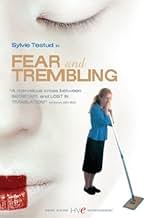
The plot involves a Belgian woman (Amelie) who loves Japan (having spent her early childhood there) and who obtains employment at a huge corporation in Tokyo. Through various cultural misunderstandings, she continually gets demoted until her job mainly involves cleaning toilets.
The film depicts late 80's / early 90's Japanese corporate culture as unbelievably hierarchical, brutal, inefficient and de-humanizing. I suspect this was exaggerated, for comic and dramatic effect. And, for the sake of the Japanese people, I hope so.
My only two complaints about Fear and Trembling are (i) the over-use of the voice-over narration to tell the story, and (ii) the fact that we do not get any hint of Amalie's life (or anyone else's life) outside the office.
With respect to the latter point, another commenter noted "In the novel Amelie Nothomb writes : this could be leading to think I had no life outside the office, which is wrong. but for a schizophrenic reason, when I was at job in the 44th floor toilets of the yumimoto company I couldn't think of myself as the same person respected and loved by friends outside."
Overall, it was entertaining, thought-provoking, and by the end, strangely moving. Both my wife and I got a bit misty-eyed at the end - I was a bit surprised that the movie drew such sudden emotion out of me. Definitely worth seeing.
'Gaijin: Approach the Emperor with fear and trembling!'
A mind-boggling view into the heart of Japan, "Fear and Trembling" includes some of the incongruous hilarity of Sofia Coppola's "Lost in Translation" and the monstrous (if ceremonially correct) barbarity of Nagisa Oshima's "Merry Christmas, Mr Lawrence," but it's also tremendously new and different. It will make you laugh, cringe, learn, and refuse to accept what appears obvious to those on the screen.
As those two other Western perspectives on Japan, Alain Corneau's story is about the comedy and trauma of East-West relations, in this case through the epic (and yet deeply personal) struggle of a young Belgian woman "to fit in" with a Tokyo corporation.
Amélie Northomb is the author of the autobiographical novel on which the film is based, Sylvie Testud is the brilliant actress who plays the role. Amélie was born in Tokyo, daughter of Brussels' ambassador to Japan (although the film doesn't say this), lived there until age 5 when her family returned to Belgium. She considered Japan her real home, maintaining a deeply-felt, romantic attachment to the language and culture of the country.
In her mid-20s, Amélie gets a job as a translator with a giant corporation in Tokyo, and the film tells the story of her often incredible life of abuse, humiliation, and (to an outsider) near-insane routines that's the lot of Japan's salarymen... especially those who are women. Amélie goes from doing brilliant multilingual research - in violation, as it turns out, of company procedures, defying a supervisor's hatred of "odious Western pragmatism" - to resetting calendars... to serving coffee... to being made to copy the same document over and over again... to months of cleaning restrooms.
Impossible? Well, yes, but it is both "a true story" in fact, and Corneau - the great director of "Tous les matins du monde" and "Nocturne indien" - somehow gets the audience a few tentative steps closer to the "Japanese mind." It is, of course, only a partial success, but in the end, there is a fragile, right-brain appreciation of what is "most Japanese" in the film: Amélie's persistence through it all, "to save face."
At the same time, much of the conflict remains incomprehensible to an outsider, such as a supervisor's order to Amélie (hired because of language ability) "to forget Japanese" when there are visitors to the office. His explanation: "How could our business partners have any feeling of trust in the presence of white girl who understood their language? From now on you will no longer speak Japanese."
In the large, uniformly excellent Japanese cast, the name to learn is that of Kaori Tsuji, an amazing physical presence: a 6-foot-tall Japanese woman with a face that's both icily "perfect" and achingly vulnerable. In her film debut, Tsuji successfully copes with a major role that requires projecting many deep, often conflicting emotions - without changing her uniform, constant "correct expression."
Personally, "Fear and Trembling" came as a surprise, almost a shock. I thought, mistakenly, that after living in Hawaii for a decade, and having besides innumerable points of contact with Japanese culture and people, I wouldn't feel about an apparently truthful picture of the country as if I observed some bizarre and incomprehensible aliens... but I did.
Moving
Belgian Amelie seems to know Japan and it's culture, but can't help get into trouble by acting "Western" while working in a Japanese office. As the film goes on you see Amelie make mistakes and you get the urge to warn her not to get into trouble. Her sense of absurdity and courageous submittance make her a likable character. The constricted setting in which people don't express their feelings make the internal monologues and narration very functional.
The story is strong, the filming sober and functional, the cast well-picked. A nice experience for anyone who wants to watch a production from outside LA.
simple answer
By the way, some of the text appearing at the official web site (http://www.cinemaguild.com/fearandtrembling/) as background decoration actually looks like Korean or something. It is definitely not Japanese. I'm not talking about the Katakana characters outside the flash window, but the white background inside the flash window itself, though it is very hard to see on some monitors.


¿Sabías que…?
- TriviaBased on Amélie Nothomb's real-life experience when she was living Japan in her early twenties in the early 1990s . The real-life events narrated in the film took place at the same time than those narrated in Tokyo Fiancée (2014) which depicts Amélie Nothomb's romance with her then-fiancé Rinri. However, Tokyo Fiancée's director Stefan Liberski set his film in the early 2010s.
- ErroresWhen Amélie sorts all GmbH clients in the same folder, her superior explains her that "GmbH is like Ltd in English or SA in French". GmbH is not SA in French, but SARL (Société anonyme à responsabilité limitée).
- ConexionesFeatures Feliz Navidad, Mr. Lawrence (1983)
- Bandas sonorasGoldberg Variations
(selections)
Written by Johann Sebastian Bach
Performed by Pierre Hantaï, harpsichord
Selecciones populares
- How long is Fear and Trembling?Con tecnología de Alexa
Detalles
- Fecha de lanzamiento
- Países de origen
- Sitios oficiales
- Idiomas
- También se conoce como
- Fear and Trembling
- Locaciones de filmación
- Productoras
- Ver más créditos de la compañía en IMDbPro
Taquilla
- Total en EE. UU. y Canadá
- USD 126,684
- Fin de semana de estreno en EE. UU. y Canadá
- USD 6,007
- 21 nov 2004
- Total a nivel mundial
- USD 2,305,213