ÉVALUATION IMDb
7,8/10
20 k
MA NOTE


Au cours d'un été étouffant, un détective d'homicide inexpérimenté tente de retrouver son pistolet Colt volé.Au cours d'un été étouffant, un détective d'homicide inexpérimenté tente de retrouver son pistolet Colt volé.Au cours d'un été étouffant, un détective d'homicide inexpérimenté tente de retrouver son pistolet Colt volé.
- Réalisation
- Scénaristes
- Vedettes
- Prix
- 4 victoires au total
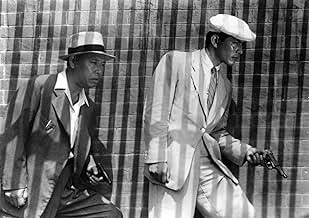
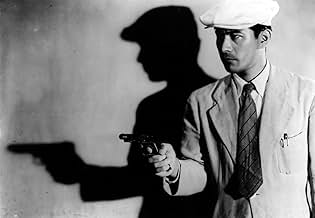
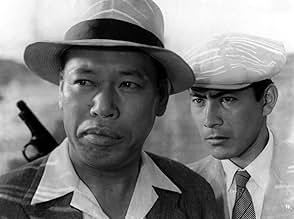
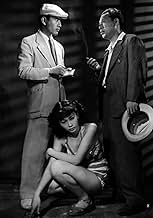


7,820.4K
1
2
3
4
5
6
7
8
9
10
Avis en vedette
Akira Kurosawa on the verge of greatness.
The following year, 1950, would see Kurosawa achieve his first major international success with the masterpiece Rashomon. Here, Kurosawa doesn't quite have the sureness of touch which would characterize most of his career, but Stray Dog is nevertheless a fine film noir and an effective exploration of Kurosawa's ideas about postwar Japan in particular and the human condition in general.
As you might expect from such a genius, Kurosawa is not satisfied with a simple good-guys/bad-guys cops-and-robbers story. He explores in depth the social and economic conditions in postwar Japan which led many young people--particularly returning veterans--to take to crime, and also the particular circumstances which motivate the acts of Yusa (Isao Kimura), the criminal. Indeed, a series of mistakes by the hero, rookie detective Murakami (Toshiro Mifune), are one factor behind Yusa's crimes.
But neither is Stray Dog a facile blame-society message film, either. Kurosawa makes no excuses for Yusa. By giving Murakami a very similar history (so similar, in fact, that it comes off as a little contrived), Kurosawa makes the point that Yusa had the same choice as Murakami. That he chose differently is his responsibility.
But even more interesting to me is the character of chief detective Sato (Takashi Shimura), Murakami's superior officer, mentor, and friend.
Sato is the wise elder figure in this film, and in the hands of a lesser artist than Kurosawa, such a character generally ends up as a mouthpiece for the director's own viewpoint. Here, though, Kurosawa permits Sato to espouse a hardcore law-and-order philosophy: The cops are the good guys, the crooks are the bad guys, and that's it. Sato has no patience for Murakami's guilt feelings or touchy-feely philosophizing.
That Kurosawa would permit this view (which is not Kurosawa's view, nor the film's) to be given voice by the film's wisest, kindest, most competent, and most likable character is a mark of his confidence and courage.
As you might expect from such a genius, Kurosawa is not satisfied with a simple good-guys/bad-guys cops-and-robbers story. He explores in depth the social and economic conditions in postwar Japan which led many young people--particularly returning veterans--to take to crime, and also the particular circumstances which motivate the acts of Yusa (Isao Kimura), the criminal. Indeed, a series of mistakes by the hero, rookie detective Murakami (Toshiro Mifune), are one factor behind Yusa's crimes.
But neither is Stray Dog a facile blame-society message film, either. Kurosawa makes no excuses for Yusa. By giving Murakami a very similar history (so similar, in fact, that it comes off as a little contrived), Kurosawa makes the point that Yusa had the same choice as Murakami. That he chose differently is his responsibility.
But even more interesting to me is the character of chief detective Sato (Takashi Shimura), Murakami's superior officer, mentor, and friend.
Sato is the wise elder figure in this film, and in the hands of a lesser artist than Kurosawa, such a character generally ends up as a mouthpiece for the director's own viewpoint. Here, though, Kurosawa permits Sato to espouse a hardcore law-and-order philosophy: The cops are the good guys, the crooks are the bad guys, and that's it. Sato has no patience for Murakami's guilt feelings or touchy-feely philosophizing.
That Kurosawa would permit this view (which is not Kurosawa's view, nor the film's) to be given voice by the film's wisest, kindest, most competent, and most likable character is a mark of his confidence and courage.
The brilliance of early Kurosawa
Impressive as some of the later films of Kurosawa are - "Kagemusha" and "Ran" for example, I have to confess that it is his early work, particularly those set in modern Japan as opposed to its feudal past, that I find myself returning to with greater pleasure. He was not one of those artists who necessarily got better and better, rather was he one who continued to take on different challenges, not always with the same degree of success, as "Dodesukaden" and "Dreams" were to prove. I have long regarded the 1952 "Ikiru" as his greatest achievement, with the three modern day day films starring Toshiro Mifune that precede it, "Drunken Angel", "The Quiet Duel" and "Stray Dog", fascinating consolidations of his skill as a director. "Stray Dog" revels in technical accomplishment. It tells the story of a policeman who, after experiencing the theft of his gun while travelling on a bus, embarks on an odyssey to retrieve it. Questions of morality and honour loom large as they do in any Kurosawa film, with the quest becoming ever more urgent as evidence is gathered of the weapon being used in criminal activities. What might be regarded as plain bad luck in another culture is here seen as a matter of shame and dishonour by the unfortunate policeman, that has to be addressed forsaking all else. The search is pursued in a dazzling series of chases, encounters and interrogations that leaves the audience, like the hero, exhausted at times. The weather is hot throughout, characters sweat profusely and sometimes everything erupts in a tropical downpour - no other director uses rain so physically. Perhaps, at over two hours, "Stray Dog" is a little too long to sustain its material. It sags a little in the middle, but the chases at the outer ends of the film are wonderfully done, particularly the penultimate sequence where the cop pursues his prey through vegetation where city and countryside meet. You can almost smell the steamy atmosphere of a morning after rain where everything is about to heat up again. Possibly the other two Mifune films of the same period have the edge on this. They are more meditative works, their lengths more sustainable. But, for sheer cinematic bravado, this is the one.
Early Kurosawa is still good Kurosawa
This early Kurosawa effort floats stylistically somewhere between the film noir and neo-realism, incorporating the best from both worlds to elaborately craft a landscape (both physical and social) of post-war Japan. It's only been 4 years since the dreadful A-bombings and the subsequent defeat of Japan in WW2 and both the country and the people are deeply scarred. War veterans return home to find a country torn by poverty and as the saying goes, desperate conditions demand desperate measures.
A very young Toshiro Mifune plays the greenhorn detective who has his gun stolen and spends the rest of the movie trying to track down the culprit. As it turns out the culprit is a war veteran just like Mifune's character, only where the latter tried to do good and found an honest job, the former opted for the easy way out and became a criminal, using the stolen gun to rob and kill. This adds an additional layer of motivation for detective Sato. Not only does he have to restore his honour (ironically symbolised by the lost gun which he tries to retrieve), but also redeem himself by bringing the killer to justice. What makes matters worse for him is that every time his stolen gun is fired someone dies or gets injured, which adds another burden of guilt on the shoulders of the young detective.
The story might appear too moralistic and convenient (both antagonist and protagonist share a common background, being war veterans, making the distinction of good and bad all too easy), but it has to be seen in the context of the times. Mifune says that there are no bad people, only bad situations. But as his detective collaborator on the case remarks (played by the great Takashi Shimura, who also starred in Seven Samurai) he faced the same bad situation and made something good out of it. Kurosawa here neatly balances the social climate of post-war Japan and the conditions of the times with personal responsibility.
Story-wise it's a worthy effort, but like Rashomon, it sounds a little bit better than it actually is. Not that Stray Dog is a bad movie by any means, but clocking in at 2 hours it starts to drag near the middle. There are some nice set-pieces that showcase Kurosawa's growing talent (like the phone scene in the hotel where he uses inter-cutting to great effect) and the performances are solid all around. There's also a silent 10 minute montage of location footage shot in rundown neighborhoods as Sato searches the black market for his gun, which serves as a poignant snapshot of Japanese history.
Kurosawa would go on to achieve international acclaim with his next movie, Rashomon, but Stray Dog already shows that he was destined for great things. Compared to later entries in his filmography Stray Dog appears to be a minor entry, but it's still well worth the time to discover.
A very young Toshiro Mifune plays the greenhorn detective who has his gun stolen and spends the rest of the movie trying to track down the culprit. As it turns out the culprit is a war veteran just like Mifune's character, only where the latter tried to do good and found an honest job, the former opted for the easy way out and became a criminal, using the stolen gun to rob and kill. This adds an additional layer of motivation for detective Sato. Not only does he have to restore his honour (ironically symbolised by the lost gun which he tries to retrieve), but also redeem himself by bringing the killer to justice. What makes matters worse for him is that every time his stolen gun is fired someone dies or gets injured, which adds another burden of guilt on the shoulders of the young detective.
The story might appear too moralistic and convenient (both antagonist and protagonist share a common background, being war veterans, making the distinction of good and bad all too easy), but it has to be seen in the context of the times. Mifune says that there are no bad people, only bad situations. But as his detective collaborator on the case remarks (played by the great Takashi Shimura, who also starred in Seven Samurai) he faced the same bad situation and made something good out of it. Kurosawa here neatly balances the social climate of post-war Japan and the conditions of the times with personal responsibility.
Story-wise it's a worthy effort, but like Rashomon, it sounds a little bit better than it actually is. Not that Stray Dog is a bad movie by any means, but clocking in at 2 hours it starts to drag near the middle. There are some nice set-pieces that showcase Kurosawa's growing talent (like the phone scene in the hotel where he uses inter-cutting to great effect) and the performances are solid all around. There's also a silent 10 minute montage of location footage shot in rundown neighborhoods as Sato searches the black market for his gun, which serves as a poignant snapshot of Japanese history.
Kurosawa would go on to achieve international acclaim with his next movie, Rashomon, but Stray Dog already shows that he was destined for great things. Compared to later entries in his filmography Stray Dog appears to be a minor entry, but it's still well worth the time to discover.
"A stray dog becomes a mad dog."
A long-standing blemish on my status as a film buff has been the fact that I had never seen a film directed by Akira Kurosawa, easily the most well-known and respected Japanese filmmaker. Finally, my drought has been broken, as I sat down last night to enjoy 'Nora inu / Stray Dog (1949).' A police procedural in the classic film-noir tradition, the film stars Kurosawa-regular Toshirô Mifune as a young homicide detective whose firearm is pick-pocketed while on a bus. When it becomes clear that the weapon has fallen into the hands of a desperate, murdering criminal, Det. Murakami becomes consumed with guilt and shame, and it is only through the experienced guidance of mentor Det. Sato (Takashi Shimura) that he can overcome his insecurities and track down the suspect. 'Stray Dog' was the director's tenth film, and the third in a wealth of collaborations with Mifune throughout an illustrious career. Though it is not quite the masterpiece I had {probably unreasonably} been anticipating, I can only promise that my first Kurosawa will certainly not be my last.
Surprisingly, 'Stray Dog' is similar in many regards to Vittorio De Sica's neorealist masterpiece 'The Bicycle Thief (1948).' Both films concern a disillusioned man's seemingly-futile search for an essential stolen object, in a city of poor and pitiable individuals, where, in the aftermath of World War Two, widespread economic difficulties have forced many towards a life of crime. When Det. Murakami first begins searching for his stolen gun, there is a wonderful extended sequence in which he purposelessly wanders the poverty-stricken streets, experiencing the decadence of society for himself, for the first time understanding why a criminal might have been forced to tread a darkened path. A very important theme of the film is the obvious parallel between Det. Murakami and his suspect, Yusa (Isao Kimura). Both individuals fell on hard times when their knapsacks were stolen: while the former took the crucial step towards law enforcement, the latter chose the opposite path, eventually becoming a thief and a wanted murderer. In the story's climactic chase sequence, the two men tussle violently in the undergrowth, their faces becoming coated in a layer of mud; for a decisive few moments, detective and criminal are practically indistinguishable from each other.
One component of film-making that Kurosawa had evidently mastered by 1949 was creating intensity, and, in many ways, 'Stray Dog' is simply discomforting to watch. The events of the film appear to take place during an extreme heatwave, and the perspiration clings to the skin of the actors as though they are practically roasting in their seats. When the story reaches a devastating climax, its arrival is heralded by the breaking of a storm, the passing of the sweltering drought perhaps symbolising that the dull, futile routine of police procedure has come to an end. I was also impressed by the frantic chase sequences at both the beginning and end of the film, which, aside from being exceptionally thrilling, were genuinely harrowing. Watching Murakami and Yusa grapple in the vegetation, before both collapsing to the ground in fatigue, I don't think I've ever seen film characters looking so utterly exhausted. Despite a masterful opening and closing, 'Stray Dogs' tended to drag a lot in the middle, with the two detectives moving from one possible witness to the other, very slowly gathering the information they require to track down their suspect. Nonetheless, I now have the massive undertaking of deciding which of Akira Kurosawa's films I will watch next.
Surprisingly, 'Stray Dog' is similar in many regards to Vittorio De Sica's neorealist masterpiece 'The Bicycle Thief (1948).' Both films concern a disillusioned man's seemingly-futile search for an essential stolen object, in a city of poor and pitiable individuals, where, in the aftermath of World War Two, widespread economic difficulties have forced many towards a life of crime. When Det. Murakami first begins searching for his stolen gun, there is a wonderful extended sequence in which he purposelessly wanders the poverty-stricken streets, experiencing the decadence of society for himself, for the first time understanding why a criminal might have been forced to tread a darkened path. A very important theme of the film is the obvious parallel between Det. Murakami and his suspect, Yusa (Isao Kimura). Both individuals fell on hard times when their knapsacks were stolen: while the former took the crucial step towards law enforcement, the latter chose the opposite path, eventually becoming a thief and a wanted murderer. In the story's climactic chase sequence, the two men tussle violently in the undergrowth, their faces becoming coated in a layer of mud; for a decisive few moments, detective and criminal are practically indistinguishable from each other.
One component of film-making that Kurosawa had evidently mastered by 1949 was creating intensity, and, in many ways, 'Stray Dog' is simply discomforting to watch. The events of the film appear to take place during an extreme heatwave, and the perspiration clings to the skin of the actors as though they are practically roasting in their seats. When the story reaches a devastating climax, its arrival is heralded by the breaking of a storm, the passing of the sweltering drought perhaps symbolising that the dull, futile routine of police procedure has come to an end. I was also impressed by the frantic chase sequences at both the beginning and end of the film, which, aside from being exceptionally thrilling, were genuinely harrowing. Watching Murakami and Yusa grapple in the vegetation, before both collapsing to the ground in fatigue, I don't think I've ever seen film characters looking so utterly exhausted. Despite a masterful opening and closing, 'Stray Dogs' tended to drag a lot in the middle, with the two detectives moving from one possible witness to the other, very slowly gathering the information they require to track down their suspect. Nonetheless, I now have the massive undertaking of deciding which of Akira Kurosawa's films I will watch next.
10davidals
Kurosawa's first major masterpiece
STRAY DOG stands as the legendary Akira Kurosawa's first real masterpiece, noteworthy for at least two big reasons: the style - classic American film noir (rich, velvety b&w atmospheres), enhanced with a touch of Italian neo-realism (great use of diverse locations, which provide a great view of day-to-day postwar Japan), and the star, a young Toshiro Mifune, whose truly collaborative association with Kurosawa was cemented here, and would grow in spectacular fashion during the subsequent 16 years.
Mifune became as much of an international icon as Kurosawa, and this is the first film where it's easily evident why. As an example of film noir, STRAY DOG offers plenty of gripping suspense and moral complexity, and holds up well alongside classics like THE BIG HEAT, THE KILLING or THE MALTESE FALCON. Kurosawa touched upon international influences to an unprecedented degree in Japanese film (the internationalist impulses of Ozu, Kenji Mizoguchi or Mikio Naruse are just as deep and varied, but far more discreetly deployed), Kurosawa also skillfully highlights Japanese specifics (the rookie cop expecting to be fired, even accepting the possibility in an apologetic fashion, only to be assured that he will not be fired - this would not occur in a similar American setting), while always linking the same details to universals: honor, nobility, responsibility. This would become the thread linking Kurosawa's celebrated period/samurai films to his contemporary dramas. STRAY DOG was perhaps the first of his films where it truly resonates in a global fashion - a timeless, classic film.
Mifune became as much of an international icon as Kurosawa, and this is the first film where it's easily evident why. As an example of film noir, STRAY DOG offers plenty of gripping suspense and moral complexity, and holds up well alongside classics like THE BIG HEAT, THE KILLING or THE MALTESE FALCON. Kurosawa touched upon international influences to an unprecedented degree in Japanese film (the internationalist impulses of Ozu, Kenji Mizoguchi or Mikio Naruse are just as deep and varied, but far more discreetly deployed), Kurosawa also skillfully highlights Japanese specifics (the rookie cop expecting to be fired, even accepting the possibility in an apologetic fashion, only to be assured that he will not be fired - this would not occur in a similar American setting), while always linking the same details to universals: honor, nobility, responsibility. This would become the thread linking Kurosawa's celebrated period/samurai films to his contemporary dramas. STRAY DOG was perhaps the first of his films where it truly resonates in a global fashion - a timeless, classic film.


Le saviez-vous
- AnecdotesMuch of the film was shot in the slums of postwar Japan. These parts were directed by chief assistant director Ishirô Honda, who had ventured into some dangerous, even yakuza-run, territory with camera operator Kazuo Yamada. Many of the scenes of Toshirô Mifune's character from the waist down are actually Honda standing in. In his book, Something Like an Autobiography, Akira Kurosawa described Honda's role stating, "I had Honda do mainly second-unit shooting. Everyday I told what I wanted and he would go out into the ruins of postwar Tokyo to film. There are few men as honest and reliable as Honda. He faithfully brought back exactly the footage I requested, so almost everything he shot was used in the final cut of the film. I'm often told that I captured the atmosphere of postwar Japan very well in Stray Dog, and if so I owe a great deal of that success to Honda."
- GaffesIn one scene, the looped first half of the popular waltz "Waves of the Danube" is heard, played on accordion, while on screen a man appears to play harmonica.
- Citations
Police Inspector Nakajima: Bad luck either makes a man or destroys him. Are you gonna let it destroy you? Depending how you take it, bad luck can be a big break.
- ConnexionsFeatured in Kurosawa Akira: Tsukuru to iu koto wa subarashii: Stray Dog (2002)
- Bandes originalesThe Waves of the Danube
(uncredited)
Composed by Iosif Ivanovici
[Played on a harmonica outside the bar when Murakami follows Ogin]
Meilleurs choix
Connectez-vous pour évaluer et surveiller les recommandations personnalisées
- How long is Stray Dog?Propulsé par Alexa
Détails
- Date de sortie
- Pays d’origine
- Langues
- Aussi connu sous le nom de
- Chien enragé
- Lieux de tournage
- Ameya Yokocho market, Ueno, Tokyo, Japon(black market scenes)
- sociétés de production
- Consultez plus de crédits d'entreprise sur IMDbPro
Box-office
- Brut – États-Unis et Canada
- 46 808 $ US
- Fin de semaine d'ouverture – États-Unis et Canada
- 15 942 $ US
- 28 juill. 2002
- Brut – à l'échelle mondiale
- 47 023 $ US
- Durée
- 2h 2m(122 min)
- Couleur
- Mixage
- Rapport de forme
- 1.37 : 1
Contribuer à cette page
Suggérer une modification ou ajouter du contenu manquant