ÉVALUATION IMDb
7,2/10
6,6 k
MA NOTE


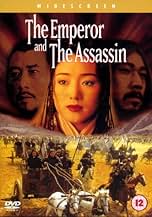
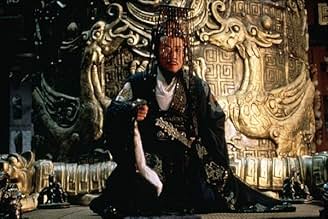
Ajouter une intrigue dans votre langueIn pre-unified China, the King of Qin sends his concubine to a rival kingdom to produce an assassin for a political plot, but as the king's cruelty mounts she finds her loyalty faltering.In pre-unified China, the King of Qin sends his concubine to a rival kingdom to produce an assassin for a political plot, but as the king's cruelty mounts she finds her loyalty faltering.In pre-unified China, the King of Qin sends his concubine to a rival kingdom to produce an assassin for a political plot, but as the king's cruelty mounts she finds her loyalty faltering.
- Réalisation
- Scénaristes
- Vedettes
- Prix
- 7 victoires et 11 nominations au total



7,26.6K
1
2
3
4
5
6
7
8
9
10
Avis en vedette
Historic Epic that blows away "Patriot" or "Gladiator"
After seeing dressed up action films, like the two mentioned above, Emperor and the Assassin was a godsend. This film was such a marvelous blend of action, intrigue, and personality, and I'm sure I'll see it again and again in years to come.
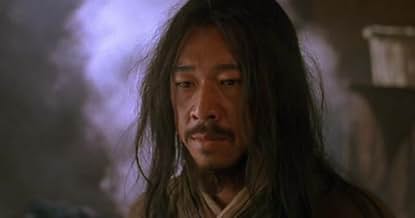
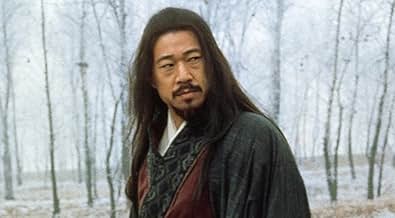
Some of the complaints about the movie have been the golden/brown tint and the quick, disorienting editing. However, I loved both of these qualities in the movie, though the editing did take some time to get used to. A great example of it, is when we're introduced to Jing Ke, the assassin. He is offered an assignment for five thousand, and we see a close up of his face as he demands ten thousand. The next shot shows him with sword drawn, in the house of his victims. That whole introduction to the assassin was marvelously edited, in my opinion. You have to realize that in order to fit the epic plot into just under three hours, a lot of tiny details needed to be cut out. The quick editing also makes the movie seem much shorter than it really is.
Someone said that the swordfighting in the movie (what little of it there was) seemed like high school drama, but I strongly disagree. Most of the action is captured in a few shots, making it seem much more realistic. In so many american films, we see a a flash of a dozen close ups, without getting a feel for what is even happening! Also, the constant use of slow motion in many movies gets so old. By having the fighting in this movie fast and furious, it is much more affecting.
I won't give away the ending, but it was really suspenseful and surprising. I had no idea what would happen (being unfamiliar with Chinese history helped), and was on the edge of my seat! So, to conclude, if you like sweeping historical epics, make sure to see this! I really like the films of Kurosawa, and saw some similarities here, so also if you like his movies, see this!!
Some of the complaints about the movie have been the golden/brown tint and the quick, disorienting editing. However, I loved both of these qualities in the movie, though the editing did take some time to get used to. A great example of it, is when we're introduced to Jing Ke, the assassin. He is offered an assignment for five thousand, and we see a close up of his face as he demands ten thousand. The next shot shows him with sword drawn, in the house of his victims. That whole introduction to the assassin was marvelously edited, in my opinion. You have to realize that in order to fit the epic plot into just under three hours, a lot of tiny details needed to be cut out. The quick editing also makes the movie seem much shorter than it really is.
Someone said that the swordfighting in the movie (what little of it there was) seemed like high school drama, but I strongly disagree. Most of the action is captured in a few shots, making it seem much more realistic. In so many american films, we see a a flash of a dozen close ups, without getting a feel for what is even happening! Also, the constant use of slow motion in many movies gets so old. By having the fighting in this movie fast and furious, it is much more affecting.
I won't give away the ending, but it was really suspenseful and surprising. I had no idea what would happen (being unfamiliar with Chinese history helped), and was on the edge of my seat! So, to conclude, if you like sweeping historical epics, make sure to see this! I really like the films of Kurosawa, and saw some similarities here, so also if you like his movies, see this!!
The Emperor and the Assassin, sure, but don't forget Lady Zhao!
This is an excellent film. No, it's not Mel Gibson in "Braveheart," but then, it's not trying to be. Actually, "The Emperor and the Assassin" probably has (thankfully) more in common with a Shakespearean production than a Hollywood blockbuster.
In the third century BC, the King of Qin is attempting to unite (in other words "conquer") the seven kingdoms of China. He has already overthrown the Kingdom of Han. Now he needs an excuse to invade the Kingdom of Yan.
This is where the Lady Zhao comes in. She and the King have been friends since childhood. They are obviously very much in love, but cannot marry for political reasons. Together they devise a plot. She will pretend to have fallen into disfavor with the King and escape to Yan. Once there she will convince the Prince of Yan to send an assassin back to kill the King. When the assassination fails, the King will have his excuse to invade Yan.
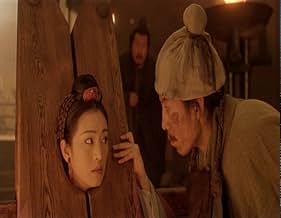
Once in Yan, however, Lady Zhao begins to reconsider. Hearing and seeing more and more examples of her old childhood friend's ruthlessness, she begins to wonder if the King may need to be assassinated for real.
One sure sign that you're not watching a Hollywood production is the final encounter between the King and the assassin. Unlike a Hollywood movie where the hero and villain are clearly defined and the final outcome already predetermined, this is a fight that could truly go either way.
This is a well crafted and well acted story of a tumultuous time in Chinese history. There is a mixture of both incredible beauty and incredible ugliness. Most beautiful of all, however, is Gong Li as the Lady Zhao. I grow more and more convinced every time I see her that Gong Li is the most beautiful woman in the world.
I must say, however, that she does have one unintentionally funny line in this film. Early on Gong Li asks one of her servants "Do I have a beautiful face?"
Duh!!!
In the third century BC, the King of Qin is attempting to unite (in other words "conquer") the seven kingdoms of China. He has already overthrown the Kingdom of Han. Now he needs an excuse to invade the Kingdom of Yan.
This is where the Lady Zhao comes in. She and the King have been friends since childhood. They are obviously very much in love, but cannot marry for political reasons. Together they devise a plot. She will pretend to have fallen into disfavor with the King and escape to Yan. Once there she will convince the Prince of Yan to send an assassin back to kill the King. When the assassination fails, the King will have his excuse to invade Yan.
Once in Yan, however, Lady Zhao begins to reconsider. Hearing and seeing more and more examples of her old childhood friend's ruthlessness, she begins to wonder if the King may need to be assassinated for real.
One sure sign that you're not watching a Hollywood production is the final encounter between the King and the assassin. Unlike a Hollywood movie where the hero and villain are clearly defined and the final outcome already predetermined, this is a fight that could truly go either way.
This is a well crafted and well acted story of a tumultuous time in Chinese history. There is a mixture of both incredible beauty and incredible ugliness. Most beautiful of all, however, is Gong Li as the Lady Zhao. I grow more and more convinced every time I see her that Gong Li is the most beautiful woman in the world.
I must say, however, that she does have one unintentionally funny line in this film. Early on Gong Li asks one of her servants "Do I have a beautiful face?"
Duh!!!
Certainly not disappointing
For a feature film, the plot closely follows history--or at least historical gossip. But then the Chinese, who know the story very well from seeing it portrayed again and again, would never tolerate it otherwise. The attention to detail is wonderful, especially for anyone who has read Sima Qian's account in the Records of the Historian. Jing Ke, according to Sima Qian, did indeed make an attempt on Qin Shi Huang's life at the request of the Crown Prince of Yan before unification. Sima Qian explicitly mentions both the head of General Fan and the dagger rolled up into the map, as well as the dagger being thrown into the brass column. Although Jing Ke is described as no stranger to swordplay, he's hardly the invincible warrior portrayed by Chen Kaige. Jing Ke is indeed this film's weakest link. In reality (again, according to Sima Qian), he was a heavy drinker and put off his visit to Qin for as long as possible, spending a good deal of time with the ladies of Yan before the crown prince finally ordered him on his way. He was, in short, a human being and was not looking forward to death although he was willing to accept it. Chen Kaige's Jing Ke is afraid of death, but not his own. He is the classic ruthless killer turned disillusioned pacifist. His love (or maybe just affection) for a woman and pity for several hundred children whom Zheng had buried alive (not even two thousand years of hostile Confucian historians claimed Qin Shi Huang did this, although there is a legend about him burying 460 Confucians up to their necks and then beheading them)is enough to make this former assassin kill again. The melodrama is not convincing and the character ends up being just plain boring. The acting here isn't shabby, though not very interesting given the character. As for Lady Zhou, in all the numerous stories I've heard about Qin Shi Huang, she's never come up. Anyway, Gong Li is famous enough for Americans to have heard of her (thanks to Zhang Yimou) and there needed to be a love interest, so here she is. It's unfortunate that her performance is almost as wooden as Jing Ke's character. She's done much better (in Qiu Ju for example) at being subtle; here she just barely manages presence. But all of this is trivial compared to the extraordinary acting of Li Xuejian as Zheng himself. Qin Shi Huang is for the Chinese rather what Milton's Satan is for us: accepted as a villain, but a noble one. Qin Shi Huang's accomplishments radiate an awe all the way across two thousand years into the present and Li captures his frightening will without compromising his humanity. Li's performance is enough, but the scope of the film is grand although the photography is purposely drab. It does feel ancient. The score is adequate, scarcely moving though very appropriate to the action. Though I've only seen it once, I believe that Chen Kaige should be given more credit for his camera work than other reviewers have allowed him. The opening credits are exhilarating. If five stars its absolutely average, I given three more for Li Xuejian's acting and Chen Kaige as an actor, writer, and director.
A compelling epic
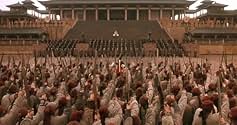
This three-hour Chinese epic, set in 220 B.C., may ultimately amount to a familiar theme of an Emperor's idealistic dream of peace through unification mutating into corrupted isolation, and there's nothing inherently challenging about the film, but it's a compelling narrative, crammed with intrigue and passion and betrayal and epic events told in vivid strokes. Even for those not drawn to such historical spectacles for their own sake, it's an astonishing feast for the eyes: the scene depicting the coup attempt of the Marquis is one of the most staggering evocations of physical space and grandeur in memory, and the battle scenes are memorable both in their scope and their immediacy. The title sums up the film's use of compelling contrasts - huge plainland vistas set against intimate horrors; the noblest of motives set against the most degraded; hope turning to dust. If you've never seen a three-hour Chinese epic, this wouldn't be a bad place to start.
Compared to Farewell My Concubine, it does not reach that level
Chen Kiage (Farewell My Concubine) and Zhang Yimou (Red Sorghum, To Live) have been always considered two of the greatest director of modern China cinema history. This time Chen took three years after his previous film and came back with a movie about the first Chinese emperor Qin and his legendary story with a woman he loves, his adversary and an assassin in very ancient China of 221 BC. Assassin Jingke stab emperor Qin is a well know story that nearly every Chinese know it so well. Assassin Jingke was considered a biggest hero in the history for his great sacrifice spirit and the brave suicide assassination, although his action was failed. Zhang Fengyi is one of my favorite actor (I like his performance in Farewell my concubine), his assassin Jinke is silent and full of passion in the heart, that is convincing. Li Xuejian is honorable actor but just miscast here, His King Qin is always with tears in his eyes and feels miserable. I can not understand why Chen decides to make this most tyranny emperor in the Chinese history always crying. The most attractive role in the movie is Marquis Changxin, he married Qin's mother and most time he looks like idiot but actually he has his own ambitious plan. Marquis Changxin is convincingly played by Wang Zhiwen, I like him so much.
The movie do have some memorable moments, one is Jingke took a assignment to kill the whole family of ironsmith, but when he facing the angelic blind daughter of ironsmith, he cannot do his job. Late, the daughter killed herself. That event had a biggest influence for the rest of Jingke's life, also a big impact for the audience.
The movie has some most popular Chinese comedian (Pan Changjiang for prison officer and Zhao Benshan for Gao Jianli) for the friendly cameo, when they appears in the screen, audience shout and smiled. This would not happened when this movie is showed in country outside China.
I don't know if it is the biggest budget film in China, but it is surely one of them. They built Qin's palace especially for this movie and now becomes a tourist sight. It is near my city. I didn't go there but my father did. He said it is great building.
Overall, this is the excellent movie for the people like ancient Chinese costume and culture. The photography is very beautiful. Compared to the greatest "Farewell My Concubine", Chen does not make it reach that level. I give it *** for the rate from * to ****.
The movie do have some memorable moments, one is Jingke took a assignment to kill the whole family of ironsmith, but when he facing the angelic blind daughter of ironsmith, he cannot do his job. Late, the daughter killed herself. That event had a biggest influence for the rest of Jingke's life, also a big impact for the audience.
The movie has some most popular Chinese comedian (Pan Changjiang for prison officer and Zhao Benshan for Gao Jianli) for the friendly cameo, when they appears in the screen, audience shout and smiled. This would not happened when this movie is showed in country outside China.
I don't know if it is the biggest budget film in China, but it is surely one of them. They built Qin's palace especially for this movie and now becomes a tourist sight. It is near my city. I didn't go there but my father did. He said it is great building.
Overall, this is the excellent movie for the people like ancient Chinese costume and culture. The photography is very beautiful. Compared to the greatest "Farewell My Concubine", Chen does not make it reach that level. I give it *** for the rate from * to ****.


Le saviez-vous
- AnecdotesThe Xianyang palace was reconstructed in its entirety in the city of Dongyang in Zhenjiang province. Much of the film, including the final scene, was shot there. It is now being preserved as a theme park drawing large numbers of tourists. In addition, the capital cities of the other kingdoms featured in the film, Yan Zhao and Han, were constructed as several sights across China. All have been meticulously built to scale with special attention paid to their historical accuracy.
- Autres versionsFirst cut was deemed regime-critic by chinese censors and therefore rejected. Approximately 30 minutes were cut to make a more regime-friendly version.
Meilleurs choix
Connectez-vous pour évaluer et surveiller les recommandations personnalisées
Détails
- Date de sortie
- Pays d’origine
- Sites officiels
- Langue
- Aussi connu sous le nom de
- The Emperor and the Assassin
- sociétés de production
- Consultez plus de crédits d'entreprise sur IMDbPro
Box-office
- Budget
- 15 000 000 $ US (estimation)
- Brut – États-Unis et Canada
- 1 267 239 $ US
- Fin de semaine d'ouverture – États-Unis et Canada
- 47 295 $ US
- 19 déc. 1999
- Brut – à l'échelle mondiale
- 1 267 239 $ US
- Durée
- 2h 42m(162 min)
- Couleur
- Mixage
- Rapport de forme
- 1.85 : 1
Contribuer à cette page
Suggérer une modification ou ajouter du contenu manquant