ÉVALUATION IMDb
6,8/10
9,8 k
MA NOTE
Ajouter une intrigue dans votre langueA woman watches time passing next to the suitcases of her ex-lover (who is supposed to come pick them up, but never arrives) and a restless dog who doesn't understand that his master has aba... Tout lireA woman watches time passing next to the suitcases of her ex-lover (who is supposed to come pick them up, but never arrives) and a restless dog who doesn't understand that his master has abandoned him. Two living beings facing abandonment.A woman watches time passing next to the suitcases of her ex-lover (who is supposed to come pick them up, but never arrives) and a restless dog who doesn't understand that his master has abandoned him. Two living beings facing abandonment.
- Réalisation
- Scénaristes
- Vedettes
6,89.8K
1
2
3
4
5
6
7
8
9
10
Avis en vedette
Oh well, we don't find out now that Pedro
While Swintons performance is a great showcase for her range and understanding of this character - The Human Voice can feel a bit to self indulgent and overly sarcastic. Almodovars direction shines in the moments where Swinton dominates the screen but falters when trying to build a world around her that would support the feeling of the emotional turmoil she is in.
Cocteau according to Almodóvar
Jean Cocteau's play La Voix Humaine (The Human Voice) opened at the Comédie Française in 1930 as a atar vehicle for Belgian actress Berthe Bovy, then popular in Parisian stages. The work involves a woman, only identified as Elle = She, speaking on the telephone with his lover of several years, who is leaving her.for another woman. Her interlocutor is silent for the duration and we don't even know for sure if he is listening or if the connection has been broken.
The play had an enduring popularity, and has been since in the repertory of many theater companies. It was put on screen several times, among them by Roberto Rossellini (first episode of L'Amore 1946: actress Anna Magnani) and by Ted Kotcheff (1966: actress Ingrid Bergman). It even had a second life as an opera by Francis Poulenc in 1958, which has been as well accepted as the play and is still being staged and recorded.
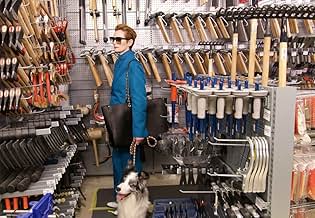
This being the Almodóvar version, we may expect some off the wall happenings. One is a very funny scene where the protagonist browses for axes in a hardware store that seems to have an unusually large inventory of the item. On another, the axe in question is used in a hilarious way. We are shown mid-movie that She's apartment is actually a set in a sound stage which is perhaps a gentle dig at he artificiality of the play. And, last but not least, we have the director's trademark, cinematography in gloriously saturated colors. Tilda Swinton does an outstanding job as She; she tones down the melodrama and borders on the humorous at times. All in all, a refreshing take on the play and the best version I have seen.
The play had an enduring popularity, and has been since in the repertory of many theater companies. It was put on screen several times, among them by Roberto Rossellini (first episode of L'Amore 1946: actress Anna Magnani) and by Ted Kotcheff (1966: actress Ingrid Bergman). It even had a second life as an opera by Francis Poulenc in 1958, which has been as well accepted as the play and is still being staged and recorded.
This being the Almodóvar version, we may expect some off the wall happenings. One is a very funny scene where the protagonist browses for axes in a hardware store that seems to have an unusually large inventory of the item. On another, the axe in question is used in a hilarious way. We are shown mid-movie that She's apartment is actually a set in a sound stage which is perhaps a gentle dig at he artificiality of the play. And, last but not least, we have the director's trademark, cinematography in gloriously saturated colors. Tilda Swinton does an outstanding job as She; she tones down the melodrama and borders on the humorous at times. All in all, a refreshing take on the play and the best version I have seen.
Pedro and Tilda
Pedro Almodovar's short is, as the credits state - "freely adapted" from a Jean Cocteau stage production. Almodovar retains the central conceit of the play as it essentially is a monologue with a woman on a telephone talking with a lover (the other voice is never heard). Almodovar includes a brief prologue and he winks at the viewer by 'revealing' the artificiality of his own production. He also revels in his usual saturated color schemes.
Fortunately, the woman is played by Tilda Swinton who has to carry the full half hour alone. Almodovar wisely has shaped the material (for the first time in English) around Swinton's talents and she carries it off for the most part, even if some of the eccentricities the Writer-Director don't really work.
The dog
The dog is identified in the film credits at the end, but oddly not here - his name is Dash. And he does a great job.
Minor Almodóvar.
'The Human Voice (2020)' is a short film based around Jean Cocteau's play of the same name. It's directed by Pedro Almodóvar (his English-language debut) and stars Tilda Swinton as pretty much the only on-screen character (there are some background extras towards the start, but that's about it). It's a very pared-down affair, not just within its story but also within its presentation. Though it's colourful and sometimes lavish, it doesn't have the same, shall I say, 'high-calibre melodrama' feel that much of the famous director's work has. Instead, it draws as much attention to its focal performance as possible, the film taking a backseat to its subject. This isn't necessarily a bad thing, even if it runs the risk of making the flick's central monologue become a little monotonous, as it draws attention to the main reason the thing exists in the first place. In many ways, the short feels purely like a vehicle for Swinton to flex her acting muscles. The actual story isn't all that impactful and it's only as interesting as it is (it never gets boring) because it's performed so utterly well. Ultimately, however, the flick comes across as a little hollow. It's entertaining enough for what it is, but it doesn't have much staying power and it isn't actually all that compelling. It isn't bad, don't get me wrong. It's just a very, I suppose, 'in-one-ear-and-out-the-other' kind of thing. Still, it's worth a watch if you're a fan of its director, star or source material (which, incidentally, bears some similarities with 'Women On The Verge Of A Nervous Breakdown (1988)', since Almodóvar has been inspired by Cocteau's work for quite some time). 6/10.
Le saviez-vous
- AnecdotesThis is Pedro Almodóvar's first film in English.
- ConnexionsFeatured in Projector @ LFF: One Night in Miami/The Human Voice (2020)
Meilleurs choix
Connectez-vous pour évaluer et surveiller les recommandations personnalisées
Détails
Box-office
- Brut – à l'échelle mondiale
- 164 623 $ US
- Durée
- 30m
- Couleur
- Mixage
- Rapport de forme
- 1.85 : 1
Contribuer à cette page
Suggérer une modification ou ajouter du contenu manquant