NOTE IMDb
6,9/10
2,1 k
MA NOTE

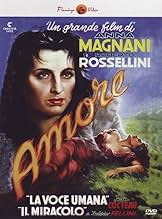
Ajouter une intrigue dans votre langueIn part one, a heartbroken woman talks to her ex-lover on the phone. In part two, a pregnant woman believes she is carrying the child of Saint Joseph.In part one, a heartbroken woman talks to her ex-lover on the phone. In part two, a pregnant woman believes she is carrying the child of Saint Joseph.In part one, a heartbroken woman talks to her ex-lover on the phone. In part two, a pregnant woman believes she is carrying the child of Saint Joseph.
- Réalisation
- Scénaristes
- Stars
- Récompenses
- 2 victoires et 2 nominations au total

Anna Magnani
- La donna al telefono
- (segments "Una voce umana", "Il miracolo")
- …

Federico Fellini
- Il vagabondo
- (segment "Il miracolo")
- (non crédité)
Amelia Robert
- L'insegnante
- (segment "Il miracolo")
- (non crédité)
6,92.1K
1
2
3
4
5
6
7
8
9
10
Avis à la une
10sakatz
The Miracle, Censorship and the Supreme Court
Contrary to the previous reviewer, "The Miracle" WAS released in New York City at the Paris Theater in 1950 (it was part of a 2-film anthology called "The Ways of Love"). It did well at the box office and went on to win Best Foreign Film from the NY Film Critics.
Cardinal Spellman objected to the film and denounced it in print. Since the film had already passed the NY censorship board without objection, he put pressure on the owner of the Paris Theater to stop showing the film before he was able to get the censorship board to reverse itself.
The film's distributor, Joseph Burstyn, went to court to defend the film and the Supreme Court, in a landmark ruling in 1952, decided the censorship board had violated the Constitution's separation of church and state clause and, furthermore, reversed its 1915 Mutual Film vs. Ohio ruling and determined that film was protected under the First Amendment.
Cardinal Spellman objected to the film and denounced it in print. Since the film had already passed the NY censorship board without objection, he put pressure on the owner of the Paris Theater to stop showing the film before he was able to get the censorship board to reverse itself.
The film's distributor, Joseph Burstyn, went to court to defend the film and the Supreme Court, in a landmark ruling in 1952, decided the censorship board had violated the Constitution's separation of church and state clause and, furthermore, reversed its 1915 Mutual Film vs. Ohio ruling and determined that film was protected under the First Amendment.
Essential,
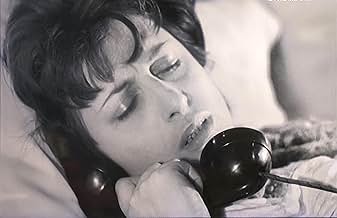
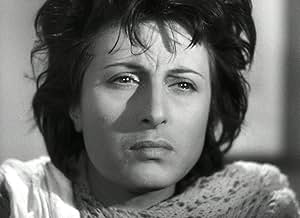
Long unavailable in its entirety Roberto Rossellini's "L'Amore" remains one of his very greatest films. It is, in fact, two films; the second part, "The Miracle" has been shown separately and ran into censorship problems both in Italy and abroad. Fundamentally, it is a vehicle for Anna Magnani who is quite magnificent. In the first part, Cocteau's monologue "The Human Voice", she is the only person on screen, a lone woman on the telephone to the lover who has left her for another woman. For a good deal of the time Rossellini keeps the camera on that wonderful face and she is heart-breaking.
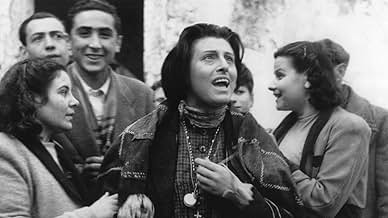
In the second part she is the deluded peasant seduced, and made pregnant, by none other than Federico Fellini , (who co-wrote the script with Rossellini and Tullio Pinelli). Magnani believes her seducer to be St Jospeh and the baby she is carrying to be some sort of new Messiah, (it was this that so offended the powers that be). Again she is magnificent, (Rossellini dedicated the film 'to the art of Anna Magnani"), in a role totally different from the part she plays in "The Human Voice". It is easy to see how this second part could be released separately from the first, (they are very different in tone), and this small masterpiece is as great a 'short' film as the cinema has given us. Nevertheless, seeing both parts together is testament to the genius of both director and star. Essential.
In the second part she is the deluded peasant seduced, and made pregnant, by none other than Federico Fellini , (who co-wrote the script with Rossellini and Tullio Pinelli). Magnani believes her seducer to be St Jospeh and the baby she is carrying to be some sort of new Messiah, (it was this that so offended the powers that be). Again she is magnificent, (Rossellini dedicated the film 'to the art of Anna Magnani"), in a role totally different from the part she plays in "The Human Voice". It is easy to see how this second part could be released separately from the first, (they are very different in tone), and this small masterpiece is as great a 'short' film as the cinema has given us. Nevertheless, seeing both parts together is testament to the genius of both director and star. Essential.
Historically an Important Movie as the First to Challenge Censorship in Hollywood Films
Movies in the United States weren't protected under the First Amendment providing free speech ever since a 1915 United States Supreme Court ruling saw filmmaking as a business rather than simply public opinion. The Italian film August 1948 "L'Amore" ("Love"), directed by Roberto Rossellini, became a landmark case which was the first step in the erosion of censorship in Hollywood. Reviewing the content of the Italian film, the Supreme Court stated in a 1952 decision Rossellini's work is a form of artistic expression, giving cinema First Amendment rights guaranteeing freedom of speech, the first time since 1915.
Broken into two segments, "L'Amore's" first part, 'The Human Voice,' didn't cause any problems with the Hays Office censors when it was first shown in New York City in 1950. But it was the second half, titled 'The Miracle,' which sent dissenters howling in protest, especially those in high authority in the Catholic Church. The controversy was litigated all the way to the Supreme Court, whose members unanimously ruled in favor of the movie's U. S. distributor, Joseph Burstyn. Said film reviewer Gino Moliterno of the milestone decision, "Part of the miracle of Il miracolo, then, turned out to be its role in initiating the beginning of the demise of film censorship in the United States." 'The Miracle,' starring Anna Magnani and Federico Fellini, the future Italian director in his only acting film role and who wrote the script, sees Nannina as a borderline religious fanatic who makes a living gathering astray goats on the town's steep hillsides. She meets a stranger whom she thinks is Saint Joseph. A bit of wine and a sleepy nap results in Nannina's pregnancy. She thinks it's all due to a miracle rather than the stranger taking advantage of her. The townspeople make fun of her reasoning, causing her to seek refuge in the hills where she's about to give birth. A goat leads her to an empty church to deliver her baby.
Once released in Italy, 'The Miracle' elicited some criticism but no obstacles in showing it. The negativity was largely more for its aesthetics, criticizing the director whose 1945's "Rome, Open City" introduced Italian neo-realism for not sticking to the genre. Those critics bemoaned, "Rossellini has completely abandoned neo-realism." But it was a different story in the United States when "L'amore" premiered at NYC's Paris Theatre in December 1950. Distributor Joseph Burstyn dropped the feature film's first part, 'The Human Voice,' and lumped ' The Miracle' in with two French short films, one by director Jean Renoir. Protesters began carrying signs proclaiming "Don't Enter the Cesspool," supported by the National Legion of Decency and the Catholic diocese, led by Cardinal Francis Spellman, who on the pulpit called Rossellini's short film blasphemous. Despite the New York Film Critics voting it the best foreign language film of the year, the New York State Board of Regents condemned it, labeling the short film 'sacrilegious." The state's authorities pulled Burstyn's movie license. In 'Joseph Burstyn, Inc. V. Wilson,' the case went through the state's court system, ending up at the U. S. Supreme Court. In a 9-0 vote delivered in May 1952, the Court claimed in what is called the 'Miracle Decision,' films DO enjoy freedom of expression.
The Supreme Court's decision didn't quite open the floodgates towards total abandonment of film censorship. The Hays Office, formed in an agreement between the studios and the censors, still exercised its control so individual local and state governments would unlikely sue Hollywood film companies in expensive lawsuit cases. But the 'Miracle Decision' did establish a precedent which served as a foundation for subsequent court cases which relied on the 'Miracle Decision' to thwart censoring movies. The 1952 ruling ultimately led to a total abandonment of the Hays Office and censorship by the mid-1960s in most parts of the United States.
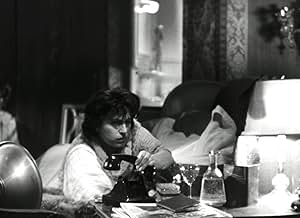
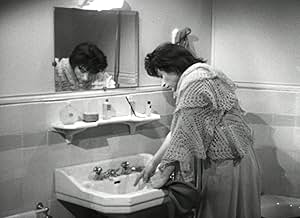
"L'Amore's" opener, known as 'The Human Voice," adapted from a Jean Cocteau 1930 play, stars actress Magnani in a solo performance whose telephone conversation with a boyfriend consists of the entire short film. He informs her he's marrying another woman the next day. As film reviewer Jay Carr notes, "It's her face in closeup that does the job, whether expressing raw suffering, or aching anxiety when, running her hands over her face while looking in a mirror at unforgiving evidence that she's alone and getting older." While Magnani and Rossellini were staying in Paris, she mentioned to the director her one-woman 1942 stage act would make for a great short film. He agreed, filming the extended scene at a local Paris movie studio. To make it into a full-length movie, he directed 'The Miracle,' whose script was written by Fellini, to accompany 'The Human Voice.' Because of "L'Amore's" milestone court case, the feature film is forever included in the history books for changing the course of American cinema.
Broken into two segments, "L'Amore's" first part, 'The Human Voice,' didn't cause any problems with the Hays Office censors when it was first shown in New York City in 1950. But it was the second half, titled 'The Miracle,' which sent dissenters howling in protest, especially those in high authority in the Catholic Church. The controversy was litigated all the way to the Supreme Court, whose members unanimously ruled in favor of the movie's U. S. distributor, Joseph Burstyn. Said film reviewer Gino Moliterno of the milestone decision, "Part of the miracle of Il miracolo, then, turned out to be its role in initiating the beginning of the demise of film censorship in the United States." 'The Miracle,' starring Anna Magnani and Federico Fellini, the future Italian director in his only acting film role and who wrote the script, sees Nannina as a borderline religious fanatic who makes a living gathering astray goats on the town's steep hillsides. She meets a stranger whom she thinks is Saint Joseph. A bit of wine and a sleepy nap results in Nannina's pregnancy. She thinks it's all due to a miracle rather than the stranger taking advantage of her. The townspeople make fun of her reasoning, causing her to seek refuge in the hills where she's about to give birth. A goat leads her to an empty church to deliver her baby.
Once released in Italy, 'The Miracle' elicited some criticism but no obstacles in showing it. The negativity was largely more for its aesthetics, criticizing the director whose 1945's "Rome, Open City" introduced Italian neo-realism for not sticking to the genre. Those critics bemoaned, "Rossellini has completely abandoned neo-realism." But it was a different story in the United States when "L'amore" premiered at NYC's Paris Theatre in December 1950. Distributor Joseph Burstyn dropped the feature film's first part, 'The Human Voice,' and lumped ' The Miracle' in with two French short films, one by director Jean Renoir. Protesters began carrying signs proclaiming "Don't Enter the Cesspool," supported by the National Legion of Decency and the Catholic diocese, led by Cardinal Francis Spellman, who on the pulpit called Rossellini's short film blasphemous. Despite the New York Film Critics voting it the best foreign language film of the year, the New York State Board of Regents condemned it, labeling the short film 'sacrilegious." The state's authorities pulled Burstyn's movie license. In 'Joseph Burstyn, Inc. V. Wilson,' the case went through the state's court system, ending up at the U. S. Supreme Court. In a 9-0 vote delivered in May 1952, the Court claimed in what is called the 'Miracle Decision,' films DO enjoy freedom of expression.
The Supreme Court's decision didn't quite open the floodgates towards total abandonment of film censorship. The Hays Office, formed in an agreement between the studios and the censors, still exercised its control so individual local and state governments would unlikely sue Hollywood film companies in expensive lawsuit cases. But the 'Miracle Decision' did establish a precedent which served as a foundation for subsequent court cases which relied on the 'Miracle Decision' to thwart censoring movies. The 1952 ruling ultimately led to a total abandonment of the Hays Office and censorship by the mid-1960s in most parts of the United States.
"L'Amore's" opener, known as 'The Human Voice," adapted from a Jean Cocteau 1930 play, stars actress Magnani in a solo performance whose telephone conversation with a boyfriend consists of the entire short film. He informs her he's marrying another woman the next day. As film reviewer Jay Carr notes, "It's her face in closeup that does the job, whether expressing raw suffering, or aching anxiety when, running her hands over her face while looking in a mirror at unforgiving evidence that she's alone and getting older." While Magnani and Rossellini were staying in Paris, she mentioned to the director her one-woman 1942 stage act would make for a great short film. He agreed, filming the extended scene at a local Paris movie studio. To make it into a full-length movie, he directed 'The Miracle,' whose script was written by Fellini, to accompany 'The Human Voice.' Because of "L'Amore's" milestone court case, the feature film is forever included in the history books for changing the course of American cinema.
two portraits of sadness
L'Amore is divided into two parts, the first called "A Human Voice", and the second named "The Miracle". Anna Magnani is wonderful at both. The first episode is about love and sadness. A woman is pursuing for a man who does not love her any longer. The whole episode occurs whitin a bedroom, with Anna and a telephone. The dialogue of Anna with her ex-husband is simply fantastic and very emotive. The second episode, more cryptic and stronger, shows us a medieval Italian town with all its beliefs and supersticions. A woman, Anna Magnani again, makes remember us the mistery of creation, with symbolic references to some christian icons (as virgins, poor people, saints, etc.). In sum, this is a wonderful film.
The film that broke America's freedom of cinema.
When it was scheduled to be shown in New York, L' Amore was protested by religious leaders led by Cardinal Francis Spellman. The film board of New York quickly yanked it before even hitting the screen. After viewing this case, the Supreme Court ruled that for the first time that films are "a significant medium for the communication of ideas." It wasn't until this point that the First Amendment covered film as a freedom of speech. This didn't stop censorship, but it did open new doors.


Le saviez-vous
- AnecdotesWhen, in 1952, the "Il Miracolo" segment of the film was released in the United States as "The Miracle", it was the subject of a legal battle in which the Supreme Court ruled for the first time that motion pictures, like books and newspapers, were protected under the First Amendment to the Constitution.
- Citations
La donna al telefono (segment "Una voce umana"): What? My black satin dress. Yes, I'm still wearing it. No, I didn't smoke. Just three cigarettes. I swear
- ConnexionsEdited into Histoire(s) du cinéma: Une histoire seule (1989)
Meilleurs choix
Connectez-vous pour évaluer et suivre la liste de favoris afin de recevoir des recommandations personnalisées
- How long is Love?Alimenté par Alexa
Détails
- Date de sortie
- Pays d’origine
- Langue
- Aussi connu sous le nom de
- La voix humaine
- Lieux de tournage
- Amalfi Coast, Salerno, Campania, Italie("Il Miracolo" segment)
- Sociétés de production
- Voir plus de crédits d'entreprise sur IMDbPro
- Durée
- 1h 9min(69 min)
- Couleur
- Rapport de forme
- 1.37 : 1
Contribuer à cette page
Suggérer une modification ou ajouter du contenu manquant