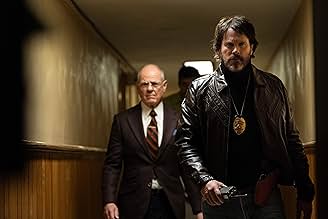
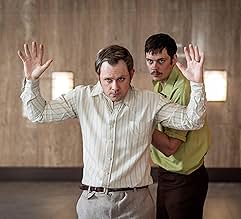
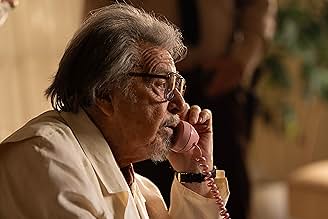
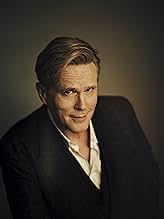
L'8 febbraio 1977, Tony Kiritsis, armato, irrompe nell'ufficio di Richard Hall, presidente della Meridian Mortgage Company, e lo prende in ostaggio, minacciandolo con un fucile da caccia pun... Leggi tuttoL'8 febbraio 1977, Tony Kiritsis, armato, irrompe nell'ufficio di Richard Hall, presidente della Meridian Mortgage Company, e lo prende in ostaggio, minacciandolo con un fucile da caccia puntato al collo da un meccanismo a filo.L'8 febbraio 1977, Tony Kiritsis, armato, irrompe nell'ufficio di Richard Hall, presidente della Meridian Mortgage Company, e lo prende in ostaggio, minacciandolo con un fucile da caccia puntato al collo da un meccanismo a filo.
Disponibile a breve
In uscita il 16 gennaio 2026
- Premi
- 1 vittoria e 2 candidature totali
7,0394
1
2
3
4
5
6
7
8
9
10
Recensioni in evidenza
Unflinching exploration of class, despair, and human empathy.
We saw a preview screening of Dead Man's Wire through Film Independent, followed by a powerful discussion with director Gus Van Sant and producer Cassian Elwes.
Based on the 1977 Tony Kiritsis hostage case, Dead Man's Wire retells a shocking real event: a man pushed to desperation by a mortgage company wires a shotgun to his mortgage broker and takes him hostage. Van Sant's direction transforms what could have been a cliched and formulaic true-crime story into an unflinching exploration of class, despair, and human empathy.
Bill Skarsgård delivers a career-defining performance as Tony Kiritsis. He grounds the role in vulnerability and wounded pride rather than pure rage. Dacre Montgomery, as Richard Hall, the hostage and reluctant villain, balances fear with surprising tenderness. Al Pacino, as Hall's father, looms like a cold shadow whose presence makes the film's flashes of humanity shine even brighter.
Colman Domingo's portrayal of the radio host is magnetic, his voice functions as conscience and chorus. From the studio booth he narrates, questions, and humanizes what the nation watches. His on-air calm becomes the film's moral center.
Visually, the film is a study in contrast. Van Sant and cinematographer Christopher Blauvelt use incredibly crisp and detailed images that could only be generated with modern technology, such as a burning cigarette or the close-up of someone's facial emotions, contrasted with stills reminiscent of grainy 70's newspaper B&W photography and the scanlines from the eras early color video cameras. The juxtaposition creates a layered visual tapestry that collapses documentary immediacy and archival memory into a single, haunting rhythm.
Danny Elfman's score weaves with period tracks from Gil Scott-Heron and Yes to give the film its emotional scaffolding. Sound design is precise: the crackle of a live microphone, the hollow echo of an empty office, the ominous small clicks of the device that gives the film its title. These elements turn aural texture into visceral tension.
The film also gestures at a broader pattern of public anger and institutional failure that come from the headlines of today. An examination of the moral complexity that helps the movie avoid cheap sensationalism. Instead it asks a sharper question: what happens when people are failed by legal, financial, and other systems?
Dead Man's Wire is timely. Foreclosures and financial desperation, corporate coldness and lack of compassion are not relics of the 1970s. Van Sant's film insists on empathy as an active response. It does not excuse violence. It insists on understanding the humananity behind it.
Beautifully acted, technically exacting, and emotionally resonant. A haunting meditation on dignity, rage, and the fragile threads that bind us. Highly recommended.
Based on the 1977 Tony Kiritsis hostage case, Dead Man's Wire retells a shocking real event: a man pushed to desperation by a mortgage company wires a shotgun to his mortgage broker and takes him hostage. Van Sant's direction transforms what could have been a cliched and formulaic true-crime story into an unflinching exploration of class, despair, and human empathy.
Bill Skarsgård delivers a career-defining performance as Tony Kiritsis. He grounds the role in vulnerability and wounded pride rather than pure rage. Dacre Montgomery, as Richard Hall, the hostage and reluctant villain, balances fear with surprising tenderness. Al Pacino, as Hall's father, looms like a cold shadow whose presence makes the film's flashes of humanity shine even brighter.
Colman Domingo's portrayal of the radio host is magnetic, his voice functions as conscience and chorus. From the studio booth he narrates, questions, and humanizes what the nation watches. His on-air calm becomes the film's moral center.
Visually, the film is a study in contrast. Van Sant and cinematographer Christopher Blauvelt use incredibly crisp and detailed images that could only be generated with modern technology, such as a burning cigarette or the close-up of someone's facial emotions, contrasted with stills reminiscent of grainy 70's newspaper B&W photography and the scanlines from the eras early color video cameras. The juxtaposition creates a layered visual tapestry that collapses documentary immediacy and archival memory into a single, haunting rhythm.
Danny Elfman's score weaves with period tracks from Gil Scott-Heron and Yes to give the film its emotional scaffolding. Sound design is precise: the crackle of a live microphone, the hollow echo of an empty office, the ominous small clicks of the device that gives the film its title. These elements turn aural texture into visceral tension.
The film also gestures at a broader pattern of public anger and institutional failure that come from the headlines of today. An examination of the moral complexity that helps the movie avoid cheap sensationalism. Instead it asks a sharper question: what happens when people are failed by legal, financial, and other systems?
Dead Man's Wire is timely. Foreclosures and financial desperation, corporate coldness and lack of compassion are not relics of the 1970s. Van Sant's film insists on empathy as an active response. It does not excuse violence. It insists on understanding the humananity behind it.
Beautifully acted, technically exacting, and emotionally resonant. A haunting meditation on dignity, rage, and the fragile threads that bind us. Highly recommended.
Interesting true crime story
I saw this film at the AFI Film Festival in Hollywood. I had not heard of this story before and when the chyron came on saying "based on a true story" I had my doubts - remember Fargo? Anyway, it is really a true story of a man (Bill Skarsgard) who kidnaps a mortgage company executive whom he believes cheated him. Skarsgard is outstanding as the man with a mission to get his money back and the supporting cast is good. Pacino's role is very limited but of course he is good as the executive's father. Direction by Gus Van Sant is good and the period recreations are well done with Louisville filling in for Indianapolis where the event actually occurred (I happened to talk to a gentlemen who sat next to me at another movie and he confirmed the location and accuracy of the movie). Bottom line - recommended for true crime fans.
Dead Man's Wire - Gus Van Sant's Boldest Film Yet
Dead Man's Wire is a masterclass in tonal balance-tense, hilarious, and deeply unsettling. Gus Van Sant crafts a 1970s-set crime drama that feels both timeless and urgently relevant. From the first scene, I was hooked. The pacing is flawless, the atmosphere electric, and the emotional stakes never let up.
Bill Skarsgård delivers a performance that's nothing short of Oscar-worthy. His portrayal of Tony Kiritsis is manic, tragic, and disturbingly charismatic. But what truly surprised me was Al Pacino. In a brief but unforgettable role as the arrogant father of the hostage, Pacino channels a Southern drawl and a venomous detachment that adds a layer of surreal comedy to the film. His phone call scene-mocking his own son while refusing to apologize-is one of the most chilling and absurd moments I've seen on screen this year.
Van Sant's direction is razor-sharp. He allows moments of improvisation (the "milk with ice" detail was apparently ad-libbed!) that add authenticity and spontaneity. The production design perfectly captures the grainy, analog tension of the era, and the soundtrack-especially the radio segments-grounds the film in a media landscape that feels eerily familiar.
What elevates Dead Man's Wire is its refusal to simplify. It doesn't ask for pity, nor does it glorify madness. Instead, it exposes a system so broken that even the most outrageous acts begin to make sense. It's a film that laughs at the absurdity of injustice while never losing sight of its human cost.
This is Van Sant at his most daring, most political, and most emotionally precise. A cinematic triumph.
Bill Skarsgård delivers a performance that's nothing short of Oscar-worthy. His portrayal of Tony Kiritsis is manic, tragic, and disturbingly charismatic. But what truly surprised me was Al Pacino. In a brief but unforgettable role as the arrogant father of the hostage, Pacino channels a Southern drawl and a venomous detachment that adds a layer of surreal comedy to the film. His phone call scene-mocking his own son while refusing to apologize-is one of the most chilling and absurd moments I've seen on screen this year.
Van Sant's direction is razor-sharp. He allows moments of improvisation (the "milk with ice" detail was apparently ad-libbed!) that add authenticity and spontaneity. The production design perfectly captures the grainy, analog tension of the era, and the soundtrack-especially the radio segments-grounds the film in a media landscape that feels eerily familiar.
What elevates Dead Man's Wire is its refusal to simplify. It doesn't ask for pity, nor does it glorify madness. Instead, it exposes a system so broken that even the most outrageous acts begin to make sense. It's a film that laughs at the absurdity of injustice while never losing sight of its human cost.
This is Van Sant at his most daring, most political, and most emotionally precise. A cinematic triumph.
This is NOT really an Al Pacino film.
Al Pacino receives top billing in this true-life story, though he's probably in the film no more than five or ten minutes. So, if you're watching it for him, you'll likely feel hoodwinked!
The story is about a real person, Tony Kiritsis (Bill Skarsgård). In 1977, Kiritsis entered mortgage company office...taking the president hostage and rigging him up with a 'dead man's wire'...a harness of sorts attached to a shotgun aimed at the president! In other words, if police tried to stop Kiritsis, the gun would go off. Why did he do this desperate act? Well, he felt like the company had ruined him financially...stealing his idea for a shopping mall. What happened after? See the film.
The acting is generally very good (though Pacino does seem to ham it up a bit) and the story is interesting. However, it's also a film you could either watch or just read the Wikipedia article about Kiritsis. Now I am not saying it's a bad film in any way...it's very good. But the story is simple and if you just want to know how it all works out, read the article.
The story is about a real person, Tony Kiritsis (Bill Skarsgård). In 1977, Kiritsis entered mortgage company office...taking the president hostage and rigging him up with a 'dead man's wire'...a harness of sorts attached to a shotgun aimed at the president! In other words, if police tried to stop Kiritsis, the gun would go off. Why did he do this desperate act? Well, he felt like the company had ruined him financially...stealing his idea for a shopping mall. What happened after? See the film.
The acting is generally very good (though Pacino does seem to ham it up a bit) and the story is interesting. However, it's also a film you could either watch or just read the Wikipedia article about Kiritsis. Now I am not saying it's a bad film in any way...it's very good. But the story is simple and if you just want to know how it all works out, read the article.
Slick 70s crime tale from Gus Van Sant
Watched at the 2025 Toronto International Film Festival.
Gus Van Sant has always been a fascinating director as his works on Elephant, Good Will Hunting, Gerry, To Die For, Last Days, and Paranoid Park are some of my favorite indie art-house movies ever. Since his last movie in seven years, Van Sant brings a slick, tense and comedic tale about the kidnapping and crime moment by Tony Kiritsis and the tension surrounding the event.
Throughout, the production designs, Van Sant's direction and the atmosphere is strong. It helps build a sense of it's time period and the characters that are situated in this tense moment. What Van Sant succeeds is grasping the characters motives, understand their personalities and see through them as human. Paralleling themes about the corrupted and flawed system behind the mortgage and money business, and the conflicts it creates. The writing, while it is pretty straight-forward and predictable, is solid as some of the themes and concepts explored are interesting.
All of the performances are pretty good. Bill Skarsard is absolutely fantastic, alongside with the rest of the cast members. I do wish some of the pacing in the second act and certain dialogue moments could improve as some of the moments did feel a bit overlong or strangely paced at times. But overall, it's nice to see Van Sant still got it with his talents.
Gus Van Sant has always been a fascinating director as his works on Elephant, Good Will Hunting, Gerry, To Die For, Last Days, and Paranoid Park are some of my favorite indie art-house movies ever. Since his last movie in seven years, Van Sant brings a slick, tense and comedic tale about the kidnapping and crime moment by Tony Kiritsis and the tension surrounding the event.
Throughout, the production designs, Van Sant's direction and the atmosphere is strong. It helps build a sense of it's time period and the characters that are situated in this tense moment. What Van Sant succeeds is grasping the characters motives, understand their personalities and see through them as human. Paralleling themes about the corrupted and flawed system behind the mortgage and money business, and the conflicts it creates. The writing, while it is pretty straight-forward and predictable, is solid as some of the themes and concepts explored are interesting.
All of the performances are pretty good. Bill Skarsard is absolutely fantastic, alongside with the rest of the cast members. I do wish some of the pacing in the second act and certain dialogue moments could improve as some of the moments did feel a bit overlong or strangely paced at times. But overall, it's nice to see Van Sant still got it with his talents.
Lo sapevi?
- QuizDead Man's Wire is partially based on the documentary Dead Man's Line (2018)
- BlooperThere are a few questionable items & phrases that either were not popular or didn't exist in 1977. "Kerfuffle" wasn't used in the US until the late 1990's, and Sugar-free baked goods would not have been easily available. They were most sought after for diabetics. If Richard Hall was seeking them out, the logic is- he was diabetic. But, that is not mentioned or ever an issue during his captivity, so this detail seems irrelevant.
I più visti
Accedi per valutare e creare un elenco di titoli salvati per ottenere consigli personalizzati
2025 TIFF Festival Guide
See the current lineup for the 50th Toronto International Film Festival this September.
Dettagli
- Tempo di esecuzione
- 1h 45min(105 min)
- Colore
Contribuisci a questa pagina
Suggerisci una modifica o aggiungi i contenuti mancanti