

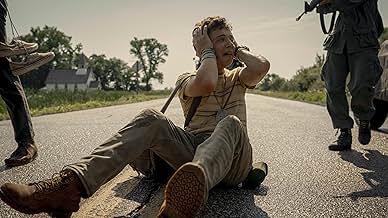
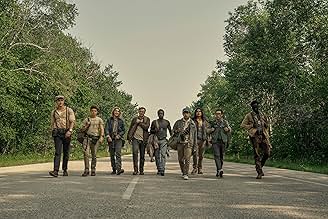
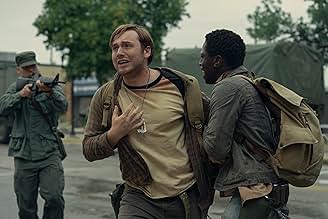
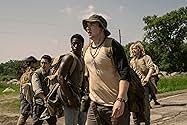
A group of teenage boys compete in an annual contest known as "The Long Walk," in which they must maintain a certain walking speed or get shot.A group of teenage boys compete in an annual contest known as "The Long Walk," in which they must maintain a certain walking speed or get shot.A group of teenage boys compete in an annual contest known as "The Long Walk," in which they must maintain a certain walking speed or get shot.
- Director
- Writers
- Stars
- Awards
- 1 win & 5 nominations total





- Director
- Writers
- All cast & crew
- Production, box office & more at IMDbPro
6.874.2K
1
2
3
4
5
6
7
8
9
10
Featured reviews
A Step Ahead
By 1977, Stephen King was rapidly becoming a household name, with the best sellers 'Carrie', 'Salem's Lot' and 'The Shining' making him one of the horror genre's rising stars. Success, however, brought limitations. At the time, publishers believed the public wouldn't accept more than one book a year from a single author, and King's output far outpaced that rule. To sidestep it- and to see whether his popularity came from genuine talent or just luck- he adopted the pseudonym, Richard Bachman. Bachman became both an experiment and an outlet, a shadow identity that allowed King to publish more freely without diluting the value of his established brand.
Bachman's second novel, 'The Long Walk,' was first published in 1979, though written years earlier while King was a freshman at the University of Maine. Set in a near-future America, it follows a group of young men competing in a brutal annual contest where they must keep walking above a set pace- or face execution.
A kind of science-fiction allegory for the Vietnam War draft, it resists being pinned down to a single reading, and has long tempted filmmakers. George A. Romero was first attached to direct in the late 1980s, but the project never materialized. Years later, Frank Darabont- who successfully adapted King's 'The Shawshank Redemption,' 'The Green Mile' and 'The Mist'- also took a crack at developing it, though his version likewise stalled in development. Finally, in late 2023, it was announced that Francis Lawrence had assumed directorial duties, working from a screenplay by JT Mollner.
Lawrence's film is a strong, faithful adaptation of the source material, capturing both its relentless tension and thematic depth. Although somewhat mischaracterized as a horror, the film is consistently unsettling, immersing viewers in a dystopian world where brutality and violence are commonplace. Much like the novel, it aims to explore themes of conscription, authoritarian control and the expendability of youth, while also serving as a pointed critique of capitalism and the societal pressures that pit individuals against one another.
However, while 'The Long Walk' gestures toward these themes, Lawrence rarely probes them with the depth they deserve, presenting them more as background texture than as active philosophical inquiry. For instance, the spectacle of the Walk itself is ripe for commentary on media voyeurism and desensitization, yet the film stops short of interrogating the audience's complicity or the system's mechanisms of control. It's evocative, but not especially reflective.
Moreover, Mollner's dialogue is occasionally clunky, leaning heavily on overwrought emotional beats. Characters speak less as people and more as thematic signposts, particularly in moments of tension where nuance is sacrificed to reiterate stakes we already understand. Further, the characters themselves are largely archetypal. While this mirrors King's tendency to populate his stories with familiar types, the film does little to complicate or humanize them. Motivations are thinly sketched, emotional arcs predictable. As a result, the titular walk feels less like a descent into psychological horror and more like a grim endurance test with interchangeable figures.
Beyond its narrative strengths and weaknesses, 'The Long Walk' excels in its technical execution, helping to sustain tension and immerse viewers in its dystopian world. Director of photography Jo Willems captures the relentless monotony and oppressive heat of the journey with a stark, unflinching eye. He utilises a muted colour palette- dominated by greys, browns, and washed-out greens- reinforcing the bleakness and brutality of the film's world.
Complementing the cinematography is Nicolas Lepage's minimalist, atmospheric production design. Rather than overbuilding the dystopia, he and his team suggest decay through subtle cues: crumbling buildings, cracked sidewalks, rusted metalwork. The roadside becomes a purgatory, with sparse signage and empty towns evoking both Americana and abandonment. It's not flashy, but its restraint serves the story- though some might wish for a more vivid sense of the society watching from the sidelines.
In addition, Mark Yoshikawa's editing is tight and purposeful, maintaining a steady rhythm mirroring the walk's relentless pace. Most of the film unfolds in linear fashion, enhancing the narrative's sense of inevitability- an endless march toward a conclusion that can only be grim. Jeremiah Fraites' score is subtly atmospheric, simmering beneath the surface like a pulse.
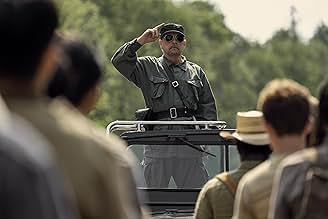
Although saddled with somewhat one-note characters, most of the cast perform admirably. Cooper Hoffman and David Jonsson, as the leading lads Ray Garraty and Peter McVries, carry the weight of the story with impressive intensity, conveying the physical strain and psychological tension of the walk with nuance. Ben Wang steals every scene he's in, while Charlie Plummer makes for an effective young psychopath. Further, Mark Hamill is a gruff delight as the constant-sunglass-sporting Major, who runs the show; someone you'll really love to hate.
In conclusion, while Francis Lawrence's 'The Long Walk' doesn't fully capitalize on the philosophical weight of its premise, it remains a gripping adaptation of one of Stephen King's most haunting early works. Lawrence's direction, paired with strong technical craftsmanship and committed performances, ensures the film leaves a lasting impression- even if it strolls past some of its deeper questions. It's a bleak, relentless journey that, despite its flaws, is a step ahead of many other King adaptations.
Bachman's second novel, 'The Long Walk,' was first published in 1979, though written years earlier while King was a freshman at the University of Maine. Set in a near-future America, it follows a group of young men competing in a brutal annual contest where they must keep walking above a set pace- or face execution.
A kind of science-fiction allegory for the Vietnam War draft, it resists being pinned down to a single reading, and has long tempted filmmakers. George A. Romero was first attached to direct in the late 1980s, but the project never materialized. Years later, Frank Darabont- who successfully adapted King's 'The Shawshank Redemption,' 'The Green Mile' and 'The Mist'- also took a crack at developing it, though his version likewise stalled in development. Finally, in late 2023, it was announced that Francis Lawrence had assumed directorial duties, working from a screenplay by JT Mollner.
Lawrence's film is a strong, faithful adaptation of the source material, capturing both its relentless tension and thematic depth. Although somewhat mischaracterized as a horror, the film is consistently unsettling, immersing viewers in a dystopian world where brutality and violence are commonplace. Much like the novel, it aims to explore themes of conscription, authoritarian control and the expendability of youth, while also serving as a pointed critique of capitalism and the societal pressures that pit individuals against one another.
However, while 'The Long Walk' gestures toward these themes, Lawrence rarely probes them with the depth they deserve, presenting them more as background texture than as active philosophical inquiry. For instance, the spectacle of the Walk itself is ripe for commentary on media voyeurism and desensitization, yet the film stops short of interrogating the audience's complicity or the system's mechanisms of control. It's evocative, but not especially reflective.
Moreover, Mollner's dialogue is occasionally clunky, leaning heavily on overwrought emotional beats. Characters speak less as people and more as thematic signposts, particularly in moments of tension where nuance is sacrificed to reiterate stakes we already understand. Further, the characters themselves are largely archetypal. While this mirrors King's tendency to populate his stories with familiar types, the film does little to complicate or humanize them. Motivations are thinly sketched, emotional arcs predictable. As a result, the titular walk feels less like a descent into psychological horror and more like a grim endurance test with interchangeable figures.
Beyond its narrative strengths and weaknesses, 'The Long Walk' excels in its technical execution, helping to sustain tension and immerse viewers in its dystopian world. Director of photography Jo Willems captures the relentless monotony and oppressive heat of the journey with a stark, unflinching eye. He utilises a muted colour palette- dominated by greys, browns, and washed-out greens- reinforcing the bleakness and brutality of the film's world.
Complementing the cinematography is Nicolas Lepage's minimalist, atmospheric production design. Rather than overbuilding the dystopia, he and his team suggest decay through subtle cues: crumbling buildings, cracked sidewalks, rusted metalwork. The roadside becomes a purgatory, with sparse signage and empty towns evoking both Americana and abandonment. It's not flashy, but its restraint serves the story- though some might wish for a more vivid sense of the society watching from the sidelines.
In addition, Mark Yoshikawa's editing is tight and purposeful, maintaining a steady rhythm mirroring the walk's relentless pace. Most of the film unfolds in linear fashion, enhancing the narrative's sense of inevitability- an endless march toward a conclusion that can only be grim. Jeremiah Fraites' score is subtly atmospheric, simmering beneath the surface like a pulse.
Although saddled with somewhat one-note characters, most of the cast perform admirably. Cooper Hoffman and David Jonsson, as the leading lads Ray Garraty and Peter McVries, carry the weight of the story with impressive intensity, conveying the physical strain and psychological tension of the walk with nuance. Ben Wang steals every scene he's in, while Charlie Plummer makes for an effective young psychopath. Further, Mark Hamill is a gruff delight as the constant-sunglass-sporting Major, who runs the show; someone you'll really love to hate.
In conclusion, while Francis Lawrence's 'The Long Walk' doesn't fully capitalize on the philosophical weight of its premise, it remains a gripping adaptation of one of Stephen King's most haunting early works. Lawrence's direction, paired with strong technical craftsmanship and committed performances, ensures the film leaves a lasting impression- even if it strolls past some of its deeper questions. It's a bleak, relentless journey that, despite its flaws, is a step ahead of many other King adaptations.
Too unbelievable
The long walk, you see them walking all the time, but it doesn't show that the distance weighs. The longest distances walked are nowhere near 300 plus miles. That's impossible. And yet they talk, look just out of bed. It's the lack of seeing accomplishment at a great physical cost, is what put me off. Walking without shoes is totally impossible, yes he does it laughing. Maybe I'm biased as a long distance walker myself. For me there was not enough happening of worth. The end is devoid of all logic.
Walking to Nowhere
I'll start by saying I haven't read Stephen King's book, but the concept of a dystopian death march with one winner and no finish line sounded pretty intriguing.
Turns out, it's just... walking. For almost two hours. Straight.
I didn't know exactly what to expect, but I guess I should've known better - watching people walk (and talk, and occasionally fall over) probably can't carry an entire movie. The film kind of flatlines early on and just keeps dragging its feet, literally. Nothing major really happens - it's just endless walking with bits of dialogue sprinkled in, and none of it feels impactful enough to justify the runtime.
It's like watching a horror movie without horror, or a war movie without war - just the awkward middle bits where everyone's sweaty and miserable. The concept had potential, but it feels like it forgot to actually go anywhere (ironically).
Most of the characters are forgettable or painfully stereotypical: the cocky one, the quiet one, the emotional one, the guy who clearly won't make it past the halfway point, and a few randoms who seem to exist just to fill the quota of "people who can die later". Some are purposely annoying, some are just... there. And while I get that the point is supposed to be bleak and psychological, it ends up feeling weirdly hollow.
The film tries to say something deep about humanity, sacrifice, survival, or whatever, but it never quite lands. In the end, it's just a story about a short-lived friendship that won't last, told through the world's longest, most uneventful walk.
I wouldn't say it's bad-bad.. it's just frustratingly dull. It's one of those films where you keep waiting for something to happen... and then the credits roll.
In essence, The Long Walk is a long watch.
Turns out, it's just... walking. For almost two hours. Straight.
I didn't know exactly what to expect, but I guess I should've known better - watching people walk (and talk, and occasionally fall over) probably can't carry an entire movie. The film kind of flatlines early on and just keeps dragging its feet, literally. Nothing major really happens - it's just endless walking with bits of dialogue sprinkled in, and none of it feels impactful enough to justify the runtime.
It's like watching a horror movie without horror, or a war movie without war - just the awkward middle bits where everyone's sweaty and miserable. The concept had potential, but it feels like it forgot to actually go anywhere (ironically).
Most of the characters are forgettable or painfully stereotypical: the cocky one, the quiet one, the emotional one, the guy who clearly won't make it past the halfway point, and a few randoms who seem to exist just to fill the quota of "people who can die later". Some are purposely annoying, some are just... there. And while I get that the point is supposed to be bleak and psychological, it ends up feeling weirdly hollow.
The film tries to say something deep about humanity, sacrifice, survival, or whatever, but it never quite lands. In the end, it's just a story about a short-lived friendship that won't last, told through the world's longest, most uneventful walk.
I wouldn't say it's bad-bad.. it's just frustratingly dull. It's one of those films where you keep waiting for something to happen... and then the credits roll.
In essence, The Long Walk is a long watch.
Again some garbage
Read the book as a kid, and it never left me.
Stephen King - writing as Richard Bachman - didn't need monsters or explosions to terrify.
He gave us a hundred boys walking down an endless road, dying one by one under the weight of exhaustion, fear, and quiet madness.
It was slow, suffocating, and profoundly human. The horror wasn't in the gunfire - it was in the silence between steps.
And then came the 2025 "movie".
Absolute betrayal. Everything that made the book powerful - the tension, the intimacy, the claustrophobic pacing - is gone.
Filmmakers clearly didn't trust the story's simplicity, so they threw in noise, chaos, and overexposed emotion.
Turned King's psychological death march into yet another dystopian action flick with shaky cameras and empty dialogue.
Characters are cardboard cutouts delivering cliché lines between slow-motion shots.
Watching this movie felt like watching someone pave over a graveyard. Hollywood gloss and lazy direction that doesn't respect the story. It doesn't even seem to understand it.
Shallow and soulless Garbage.
Stephen King - writing as Richard Bachman - didn't need monsters or explosions to terrify.
He gave us a hundred boys walking down an endless road, dying one by one under the weight of exhaustion, fear, and quiet madness.
It was slow, suffocating, and profoundly human. The horror wasn't in the gunfire - it was in the silence between steps.
And then came the 2025 "movie".
Absolute betrayal. Everything that made the book powerful - the tension, the intimacy, the claustrophobic pacing - is gone.
Filmmakers clearly didn't trust the story's simplicity, so they threw in noise, chaos, and overexposed emotion.
Turned King's psychological death march into yet another dystopian action flick with shaky cameras and empty dialogue.
Characters are cardboard cutouts delivering cliché lines between slow-motion shots.
Watching this movie felt like watching someone pave over a graveyard. Hollywood gloss and lazy direction that doesn't respect the story. It doesn't even seem to understand it.
Shallow and soulless Garbage.
No essence
I recently watched this movie, and to be honest, I'm struggling to understand the purpose behind it. From start to finish, it felt like the entire experience was built almost entirely around dialogue, yet those conversations rarely carried any real weight or depth. A film can absolutely thrive on dialogue alone when it's sharp, meaningful, or layered with subtext, but here it felt shallow, repetitive, and ultimately unconvincing.
The characters spend so much time talking, but what they're saying doesn't seem to move the story forward or reveal anything profound about who they are. Instead, it feels like words for the sake of words-long exchanges that might have been aiming for philosophical or emotional depth but fell flat. Without strong dialogue, the movie doesn't have much else to lean on, because there isn't really a compelling plot, standout visuals, or a strong atmosphere to carry the gaps.
Movies built around minimal action and heavy dialogue can be powerful when done well, but this one left me unmoved. It's not that I expect explosions or constant action, but I do expect substance. Unfortunately, this movie just didn't deliver, and I walked away more frustrated than entertained.
The characters spend so much time talking, but what they're saying doesn't seem to move the story forward or reveal anything profound about who they are. Instead, it feels like words for the sake of words-long exchanges that might have been aiming for philosophical or emotional depth but fell flat. Without strong dialogue, the movie doesn't have much else to lean on, because there isn't really a compelling plot, standout visuals, or a strong atmosphere to carry the gaps.
Movies built around minimal action and heavy dialogue can be powerful when done well, but this one left me unmoved. It's not that I expect explosions or constant action, but I do expect substance. Unfortunately, this movie just didn't deliver, and I walked away more frustrated than entertained.
The Big List of Fall Movies 2025
The Big List of Fall Movies 2025
See a full list of all the movies coming to theaters this fall.

Soundtrack
Preview the soundtrack here and continue listening on Amazon Music.


Did you know
- TriviaOn August 30, 2025, Lionsgate held a special screening where the invited audience was required to walk on treadmills at the regulation 3 mph for the duration of the film, under threat of being thrown out if they slowed down.
- GoofsPeter's large facial scar changes intensity throughout the film, even completely disappearing in some scenes.
- Quotes
Hank Olson #46: I DID IT ALL WRONG!
- ConnectionsFeatured in The Big Thing: THE LONG WALK (2025) | NON-SPOILER REVIEW! (2025)
- How long is The Long Walk?Powered by Alexa
Details
- Release date
- Countries of origin
- Official site
- Language
- Also known as
- La larga marcha
- Filming locations
- Production companies
- See more company credits at IMDbPro
Box office
- Budget
- $20,000,000 (estimated)
- Gross US & Canada
- $35,163,573
- Opening weekend US & Canada
- $11,703,621
- Sep 14, 2025
- Gross worldwide
- $63,117,958
- Runtime
- 1h 48m(108 min)
- Color
- Sound mix
- Aspect ratio
- 2.39 : 1
Contribute to this page
Suggest an edit or add missing content