Arch Hades, London, March 2026, by Maryam Eisler

Arch Hades’ multidisciplinary practice oscillates between poetry, painting and text-based installation, shaped by existential philosophy and an unflinching engagement with the human condition. She speaks to Catherine Loewe about grief, gender, power and the inspiration behind her most monumental work, unveiled during this year’s Venice Biennale

Catherine Loewe: Your route into the arts was unconventional: you had an earlier career in politics, then published six volumes of poetry. How did the transition into visual art occur?

Follow LUX on Instagram: @luxthemagazine

Arch Hades: It began with failure. I took Art at GCSE, but when a teacher lost my coursework I was downgraded to a grade B. At my academically competitive school, I was told not to bother doing Art for A level or applying to art school, so I didn’t. I did, however, excel in Politics. I took a year out before university to work in Parliament and continued throughout my degree. I didn’t even attend my graduation – I didn’t want to take the day off. I was locked in for years, until I grew disillusioned and decided it was time to try and do something creative. Turns out politics is not that different from the arts. Politics is competitive storytelling.

A studio view of Return, 2025, by Arch Hades

The pivotal moment came when my fourth book Arcadia was illustrated and sold as a digital film at Christie’s for a tidy sum and I was able to set up a home studio. The reward for making art is you get to make more art. I spent the pandemic writing books and re-training as a painter. I was 30 by the time I picked up a paintbrush since my B at GCSE. It’s been a journey.

CL: How has your time in the political sphere impacted your practice? Are you engaged in gender politics?

AH: Oh boy, my whole life is gender politics. Making art as a woman is inherently political because it represents a rejection of the traditional life of silent service, even if the work itself isn’t explicitly political. Some of my poetry does address politics directly – particularly 21st Century Human, which includes a section titled 21st Century Woman on emotional labour and gender expectations.

My visual practice is rooted in existentialism, which I see as a political philosophy. Existentialism insists on responsibility without divine authority: meaning must be made, not received. Historically, as women, we have come so far – once we couldn’t vote, open bank accounts or wear trousers, and that exclusion was normalised. Progress depends on better choices and accountability. I want to see powerful men being held responsible for their actions. There is more to hope and fight for.

Roots, 2025, by Arch Hades

CL: What are your defining moments?

AH: Experiencing loss and grief at an early age. Once death enters your life, it never fully leaves. It’s impossible to explain human cruelty to a child. After profound loss washes over you, all beauty becomes marked by tragedy – by its inevitable impermanence and the knowledge that none of this is ours, we are only permitted to enjoy it for a while. There is a glory in that. It’s a privilege to love what death does not touch.

Read more: Arch Hades’ Return at the Venice Biennale

CL: What do you look for in an extraordinary work of art?

AH: The mysterious and the inexplicable: I’m drawn to works I cannot fully rationalise, those I return to again and again. One of my favourite paintings is Cow Beside a Ditch by Willem Maris. There is nothing ostensibly remarkable about it, yet it feels as though it was painted specifically for me. Donna Tartt describes this sensation perfectly in The Goldfinch as “the nail where your fate is liable to catch and snag”.

The Sea, The Sea, 2025, by Arch Hades

CL: Which artists have shaped your visual language?

AH: The list is ever growing, but I always return to René Magritte, Franz Sedlacek, Andrew Wyeth, Tamara de Lempicka and Francis Bacon – artists who balance precision with unease and return insistently to the human condition.

CL: Who are your favourite poets, living and dead?

AH: Byron, Rainer Maria Rilke, Mary Oliver, WH Auden, Carol Ann Duffy, Joseph Brodsky and Pablo Neruda.

CL: What is your current obsession?

AH: Byzantine iconography. It’s supremely stylised and unapologetically confident: elongated forms, flattened space, strict geometry, repetition of symbols and often bizarre human expressions. In my new series I replace human saints with scenes of nature – a not-so-subtle nod to what we should really be worshipping.

It’s time to return the love I borrowed, Confessions series, 2025, by Arch Hades

CL: Can you describe your working process?

AH: I begin at the end. Whether writing or painting, I visualise the final state before I start. In poetry, I often write the last line first. I first need to articulate to myself what I want the viewer or reader to feel, then visualise the final composition, textures and rhythm before executing the steps. I’m not spontaneous or carefree, I’m a planner.

CL: How do you think about colour?

Read more: Marcantonio Brandolini d’Adda’s art manifesto

AH: I love the drama of monochrome and draw great inspiration from filmmakers like Tarkovsky and Fritz Lang.

Too many colours overstimulate me – orange in particular makes my skin itch. I haven’t worn anything but black for years. Sergei Parajanov’s The Colour of Pomegranates demonstrates how restrained colour, glazed against near-monochrome scenes, can be devastatingly effective. In my own work, I typically introduce only two colours – ultramarine blue-green and alizarin crimson – to pull the eye toward the central subjects of the composition.

I catch myself mourning the present like it’s already a memory, Confessions series, 2025, by Arch Hades

CL: Tell us about Return (2025), the centrepiece of your upcoming Venice exhibition.

AH: Return is a 13-metre-wide, 22-panel painting composed of 63 life-size nude figures, installed across three walls, like an altar triptych. It’s the largest scale project I’ve undertaken and a huge honour to be invited by the Erarta Foundation to show in a beautiful decommissioned church on the Grand Canal.

The work draws inspiration from Gustav Klimt’s lost Faculty Paintings, particularly his vision of bodies drifting through a symbolic river of life. My figures echo Greco-Roman sculpture: they flow, merge and ultimately dissolve into a black abyss at the centre, tracing the full spectrum of human emotion – grief, fear, desire, tenderness. Some are tributes to family and friends; others reference art history – the Three Graces, or Bernini’s Rape of Proserpina in the Galleria Borghese.

Klimt’s Faculty Paintings have a tragic history. Commissioned in 1894 for the Great Hall of the University of Vienna, the panels – on Medicine, Philosophy and Jurisprudence – were destroyed when retreating German SS forces set fire to the building. Only preparatory sketches and photographs remain. That sense of loss, of cultural memory erased feels profoundly relevant.

Return | Ritorno  unfolds across three floors of the Scoletta Battioro e Tiraoro di Venezia, a decommissioned church on the Grand Canal in Venice. Photograph by Eva Herzog

CL: You’re also presenting Sphinx, an interactive sculpture that integrates visual art and poetry.

AH: Every sculpture begins with a poem. I look for ways to materialise language as a physical object, using acrylic polymer and mirrors to explore reflection, transparency and opacity. Debuting Sphinx in Venice feels fitting. I loved the riddle as a child, the idea of the self as a traveller passing through time. That question – the nature of being human – runs through everything I do. We labour in webs spun long before we were born, but we can still shape our fate.

Read more: Jennifer Shorto’s highlights of the Cora Sheibani collection

My optimism comes from lived experience. My mother took us out of a totalitarian environment and into this dream of democracy, where individual choices matter. It is not hopeless or useless.

CL: Text continues to play a central role in your practice. Can you tell us more?

AH: Writing has always sought permanence – from The Epic of Gilgamesh onward. Poetry demands vulnerability, and connection demands authenticity. My Confessions series, which will also be included in the Venice show, draws on decades of journalling. I enlarge handwritten diary fragments onto concrete and marble slabs, transforming private confession into public object. Here, text is not illustrative – it is the work. Sometimes it succeeds, sometimes it doesn’t. It requires vulnerability, but I’ve found that the phrases I was most afraid to reveal are often the ones that resonate the most with audiences.

CL: We’re living through profound cultural and political shifts. How do you situate yourself within this moment?

AH: I hate that we are transitioning from nature as our host of life to mass technology as our environment. That’s what Arcadia, my fourth book, is about. We risk losing something ancient and essential in the process.

CL: Which artwork would you live with, if you could?

AH: Malevich’s Black Square, displayed in the corner as originally intended. It articulates one of my central philosophical positions: the rejection of religious authority and challenging tradition that ultimately celebrates existentialism. I don’t believe I should own it – but perhaps I could borrow it?

CL: If you could have lunch with anyone you admire, who would it be?

AH: Goodness, there are so many people I look up to. Living: Maria Ressa, Anne Applebaum, Maia Sandu. And dead: Jane Goodall, Ruth Bader Ginsburg, Mileva Marić.

I’d like to have lunch with Shabana Mahmood, the [UK] Home Secretary, or Bridget Phillipson, [UK] Minister for Women and Equalities, to persuade them to bring forward policy to create a publicly accessible nationwide register of stalkers, domestic abusers, sexual offenders and anyone convicted of killing their female partner. Up to a quarter of these men are repeat offenders and I believe women should have access to information about someone’s history of sexual violence, if they are considering dating them. This will save lives and is a vital step towards protecting women and girls.

Arch Hades, London, March 2026, by Maryam Eisler

CL: What advice would you give to your 20-year-old self?

AH: Don’t get married. In fact, don’t even date anybody.

CL: What’s something that people don’t know about you?

AH: I’m an ordained minister. I’m not religious, I just enjoy officiating gay marriages.

Read more: A conversation with Claudio Laager

CL: What do you hope audiences take away from your work?

AH: I hope my art and poetry might become the “nail where your fate is liable to snag”. Like reading something you thought only happened to you, only to discover it happened to Byron 200 years ago. That recognition collapses time and liberates suffering and isolation. This is why art matters – because life matters.

Arch Hades’ solo exhibition, Return | Ritorno, runs from 7 May to 30 October 2026 at Scoletta Battioro e Tiraoro di Venezia

archhades.com

Share:
Reading time: 9 min

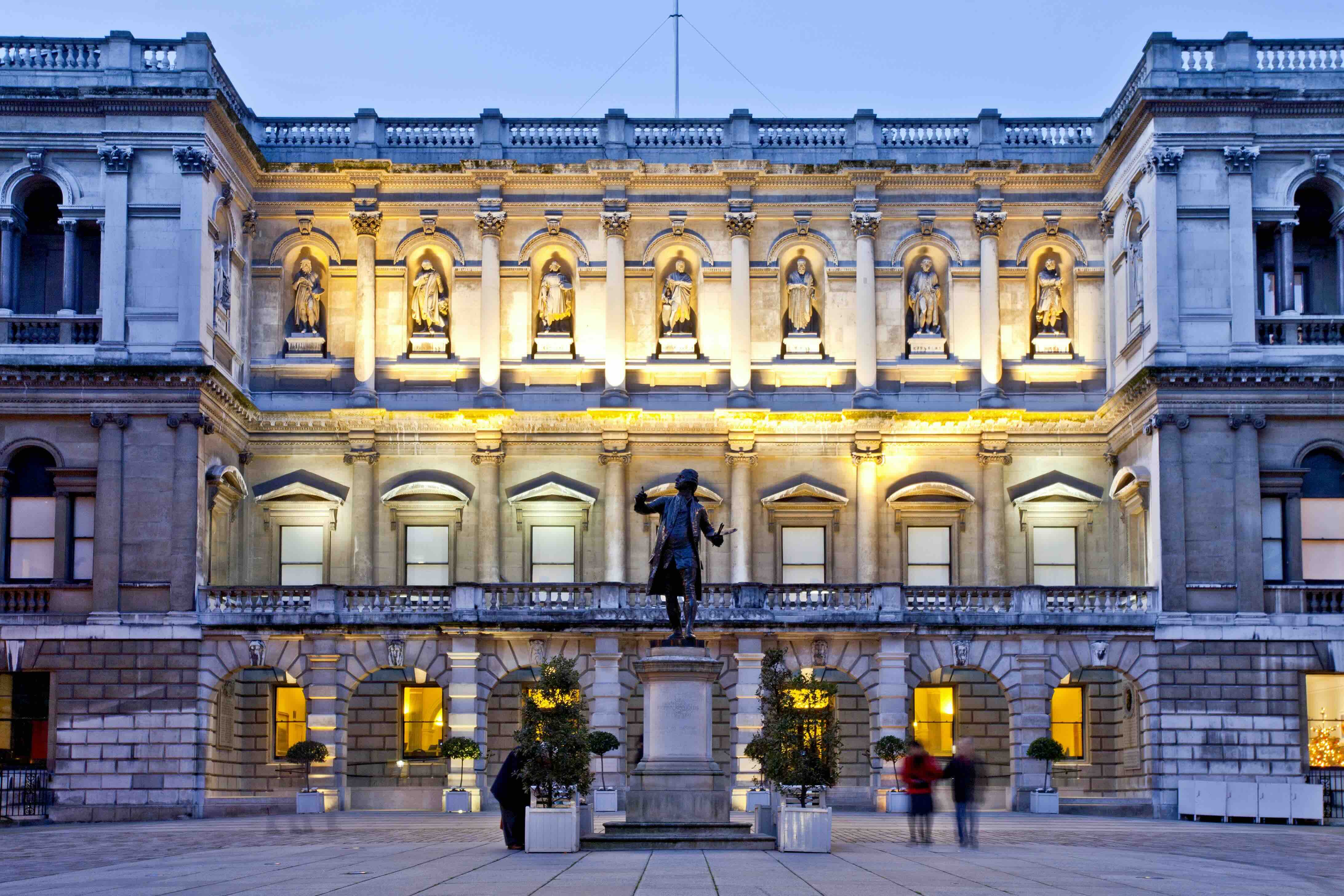
The historic Burlington House on Piccadilly, which houses the Royal Academy of Arts, featuring the courtyard statue of the RA’s first President, artist Sir Joshua Reynolds

To the hundreds of thousands who visit its exhibitions every year, the Royal Academy of Arts is a must-visit museum on the European art circuit. Like its peers at the top of the art world, it has created shows that have redefined the art scene, including ‘A New Spirit in Painting’ in 1981 and 1997’s ‘Sensation’; more recently, it has hosted blockbuster solo shows by the likes of Marina Abramović and William Kentridge – both, coincidentally, artists who have created cover logos for LUX. But the RA has a lesser-known jewel in its crown. As the name says, it is an academy – an art school, probably the world’s most respected – with studios housing artists on a three-year immersion course in its premises at the heart of Mayfair. It even has its own design technology studios and sculpture kiln. Eliza Bonham Carter, the celebrated Director of the RA Schools, was invited to create the LUX logo for our cover this issue, while Renoir Saulter, one of her students, imagines his own working of our cover on these pages

Follow LUX on Instagram: @luxthemagazine

“The breadth of talent that comes from the RA Schools is amazing, from Constable and Turner to Millais, and now to Michael Armitage, Rachel Jones and Lynette Yiadom-Boakye. In the life-drawing room, we still have the original benches where Constable and Turner learned to draw”

Batia Ofer, Chair, Royal Academy Trust

“The Royal Academy Schools is an independent postgraduate school of art that offers a three-year programme. One of many remarkable aspects of the school is that it remains free of charge to all who study with us. We support speculative practice, experimentation and the possibilities of learning through making. The central focus is the studio, where each student explores their own practice supported by an academic structure and our specialist workshops. Our graduates go on to contribute meaningfully to culture in many ways, including through exhibitions, teaching, writing and curating”

– Eliza Bonham Carter, Director, Royal Academy Schools

“Being at the RA Schools is like a great plate of scran shared with the family or a cold pint after some hard graft. The experience is fruitful, mind-bending, hardcore and cosy. The whole staff, security and tutors really make the place feel like home”

– Renoir Saulter, artist and student, Royal Academy Schools

Reimagined LUX covers, with logos by artist and RA Schools student Renoir Saulter, and cover photograph of Batia Ofer by Simon de Pury

royalacademy.org.uk

Share:
Reading time: 2 min

This content is password-protected. To view it, please enter your password below:

Share:
Reading time: 14 min

Marcantonio Brandolini d’Adda, photographed by Simon de Pury

Artist, artisan, thinker: Marcantonio Brandolini d’Adda hails from one of the most significant Venetian families and is a contemporary reincarnation of a Renaissance rebel, with looks and connections to match. He tells LUX his manifesto for 2026 and beyond

“From next year, I’m not going to be an entrepreneur, nor an artist or a designer – I’m just going to be me. There should be a new word, perhaps, to communicate all those personas in one – like a kind of Frankenstein.

Follow LUX on Instagram: @luxthemagazine

I suppose putting things into categories is part of life. But for me, there’ll be no more putting things into boxes or letting others define what I am.

“Moduli Luminosi” solo exhibition at David Gill, London, 2025

From next year, my direction is clear: I’m focusing on my artistic development – on developing my creative soul, my language. I think others should “feel” what you are.

My question has always been: why am I creating work for the public to see? Is it to express my feelings? To confront social injustices? The new work I’m putting together is an attempt to answer that question.

Read more: Arch Hades’ Return at the Venice Biennale

My creative process has three stages. It starts with confusion – with an existentialist question, such as, “what’s the point of life?” The answers can be infinite. Then I start writing answers and asking more questions, digging until I get an answer to investigate with intensity. This stage is rough. I write differently. My hands hurt from how tightly I press the pencil. Then comes the final stage: peace. That intensity dissolves into a line, shape, drawn in pastel. At that point I’ve answered my question. I feel complete.

White Pool glassware designed by Alvise De Mezzo, by Laguna~B, of which Brandolini d’Adda is Artistic Director

In my next work, glass is out. People always say, “glass is your passion”, but it has never been a material I’ve liked to express myself with. I want to understand what I am doing and why and communicate that to the public. For now, that means not using glass. It might eventually come back in another form, but it’s a question I hope this research will answer.

Read more: Jennifer Shorto’s highlights of the Cora Sheibani collection

This work is important to me. I never went to art school, so this process of realising what life and art should be comes entirely from within. It’s not something I’ve been taught.

Marcantonio Brandolini d’Adda at work in his studio

Coming from a famous family can be a challenge. But I see it as an opportunity, a tool to communicate with the public and understand what might be useful to them. I can’t hold a conversation for more than 10 minutes. If I can do it through art, then maybe my background will become a “fuck you” to everyone.

Venice is in my DNA. It’s a city that gives me tranquillity, space. But I want my business to grow beyond that – to stand alone. I will have an atelier open to the public in Venice. You may see some glass, but also what’s next – perhaps performance, or sculpture, too.

lagunab.com

Share:
Reading time: 2 min

Arch Hades photographed in her studio by Eva Herzog

In her newest exhibition ‘Return | Ritorno’, the poet and artist Arch Hades has transformed the historic site of Scoletta Battioro e Tiraoro di Venezia into a stage for her artworks. Displayed amongst the building’s architecture, paintings, and sculpture, Arch Hades has created an immersive environment of large-scale works and soundscape for the 61st Venice Biennale
Follow LUX on Instagram: @luxthemagazine

Return | Ritorno  unfolds across three floors of the Scoletta Battioro e Tiraoro di Venezia, a decommissioned church on the Grand Canal in Venice. Photograph by Eva Herzog

Arch Hades uses fibreglass and acrylic polymer to create a ‘marble’ finish for her piece I want to return to the past but no one will be there, as part of her Confessions Series. Photograph by Eliot Gelberg-Wilson

Return, 2025. The centrepiece of the exhibition is a monumental 22-panel painting spanning 13 metres which pays homage to Greco-Roman sculpture. Photographed by Eva Herzog

LUX Editor-in-Chief Darius Sanai with Arch Hades at the opening of Return | Ritorno for the 61st Venice Biennale

Arch Hades combines her poetry with visual art in her display of Sphinx, 2026. Photography by Eva Herzog

Arch Hades, Rain, 2025, exhibited alongside the site-specific work of Scoletta Battioro e Tiraoro di Venezia. Photography by Eva Herzog

Exhibition details:

Return | Ritorno  
Scoletta Battioro e Tiraoro di Venezia

Supported by Erarta Foundation 
7 May - 30 October 2026 

archhades.com

Share:
Reading time: 1 min

A portrait of Jennifer Shorto, a textile and wallpaper designer who is inspired by antique textiles from across the world

Jennifer Shorto, textile and wallpaper creator for the famous and discerning around the world, chooses six pieces for the season from the quirkily magnificent collections of London-based jeweller Cora Sheibani

Follow LUX on Instagram: @luxthemagazine

1. Decorated Gugelhupf ring

Platinum with ebony, diamond, ruby and blue sapphire: there are only bold rings for me – ebony with gems shifts attention from my hands to drama. I am fascinated by wood with stones.

2. Transition earrings

Platinum with pink spinel and grey sapphire: these are classical yet unexpected – rigorous in line, playful in pink. They seduce me into wearing earrings again.

Read more: Bentley by LUNAZ review

3. Triple C&C necklace

Citrine and silex jasper, with 18k yellow-gold clasp: citrine is liquid sunshine, its luminous gold complements my skin and clothes, radiating warmth and vibrant energy.

4. Tetris brooch with jabot pin

18k champagne gold with smoky quartz and aquamarine: I love holding dresses and jackets together with brooches. Smoky quartz with aquamarine is a quietly stunning pairing.

Read more: A tasting of Joseph Phelps wines with Maison President David Pearson

5. Sorbet ring

18k rose gold with peach and purple Edison pearls: the colour clash of these gems is delicious – I’m thrilled to see these unusual pearls.

6. B&B earrings

18k yellow gold with Palmeira citrine and orange zircon: flattering and vibrant, they light up the face. Rigour keeps them timeless, never old-fashioned.

All corasheibani.com

jennifershorto.com

Share:
Reading time: 1 min

Claudio Laager, photographed by Isabella Sheherazade Sanai

Claudio Laager is the General Manager of the Grand Hotel Kronenhof in Pontresina. A local to the Engadin valley, Laager brings a personal perspective to luxury hospitality, blending tradition with a hands-on approach that connects guests to the natural beauty surrounding the hotel. LUX speaks to him about the unique stay offered at the Kronenhof

LUX: How would you characterise the Kronenhof and Pontresina compared to the Kulm and St Moritz?

Follow LUX on Instagram: @luxthemagazine

Claudio Laager: Whereas St. Moritz attracts the international, lifestyle-focused set, Pontresina is a more typically Swiss holiday destination. People come here because of the beautiful nature and the original charm of the village. In St. Moritz you can buy luxury handbags in almost every store. Here in Pontresina, people are perfectly happy with the sports shops selling hiking and cross-country skiing equipment.

A view of the Grand Hotel Kronenhof from the surrounding snowy alps

LUX: What changes have you brought in under your management?

CL: When I took over the management in 2023, I decided to get closer to the guests and help them discover the beautiful landscape surrounding the Grand Hotel Kronenhof.

Read more: Umberta Beretta on the artists and philanthropists of Venice

As a local who grew up here, I know the best spots, and I regularly take guests out on excursions. Every Friday at dusk, for example, I take guests to the Val Bever for wildlife watching. It’s a different, authentic way to experience the Engadin valley.

LUX: Is summer in the Alps becoming more appealing for more people?

Hotel Kronenhof’s neo-Baroque Grand Restaurant, dating back to 1872

CL: Yes, summer in the Alps has so many advantages, not least the very mild, comfortable temperatures, especially compared to southern Europe at that time of year. It’s never crowded and wonderfully relaxed. Autumn is also a personal favourite of mine. During foliage season the forest takes on a golden glow and it’s quite something. We are one of the only five-star properties in the area to stay open in autumn, and we’re seeing more and more bookings and returning guests who have discovered the special allure of this time of year.

LUX: There are lots of luxury chain hotels opening now in the Alps. How is the Kronenhof able to compete?

CL: Well, I’m pretty sure it comes down to the uniqueness of the place itself, one of the oldest and most beautiful “Belle Époque” structures in the Alps, in a perfect location with breathtaking mountain views. That’s very hard to replicate. And then there’s the service element too. We strive for excellence, but we also look for personality in our staff. There has to be room for individuality.

A view of the alps from the lobby lounge

LUX: Is discreet luxury going to be lost with the rise of the social media generation?

CL: Not really. We’re actually seeing quite the opposite here. Guests come to disconnect and rediscover more analogue pleasures. For example, once guests are in-house, we prefer to communicate through handwritten notes. It’s a small detail, but it’s becoming an increasingly rare one.

Read more: Bentley by LUNAZ review

LUX: What is your exact favourite moment of the day, week, month and year to have a drink in your bar and what would you drink?

CL: My daily schedule doesn’t often allow me to wind down at work and have a drink. On my day off I usually enjoy simple beer or a good red wine.

kronenhof.com

Share:
Reading time: 3 min

A portrait of Umberta Beretta – philanthropist, art collector and LUX Contributing Editor – in situ

Philanthropist, collector and LUX Contributing Editor Umberta Gnutti Beretta is one of the leading lights of the Italian contemporary cultural scene.  As the 2026 Biennale takes off, the guest editor of our Venice Biennale Special section, who has a must-see private art space at her family’s factory in Brescia, shares her thoughts on contemporary artists she admires who have studied and created in Venice.

She also nominates four luminaries in the city’s cultural scene, who in turn share their thoughts on their creative and collecting practices, and on the latest artistic transformation of La Serenissima

Venice is historically the home of the events within the contemporary art ecosystem. Although the exhibition takes place every two years, the reasons that position Venice as a central hub for artists extend far beyond this recurring occasion.

Follow LUX on Instagram: @luxthemagazine

The city welcomes artists not only as visitors or privileged observers, but also as students and researchers. The Accademia di Belle Arti di Venezia has long represented a fundamental educational context for many contemporary artistic practices. Among the artists who have developed a significant part of their trajectory there and who I admire are Giulia Andreani, Iva Lulashi and Marta Spagnoli, just to name a few.

Back to Earth, 2024, by Anastasiya Parvanova

For some, Venice does not remain a temporary experience, it becomes an existential and professional choice, a place in which to live and create.

Within this context, a visit to the walk-up studio of Giorgio Andreotta Calò, a native of Venice, is a key to understanding the profound relationship between artistic practice, urban space and the lagoon environment. Giorgio Andreotta Calò has spent time in Berlin and Amsterdam, but his studio remains in Venice.

Another Venice native is Chiara Enzo, a young painter who brings into her painting the dampness and the dim light of her city. Trained, like many others, in the classrooms of the Accademia di Belle Arti di Venezia, she has the ability to enchant you with her small canvases.

She was invited by curator Cecilia Alemani to take part in the Biennale The Milk of Dreams in 2022, and it was precisely there that I noticed her. I have not yet walked through her studio, but it sits firmly on my wish list: a room I do not yet know, and that I cannot wait to discover.

Calipso (Summer Solar Power), 2021, by Thomas Braida

And then there is Thomas Braida. He lives and works in Venice but was born in Gorizia, a borderland between Italy and Slovenia. He carries with him that silent geography. Extremely reserved in speech (he weighs his words), on canvas he opens up without restraint and his gesture becomes his narrative.

Anastasiya Parvanova comes from Bulgaria, where she studied visual arts and pedagogy. Venice welcomed her later, and she stayed.

Read more: Bentley by LUNAZ review

She paints spaces that do not exist, marginal presences, subjects that usually escape the eye, dreamlike universes. In her work, the invisible finds form. Just some of the fantastic painters to be discovered through the narrow calles of this magnificent city.

umbertagnuttiberetta.com

Adele Re Rebaudengo, President of the Venice Gardens Foundation

Adele Re Rebaudengo – President, Venice Gardens Foundation

The foundation of Adele Re Rebaudengo has restored both the Royal Gardens of Venice and the Convent Garden of the Most Holy Redeemer, with both open to the public

In 2010, I moved to Venice to devote myself gardens. In 2014, I co-founded the Venice Gardens Foundation to restore gardens in difficulty, bringing them back to their beauty.

The restored gardens of the Capuchin friars of the Church of the Most Holy Redeemer, Guidecca

This is not only to protect the city’s landscape, botanical and architectural heritage, but to affirm the fundamental role that gardens play in a community. Seeing gardens cared for by the Foundation now used again with joy and love fuels my commitment. As living beings, gardens should not be neglected, but accompanied along their path of growth with care and attention.

Read more: A tasting of Joseph Phelps wines with Maison President David Pearson

Italy is known for the art of gardening, a body of knowledge that combines aesthetics, culture and a passionate understanding of nature. It is a heritage of contemporary relevance, telling the story of the symbiotic relationship between ourselves and the landscape.

The restored Royal Gardens of Venice, adjacent to San Marco

Being heirs to this history brings a responsibility to preserve, expand and pass it on. Gardens are more than ornamental spaces: they unfold horizons – of life, memory and relationships, giving communities a greater opportunity for wellbeing than any other space.

In Venice, there are many gardens to rediscover, sheltered behind high walls, concealed within ancient palace courtyards or scattered among the narrow streets. They represent a precious presence for the city and help ensure its balance and harmony, but many require conservation work to continue to occupy their central place in the Venetian urban fabric. No community exists without a space to inhabit, because it is itself a dimension, a place; by restoring green areas, we give it the opportunity to take root. Even if gardens do not seem functional, they are essential.

venicegardensfoundation.org

Petra de Castro with Vladimir Kartashov in his Pietrasanta atelier

Petra de Castro – Patron, collector and writer

Among her current projects, Petra de Castro has a new book and is supporting Vladimir Kartashov’s installation “Sequences of Time” at San Clemente, Venice, during the Biennale

Each time I ask myself where my passion for literature, art and music comes from, the images that come to my mind are those when, aged seven or eight, I would spend twilight afternoons at the home of a very old couple, who had lost their newborn baby during the Second World War and had “adopted” me as a kind of granddaughter.

It was this couple who taught me that music must be listened to attentively, who would sit me by their gramophone to listen to Mozart and who took me to the opera to see Madama Butterfly.

Petra de Castro’s home with works by Jean-Marie Appriou and a ceiling painting by Kartashov (represented by Gowen, Geneva, since 2025)

They had me read the stories of Tolstoy out loud, and look at the paintings of Cézanne, Monet and Renoir, tell them what I saw in the paintings and then copy them.

Those days of a faraway past made me understand that the universe of literature, art, music and the humanities corresponded to my own emotional understanding. I went on to study French modern literature, German and Philosophy. I did theatre and played the piano.

Read more: Passenger Princess in the Aston Martin DBX S

I worked in dramaturgy at the Schauspielhaus Frankfurt. I did graphic and event design, and window settings for a renowned Swiss watch manufacturer. I wrote a book about Pier Paolo Pasolini’s summer journey of 1959, La Lunga Strada di Sabbia, to be published this September.

From being an art lover I became an art patron and collector, with a vision of a Gesamtkunstwerk of my own in Venice, for my private art collection, Antigone’s Tales, to find a home. The idea of storytelling within the works in my collection is very much interweaved with the history of Venice and with the theme of Vladimir Khartashov’s installation, “Sequences of Time”. This Gesamtkunstwerk will be my life’s achievement and I trust in the process.

Nicoletta Fiorucci – Founder, Nicoletta Fiorucci Foundation

Collector Nicoletta Fiorucci founded her eponymous foundation to promote experimentation in art focusing on radical, interdisciplinary and community-oriented ideas, with a Venice venue opened in 2025

Sharing experiences with artists has always been my starting point. I’m drawn to artists who sense shifts in culture, ecology and politics, articulating what feels intangible or unresolved. In a moment defined by speed and distraction, I value contexts in which an artistic practice can unfold slowly and rigorously, and artists who champion that. Art can offer a different tempo, one that encourages reflection instead of consumption.

The Nicoletta Fiorucci Foundation grew out of a desire to support artists in a way that feels attentive and long-term. It is about possibility rather than preservation, about creating the conditions for risk, experimentation and sustained thinking. I’m motivated by dialogue: the conversations between artist and curator, idea and space, visitor and time. Those exchanges often become more meaningful than the object itself. Ultimately, what drives me is the belief that artists help us rehearse possible futures. By supporting their research and experimentation, I hope to contribute to a cultural environment that is inclusive and forward-looking.

The foundation is conceived as a long-term commitment, thus my strategy is intentionally patient. I am interested in sustained relationships with artists, curators and researchers, creating a context where ideas can develop over time. The aim is to build trust, to offer a space where artists feel supported enough to take risks. That may mean site-responsive projects, research-based work or installations that respond directly to Venice’s architecture or history. I’m less interested in spectacle and more in depth.

The exterior of the Nicoletta Fiorucci Foundation, a former 15th-century palazzo in Dorsoduro

Living in Venice has always been my dream, and not just for her beauty. Venice is a city of paradox: fragile yet resilient, historic yet continually reinvented. It has always been shaped by exchange: of goods, cultures, ideas. That openness feels essential to contemporary artistic dialogue. At the same time, Venice embodies urgency. Questions of climate change and preservation are very tangible realities. Working in Venice means engaging with vulnerability in a direct way. The city demands sensitivity, to water, to light, to material decay, to histories layered over centuries. Venice also slows you down. Its scale and geography encourage attentiveness. This rhythm aligns with my desire to create exhibitions that unfold gradually and invite reflection. 

Read more: Grand Hotel Kronenhof Pontresina Review

Rather than competing with the city’s grandeur, I see the foundation’s role as contributing thoughtfully to its ongoing narrative. Venice does not need more content; it needs meaningful layers. By working here, I hope to participate in a dialogue between past and future, acknowledging history while making space for contemporary voices. Over time, I hope the foundation becomes a point of connection, linking Venice to international conversations while remaining grounded in its local context, a space of inquiry where ecological, social and cultural questions can be explored through artistic practice. Success for me would mean that artists see the foundation as a place of dialogue, where experimentation is encouraged. 

The foundation is located in Dorsoduro, which has a quieter, more residential rhythm, slightly removed from the spectacle associated with major art events. That intimate scale has shaped the way people experience the exhibitions. Visitors tend to stay longer. Artists often feel comfortable inhabiting the space more fully. The atmosphere encourages proximity, between the artwork and the viewer, and between visitors themselves. I have discovered how much people value spaces that feel personal rather than institutional. The foundation’s setting allows for a different kind of encounter: less about circulation, more about presence. It has also reinforced the importance of context. In Dorsoduro, the architecture, light and surrounding community become part of the exhibition. The experience feels less like attending an event and more like entering into a shared moment of reflection. That sense of closeness has been one of the most rewarding discoveries. 

To Love and Devour, 2025, by Tolia Astakhishvili, exhibition view of a site-specific installation at the Nicoletta Fiorucci Foundation, curated by Hans Ulrich Obrist

The projects that have meant the most to me are those where the artist truly inhabited the space: physically and conceptually. The most memorable exhibitions of the Nicoletta Fiorucci Foundation, and before that the Fiorucci Art Trust, were not necessarily the most visible, but the ones that generated sustained dialogue and emotional resonance. I am especially moved by projects that embrace vulnerability, works that explore memory, displacement, ecology or personal history. When an exhibition becomes an atmosphere rather than simply a display, I feel it creates a deeper connection. 

Meaningful projects are often collaborative in spirit. They involve trust between artist and curator, and a willingness to adapt to the specificities of the place in which they happen. These moments reaffirm why the foundation exists: to create the conditions for thoughtful experimentation. Rather than identifying a single highlight, I value the cumulative process, the gradual building of relationships and ideas.  

Each project adds a layer to the foundation’s evolving identity. The exhibition from May to November 2026 is by Lydia Ourahmane, curated by Polly Staple. What excites me about this collaboration is its sensitivity to context. Lydia Ourahmane’s practice often engages with absence, infrastructure and invisible systems that shape everyday life. Her work carries both political depth and emotional subtlety, which feels particularly resonant in Venice. Polly Staple brings a curatorial approach that is rigorous yet spacious. I anticipate an exhibition that fosters atmosphere, listening and architectural response over immediate spectacle. It may not offer easy conclusions, but it will likely generate questions about place, movement and the systems that underpin contemporaneity. I hope visitors will feel invited to slow down and reflect. 

nf.foundation

A portrait of Luca Bombassei, an architect who synthesises the ancient and contemporary

Luca Bombassei – Architect, entrepreneur and collector

The practice and projects of Luca Bombassei operate at the intersection of past and future, exemplified in his recently acquired and restored apartment in the Palazzo Contarini Corfù, which overlooks the Grand Canal

Read more: Hotel Balzac Paris review

I grew up in an environment where things were made to last, not to impress but to age well and to carry meaning over time. Collecting art and supporting projects comes from this same place: it’s a way of staying intellectually alive, of engaging with ideas that challenge me rather than reassure me. I’m drawn to works and projects that take risks, that may even feel uncomfortable at first but that are grounded in intelligence, craft and intention. What truly drives me is curiosity guided by responsibility. 

A main bedroom view, with art by Alex Katz and Ettore Sottsass

I don’t really believe in fixed strategies. I believe in direction, in intuition and in the ability to change course when something more interesting appears. My goal is not to build a “collection” in the traditional sense, but a constellation of projects, places and relationships that reflect how I think and live. If there is a method, it’s to avoid repetition, to stay alert and to accept that coherence is not a value in itself. As I often say, coherence is for people who have run out of ideas, what matters more to me is intellectual honesty. 

I love the past for its discipline and confidence. There was a belief in knowledge, in materials and in the responsibility of form. At the same time, I’m deeply interested in the future, not as an abstract promise but as a space of experimentation: new technologies, new ways of living, new cultural models. In my work, these two forces coexist naturally. Tradition gives me a foundation; the future gives me permission to take risks. I don’t work with nostalgia, but with memory – there’s an important difference. 

A living-room view of Luca Bombassei’s Venetian apartment, with metal bookcase by Bombassei and painting by Nathlie Provosty

What excites me most are projects that sit in between definitions. I’m working on initiatives where architecture becomes a framework for cultural exchange rather than a finished object; projects where the past is not staged or idealised but questioned and activated. They are complex, sometimes even contradictory, but that’s exactly where I feel most at home.  

Living in Venice has taught me that nothing truly belongs to you. A palazzo is not a trophy, it’s a responsibility. The city itself is a lesson in adaptability: Venice has survived for centuries not by resisting change, but by absorbing it intelligently. I’ve learnt that beauty is something you practise every day through care, through use, through attention. Venice also teaches restraint: knowing when to intervene, and when to step back. 

Venice doesn’t need to be saved, it needs to be understood. Its future doesn’t lie in spectacle or nostalgia, but in serious cultural work, education and long-term thinking. I still believe Venice can be a laboratory – not for trends, but for ideas; a place where history and contemporaneity do not cancel each other out but challenge one another. Being part of that tension is what keeps the city, and my work, alive. 

lucabombassei.com

Share:
Reading time: 14 min