I'm not particularly interested in the vanity of shouting "first" when presenting new information, that's the sort of braggadocio sober researchers leave to the yellow press. Nevertheless there has been a lot of first reveals on this 'blog, a fact I've been repeatedly encouraged to point out so as to draw attention to the work done here and increase the readership.
So, for example, this 'blog was the first to recognize and analyze the Beyond This Point be Dragons mss, the Dave Megarry pre D&D character sheets, the first to identify numerous portions of Arneson's direct contribution to D&D such as magic swords, treasure tables, movement rates, and so on (particularly in This Post), the first to figure out how Blackmoor and Tonisborg and Temple of the Frog and Loch Gloomin were stocked, the first to reveal and identify lost maps of Blackmoor, the Spanish Royals character sheet, etc. etc. etc.
Those are all great topics, regardless of where they first appeared, but now I'm about to reveal something that, for many, will surpass all of those in cultural historical significance - a set of rules for fantasy RPG play, typed and "published" via copies distributed prior to the printing of D&D.
The author of this ruleset was Richard Snider, so we are calling it "The Richard Snider Variant" or RSV for short, with apologies to the NCC.
In the Twin Cities group, Richard was young - just 19 years old in 1972 - and not a prominent figure. Mostly he was thought of as John Sniders kid brother and something of a rebel. In later years, Richard went on to work with Dave Arneson on
Adventures in Fantasy, and then his own
Powers and Perils game. In 2009, Richard was married and working as a self employed landscaper, when sadly, he passed away at only 56.
Here is how we know what we know about the RSV.
In the course of research on the
Beyond this Point be Dragons manuscript, I was sent a set of much faded copies, unsigned, undated, and unknown to the owner, who thought they might be more material by Mark Bufkin, editor of BTPBD.
Two of the 6 pages however contained material I immediately recognized, it was, word for word, these sections found in the "Richard Snider's Additions" portion of Arneson's
First Fantasy Campaign:
Differences in Creatures From Blackmoor Game
Population of Known Area
Wizardry Apprenticeship
Languages (with additional text cut from FFC)
Odds of Creature Friendship
Thus we can safely ascribe the "RSV" to the pen of Richard Snider. The"variant" refers to the nature of the rules themselves. They are rules for a "spin off" sub-campaign of the Blackmoor game.
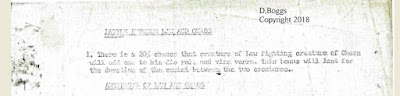
The RSV consists of the following topics in the following order (caps or lack of them are according to the original):
BATTLE BETWEEN LAW AND CHAOS
ARTIFACTS OF LAW AND CHAOS
saving throws:
SECRET PASSAGE
KNOWN LEGENDS
MOVEMENT
RECOVERY OF DAMAGE
MAGIC SPELLS AND MINIMUM POINTS NEEDED TO USE THEM:
MAGICAL EXHAUSTION:
EFFECT OF SPELLS:
THE SIDES IN LAW AND CHAOS
HERO, SUPER HERO CREATURES
THE PLANES OF CONTACT
THE PENTAGRAM
CREATURE ATTACK VALUES:
MAGIC RESISTANCE OF CREATURES:
POINT VALUE OF CREATURES:
POINTS NEEDED TO RAISE LEVEL:
COST OF SPECIAL FLUNKIES:
COST OF THINGS
HOW TO FIGURE HOW MANY HITS A CHARACTER CAN TAKE :
CREATURES
THINGS TO ROLL FOR IN MAKING HERO OR SUPERHERO:
THINGS TO ROLL IN MAKING WIZARD:
DIFFERENCES IN CREATURES FROM BLACKMOOR GAME:
POPULATION OF KNOWN AREA:
WIZARDRY APPRENTICESHIP:
Odds of creature friendship:
In future posts we will be looking at the content of each of these topics in detail. - there is simply too much to talk about to squeeze it all in to this post today.
For now, let's begin with the eyebrow raising assertion I made that the RSV is a published set of fantasy RPG rules older than D&D.
The Terminus Post Quem is established easily enough. The document itself repeatedly references Blackmoor, which must therefore have been well established when the RSV was created. There are also apparent influences drawn from the British Midguard PBM game, initially developed in 1971. Thus an absolute TPQ of 1971, and a probable provenance of 1972, as I'll show below.
That there could be ties between Blackmoor and Midguard, is no big shock. Arneson made it a point, during his trip to Europe in 1972, to meet with members of the London war gaming scene and spend time in at least one prominent game store there. That he might have then been exposed to Midguard is easily plausible, and through him, Richard Snider.
The strongest parallels between Midguard and the RSV are to be found in the magic system of each.
An obvious connection is the prominence of Artifacts in both games - more on that in another post. Both also use spell points to cast spells, Midguard wizards have an Innate Power Rating (IPR) and Endurance Points; RSV wizards have a single Magic Power Ability (MPA). These function identically as a range of points the wizard has available to "spend" on casting spells. They are also both determined by formulas combining several factors.
Endurance Points in Midguard also have a second function which allows a wizard to spend them in defense against an opponent's spell, RSV has a separate Magic Resistance number. Magic Resistance is not a reservoir spent in defense, but rather a fixed number that can be subtracted from the chance a spell has to effect a creature. So while they function somewhat differently, both Midguard and RSV have a statistic which provides a defense against magic.
There are differences in these systems, however, and I haven't noted any direct rule copying by Snider. It is even conceivably possible Richard based his rules on a detailed word of mouth description of the Migurad system, but the fact that both Midguard and Richard Sniders Variant feature artifacts and spell points should not be dismissed as coincidence as these were very novel ideas in the early 1970's. It is very unlikely you would see both these features independently appear as equally prominent aspects of both games. However, it is a bit trickier to say exactly what iteration of Midguard Richard drew inspiration from. (For a detailed look at Midguard magic, see Jon Peterson's post
Here.)
A revised version of Midguard - Midguard II, was prepared in the United States in the Fall of 1972, It was possibly this version of Midguard, or perhaps both versions, that may have influenced Richard's magic rules. There is a small hint in favor of Midguard II. In Midguard II endurance points are recast as Energy Points. The RSV rules uses the word energy in the term "Life Energy Level" (familiar to OD&D fans) and even "Life Energy Points".
Life Energy Level/Points of RSV is both like and unlike the Life Energy Level of OD&D. Both Heroes and Wizards have Life Energy Level/points, but level advances much more quickly with Wizards. Like Levels in D&D, Life Energy Levels benefit some statistics, such as MPA for wizards and bonuses for Superheroes, but has no effect on others, such as saving throws.
Further, in the RSV, Life Energy Level is not directly relevant to Hit Points (Hits), but effects hits only fractionally as one component of a complex formula to determine HP.
You said it was pre D&D?
Yes. Differences like that above are important when considering the relationship of the RSV to D&D, determining which came first, and whether one influenced the other.
Indeed, an initial hint is the very nature of the RSV itself. The rules place themselves clearly as a variant of Blackmoor, playing off that campaign and its rules as played at the time he wrote. If Richard Snider had decided to undertake his own version of the Blackmoor game, after the D&D playtest began circa March of 1973, we would surely see multiple points of intersection where Snider drew from, contrasted with, or referred to the playtest rules of D&D being used in Blackmoor at that time. However, there is scant genetic resemblance in any core mechanic, or even on a structural level, to the D&D playtest rules for Richard's variant campaign. Instead we see multiple points of intersection with a combination of Midguard, CHAINMAIL, and pre D&D Blackmoor.
Therefore we can look at the content and take note of both what it contains and what it does not in comparison to the known drafts of D&D. For this I'm relying on BTPbD as my stand in for the Guidon D&D draft of 1973 - an imperfect but serviceable solution and all that is available to me at the moment.
Here is some of what is found in the original D&D draft, but are not present in RSV.
Numbered levels for "Fighters" - RSV has only the pre D&D hero and superhero levels
Level titles for wizards - like Blackmoor, the RSV has multiple levels for wizards but no titles
Copper coins, silver coins, gems and jewelry
Treasure Tables
Spell Level tables
3d6 ability scores - ability scores in the RSV are 2d6 as in pre D&D Blackmoor
Non-CHAINMAIL, non Blackmoor "new" monsters like gnolls and invisible stalkers, None of the new D&D monsters are present (thought there are a few unique new monsters in addition to the CM stock)
saving throw categories that progress with each level for all classes - the RSV uses a single save
Clerics or Priest or Evil High Priest characters or NPC's - no hint of anything Cleric related in RSV
Terms like:
"Magic-user"
"Fighting men"
"Hit Points"
"Hit Dice"
"Hirelings"
"Plate mail"
"Armor Class"
Many of familiar D&D spells are absent, for example there is no:
Charm Person
Continual Light
Detect Magic
Hold Portal
Invisibility
Fly
Hold Person
Sleep
The RSV also does not contain these terms found in published D&D
"Player Character"
"Non Player Character"
Instead of the familiar 6 ability scores, RSV expects rolls for Strength, Health, Intelligence, Leadership, Horsemanship, Sailing, Flying, normal (melee) combat skill, and archery skill. This RSV list is clearly a close variant of the same characteristics found on early Blackmoor character sheets (see
Here)
Perhaps even more telling, while there are references to Blackmoor norms and rules, there is no reference whatever in the 6 page RSV to anything like the 50 - 100 page GD&D document.
In each of these areas above, the RSV displays a strong resemblance to pre-D&D Blackmoor norms, and a correspondingly thorough ignorance of the early D&D material found in the GD&D draft. An entire section of the RSV is devoted to specifying the differences in rules and monsters from those of Blackmoor, but there is absolute silence when it comes to the D&D draft rules, let alone the published version of the game.
When the D&D playtest became available to the Twin Cities gamers in the spring of 1973, it was immediately adopted as the playtest rules and shared among the group. Richard could not have been unaware of these rules. Given the collaborative climate of the time, it would not be credible to argue Snider could have or would have willfully ignored the innovations and ideas and terms Gygax brought to the game. Snider certainly did not ignore CHAINMAIL. The THE SIDES IN LAW AND CHAOS table being but one of several examples of CM derived material, copying, as it does, the "GENERAL LINE UP" table of alignments.
Compare to CHAINMAIL 2nd print below:
Thus the complete independence from"D&Disms" in these sections is explicable only in a pre-D&D context. The RSV could not exist as created after the GD&D draft became available to Twin Cities gamers.
That being the case we can look to the known stages of development of Blackmoor and D&D for clues to a plausible timeframe for the creation of the RSV.
First, it is useful to consider the context of Richard Snider's place in the Twin Cities scene. Being younger, he, like David Megarry, was an up and coming player, eager to make his mark in the group as his older brother John had. However, unlike Megarry, Richard is a virtual unknown as far as references in the Corner of the Table newsletter is concerned. Its unclear if he participated in any first year Blackmoor games, and if he did his participation must have been minimal. This apparent fact suggest a later rather than earlier date for the RSV.
Richards desire to become more involved with the group and with play in Blackmoor, may have found it's opportunity in complaints from Arneson. Arneson complained that his players were focusing on Blackmoor to such an extent that he was becoming overwhelmed and neglecting other gaming responsibilities. His solution was to delegate:
"Persons would "stop" by to play day after day. Some two to three months later (It's all a blur now!) the first referee collapsed in silly giggling and announced the destruction of the entire world, or some such nonsense. Well, he needed a rest, but by then various dungeons were appearing, a space campaign was begun, others were allowed to use the original dungeon and referee with it, and role playing went on in Blackmoor and eslewhere." My Life and Role-Playing, Arneson, Different Worlds #3, June/July 1979.
"After six months I burned out for a while but by then the original dungeon crew had two other campaigns going." Arneson on Backmoor - undated floppy disk (Kevin McColl Collection).
"Greg Svenson and Richard Snider were first to branch out; it took several months to start their kingdoms." Arneson Interview, Fight on #2, Summer 2008
The "two - three months" and"six months" comments above can be taken with a grain of salt, as can the timing of the campaigns he mentions, and it's unclear if the "two other campaigns" referred to in the first quote were both fantasy campaigns. I brought it up because of the quote above from Fight On! that seems to intersect with it. Greg Svenson of course, created Tonisborg, but Richard Sniders campaign is much less well known.
Regardless of exactly when Arneson first suffered GM burnout running Blackmoor, he seems to have (still?) felt pressured in the fall of 1972 at the time Dave Megarry created his Dungeon! game. Megarry has commented that one of his incentives for creating Dungeon was that it would give Arneson a break. Arneson seemed to agree in this comment from 1978:
"First conceived and played some two years before the publication of D&D, Dungeon!
relieved the pressure on the old dungeonmaster for multiple dungeon expeditions." Arneson, Wargaming #4, 1978.
Richard Snider may have been motivated and encouraged by Arneson to start his own campaign almost anytime in 1972, but perhaps especially by fall.
A fall of 1972 creation date would also make it easier to account for the apparent ties to Midguard, as that would post date Arnesons trip to Europe and his time spent with the South London Wargame Club.
Tentatively then, I'm assigning a "most probable" range of September 1972 to February 1973 for the creation of the RSV, with the recognition that it could date several months earlier, but no later for reasons I will get into in a future post.
Lastly, I know what some of you are thinking. If we have a set of pre D&D rules from Blackmoor, then HOLY GRAIL! it's Dave Arneson's Blackmoor system! Right?
Wrong.
These are Richard Snider's rules for Richard Snider's system. Assuming more than that is fraught with faults. Having said that, the RSV rules were intended to be familiar enough to Blackmoor players to be basically compatible with Arneson's play methods, so in that sense they do resonate with Dave Arneson's rules. Richard undoubtedly codified some of the things Dave was doing, but then again, so did Gygax. Some of these rules could be exactly what Arneson did in some cases, but on the whole we can only say with certainty that the RSV was Richard Sniders attempt to make sense of his Blackmoor experience and put his own spin on how to make and handle characters in their adventure games.
I hope you have enjoyed this post. In future posts, I will be looking at the RSV in greater depth, and as always, other new and original topics. Please consider supporting my research by clicking the Patreon widget at the top of the page.