Atractocerus – one of the weirdest insects you can find today

It’s a long-standing tradition in Entomology courses to prank the students during the final practical exam with something they cannot identify. Usually the course instructor or teaching assistants glue together body parts from insects of different orders, creating an impossible-to-ID chimera. This can include sticking grasshopper and beetle legs to the body of a wasp, along with a pair of cicada wings, for example. Or attaching the head of a longhorn beetle to a fly’s torso, adding raptorial legs from a mantis, and applying the finishing touch with an ovipositor from a cricket. The possibilities are endless! The reason I am telling you this is that a) I admit I have taken part in this tradition as well, and b) sometimes you encounter an insect so bizarre in the wild that you have to pause for a second to remind yourself that it is not man-made. This time it is mother nature herself pranking you. If you’ve ever seen a mantidfly, a scorpionfly, or a threadwing larva then you know what I am talking about. Today’s post is about such an insect.

What is this thing?...

What is this thing?…

Just look at this thing. The head is mostly eyes and very similar to what you would find in some flies. That pointy thing under it? That’s an antenna. Very simple structure, no major modification there. The mouthparts look like small jaws. The body is long and flexible, kind of like a dragonfly’s… but it also has paddles at its rear end? The wings are short and fan-shaped with simple venation, held close against the body at rest. This insect is also quite heavy, so it’s surprising that it is supported by hair-thin legs. Again, there is no modification whatsoever on the legs. And finally, can this thing fly? Oh yes, it can! It is an excellent flier, and it looks and sounds like a big wasp.

The first time I encountered this insect was 20 years ago in the Ecuadorian Amazon, when one of the volunteers at the biological station came over carrying it and said:

“It’s dangerous to go alone! Take this.”

Bizarre insect from the Ecuadorian Amazon. Notice the abdomen is covered with mites.

Bizarre insect from the Ecuadorian Amazon. Notice the abdomen is covered with mites.

Ok, maybe my memory is failing me and it wasn’t those exact words, but we were all trying to figure out what it could be. This insect was attracted to the kitchen lights.

Well, what it is then?
This is a beetle. And it is probably one of the least beetle-like beetles that you can find. The species is Atractocerus brasiliensis, and it is a member of family Lymexilidae. This small family of beetles currently has around 70 described species, some of which are important pests of trees. The adult beetles themselves are short lived. Atractocerus brasiliensis larvae were recorded in mango and palm trees, as well as hardwood and pine trees. At least for some lymexylid beetle species, the larvae bore into wood and feed on symbiotic fungus they grow in their tunnels (the fungus spores are deposited on the eggs by the female), often spending more than two years inside the tree. This also explains the common name for lymexylids: ship-timber beetles. These beetles were known to infest timber that was used to build ships back when ships were made out of wood. Nowadays they do not occur on ships, unless they develop a taste for metal – now that would be a sight to behold.

Interestingly, Lymexilidae is one of the oldest families of beetles. The earliest lymexylid fossil is from the mid-Cretaceous period, about 112 million years ago and was found in Brazil. Moreover, five species in the subfamily Atractocerinae have been described from mid-Cretaceous Burmese amber. The current distribution of genus Atractocerus in Latin America, Africa, India, South East Asia and Australia might suggest a Gondwanan origin.

Ship-timber beetle (Atractocerus brasiliensis), dorsal view. Amazon Basin, Ecuador

Ship-timber beetle (Atractocerus brasiliensis), dorsal view. Amazon Basin, Ecuador

Atractocerus brasiliensis is a fairly large species, with a body length reaching over 6cm. The elytra, the hardened wing covers that are one of the distinguishing features found across all beetles, are reduced to tiny square-shaped plates that cannot offer any wing protection.

Ship-timber beetle (Atractocerus brasiliensis), closeup on head and elytra. Amazon Basin, Ecuador

Ship-timber beetle (Atractocerus brasiliensis), closeup on head and elytra. Amazon Basin, Ecuador

The wings themselves are relatively small and held against the body at rest, in stark contrast to being folded several times and tucked under the elytra for storage in other members of Coleoptera. It is amazing that despite their size and simple structure they can carry the weight of the beetle quite efficiently (you can see the wings in action here). Atractocerus brasiliensis is a fast and noisy flier and would look like a wasp or a strange dragonfly to most people.

Ship-timber beetle (Atractocerus brasiliensis) with wings spread. Amazon Basin, Ecuador

Ship-timber beetle (Atractocerus brasiliensis) with wings spread. Amazon Basin, Ecuador

These beetles are not too common and used to be poorly documented. Today, thanks to platforms like iNaturalist, it is much easier to go over observations and gather data about their distribution and phenology. Lastly, just to wrap things up, not all lymexylid beetles look like Atractocerus with its bizarre appearance. In fact, the other genera look more like regular beetles, like this Melittomma brasiliensis I saw in Belize.

Ship-timber beetle (Melittomma brasiliensis) from Caves Branch, Belize

Ship-timber beetle (Melittomma brasiliensis) from Caves Branch, Belize

They have long elytra that cover the wings, although they still retain the round head structure and elongated body that are so unique to this family. So if you are one of the few lucky people who encountered one during its brief life as an adult beetle, know that you saw something really special – a beetle whose closest ancestors walked alongside some of the last dinosaurs.

Stop tricking me, neuropterans!

Hiking and photographing alone at night in Australia can be an unforgettable experience. On one hand, you can come face to face with animals you have never even heard about, and on the other hand you can find yourself surrounded by drunk Aussie folk who happened to pass by and got curious about what you are doing. Both possibilities are exciting and terrifying at the same time.

On one such hike, a warm and humid night in Kuranda tropical rainforest, and after pinching myself back to consciousness following an encounter where I was being drowned in beer breath, I stopped to inspect a bush that had some leaf damage. The culprit was discovered easily, but from the corner of my eye I could also see something else. A bright stain on the underside of one of the leaves, only a few millimeters in diameter, yet something about it looked a little off. A rule of thumb that I learned early on when visiting the tropics, is to be suspicious of anything that looks a bit out of place – most chances are that someone is hiding and trying to trick you. And indeed, this “stain” was a living creature. A flat disk-shaped insect larva. It was a neuropteran.

Neuropteran larva (Osmylops sp.) camouflaged on the surface of a leaf in ambush for invertebrate prey. Queensland, Australia.

Neuropteran larva (Osmylops sp.) camouflaged on the surface of a leaf in ambush for invertebrate prey. Queensland, Australia.

I am a big fan of Neuroptera larvae. Each family is often characterized by its own unique larval form, and some of them are absolutely bizarre. When I inspected this larva closely, I realized that I have seen this body structure before. The fleshy appendages surrounding its body were a dead giveaway for family Ascalaphidae. An owlfly larva! Owlfly larvae are excellent ambush predators and usually sit patiently motionless on leaves, rocks, tree bark etc’, hoping to surprise a passing insect.

But I was wrong.
One of the things I love most about nature is that there is no shortage of opportunities to get humbled by how much you don’t know.

This is no owlfly. This larva belongs to the family Nymphidae. It’s a lacewing.
Now, this is not the first time I am fooled by lacewings. The last time was over 10 years ago in New Zealand. In this case, I can comfort myself that I was close in my guess, as the families Nymphidae and Ascalaphidae are somewhat closely related, but the truth is Nymphidae is endemic to the Australia-New Guinea region and therefore it is unique in its own right. The family also seems to have originated in the Mid-Jurassic, with many of its closest relatives now extinct and known only from fossils.

Lacewing larva (Osmylops sp.) in ambush under a leaf

Lacewing larva (Osmylops sp.) in ambush under a leaf

Just like owlfly larvae, this Osmylops larva is an ambush predator that sits on the surface of leaves waiting for prey. Its colors complement the underside of the leaf, and staying motionless helps it to blend in and avoid detection by its prey. The feather-like appendages on each segment disrupt the body shape of the larva, allowing it to blend in better at rest, but it is also possible that they have a defensive role in detecting and deterring predators like ants. By the way, if you look carefully, some of these larvae display the common yellow-red spots to mimic leaf damage.

A different lacewing larva (Osmylops sp.) in ambush, this one has a mottled color pattern and yellow-red spots on its back to mimic leaf damage

A different lacewing larva (Osmylops sp.) in ambush, this one has a mottled color pattern and yellow-red spots on its back to mimic leaf damage

In order to catch prey quickly, this larva has long curved mandibles that are held wide open at 180 degrees. These jaws are hidden under the feather-like appendages. When prey passes by, the jaws quickly snap shut to catch the fresh meal. As mentioned above, Osmylops larvae are very small, so I tried to figure out what kind of prey they usually catch. From my observations on what is active on the surface on leaves in the forest, it seems most likely that their prey consists of small ants, flies, or moths. Notice that the larva always sits with its head facing the leaf margin – this is not a coincidence. It is much easier and faster to catch prey that is positioned at the edge of the leaf, either by knocking it off its feet or by surprising it when it stops to “enjoy the view.”
The Osmylops larva is like a deadly peek-a-boo.

Here you can see the full glory of the Osmylops larva's mandibles. Normally they are held hidden under the body and when triggered they snap shut on the prey, just like a bear-trap.

Here you can see the full glory of the Osmylops larva’s mandibles. Normally they are held hidden under the body and when triggered they snap shut on the prey, just like a bear-trap.

For those wondering, the adult Osmylops looks like a rather plain green lacewing (you can see some examples here). I would have never guessed that this elegant insect came from a round, flat, bear-trap of a larva. The transformation from larva to adult in Neuroptera is so extreme; it is among my favorite metamorphoses.

So the next time you are out in nature, don’t be shy and look closer. You might find something you did not expect, and you might learn something new! All for the better.

Little Transformers: Eusceptis effusa, spider mimicry with a twist

After a long hiatus the blog is back and no better way to revive it than another Little Transformers post! Over the years these posts have become my favorite ones to write, because I get to feel like an excited little kid again while telling you about a neat species I encountered.
Today’s post takes us back to May 2023. I paid a visit to the Ecuadorian Amazon, one of my favorite places on the planet, where I set up a light trap to survey nocturnal insects. Setting up a light trap (also known as light sheet) is an exciting activity, regardless of the location. You never know what is going to show up. Moths of course are the prime target, but many other insects join in as well. Sometimes you get a unique beetle. Sometimes you are surprised by a gargantuan fly. And sometimes, it’s a brightly colored katydid. The star of this post is a small moth named Eusceptis effusa.

At first glance, there is not much that seems special about this moth. It is a small-sized, cream-colored noctuid, with a dark patch and some lines on each forewing, and another dark band on the hindwing. It is only when the moth is at rest and viewed at a specific angle that an image is revealed. I didn’t really think much of this moth when I saw it, and took only a couple of photos, but when I finally got to edit them at home I gasped. “Is that… a SPIDER?

Eusceptis effusa, a small noctuid moth with a spider-like pattern on its wings. Wait till you figure out that its legs are a part of the illusion...

Eusceptis effusa, a small noctuid moth with a spider-like pattern on its wings. Wait till you figure out that its legs are a part of the illusion…

I have written in the past about spider mimicking-moths (read here about Petrophila or Brenthia), so this is not a new theme or a novel discovery. What makes E. effusa so special is that the wing pattern creating the spider image is distorted until you view it from the correct angle (a top-down, and slightly rear view). It is very much like the concept of Anamorphosis. What is even more striking, is that the moth’s legs play an important role in creating the image, extending the limbs of the spider. I can imagine my photo would look even more convincing if I photographed the moth from a lower angle. I believe the optimal result is when all six legs take part in the optical illusion.

Now, I’m not gonna lie, the Pareidolia is strong with this one. Not everyone sees the image of a spider, as demonstrated by the comment on Eerika Schulz’s tweet:Eerika Schulz's tweet about Eusceptis effusa

I totally get it. If you see something else, like a moth, that’s ok (I’ll address this in a second). The more important questions here are what the moth’s predator sees and whether the wing pattern helps the moth escaping predation.

Interestingly, this color pattern repeats itself consistently in almost all species of Eusceptis, with very little variation. Ok, and now… are you ready to have your mind blown?
One species in particular, Eusceptis irretita, has the image pattern in very specific colors, which bears an uncanny resemblance to the the only species in the Eusceptis genus without the image pattern, Eusceptis obscura! That’s why I cannot blame anyone who looks at the pattern and sees the image of a moth. But… is it really one moth mimicking another moth from the same genus? And why? Well, we don’t know.
It’s important to mention that very little knowledge has been collected about these species, their life cycle, and their interactions with other species, which is why it is crucial to keep an open mind and practice sharp observation skills until those questions get answered. Who knows, it might be you who uncovers the story one day! For what it’s worth, I hope I tickled your brain cells just enough to get you interested.

Photographing a total solar eclipse (with a macro lens)

Turn around
Every now and then, I get a little bit restless
And I dream of something wild

I wonder what Bonnie Tyler was thinking about when she recorded her song “Total Eclipse of the Heart.” I can definitely relate to these words. Sometimes I feel antsy and eager to step outside of my comfort zone and do something I am not too familiar with.
“Total Eclipse of the Heart” is often used in association to solar eclipses merely because it has the word “eclipse” in the lyrics. There is, however, one element in the song that resonates perfectly with what happens during an eclipse, but I am getting ahead of myself.

In August 1999 I witnessed a partial solar eclipse in the desert of Israel. Back then I was not aware that it was actually a total eclipse that passed over most of Europe and south Asia. Being in Israel, I was located outside the path of totality, but it was still an impressive experience. I clearly remember the dimming of daylight, the quick drop in temperature, and noticing songbirds around me preparing for sleep, only to realize a few minutes later that it is still midday.
I knew that experiencing a total solar eclipse is on a whole other level, as often expressed in the famous quote “The difference between 99% and 100% totality is literally night and day.” However, even with my frequent travels, I never found myself at the right time and place, and traveling far for the sole purpose of catching a few minutes’ glimpse of a total eclipse seemed a little extreme to me (more on this later). So when I realized I am very close to the path of totality on this year’s total solar eclipse, I knew I had to witness it in person. I decided to team up with two friends (one of which is the president of The Kitchener-Waterloo Astronomy Club) to travel a few hours southwest to the path of totality and spend eclipse day there. This was a very rough plan, because we knew it relied heavily on the weather cooperating. Due to the forecast changing continuously, I can honestly say we had no idea where we were going until the night before eclipse day.

Total solar eclipse sequence (composite image)

Total solar eclipse sequence (composite image)

Of course, I also wanted to photograph the event, but this proved more challenging than I anticipated. Shooting the sun or the moon often requires a long telephoto lens due to their distance. A few years ago I sold my 500mm prime lens, so I no longer own any telephoto lenses. I could rent one, but probably not without prior booking so close to eclipse day. I could also go for a wide-angle view with a composite image of the different eclipse phases as they pass through the sky, but I was never a fan of those images, and ideally this also requires prior scouting for locations to ensure an interesting composition. I did not have the time or the means to do that.
I decided to use a 100mm macro lens mounted on an old Kenko 3x teleconverter. On an APS-C sensor DSLR camera this should give me a decent view of the sun while still leaving enough room in the frame for what I was really after – the solar corona. In preparations for the eclipse, I tested both my Canon 100m f/2.8L and the Laowa 100mm f/2.8 macro lenses, and although the Laowa came in sharper I decided to go with the Canon. Why? Because I hoped to photograph a phase called “diamond ring” in which the sun peeks behind the surface of the moon. My hope was to capture the effect with a sunstar, and the Canon lens performs better in this regard (spoiler: I failed).

Unfortunately, my Frankenstein gear setup meant that I was going to sacrifice several stops of light. I initially checked out the solar eclipse exposure calculator to figure out what ISO, shutter speed, and aperture values to use for photographing, but upon testing my gear a day before the eclipse it became clear that I was missing a lot of light, resulting in an image darker than normal. Luckily, I found this article by Gordon Telepun (remember the name, he will be mentioned again in a bit) that explains how to manually calculate the correct exposure for each phase of the eclipse. I ended up choosing a combination of high ISO, slowish shutter speed and a low aperture value (ISO 800, 1/3-1/200, f/5.6 for those interested) for my eclipse photos, which would help me capture the sun’s corona at the cost of image noise.
Another helpful webpage is this lens and sensor visualization tool, where you input your camera’s sensor size and your lens’ focal length (and whether you are using a teleconverter or not) and it shows you what part of the frame the sun will occupy and how fast it will move across it. The latter can save embarrassment in the field if you do not have a tracking mount, as you can plan ahead to check your framing periodically to prevent the sun from escaping due to the earth’s rotation.

One of the most important things to keep in mind when planning is to look for a place in the eclipse’s path that has clear sky. It sounds intuitive but if I had to choose between watching a total eclipse in the city where I live where clouds are common and a desert location where clouds are rare, I would choose the desert in a heartbeat. We used Windy.com to check for cloud cover forecast and eventually settled on Erieau Beach as the site to observe the eclipse. Forecast still showed a range of 9-30% cloud cover but other options were worse.

We headed out at 5am. This was a short drive, only over a couple of hours, but after realizing that the adjacent beach is already fully booked we were concerned that we would not find parking. We ended up being the first people on the beach. Soon enough, more and more cars showed up as the morning progressed, so we were glad we got there on time. As the beach started to fill up with people we secured a space with seats (and later learned that it was on a private property, but the kind owners let us stay) where we would spend most of the day, waiting for the start of the eclipse in the afternoon. As a tip, it is good to have something to do during this time. I noticed people collecting observations for iNaturalist, playing games, or even going for a swim in the cold water of Lake Erie. My friend borrowed a solar telescope with a Hydrogen-alpha filter from his club. This was not really needed for the eclipse; you can observe the sun on any day of the year. However, this proved to be a great source of interest and entertainment to us and to fellow eclipse watchers during the wait. As for me, I spent most of this time reading and chatting with the friendly people from the local community.

Looking at the sun through a solar telescope. Notice the surroundings, looks like a normal sunny day.

Looking at the sun through a solar telescope. Notice the surroundings, looks like a normal sunny day.

It was a beautiful day and the sky was clear of clouds. The forecast, however, still predicted a 26% cloud cover at the time of the eclipse so we were a little concerned. Not as bad as other locations (looking at you, Niagara Falls), but still – we really wished for a clear view of totality. And like a clock, a wall of clouds could be seen approaching from the south at 1pm, when the eclipse was due to start at 1:59pm… Uh oh.
Despite this, we could still very easily see the sun when the eclipse started. It seems that the cloud cover consisted mostly of thin cirrus clouds made of ice crystals, and the sun, being so bright, had no problem shining straight through them. To be better prepared for the exact timings of the different eclipse phases, we downloaded Solar Eclipse Timer app by Gordon Telepun (hello again!) to our phone. I cannot recommend this app enough. It synchronizes your GPS location with the eclipse timings and calculates the different phases, giving you announcements in Gordon’s voice prior to each phase and recommendations what to watch out for. This is extremely important for several reasons. First, during the partial phases you can only look at the sun through a solar filter or solar eclipse glasses to prevent damage to your eyes or your camera sensor. Once totality hits and everything gets dark, you need to remove the filter or you will miss the whole thing. You can look at the sun without protection only when the moon completely covers it, and it is not always easy to know when it is safe. It is even more important right before totality ends, because your eyes have adjusted to darkness and are at risk of exposure to the sun’s brightness once the moon moves on. Second, if you plan to photograph the eclipse, having the timer app helps maximizing your time in totality as well as capturing the more elusive phases like Baily’s beads and diamond ring.

The start of the eclipse. The light is dimmer, everything is starting to look a little bland. My jacket though, looked brighter in person in the moments close to totality.

The start of the eclipse. The light is dimmer, everything is starting to look a little bland. My jacket though, looked brighter in person in the moments close to totality.

The time leading up to totality was not very different from my experience in 1999. Our surroundings gradually got darker as the moon’s shadow progressed to move over us, and it got breezy and cold, and I mean REALLY cold. I would not be surprised if we hit single digit temperatures – my hands were freezing. The lake now looked milky, devoid of any reflections. Shadows were fuzzy. I wore my most flamboyant jacket in preparation for the Purkinje effect. A detailed explanation of this effect from Gordon Telepun (hello again, friend!) can be found here, but to simplify, due to the change in illumination around the eclipse’s totality the color perception by our eyes changes. Red colors appear bland whereas greens and yellows appear brighter. This effect cannot be recorded with a camera because it happens inside our eyes. This is where the lyrics from the song I quoted earlier come into play. I highly recommend turning around (just like in Bonnie Tyler’s song – see, I told you we would end up here, bright eyes!) and looking at your surroundings right before and straight after totality. And indeed, as it got darker my friends commented that my jacket looked brighter with more contrast. We also saw the same effect on juniper trees that were growing in the garden behind us – they looked almost neon green, such a beautiful color!

Getting closer to totality, the light is eerie and the lake looks milky without any reflections.

Getting closer to totality, the light is eerie and the lake looks milky without any reflections.

The change in environmental conditions also triggered a change in animal behavior, of course. The birds we saw earlier in the day were now gone, but we noticed many red admiral butterflies low-flying sluggishly, looking for a place to sleep. I thought that was really cute.

In those moments leading up to totality I started feeling stressed. I really wanted to get some decent photos, and I was concerned that it would not be possible with my exposure values. I was also worried that I would have to push those values even lower now with the thin cloud cover blocking some of the light. Time was also an issue. I planned to record bracketed exposures, 7 shots for each series, and I felt that with the slow shutter speed I would not have enough time to both photograph and enjoy the eclipse. With this in mind I decided the remove my lens solar filter 1min before totality, and block it with my hand.

It was now 3:14pm. The moment of totality, when the sun is completely obstructed by the moon, is both terrifying and beautiful. The body floods you with adrenaline and you just cannot stay silent. People often discover their spiritual or religious connection and cry out “oh my god” or “Jesus Christ.” I found that very amusing. This is the only time you can safely look at the sun directly with your eyes, and you should! It is one of the most beautiful things you will see in your life. For me, I was surprised and shocked to see the actual size of the sun in the sky, and even more surprised that I could see prominences (solar flares) with my naked eyes without any help of binoculars or a telescope. It was mind blowing.

Total solar eclipse, the moment of totality. You can easily see the prominences (solar plasma flaring outwards from the surface) even with the naked eye!

Total solar eclipse, the moment of totality. You can easily see the prominences (solar plasma flaring outwards from the surface) even with the naked eye!

At our location we had 2:34 minutes of totality. I felt every passing second of it, and yet it flew by fast. I immediately started photographing. It was very stressful. I closed the aperture to record the first diamond ring but I miscalculated and it ended up too dark and out of focus. Then I started the bracketed exposures. The first run went ok, but on the second run I miscounted the exposures and messed it up. I figured out that something was wrong on my third run, and I had to switch the camera off and back on, reconfigure the exposure bracket, and start over. This wasted precious time, not to mention meddling with the camera might have affected the focus. But I kept going. I tried to capture the second diamond ring and this time the result was better, but not what I was hoping for. I used a fast shutter speed but the aperture was still f/5.6, so there was no sunstar. And right then, after I recorded the second diamond ring, my camera malfunctioned and gave me an error.

The second diamond ring phase of the total solar eclipse, a first glimpse of the sun's brightness after totality.

The second diamond ring phase of the total solar eclipse, a first glimpse of the sun’s brightness after totality.

By the way, once you get a photo of the diamond ring phase you can be a little creative... Here is a mock up of the title card for the early 2000's TV series "Heroes" that I made using my photo from the eclipse. Just for fun.

By the way, once you get a photo of the diamond ring phase you can be a little creative… Here is a mock up of the title card for the early 2000’s TV series “Heroes” that I made using my photo from the eclipse. Just for fun.

It is a repeated cliché heard on total eclipse photography tutorials, calling photographers to leave malfunctioning gear aside and enjoy the eclipse instead of trying to fix it. I remember asking myself “does this really happen?”
Well apparently it does. I don’t know what caused the error. I can only be grateful that it happened after totality was over, and that there was no actual damage to the gear. All I had to do was reinstall the battery and go back to shooting the partial phases. I was curious to see what images I got though, and was ecstatic to see that I captured some of the solar corona even with my low exposure values!

Total solar eclipse, the moment of totality. Here the corona (the outmost part of the sun's atmosphere) is more visible.

Total solar eclipse, the moment of totality. Here the corona (the outmost part of the sun’s atmosphere) is more visible.

The solar corona with its streamers. This is the photo I had in mind more or less when I thought about the total solar eclipse. You can tell I pushed my camera and post-processing to their limits, but considering I was shooting through a layer of clouds I am happy with the result.

The solar corona with its streamers. This is the photo I had in mind more or less when I thought about the total solar eclipse. You can tell I pushed my camera and post-processing to their limits, but considering I was shooting through a layer of clouds I am happy with the result.

I forgot to mention two things that happened at our location. First, the icy cirrus clouds that I mentioned earlier caused a halo to form around the sun. This is an optical phenomenon called sundog or parhelion. I have seen them in the past but never in a complete full circle. It was beautiful and mesmerising, and made the eclipse experience so much better. Needless to say, during totality when sunlight was blocked the sundog disappeared from view, only to reappear again after totality was over.
The second thing was an interesting optical effect on the lake’s water. I mentioned that the water looked milky leading up to totality. It was very difficult to make out the horizon line because there were no reflections. In the moments right before totality and straight after it, there was a subtle shimmer on the water, like a silvery sparkle. It was one of the most beautiful optical phenomena I have ever seen. People who observed total solar eclipses over snow mention the same effect.
The following clip was filmed right next to us. You can see this effect if look at the water right before totality (WARNING – people shouting):

Here’s another clip that demonstrates what an out of body experience a total solar eclipse is. It shows the shadow of the moon passing overhead during the eclipse. You can see the sundog here too.

No one can tell you exactly how you would feel the first time you see a total solar eclipse. You might cheer, you might get emotional. One thing is for sure – something happens to you when you experience it, and you leave changed forever. The image of the sun turned black, surrounded by a glowing ring of its corona, is etched in my mind and I cannot stop thinking about it. It is only but a fleeting moment, but it is one of the most beautiful things I have ever seen.

I am having a hard time finding the words to describe how I feel. All I can say is that I was humbled by the whole experience. It was definitely something that I will never forget, so stunning and thought-provoking. And going back to my statement about traveling for the purpose of watching a total solar eclipse, I see this very differently now and I completely understand it. To be honest, I might find myself doing it if the opportunity presents itself. It really is worth it. If you plan to watch a total solar eclipse (close to home or by traveling), I highly recommend Xavier Jubier’s website, the best source for everything eclipse-related. Try it, you will not be disappointed. There are interactive maps, data calculators, recommendations, etc’ for both past and future eclipses. Xavier has put together staggering amounts of information on this website, free for everyone to use. I wish I could show him gratitude in person, he really created the best website for anyone interested in watching eclipses. I know I will go back to his website in preparation for future total solar eclipses. I hope you consider doing the same.

Oh yes, one more thing. I mentioned my friend bringing the solar telescope. It seems appropriate to end this post with a photo of the full sun, taken through the telescope’s eyepiece (using Canon’s criminally underrated lens, the now-discontinued 24mm STM pancake):

Our sun, as seen through a solar telescope. Note the prominences (solar plasma flaring outwards from the surface) and sunspots (magnetic storms on the surface).

Our sun, as seen through a solar telescope. Note the prominences (solar plasma flaring outwards from the surface) and sunspots (magnetic storms on the surface).

Bear in mind the telescope produces a red image due to its special filter, so I was a little liberal with the colors during post-processing. Still, I think it came out lovely. Not only can you clearly see prominences flaring out of the sun’s surface, but you can also detect sunspots – strong magnetic storms occurring on the surface of the star. As I was looking through the telescope’s eyepiece I said to my friend “The sun is cute.”
“Cute?..” he chuckled with a raised eyebrow.
Well. I only said that because I was watching from a safe distance. I have no burning desire to touch the surface of the sun. Just give me a front row seat and I’ll be happy.

Wildlife Photographer of the Year: So, what’s it like?

This is the final post in my series about winning in Wildlife Photographer of the Year 2021. If you read my previous posts, and especially if you watched my award acceptance speech, you might have noticed a message hidden between the lines: I had no intention to enter my photos to the competition. Even though I occasionally enjoy looking through the winning photos in competitions, the truth is it was never my goal to have my photos showcased in one. I just don’t need that external validation. Please don’t confuse this with my reaction to having my photos selected as winners; it is a great honor and it is a humbling experience to see your photos displayed together with some of the world’s best wildlife photographers’ work. What I mean is that photo competitions are not very important to me and I do not photograph with the competitions in mind.
That being said, my experience as someone who won in one of the most prestigious nature photography competitions in the world can be helpful for other people who are considering submitting their work but don’t know what to expect. This post is based on my experience winning in WPY57 in 2021. If you are looking for advice which nature photography competition to choose based on your goals and budget, I highly recommend checking out Jen Guyton’s excellent blog post about the topic. It was written a while ago but she still goes back and updates it occasionally. This post is more about the personal experience that you may have while entering your work to a competition. Before I begin, let me give you the best piece of advice on the matter, which pretty much summarizes everything I am about to write:
Manage your expectations.

Me with two of my Wildlife Photographer of the Year winning images at Royal Ontario Museum, Toronto, Canada

Me with two of my Wildlife Photographer of the Year winning images at Royal Ontario Museum, Toronto, Canada

Before submitting your work to the competition:
Know why you are submitting. What is your goal? Do you want recognition? Or maybe just exposure? Are you doing this for the award’s monetary prize? Are you hoping this will lead into paid work? This is a personal question and there is no single right answer. Whatever the reason, make sure it is clear to you before you enter.
Curate you collection before submission opens. This is more of a tip, but it will save you so much time later when you select your entries.
Decide which categories in the competition will suit best for your work, and please PLEASE read the category descriptions. They are there for a reason, and they are supposed to help you focus your efforts. Remember you are trying to impress a jury of people with your work in the context of that category.

What is a good photo?
The answer depends on the competition you are entering and the jury. Your photos will be judged by people who do not know you, and most likely also not the subject in your photo. They will judge it by their own criteria, as well as the category’s. This means you have very little control over what is considered by others a good photo. You can just hope to get something that is sufficiently eye catching, novel, and technically solid to draw enough attention.

My winning images in Wildlife Photographer of the Year's Invertebrate Behavior category, displayed alongside Caitlin Henderson's katydid photo at Natural History Museum, London, United Kingdom (screenshot taken from New Scientist's coverage of the exhibition). Notice the order of images is different from one museum to another, and largely depends on the exhibition curators.

My winning images in Wildlife Photographer of the Year’s Invertebrate Behavior category, displayed alongside Caitlin Henderson’s katydid photo at Natural History Museum, London, United Kingdom (screenshot taken from New Scientist’s coverage of the exhibition). Notice the order of images is different from one museum to another, and largely depends on the exhibition curators.

During submission period:
Create a collection of all the photos you think are your best work. This collection can contain more images than you will submit eventually, I would say up to twice that amount. Now, carefully select the images that fit best to the category. Ask yourself, is this what the category calls for? Is the photo technically good? (in focus, good lighting, well composed etc’). Does it have an impact? Does it tell a story?
At this stage I encourage you to reach out to fellow photographers for feedback, especially if they already won in competitions, and even to family members and friends to some degree (if they really understand photography). Sometimes we are so biased and emotionally attached to our own work that it is easy to inflate subpar work on one hand, and on the other hand to overlook hidden gems.
Once you narrowed down your selection, comes the part that I personally hate the most – you need to title your images and write captions for them. I would argue that at this stage you should not put much of an effort to write something that would be impressive to read but more of an account of what is shown in the photo. You will get a chance to tweak the text if your photos make it to the second round of judging.
After submitting and paying the fee, you can login again one more time, maybe a few days later, just to make sure that everything is accurate. Then I suggest you leave it and focus your energy on other things.
You see, the wait, and even more so the expectation to know what is going on with your photos, will both haunt you. Many people feel stressed at this stage. They overthink and lose sleep thinking whether they should have submitted or written something else. Do not fall for it. And do not endlessly log into your account to look for updates. That would be a waste of your time.
The wait will probably be agonizing. The anxiety and desire to know whether your photos are doing well will cripple you. But I am here to tell you that the less you think about the competition, the better your response will be to whatever is coming next.

I am actually not going to write much about the second round of judging. I believe the small competitions are missing the stage entirely, and for the bigger ones it is really a means to weed out most of the entries and focus on a small selection. If your photos are selected to move forward you might have more work to do, like writing additional text and providing further information as well as the original files, but otherwise it just means more waiting. If you get rejected at this stage, read on.

After a decision is made:
This is the day, you’re supposed to hear back!
My first tip here is to make sure you check your email spam folder. You never know, the decision email might land there (that actually happened to me! And for a couple of days I had no idea that I had four winning images in WPY). Do not log into your account and refresh the page. This will not help and will only cause you despair. When the competition organizers finally send out the email, trust me it will get to you. Be patient.
From here there are two options, of course:
1. OK, your entries got rejected. Now what? Well, this is the thing. Nothing. Try not to take it personally. If you feel sad, you obviously had some expectations, and maybe some of them are shattered. Try to keep your composure about the rejection and view it from a slightly different perspective. It does not mean that your work is not good, or that someone is trying to hurt you. It only means that in the context of the specific category, your work made a smaller impression on the jury compared to another person’s work. That’s it. And that’s ok. I know it sucks. But you can try again next time, and who knows, the results can be different then. In the meantime, get some ice cream. It helps.

2. Holy crap, you actually won! Scoop yourself a bowl of your favorite ice cream and brace yourself for what’s about to come. Oh boy.
This is where you have to manage your expectations H-a-r-d.
First of all we have to divide the timeline here to pre- and post-announcement.

Pre-announcement of the results to the public:
After receiving the email with the results, you might want to run and tell everyone about your achievement. You’re ecstatic, it’s understandable. However, I would strongly advise against it, and also many of the major competitions have a strict press embargo period until the actual public announcement, during which you are supposed to keep the results secret. Sure, you can tell your partner and some of your family, but I would stop there. There is a very good reason why the results are kept quiet – to maximize the impact during the announcement (more on this later).
During the embargo period you will most likely be asked to provide additional information about the winning photos, including renaming and sometimes even rewriting the caption. If there is an awards ceremony you will be given the details and asked to prepare an acceptance speech and handle media interviews at the event. And if you are one of the lucky photographers, your photos might be chosen as a press release teaser a month before the winners are announced. That’s a lot of fun, because at this point everyone is curious to see the winning images, and your photo gets heaps of attention.

"Beautiful Bloodsucker" spotted at a bus stop in London, United Kingdom (photo by Charlie Heckworth)

“Beautiful Bloodsucker” spotted at a bus stop in London, United Kingdom (photo by Charlie Heckworth)

Post-announcement of the competition results:
I mentioned that the purpose of the press embargo on the competition results is to maximize the impact during the announcement. The competition organizers actually do their best to put you and your work in the spotlight, so I would definitely take advantage of this. If you are looking into generating income from your photography, and you are among the lucky ones whose photo ends up going viral after the competition results are announced, take every paid opportunity you can get to license it to publishers. Once a photo goes viral its potential to generate revenue decreases exponentially, so make the most of it while you still can. In fact, let’s just get this out of the way first – once the results are announced, and your photos are out there being reported as a news item, they are essentially gone. And what I mean is, it will be very difficult to gain control and stop the snowball effect. News and media outlets will report the news, and from there it will be picked up by online content creators and social media accounts. Some of these will share your work in line with the competition’s terms and conditions (usually an attribution and a reference to the competition). Others will copy and plagiarize, and encourage further unauthorized use. It’s frustrating. Be prepared. At the end of the day, there are paid opportunities for licensing the photo, selling merchandise, as well as interview or public lecture invitations, and you might even be able to generate some income from cases of copyright infringement now that you are an internationally acclaimed award-winning photographer.
One outcome worth mentioning is that very often photo agencies contact competition winners, hoping to recruit them as contributors to their growing collection of licensable images. This is a positive thing, and I highly recommend considering doing so. A good agent works on your behalf to find new ways to use your work for revenue. However, this does not mean you should accept every offer on the table. You need to do your homework here, research the agency to ensure its collection and regular clients fit well with your work. It is also important to negotiate a fair contract (a 50:50 split is normal). Do spend time reading the fine print and make sure you understand what the agency is offering and what it can do for you. Preparing images for an agency requires a lot of work in bulk that includes editing, captioning, and keywording. It is recommended to contact fellow photographers from your field who are represented by the same agency and ask about their experience and overall impression with it.

"Beautiful Bloodsucker" promotional poster spotted at Germering-Unterpfaffenhofen S-Bahn Station in Munich public transport, Germany (photo by Viktor Baranov)

“Beautiful Bloodsucker” promotional poster spotted at Germering-Unterpfaffenhofen S-Bahn Station in Munich public transport, Germany (photo by Viktor Baranov)

Now, let’s talk about expectations again. Remember what I said? Manage your expectations? This is where it gets interesting. Because even if you won and you are happy, you might still find yourself comparing your experience to that of the other winners. That is normal, but try to keep it under control and not obsess over it. Depending on the photo’s subject matter and occasionally also the photographer’s location, some competition winners experience a jump-start to their career while others get very lukewarm attention. I remember feeling very bitter when I saw other finalists getting assignments and paid offers, especially after I swept the competition with four images, two of which were category winners. However, after thinking about it I realized that I am in a completely different stage in my professional life, as I have already gotten assignments and had my work published even before I entered the competition. Another example is that some photographers are invited to celebrate the exhibition’s opening event, while others don’t even hear about it. It’s important to remember however, it usually has nothing to do with you. In my case, the local museum that hosted the exhibition never bothered to invite any of the local winning photographers to view their work on display, and invited me only after I insisted.

"Beautiful Bloodsucker" spotted on a flier for Museum Mensch und Natur, Munich, Germany (photo by Viktor Baranov)

“Beautiful Bloodsucker” spotted on a flier for Museum Mensch und Natur, Munich, Germany (photo by Viktor Baranov)

It was also interesting to compare the number and quality of interviews I got in Canada to those I got from Israel. Interviews can be an amazing experience but they can also be a disaster. For example, I had a live radio interview for which I had to be awake at 4am, and the interviewer quickly shifted the topic from my spider photo to rats for most of my time on air. I think I handled it quite well considering the conditions I was given, but it registered with me as one of the most disrespectful interviews I have ever experienced and overall just not a good look for that show in general. Did I have high expectations? Not really. Would it be nice to have gotten a bit more positive recognition after representing my country? Yes, it would.

There you go, Port Credit, Mississauga. I fixed it for you. (Please, before you go searching for it - this is NOT a real monument. I'm just poking fun.)

There you go, Port Credit, Mississauga. I fixed it for you. (Please, before you go searching for it – this is NOT a real monument. I’m just poking fun.)

And then, there are the public reactions and comments about the competition results. Let’s start with the bad. It is almost guaranteed that you will experience a lot of jealousy coming from other people. And jealousy makes people do interesting things… For starters, some people might inspect your photo and look for something wrong with it. Let’s be honest, we’ve all been guilty of this to some degree. This can be something technical like a sensor dust spot that you forgot to remove, an element out of focus, or a flaw in the composition. But it can also be something more nitpicky, like trying to make a case that your photo does not follow the category description or competition rules. I experienced this when someone questioned the authenticity of the story behind one of my winning images, and I had to go back and look for photos of the location from the time it was taken to prove my case. Not exactly a pleasant experience.

Another manifestation of jealousy is making a nasty or snarky comment. For example, one of the most common comments you get after the winners are announced is something like:
“For wildlife photographer of the year, I’d expect spectacular wildlife images. The kind I’d like to hang on my living room wall. Almost none of these make the cut.” (this is a real comment, by the way)
People have different tastes and preferences, so I totally get it. And I truly believe those who say they can take great if not better photos themselves. The question is why they aren’t submitting those photos to competitions. If you have something better, show us and go for it, enter and win! I’d be the first person to encourage and support you. Another common criticism relies less on the actual photo and more on the act of capturing it, for example I have been told that the camera I used, an almost decade-old Canon 7D, is now obsolete. Sure, but who cares? The piece of gear I used is not what the competition is about, it’s what I was able to produce with it! I have nothing against modern mirrorless cameras. The reason I do not own one at the moment is far more simple and depressing: I’m poor. Probably thanks to all those people freely using my photos without paying any licensing fees.

What I am trying to say is that you have to be mentally prepared for people being rude, smug, know-it-alls, or entitled in the comments. How you choose to deal with it can be very personal, but you don’t always have to be pleasant in response. People seem to forget there’s a person behind every work, and that creators put in a great deal of effort in their work. Nothing is ever perfect, but when things are constantly being pointed out as insufficient, especially with a superiority attitude, and without any positive reinforcement, you can’t expect the creators to be all nice. We have feelings. To the commenters out there I say: a better approach would be to put yourself in the creator’s shoes before posting a comment and see if you’d like to receive it several times a day, on every thing you make and feel proud of.
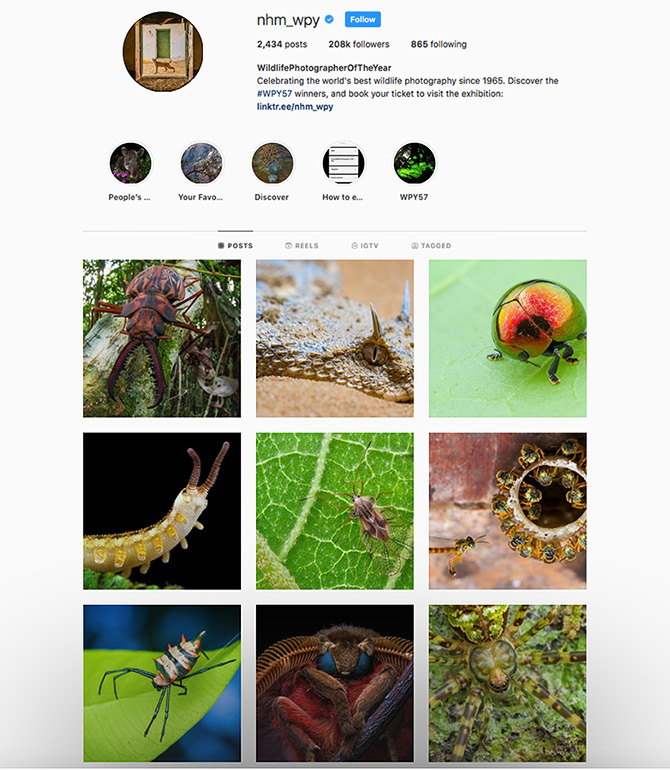
"Gil Week", social media guest posts on NHM's Wildlife Photographer of the Year Instagram account

“Gil Week”, social media guest posts on NHM’s Wildlife Photographer of the Year Instagram account

On the positive end, you will most likely gain an immense exposure and following, more people will be familiar with and support your work, and you will inspire others. To me that last bit is really important. You might even get to know some cool new people. I have had amazing conversations with other nature photographers and people who now view insects and spiders differently thanks to my work. I mentioned this in my post about “The Spider Room”, the photo went viral fast and the response was a mix of negatives and positives. The number of people who reached out to me regarding this photo was jaw-dropping, and I had a great time answering questions about it. I’m very happy that it was a conversation starter that made people pause for a moment and think.

Visitors to the Australian National Maritime Museum expressing love for my photo "The Spider Room" (photo by Cassandra Hannagan)

Visitors to the Australian National Maritime Museum expressing love for my photo “The Spider Room” (photo by Cassandra Hannagan)

Ok, so after writing this long post about photo competitions, and considering that they are not too important to me, the real question is –
am I going to enter my work to competitions in the future?
Well, the answer is yes, because the positive outcomes far outshine the negative ones, but… I’d pick only one competition that resonates best with me, and enter only ONLY if I have something unique to contribute, like a species or a behavior that has never been captured before, or an unusual composition. There are a couple of reasons for this. Remember that I do not produce my work with a photo competition in mind, but many photographers do spend a great deal of time and planning on it, and this makes winning in the competition very difficult. The other point is that the jury panel evaluates the photos by comparing them to other entries, and there is absolutely no way to know or control how well your photos will perform. In other words, it’s a bit of a gamble. But that’s what makes this game so interesting! As long as you recognize it as such and manage your expectations accordingly, you should be fine.

My winning certificates, book and merchandise from Wildlife Photographer of the Year competition. Not gonna lie, it feels good :)

My winning certificates, book and merchandise from Wildlife Photographer of the Year competition. Not gonna lie, it feels good 🙂


To read part 1 about “The spider room”, click here.
To read part 2 about “Bug filling station”, click here.
To read part 3 about “Beautiful bloodsucker”, click here.
To read part 4 about “Spinning the cradle”, click here.

Wildlife Photographer of the Year Q&A: Spinning the cradle, Behavior: Invertebrates category winner

Up next in the series of Q&A posts about my Wildlife Photographer of the Year winning images is Behaviour: Invertebrates category winner: Spinning the cradle.

Spinning the cradle. Wildlife Photographer of the Year, Invertebrate Behaviour category winner. A female fishing spider (Dolomedes scriptus) stretches out fine strands of silk from her spinnerets for weaving into her egg sac. Ontario, Canada

Spinning the cradle. Wildlife Photographer of the Year, Invertebrate Behaviour category winner. A female fishing spider (Dolomedes scriptus) stretches out fine strands of silk from her spinnerets for weaving into her egg sac. Ontario, Canada

You can watch the part when it appears in the awards ceremony here (timestamped)

 
“Spinning the cradle” really surprised me when it won in the invertebrates category. I knew the photo was good, but I never expected it to win. It is also a photo I took close to home, while on a routine walk in a forest. It goes to show the subject does not necessarily have to be something exotic or brightly colored in order to make an impact on the viewer. There are interesting things happening around us all the time. There are plenty of fascinating species very close to home, we only need to learn to find and observe them. You do not need to travel far to remote locations. Sometimes all it takes is just to look around you, you never know what you might find!

“An exquisite portrait of a remarkable piece of animal behavior”

“An exquisite portrait of a remarkable piece of animal behavior”

What is so special about this photo?
While hiking out locally and searching for arthropods for testing the Laowa 100mm 2x macro lens, I found a fishing spider (Dolomedes scriptus) under a slab of tree bark. Fishing spiders are common in wetlands where they feed on small aquatic animals (insects, amphibians, and small fish), but they are also very common in temperate forests. The spider was in the process of laying the base for an egg sac, so I thought this could be a good opportunity to observe and photograph the process, since this behavior is rarely documented. In general, spiders prefer to be hidden while constructing egg sacs. They are usually busy and distracted during the process, so they try to reduce the risk of predation to themselves and their offsprings. What I like about “Spinning the cradle” is that the photo shows the spider stretching the silk threads right before incorporating them into the rest of the forming sac. If you look closely, you can easily make out each of the separate silk strands being stretched by the spider. I have photographed weaving spiders in the past, but never in such clarity and detail. After taking the photo, I reviewed it on the camera’s back screen and I immediately knew I captured something special.

The fishing spider laying down the silk base for her egg sac, slowly working it into the shape of a bowl. This photo is rotated for easy viewing - the spider is actually facing down.

The fishing spider laying down the silk base for her egg sac, slowly working it into the shape of a bowl. This photo is rotated for easy viewing – the spider is actually facing down.

Can you explain the orientation of the photo? Something about it seems off.
“Spinning the cradle” is a rear-shot (or… a butt-shot! Did you catch that during my award acceptance speech?) of the spider stretching silk threads, but you are not really looking horizontally at the spider on eye level. Instead, the spider is standing vertically on the bark while facing down. So, in fact, the spider’s butt is facing up, and you are viewing the spider from above. I hope this makes sense.

What is the size of the spider?
This is a medium-large spider with a leg span of 6cm.

How were you able to take this photo without disturbing the spider?
Any disturbance could have caused the female spider to stop spinning and abandon her project. The main challenge here was to keep the tree bark the spider was on very steady and avoid breathing on the spider while I was photographing the behavior. We often take our breathing for granted. Most spiders have rather poor vision, but they can sense when a large animal is breathing right next to them, and will try to flee the area. So I carefully leant on the tree in a bit of an awkward position, placing the trunk between my legs to keep my body stabilized. Then I steadied the bark with my left hand and gripped the camera in my right while holding my breath, and started photographing.

An animation showing the spider in the process of incorporating silk into the forming egg sac

An animation showing the spider in the process of incorporating silk into the forming egg sac

Can you describe the spinning process? How does the spider make a spherical sac out of silk threads?
The movements of the spider’s spinnerets in action reminded me a lot of human fingers when weaving. The spider has complete control over the direction and density of the silk threads coming out of each spinneret. It is quite fascinating to watch. The spider starts with a flat circular base, and spins around in circles while adding more silk to its outer side, slowly forming walls. As the spider continues to build upwards, the silken disc gradually grows into a bowl shape. The spider continues to stretch and incorporate more silk until the bowl is deep enough to accept the egg mass. Then the spider stops, spends a few good moments laying the eggs, and quickly (and I do mean quickly) starts spinning again, this time carefully rolling the sac from side to side while tightening the silk threads, forcing its shape into a sphere. Once the sac is sealed, the process is complete.

The fishing spider in the process of laying her eggs inside her freshly spun egg sac

The fishing spider in the process of laying her eggs inside her freshly spun egg sac

The spider moments after laying her eggs. Note the smaller size of the abdomen compared to the previous photo.

The spider moments after laying her eggs. Note the smaller size of the abdomen compared to the previous photo.

How long did the spinning process take?
Spinning the egg sac, laying the eggs, and sealing the sac is a long process and requires a great investment of energy from the female spider. The process takes about 1-2 hours, during which the spider is focused on the project and is in fact vulnerable to attacks. This is the reason why spiders usually spin their egg sacs in a hide (like in this case, under bark), unexposed to potential predators and parasitoids.

The fishing spider in the process of sealing her egg sac after laying the eggs inside

The fishing spider in the process of sealing her egg sac after laying the eggs inside

What did you do after the spider finished spinning its egg sac?
After about an hour, the spider completed most of the sac and was getting ready to lay its eggs inside it, at which point I snapped a couple of final photos, slowly moved the bark back in place and left the animal to its business. There was no need to cause damage to the next generation of fishing spiders for the sake of obtaining more photos. The attentive mother will carry the sac with her until the eggs inside hatch and the hundreds of spiderlings disperse.

Once the egg sac is complete, the female fishing spider is on guard duty until it hatches

Once the egg sac is complete, the female fishing spider is on guard duty until it hatches

We like the photo! Can we buy a print from you?
Of course. Contact me and I will do my best to assist you.

If you have any questions about my photo that do not appear in this post, feel free to leave them in the comments. I will do my best to answer them.

To read part 1 about “The spider room”, click here.
To read part 2 about “Bug filling station”, click here.
To read part 3 about “Beautiful bloodsucker”, click here.
To read part 5 about what to expect when entering a photo competition, click here.

Stay tuned for the next posts in this series!

Wildlife Photographer of the Year Q&A: Beautiful bloodsucker, Behaviour: Invertebrates highly commended

Part 3 in the series of Q&A posts about my Wildlife Photographer of the Year winning images is Behaviour: Invertebrates highly commended: Beautiful bloodsucker.

Beautiful bloodsucker. Wildlife Photographer of the Year, Invertebrate Behaviour category highly commended. A female mosquito (Sabethes sp.) in mid-bite. Amazon Basin, Ecuador

Beautiful bloodsucker. Wildlife Photographer of the Year, Invertebrate Behaviour category highly commended. A female mosquito (Sabethes sp.) in mid-bite. Amazon Basin, Ecuador

You can watch the part when it appears in the awards ceremony here (timestamped)

 
“Beautiful bloodsucker” is my personal favorite among my winning images, maybe because it took the greatest effort and longest time to produce (more on that later). This photo was released in September 2021 as a teaser for the Wildlife Photographer of the Year awards ceremony along with several other finalist images. Interestingly, upon release most media outlets chose to ignore the photo and omit it from their reports, however it eventually received exposure thanks to a BBC article that covered it extensively. The photo went viral online shortly after, as “the world’s most beautiful mosquito.”

“Now, come on. Come on! That’s the finest mosquito you’ve ever seen. It looks like a fantastic piece or art deco jewellery”

“Now, come on. Come on! That’s the finest mosquito you’ve ever seen. It looks like a fantastic piece or art deco jewellery”

You can also read the CBC article about “Beautiful bloodsucker” here or listen to my radio interview.

Why is this mosquito so flamboyant?
It is not clear why Sabethes mosquitoes have such beautiful metallic colors, but they are not the only ones. Other mosquitoes (for example Psorophora cyanescens, Toxorhynchites, etc’) have blue metallic scales covering their body. I discussed the fuzzy leg ornaments in a previous blog post; it is believed that they play a role in courtship, but because they are present in both sexes it is not well understood how they are being used.

A closeup of a Sabethes mosquito in mid-bite, showing the beautiful scales covering its body

A closeup of a Sabethes mosquito in mid-bite, showing the beautiful scales covering its body

What are those curvy things above the mosquito’s head?
Those are the mosquito’s hind legs! All mosquitoes curve their hind legs upwards at rest, occasionally swinging them from side to side. These legs are covered with fine hairs and function as sensory organs to detect approaching threats. When an intruder (or a swatting hand) gets close, the legs detect the movement by changes in the air currents above the mosquito, prompting it to escape immediately by taking off.

What is the size of the mosquito?
Despite their exotic appearance, Sebethes mosquitoes are not too different in size from your typical mosquito. They are 4mm long, very tiny. The one photographed in my winning photo “Beautiful bloodsucker” is standing on my finger knuckle. Here is one photographed on my pinky finger for a better sense of scale.

Sabethes mosquito in mid-bite with pinky finger for scale

Sabethes mosquito in mid-bite with pinky finger for scale

Do you normally let mosquitoes bite you?
Not by choice, but when you are visiting a tropical rainforest it is bound to happen. Especially after rain, small water reservoirs in trees, epiphyte plants, or fallen leaves fill up and trigger female mosquitoes to go out looking for a blood meal before laying their eggs. I normally try to avoid getting bitten by wearing long sleeve clothes and putting some bug spray, but it is pretty impossible to avoid them entirely in the tropics. You can protect yourself as much as possible, but the moment you are distracted they will seize the opportunity to sneak up on you. Sabethes is the only mosquito towards which I am more forgiving. I love these mosquitoes, and every time I encounter them on my trips to South America I cheer with joy and hope that they come closer for a bite so I can take more photos of them. Am I a masochist? …maybe.

Sabethes mosquito in mid-bite. Note the swelling abdomen, filling with blood

Sabethes mosquito in mid-bite. Note the swelling abdomen, filling with blood

Isn’t this risky? Can this mosquito transmit any diseases?
It is important to remember that this is a wild animal, not a mosquito that was reared in a lab free of pathogens. There is definitely a component of risk here, as with all wildlife. These mosquitoes are important vectors of several tropical diseases, such as yellow fever and dengue fever, and perhaps other diseases as well. While taking the photo, I was bitten by this mosquito and several others, increasing the risk of contracting a vector-borne tropical disease. But I am still alive!

Is a bite from this mosquito painful?
Very. Every bite from a given species of mosquito feels a little different, mostly due to size and other morphological differences, but also thanks to differences in composition of the mosquito’s saliva. Sabethes mosquitoes are really something special. Not only do you feel them drilling into your skin, but it also leaves a painful sensation lasting hours and even days after the bite.

This Sabethes mosquito was photographed at the same location as the others, but it appears to be a different species with different leg ornaments.

This Sabethes mosquito was photographed at the same location as the others, but it appears to be a different species with different leg ornaments.

How long did it take you to get this photo?
About 4-5 years. I planned this particular photo composition for a long time. I have been encountering Sabethes mosquitoes for almost a decade and I knew I wanted something very specific. Little did I know that it would take an unbelievable amount of preparation and patience. These mosquitoes are extremely skittish and difficult to photograph well, especially in the constant heat and humidity of the rainforest. The mosquito responds to the tiniest of movements and to changes in light intensity. This means you must stay very still while attempting to photograph it, and also be prepared for the mosquito’s escape if using a flash. Fortunately, you are never alone with a single mosquito, because usually there are dozens of them hovering over your head. After carefully studying and observing the insect’s behavior for several years I was able to get a head-on, intimate photo of a female mosquito preparing to bite one of my finger knuckles. Even on the successful shoot itself it did not go smoothly the first time, and I had to keep trying for a couple of hours, all while getting bitten, until I finally got the photo I had in mind.

Why does this photo look like it was taken in a studio?
That is a great question that I received more than once. Indeed the background in “Beautiful bloodsucker” looks very plain and uniform to be considered in situ (in other words, a photo that was taken on site, in the subject’s natural habitat). However, I assure you that it was taken in the rainforest while I was visiting Ecuador. The background is simply the sleeve of my long hiking pants. After experimenting with different backgrounds on previous photography attempts, I chose this neutral background to emphasize the full spectrum of colors on the mosquito’s body.

I have seen many Sabethes mosquitoes over the years, but this female might be the prettiest so far

I have seen many Sabethes mosquitoes over the years, but this female might be the prettiest so far

Do you have any behind-the-scenes photos?
I do not, but maybe this it for the best. Almost every time I attempted to photograph these mosquitoes I was surrounded by a swarm of them. It was very annoying and I was frustrated from getting bitten. I bet it would look horrible on camera.

Sabethes mosquito biting my thumb

Sabethes mosquito biting my thumb

Do you think this photo will change people’s general view on mosquitoes?
I am a pretty realistic guy, so I do not expect my photo to make people fall in love with mosquitoes. My hope is that it will make people pause and look before they automatically swat a mosquito, and maybe appreciate and beauty and structural complexity of these animals.

We like the photo! Can we buy a print from you?
Of course. You can get a wall print of “Beautiful bloodsucker” directly from the Natural History Museum’s shop at affordable rates. If you need something different, contact me and I will do my best to assist you.

If you have any questions about my photo that do not appear in this post, feel free to leave them in the comments. I will do my best to answer them.

To read part 1 about “The spider room”, click here.
To read part 2 about “Bug filling station”, click here.
To read part 4 about “Spinning the cradle”, click here.
To read part 5 about what to expect when entering a photo competition, click here.

Wildlife Photographer of the Year Q&A: Bug filling station, Behaviour: Invertebrates highly commended

We are continuing our series of Q&A posts about my Wildlife Photographer of the Year winning images, and this time I will be reviewing Behaviour: Invertebrates highly commended: Bug filling station.

Bug filling station. Wildlife Photographer of the Year 2021, Invertebrate Behaviour category highly commended. Predatory stink bug nymph (Euthyrhynchus floridanus) feeding on a moth caterpillar. Mindo, Ecuador

Bug filling station. Wildlife Photographer of the Year 2021, Invertebrate Behaviour category highly commended. Predatory stink bug nymph (Euthyrhynchus floridanus) feeding on a moth caterpillar. Mindo, Ecuador

You can watch the part when it appears in the awards ceremony here (timestamped)

 
Out of my winning images, “Bug filling station” received the least attention and was skipped by many of the reporting media outlets. I think it is a shame, because it tells an interesting story of opportunistic survival.

“It’s a gruesome scene but it’s a remarkable piece of behavior”

“It’s a gruesome scene but it’s a remarkable piece of behavior”

What is so special about this photo?
The photo shows a small bug nymph feeding on a much larger moth caterpillar that was in preparations for pupating on a tree trunk. However, there is more depth to this story. The caterpillar is most likely a species of a tiger moth, which are characterized by having thick barbed hairs or spikes for protection against predators and parasitoids. As you can see, it didn’t really help the caterpillar in this case, for two reasons. First, the caterpillar is resting inside a very thin and poorly constructed cocoon, these are the black silk threads that can be seen in the photo. This cocoon is spacious and open because the cloud forest is a very wet environment. A typical cocoon with high-density spun silk will absorb rainwater and drown the pupa inside, whereas an open cocoon drains water better. Even though it is a thin cocoon, the caterpillar is still trapped inside and cannot leave. Second, pupating caterpillars are helpless and cannot defend themselves, as they lose the ability to walk prior to pupation, along with most of their senses. Therefore, the caterpillar is essentially defenseless at this stage, and indeed many predators and parasitoid insects seize this opportunity to attack.
Now the small bug nymph enters the picture, and decides to take advantage of the immobilized caterpillar by piercing its body with its proboscis and sucking its juices while the caterpillar is still alive. It is a great opportunity for the bug, because it can stay next to the caterpillar and feed as long as it wants or needs, without worrying about the prey escaping or the food supply running out.

Can you elaborate more about the bug’s mouthparts? I can’t understand what I am looking at.
The hemipteran proboscis is actually a complex system of mouthparts for sucking. The liquid food travels inside the narrow tube seen at the top of the mouthparts complex. This tube consists of the “jaws”; the elongated mandibles and maxillae are layered and arranged as a feeding tube. The folded part seen at the bottom is called labium (lower lip), and functions as a sheath to keep the mouthparts packed tightly together. During feeding this sheath is pushed backwards to expose the tip of the feeding tube and allows the bug to “bite” and start drinking.

What is the size of the bug?
Body length was 8mm. Judging by the size of the wing buds I would say it is two stages (=instars) away from becoming an adult.

A slightly different view of the bug filling station. The Euthyrhynchus floridanus nymph is very small compared to the huge moth caterpillar!

A slightly different view of the bug filling station. The Euthyrhynchus floridanus nymph is very small compared to the huge moth caterpillar!

Do you have any behind-the-scenes photos?
I usually travel alone, but surprisingly in this case I do! I spent a few days in the cloud forests of Mindo, Ecuador together with my friend Javier Aznar, taking photos of the beautiful arthropod fauna there. He was kind enough to take my photo.

Me photographing in Mindo, Ecuador (photo courtesy of Javier Aznar)

Me photographing in Mindo, Ecuador (photo courtesy of Javier Aznar)

What else can you tell us about this bug?
The species is the Florida predatory stink bug (Euthyrhynchus floridanus). It is a monotypic species, in other words it is the only species in its genus. It has a wide distribution in southeastern United States and northern Latin America. In contrast to most members of its family Pentatomidae, this species is carnivorous and considered beneficial. It seems to enjoy feeding on many plant pests, as well as other small insects. Interestingly, this species is also gregarious, sometimes attacking prey in groups, although in my case no other nymphs were present in the area. The adult bugs display high color polymorphism, with variable red or orange patches on a metallic dark blue body.

We like the photo! Can we buy a print from you?
Of course. Contact me and I will do my best to assist you.

If you have any questions about my photo that do not appear in this post, feel free to leave them in the comments. I will do my best to answer them.

To read part 1 about “The spider room”, click here.
To read part 3 about “Beautiful bloodsucker”, click here.
To read part 4 about “Spinning the cradle”, click here.
To read part 5 about what to expect when entering a photo competition, click here.

Wildlife Photographer of the Year Q&A: The spider room, Urban Wildlife category winner

Recently I was honored to have four of my photos commended in the prestigious Wildlife Photographer of the Year photo competition organized by the Natural History Museum in London. This is a major achievement for me, and not something that I take lightly. A lot of hard work, dedication, and patience got me to this point. Most photographers spend years trying to get a single photo recognized in the competition, usually without success. To have four entries selected as finalists, with two category winners, is not something I expected even in my wildest dreams. The attention from the press and the general public after the awards ceremony and the winners announcement (watch it here) was overwhelming and sometimes exhausting (especially in the case of the photo “The spider room”). Now that things have calmed down a little, I decided to dedicate a few posts to the competition; to answer some of the repeating questions from people, and provide a bit of the background story for each of my winning photos.

We start off this series of posts with Urban Wildlife category winner: “The spider room”. First of all if you have not read the full story behind this photo, feel free to head over to this post.

The spider room. Wildlife Photographer of the Year 2021, Urban Wildlife category winner. Phoneutria fera and its babies under my bed. Amazon basin, Ecuador

The spider room. Wildlife Photographer of the Year 2021, Urban Wildlife category winner. Phoneutria fera and its babies under my bed. Amazon basin, Ecuador

You can watch the part when it appears in the awards ceremony here (timestamped).

Out of my winning images, this is probably the photo that made the most impact. The public response to it was phenomenal. It went viral immediately after the awards ceremony, attracting comments from thousands of people. I got literally hundreds of messages and questions about it over social media. It seems that people either like this photo, or really, REALLY hate it. The interesting thing is that either way, people have an opinion about it. They talk about it. It’s a conversation starter. I couldn’t ask for a better result. There is also a story behind the submission of this photo to the competition that I will mention later.

“Seriously... This was under Gil Wizen’s bed, I’m sure it might send a shiver down your spine, but when I tell you that it was a Brazilian wandering spider, a very large animal and one of the most venomous spiders in the world, you’d be more worried”

“Seriously… This was under Gil Wizen’s bed, I’m sure it might send a shiver down your spine, but when I tell you that it was a Brazilian wandering spider, a very large animal and one of the most venomous spiders in the world, you’d be more worried”

Ok, spill out the truth. Is it real?
Yes.

What is the size of the spider? It looks huge!
This is an adult female Phoneutria fera, or Brazilian wandering spider. It is one of the largest araneomorph (non-tarantula) spiders in the world. The spider can easily cover an adult human’s hand with its leg span, which is almost 6 inches or 15 centimeters. The lens used to capture the photo makes it look bigger (forced perspective).

What is this “forced perspective”?
Forced perspective is an optical illusion that makes an object appear physically different (larger, smaller, closer, or farther) than it actually is. In this case I used a short focal length wide-angle lens, photographing the spider under my bed from a very short distance to make it appear larger in the frame while still retaining most of the details of the background.

Don’t spiders have 8 legs? I only see 6!
Spiders indeed have eight legs. This spider is not missing any legs, but it holds the two front pairs closely together, making it look like it is a single pair of legs.

A wandering spider (Phoneutria fera) female guarding her babies. Amazon Basin, Ecuador

A wandering spider (Phoneutria fera) female guarding her babies. Amazon Basin, Ecuador

What is that thing on the floor next to the spider?
The spider is feeding on a cockroach, so right under it there is a cockroach leg that it discarded. However, since the online version of the photo is usually of low resolution, most people mean the black area on the floor in front of the spider – that is simply a hole in the floorboard.

How venomous is this spider?
To quote from wandering-spiders.net: “Phoneutria venom contains a wide variety of peptides and proteins including neurotoxins, which act on the ion channels and chemical receptors of the neuromuscular systems of insects and mammals.” This means the venom has the potential to cause excitatory symptoms such as salivation, muscle spasms, loss of consciousness, loss of control over muscles, priapism (yup, you read that right), and in some cases even death.

Oh no! Banana spider aka Brazilian wandering spider (Phoneutria fera) in my kitchen!

Oh no! Banana spider aka Brazilian wandering spider (Phoneutria fera) in my kitchen!

Where was this photo taken? I am worried!
The spider room photo was taken in a biological research station in Ecuador. Phoneutria spiders are only found in the tropical regions of Latin America.

How did you not set the whole room on fire?? What’s wrong with you, look at this thing!
And why would I do that? The spider doesn’t know it is in someone’s room. It doesn’t even know what a human is. Allow me to quote myself: We DO NOT burn houses just because a spider happened to walk in. It’s absurd. Just because a spider found its way into your house, doesn’t mean it’s going to go after you. Spiders are constantly busy surviving, they have no time for us. If you find a spider at home, please kindly escort it out. The spider will thank you, and both of you will be happy. No need to cause property damage and possibly hurt yourself and others in the process.

It doesn’t look like any bed that I’ve ever seen. Can we see the bed?
Yes you can! Just don’t expect too much.

The bed where Phoneutria fera was found (photo courtesy of Alex Shlagman)

The bed where Phoneutria fera was found (photo courtesy of Alex Shlagman)

This photo isn’t mine. It was taken by my colleague during our previous stay at the site in 2007 and the room has changed considerably since then, but it’s the same bed.

Do you have any behind-the-scenes photos?
Unfortunately I was alone during the encounter with the spider, so I have no behind-the-scenes photos. However, I can try to communicate the experience. After figuring out that the source for the baby spiders in my room was under the bed, I decided to crawl under it to take a closer look. Someone on twitter posted this image, either directly or indirectly connected to my spider photo, and it encapsulates the scene very well:


When I looked under the bed, this is what I saw:

Phoneutria fera under my bed. Amazon basin, Ecuador

Phoneutria fera under my bed. Amazon basin, Ecuador

And one look was all I needed. I immediately knew which kind of photo I wanted to take.

Weren’t you scared to get so close to the spider?
I was not scared to photograph the spider from up close, because it was busy feeding and did not pay attention to me. However, after photographing I decided to relocate it outside, and this involved moving the spider. I was a little concerned because this spider is extremely fast and defensive, so I moved slowly and used extreme caution.

Closeup of a wandering spider (Phoneutria boliviensis) resting on a leaf in the Ecuadorian Amazon. I got very close when taking this photo and the spider could not care any less.

Closeup of a wandering spider (Phoneutria boliviensis) resting on a leaf in the Ecuadorian Amazon. I got very close when taking this photo and the spider could not care any less.

How did you move the spider outside?
There is a simple trick for catching spiders by placing a cup over the arachnid and sliding a piece of paper underneath. It works with any spider, large or small, tarantula or araneomorph spider. This is what I did with the Brazilian wandering spider before carrying it outside to release.

You said you relocated the spider outside, but what about all the babies?
The babies were left untouched. After hatching from the egg sac, baby spiders need very little attention. In some spiders the mothers stay close to the babies to protect them, but the truth is they are independent and can take care of themselves. That is why they were already dispersing around in the room. In addition, the baby wandering spiders have tiny fangs and physically cannot bite humans, so they are harmless.

Don’t spiders go back to their nest if moved away from it? Did the spider return?
After it was released the spider did not return to the room. However, this question is justified because I have heard more than one account where a wandering spider was relocated and showed up in the same place the day after. It is possible that the spider can find its way back following chemical cues. Silk may contain important information about the individual spider that placed it, and this information can be used by the same animal or other spiders for tracking.

Did you have any similar encounters with these spiders?
I encounter members of genus Phoneutria almost every time I visit Latin America. I always get startled at first because it is a very large spider, but then I continue to observe them without worries. They are interesting animals with an important role in their habitat and we should treat them with respect.

Wandering spider (Phoneutria depilata) preying on a katydid. Photographed on the thatched roof of a cabin in Colombia.

Wandering spider (Phoneutria depilata) preying on a katydid. Photographed on the thatched roof of a cabin in Colombia.

Wandering spider (Phoneutria depilata) preying on a katydid. Limón Province, Costa Rica

Wandering spider (Phoneutria depilata) preying on a katydid. Limón Province, Costa Rica

We like the photo! Can we buy a print from you?
Of course. Contact me and I will do my best to assist you.

Can I use your photo for my super funny meme? Please!
This has already happened even before the photo won in the competition.
I had a feeling that the photo would go viral after the winners announcement, and expected the internet to have a field day using it for memes. As long as the memes are civil, do not call for violence, damage of property, or the unnecessary killing of spiders – I am fine with it.

What is the story behind the submission that you mentioned in the beginning of the post?
As mentioned in my award reception speech for “The spider room”, I actually had no intention to submit this photo to the competition. My plan was to submit another photo of a wandering spider preying on a katydid, however my good friend Ellen Woods, who encouraged me to enter my work to the competition in the first place (something I will discuss in a later post in this series), insisted that I submit this particular photo in the Urban Wildlife category. And she was spot on! So the way I see it, this is more her win than mine.

Wandering spider (Phoneutria depilata) preying on a katydid. Photographed in Colombia. This was the photo I initially planned to submit to the competition. Looking back, it would probably not have been picked up as a finalist.

Wandering spider (Phoneutria depilata) preying on a katydid. Photographed in Colombia. This was the photo I initially planned to submit to the competition. Looking back, it would probably not have been picked up as a finalist.

Why did you submit this photo in the “Urban Wildlife” category, when it shows a research station close to the rainforest and has nothing to do with being urban?
I admit I hesitated to submit the photo because of this. However upon careful inspection of the category’s definition in the competition, the text reads: “Across the world, humans have created new habitats. Many animals have adapted to these built environments, some more successfully than others. These images focus on the magic of the commonplace, the surprise of the unexpected or the wonder of the normally unseen.” This means that the category is intended for photos of animals adapting to any human-made environment. Not necessarily just cities, even if it is the first thing that comes to mind when hearing the word “urban”.

If you have any questions about my photo that do not appear in this post, feel free to leave them in the comments. I will do my best to answer them.

To read part 2 about “Bug filling station”, click here.
To read part 3 about “Beautiful bloodsucker”, click here.
To read part 4 about “Spinning the cradle”, click here.
To read part 5 about what to expect when entering a photo competition, click here.

Goodbye 2020-2021: Why I will no longer post “year in review” recaps on this blog

If you have been following this blog long enough, you might have noticed that 2019 was the last year I wrote a “year in review” recap for. I think forcing myself to write a list of my annual accomplishments is overall a positive thing, but what about those years I feel like I had no accomplishments or personal growth? The pressure to prove something of self worth can have a negative effect.

I think it is safe to say that for many of us 2020 was a real challenge, dealing with the emerging global COVID-19 pandemic and the confusion that followed. 2021 was slightly better (or maybe we just got used to the situation), but here we are in 2022 and although things are slightly better we are still not out of it. I can’t help thinking if one day we will look back on this and chuckle “hehe, remember COVID??” As for me, I had a few trips planned in 2020, of course none of them materialized as commercial flights got grounded very quickly and borders closed. Later when travel restrictions were somewhat lifted I made the conscious decision not to travel. It was the responsible thing to do, and I still feel that way, despite seeing many (many!) of my photographer friends taking advantage of the low cost flights for photo trips. I promised myself that I would never get political on this blog (and online in general), I prefer doing it in person. So this is as much as I will mention the topic.

No photography trips? No problem. I can pair many of my whip spiders instead.

No photography trips? No problem. I can pair many of my whip spiders instead.

While people around the world were searching for ways to entertain themselves at home during lockdowns, spending quality time with their families, perfecting their sourdough bread baking skills and learning to speak German, I took a step back to reflect. I looove self-reflection. I believe I’ve said it before on this blog: every time you have a chance to reevaluate what is important in your life, you should take it. I needed a breather. I took a break from taking photos and tried to focus on other things. I reorganized my living space (again). I thought a lot about what kind of jobs I would be willing to take now that public gatherings were cancelled and most of my income was gone. Of course I could have transitioned some of it to virtual meetings over the Zoom platform, but oh man I hate it so much. Anyway, all that thinking was quality time spent. Guess what didn’t make the cut into what I felt was important in life? Social media… I’m still going to keep my public accounts active, with Twitter getting most of the attention, but it was clear as day to me that I wanted to go back to writing on this website and investing more into it. Unfortunately, with the chaos surrounding everything, it was difficult to find the motivation to do it.

My arthropods breeding room, reorganized. One day I am going to write a post about that part of my work.

My arthropods breeding room, reorganized. One day I am going to write a post about that part of my work.

This begs the question, is it even worth it? Isn’t blogging dead? Some will argue that blogging has died a long time ago. Others will stress that it hasn’t really died, but instead switched medium into podcasts, and later video essays. I also view activity on Twitter as mini-blogging, although the limitations of the platform do not allow for very elaborate posts, so it’s something more like tease-blogging. One thing is clear – regardless of the medium, blogging takes a lot of time and effort, with no guaranteed rewards at the end. In my opinion, there is still room for traditional blogging because it is indexed so well by search engines, can easily be updated and kept on track with the times, and there is no need to satisfy some obscure algorithm on a platform that you do not own and have no control over. I still see some of my old posts getting a lot of traffic, despite similar posts in other, more accessible formats. This tells me having a website with good and valid content is still king. You know what really is dead though? MySpace. Google+. And one day it can be your current favorite social media platform. Please pause for a moment to think about that.

Spending most of my time at home allowed me to make more Ethical Ento-Mounts, and get more creative about them.

Spending most of my time at home allowed me to make more Ethical Ento-Mounts, and get more creative about them.

One thing you might have noticed is that I activated Google Adsense on this blog. Not on every post, just on very old or less informative posts (like this one!) that I do not consider cornerstone content. This was not done for generating income (I assure you that it is extremely difficult to earn anything from this revenue stream nowadays), but more for personal reasons of keeping the account active.

Last year I had a chance to play around with some new designs for business cards. I really like them.

Last year I had a chance to play around with some new designs for business cards. I really like them.

Photography-wise, at the end of 2019 one of my goals was to finish clearing up the backlog in my photo archive, and indeed I made a huge progress. But even with this type of work I had to stop and take a long break from it at some point, because you can’t sit in front of the computer all day and do just that, every day, it’s not a way to live. I used this break as an excuse to test out different printing formats and media and the results were eye-opening, so I’m glad I did it. One more thing I did was to crack down on commercial copyright infringements, especially unauthorized monetized use on YouTube. Enough is enough. And, if I have to be completely honest, many of the image licenses that followed as a result kept me fed during 2020-2021.

My photos featured in a promotional macrophotography book! See, it wasn't all bad.

My photos featured in a promotional macrophotography book! See, it wasn’t all bad.

Alright, this post feels like I’m rambling as if the past two years had no accomplishments at all to be proud of. That’s not true. The TV series I took part in was released, I had a paper published. Even without me listing personal goals achieved, there is one big accomplishment that I just cannot ignore. I have been painfully silent about my four winning images in the 2021 Wildlife Photographer of the Year Competition. I swear it is not because I try to downplay the importance of this achievement (more on that in a separate blog post), but the main reason is that I didn’t have the time to sit and write about it. The press and media coverage of the competition results is overwhelming to say the least, and only now, four months after the winners were announced, I can say that I am starting to feel the response slowing down a little. Nevertheless, the Wildlife Photographer of the Year exhibition has just started its worldwide tour, so it is far from over. Because of this, I am going to dedicate the next five blog posts to talking about the competition: one post for each winning photo (kind of a Q&A), and one opinion post about photo competitions in general and Wildlife Photographer of the Year specifically. Did you see how I turned this “year in review” post into a promotional one?? Well done, Gil, give yourself a pat on the back… Will I write more annual recap posts like this one in the future? As you can see, over the years these posts became more and more personal and less informative. They were more for me, but I looking back at them now I don’t think they hold much value to other people. So I don’t know, something tells me that I probably won’t post recaps in the future. Separate topic posts are much more interesting and reader-friendly.