
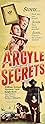
A reporter finds a WWII book listing traitors and profiteers. After he's killed in hospital, his assistant must evade police and criminals seeking the book for blackmail.A reporter finds a WWII book listing traitors and profiteers. After he's killed in hospital, his assistant must evade police and criminals seeking the book for blackmail.A reporter finds a WWII book listing traitors and profiteers. After he's killed in hospital, his assistant must evade police and criminals seeking the book for blackmail.



Ralph Brooks
- Reporter
- (uncredited)

Sayre Dearing
- Reporter
- (uncredited)

Herbert Rawlinson
- Dr. Van Selbin
- (uncredited)
- Director
- Writer
- All cast & crew
- Production, box office & more at IMDbPro
6.3608
1
2
3
4
5
6
7
8
9
10
Featured reviews
It's not The Maltese Falcon, and Gargan is no Bogart, but...
The Babel of foreign and regional accents in The Argyle Secrets seems too exotic overdone until you learn that Cy Endfield directed this short, cheap thriller from his own radio play. There, probably no more than four actors took the many and generic parts, distinguishing them with funny voices. Movies can't get away with that, so a roster of character players several of them familiar from 50s television was rounded up to fill out the cast. Since the stars are William Gargan (a couple of seasons as Martin Kane, Private Eye) and Marjorie Lord (Make Room For Daddy), with Barbara Billingsley (Leave It To Beaver) visible to those who don't blink, viewers should know better than to expect The Big Sleep.
Actually, The Maltese Falcon is the better template, of which The Argyle Secrets resembles a fifth-generation knockoff. The object in demand is a book called The Argyle Album, a detailed list of war profiteers that's being used for blackmail. A famous investigative columnist, in hospital, tells his younger colleague Gargan about it shortly before he expires, either of poison or a scalpel plunged into his pajamas. In tracking down the album, Gargan meets up with and fends off a motley of grotesques, including femme fatale Lord.
By no stretch of hyperbole can it be called good it's coarse and jumpy but now and again it shows flashes of talent (Endfield, two years later, would direct the much better The Underworld Story). There are some neat shots of the waterfront at night (the city's unspecified, but Boston comes to mind) and a tense and well-photographed sequence where an acetylene torch burns through a metal gate behind which Gargan has locked himself for safety.
Alas, Gargan is foisted off as an energetic young turk of the fourth estate, even though at the time he was 42 and looked at least 10 years older. He had started in movies in 1917, chalking up a more than respectable list of credits, but what charisma he may have once displayed had long since dissipated. Sad that the Indian Summer of his career would be spent in those lesser mediums of radio and newfangled TV. But he earns praise for spending the last years of his life, following a laryngectomy, working for the American Cancer Society.
Actually, The Maltese Falcon is the better template, of which The Argyle Secrets resembles a fifth-generation knockoff. The object in demand is a book called The Argyle Album, a detailed list of war profiteers that's being used for blackmail. A famous investigative columnist, in hospital, tells his younger colleague Gargan about it shortly before he expires, either of poison or a scalpel plunged into his pajamas. In tracking down the album, Gargan meets up with and fends off a motley of grotesques, including femme fatale Lord.
By no stretch of hyperbole can it be called good it's coarse and jumpy but now and again it shows flashes of talent (Endfield, two years later, would direct the much better The Underworld Story). There are some neat shots of the waterfront at night (the city's unspecified, but Boston comes to mind) and a tense and well-photographed sequence where an acetylene torch burns through a metal gate behind which Gargan has locked himself for safety.
Alas, Gargan is foisted off as an energetic young turk of the fourth estate, even though at the time he was 42 and looked at least 10 years older. He had started in movies in 1917, chalking up a more than respectable list of credits, but what charisma he may have once displayed had long since dissipated. Sad that the Indian Summer of his career would be spent in those lesser mediums of radio and newfangled TV. But he earns praise for spending the last years of his life, following a laryngectomy, working for the American Cancer Society.
Rare Maltese Falconish yarn
Very rare low-budget film from director Endfield (Zulu) plays like a not-bad student film version of The Maltese Falcon-- the supporting performances aren't always convincing but there are nice touches of visual imagination and good pacing.
argyle secrets
If, like Ben Mankewiecz the other night, I were to extol the tragic, shamefully HUAC truncated career of writer/director Cy Enfield, this agressively ordinary murder/espionage mystery with way too much dull narration and a rather flat acting job by lead William Gargan would not be my first choice as evidence. Think I'd go with either "Zulu" or "Hell Drivers" instead. Still, it's always nice to see the future June Cleaver get clocked and Enfield brings the thing in at under seventy minutes, which is almost always a plus in these kinds of el cheapo Saturday matinee type deals. C plus.
moody, quirky low-budget late 40's crime-noir
As I was boxing up some old films for an upcoming move, I stumbled across THE ARGYLE SECRETS, a film I must have watched a decade ago. I didn't remember anything about it and even thought it starred Tom Conway (!!), but I must have been thinking of another film. So THE ARGYLE SECRETS seemed new to me, and I was VERY impressed by it. Yes, there are some similarities with THE MALTESE FALCON, but many detective/crime films were influenced by that classic. I have not heard the radio play on which this film is based, but taken on its own, this is--like many of the releases from the fascinating "Film Classics" company, an outfit that specialized in very low-budget but quirky and atmospheric crime and detective and late noir films--a moody and distinctive film that is surprisingly good. William Gargan (close your eyes while he is speaking and see if you don't think that his speech rhythms are reminiscent of George Raft) is always an excellent hard-boiled leading man, and here he plays a journalist who is entrusted with some vague information about something called The Argyle Album, which supposedly contains all kinds of incriminating information about WWII traitors and collaborators and profiteers. He is framed for the death of the man who gave him the information, and thus he is being pursued by both police and international crooks. There are a number of hair-raising sequences where he is about to be caught or killed (one scene where he sneaks into an apartment where a policeman--an almost unrecognizable Robert Kellard-- and his mother live, and the cop has a newspaper with Gargan's face on the cover, but insists on looking at the sports section first, but is always ABOUT TO look at the front page) is very cleverly done, and there is a very creative hallucination montage after Gargan is beaten up by the bad guys. There's also an undercurrent of suggested brutality in the film that is disquieting. Gargan beats a woman who asks him to so that she will have bruises on her and thus she can claim he escaped after choking her; Gargan strong-arms a woman into submission; and there's a scene with an acetylene blow torch that is quite effective and would be considered a classic if it had appeared in , say, THE LADY FROM SHANGHAI. Writer-director Cyril Enfield was responsible for some excellent and creative mysteries in the late 40s and early 50s--THE SOUND OF FURY (aka TRY AND GET ME) is an amazing film with a strong liberal message, and THE LIMPING MAN is a wonderful mystery with a switch ending that has to be seen to be believed. Endfield is superb at creating a sense of dislocation, of disorder. A surprising credit for Assistant to the Producer is famous silent-film archivist and entrepreneur Raymond Rohauer. The film is produced by Sam X. Abarbanel, a writer and producer responsible for some of my favorite guilty pleasure such as the Spanish crime films THE NARCO MEN starring the late Tom Tryon, and THE SUMMERTIME KILLER with Chris Mitchum. Also, there are a number of juicy supporting performances--Ralph Byrd as the police inspector who isn't sure about Gargan and appears in the final scene of the film which is hilarious (and which I won't give away), and Jack Reitzen (who was in a LOT of grade-c crime films in the late 40s), doing a florid Southern accent and chewing the scenery. There are many distinctive little touches in this film--for instance, when Gargan is being interrogated by Ralph Byrd, we see a few shadows of men with hats hanging suspiciously outside the opaque windows of the office. When Gargan leaves the office and walks off screen, about five seconds later we see these shadows head in his direction. Maybe using shadows allowed the producer to use non-actors to play the roles and save money, but the effect works for whatever reason it may have been done. I will undoubtedly watch this film again soon and show it to some like-minded friends who appreciate low-budget, indie crime films of the post-World War II era. Check it out if you get a chance--it will be worth your time if you find the above description interesting.
a B from Universal
Stylish B starring William Gargan and two TV moms - Barbara Billingsley and Marjorie Lord, along with John Banner, and Ralph Byrd.
Similar to the Maltese Falcon, Gargan is Harry Mitchell, a newspaperman who is singled out among a bunch of newspapermen at the hospital to see an injured reporter. The reporter gives him an album cover for "The Argyle Album" but before he can say much more, he is dead, supposedly from a heart attack. Rip back the covers and there's a knife in his heart. Mitchell takes off.
The Argyle Album is an album with the names of people who profited from the war, traitors and people who made deals feathering their nests no matter who won.
Everyone is after it, including Lord and a gang of tough guys. Barbara Billingsley plays the dead reporter's secretary.
There were some neat things in this - spiral effects with swirls when Mitchell is knocked unconscious; and the cop who comes home, says goodbye to Mitchell, a former neighbor, and then opens the newspaper to his wanted photo on the front page.
Reminiscent of another fast talker, Lee Tracy, Gargan's voice box was removed in 1958 due to cancer, and from thereon he had an artificial voice box. While it stopped his career, he became an anti-cancer spokesperson for the American Cancer Association, living for another 21 years.
Similar to the Maltese Falcon, Gargan is Harry Mitchell, a newspaperman who is singled out among a bunch of newspapermen at the hospital to see an injured reporter. The reporter gives him an album cover for "The Argyle Album" but before he can say much more, he is dead, supposedly from a heart attack. Rip back the covers and there's a knife in his heart. Mitchell takes off.
The Argyle Album is an album with the names of people who profited from the war, traitors and people who made deals feathering their nests no matter who won.
Everyone is after it, including Lord and a gang of tough guys. Barbara Billingsley plays the dead reporter's secretary.
There were some neat things in this - spiral effects with swirls when Mitchell is knocked unconscious; and the cop who comes home, says goodbye to Mitchell, a former neighbor, and then opens the newspaper to his wanted photo on the front page.
Reminiscent of another fast talker, Lee Tracy, Gargan's voice box was removed in 1958 due to cancer, and from thereon he had an artificial voice box. While it stopped his career, he became an anti-cancer spokesperson for the American Cancer Association, living for another 21 years.


Did you know
- TriviaThe opening narrator says, "The Teapot Dome Scandal was going to be a church club misunderstanding compared to this." The Teapot Dome Scandal (1921-1923) was a bribery scandal involving the administration of US President Warren G. Harding. Secretary of the Interior Albert B. Fall had leased Navy petroleum reserves at Teapot Dome in Wyoming and California to private oil companies at low rates without competitive bidding. Before the Watergate scandal (1972-1974), Teapot Dome was regarded as the "greatest and most sensational scandal in the history of American politics."
- GoofsWhen Mitchell is in Scanlon's room, his action of reaching into his pocket and sitting on the bed is repeated from one shot to another.
- Quotes
Scanlon: Mitchell! What is it? You know where the album is. Tell me, Mitchell. Tell me!
Harry Mitchell: Why should I tell you? That's like the coach of Notre Dame giving the signals to the coach of Michigan.
Details
- Release date
- Country of origin
- Language
- Also known as
- Ronda da Morte
- Filming locations
- Hollywood Knickerbocker Hotel - 1714 N. Ivar Avenue, Hollywood, Los Angeles, California, USA(Knickerbocker Hotel exteriors, a real world location)
- Production company
- See more company credits at IMDbPro
Box office
- Budget
- $125,000 (estimated)
- Runtime
- 1h 4m(64 min)
- Color
- Aspect ratio
- 1.37 : 1
Contribute to this page
Suggest an edit or add missing content