
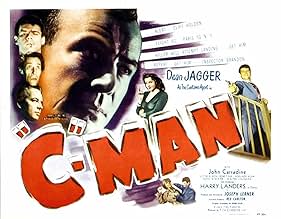
A Treasury Department agent is murdered. His best friend, a fellow agent, investigates and stumbles into a scheme involving smuggling and murder.A Treasury Department agent is murdered. His best friend, a fellow agent, investigates and stumbles into a scheme involving smuggling and murder.A Treasury Department agent is murdered. His best friend, a fellow agent, investigates and stumbles into a scheme involving smuggling and murder.




Walter Vaughn
- Customs Inspector Brandon
- (as Walter Vaughan)


Cindy Adams
- Unknown
- (uncredited)

Walter Brooke
- Joe
- (uncredited)
Jean Ellyn
- Birdie Alton
- (uncredited)

- Director
- Writer
- All cast & crew
- Production, box office & more at IMDbPro
5.8365
1
2
3
4
5
6
7
8
9
10
Featured reviews
offbeat gem with manic score
Here's one of those B-movie nuggets that makes sifting through the dregs worthwhile (quite appropriate for a tale of jewel smugglers). I'm sure it's exactly the kind of edgy, low-budget genre-piece that inspired Godard and Truffaut to create "Breathless" and "Shoot the Piano Player".
Like its near namesake "T-Men", the heroic semi-documentary frame limns a brutal, cynical noir with striking location shooting. The narrative keeps throwing us curveballs, and the tight, off-kilter framing, low-key lighting and nervy editing emphasize the randomness of the violence and the desperation of the denizens of this demimonde. Most arresting is the frantic free-jazz score, presaging Miles Davis's improvised work for "Lift to the Gallows".
The characters are idiosyncratic and played with verve. Like several other late noirs, there is an undercurrent of homosexuality among the henchmen, and John Carradine's quack doctor is addicted to Benedictine, of all things. A great, offbeat, late-night view.
Like its near namesake "T-Men", the heroic semi-documentary frame limns a brutal, cynical noir with striking location shooting. The narrative keeps throwing us curveballs, and the tight, off-kilter framing, low-key lighting and nervy editing emphasize the randomness of the violence and the desperation of the denizens of this demimonde. Most arresting is the frantic free-jazz score, presaging Miles Davis's improvised work for "Lift to the Gallows".
The characters are idiosyncratic and played with verve. Like several other late noirs, there is an undercurrent of homosexuality among the henchmen, and John Carradine's quack doctor is addicted to Benedictine, of all things. A great, offbeat, late-night view.
C MAN
I did not know this movie at all and I must admit that it is not bad at all but forgettable. Just as the other films directed by this Joseph Lerner, for instance GIRL ON THE RUN. But it is worth watching, after all John Carradine and Dean Jagger contribute a lot to the story, but they don't steal the show either. It is not a gritty.actionner, and anyway not an actionner at all. This is just an acceptable time waster, only destined to movie buffs in search of a rare item to watch. Even directed by a Joseph H Lewis or a Budd Boetticher, the result would have been the same - a bit better though - because there was nothing exceptional to take from such a story.
This film scores a C, man
Customs agent Dean Jagger (Cliff Holden) goes on the trail of a necklace and a killer. He is the C-Man.
The film moves along at a quick pace and if you just go with it, it carries you along. Unfortunately, it is a little confusing at times and because the picture quality has deteriorated, some dramatically filmed sequences are confusing instead of effective. John Carradine (Doc Spencer) plays a drunkard - it's his look that carries it off for him, not particularly his acting, although he probably wasn't acting! The soundtrack alternates between the over-dramatic and the jazzy art-house cool that suggests experimental film.
There are some very fake punch-ups that run alongside disturbing violent incidents. Make sure that your bed-knobs don't unscrew! The night club scene is also slightly embarrassing - terrible song, unrealistic audience and some poor acting.
Overall, the film is watchable - it should be better, though. Maybe a re-make?
The film moves along at a quick pace and if you just go with it, it carries you along. Unfortunately, it is a little confusing at times and because the picture quality has deteriorated, some dramatically filmed sequences are confusing instead of effective. John Carradine (Doc Spencer) plays a drunkard - it's his look that carries it off for him, not particularly his acting, although he probably wasn't acting! The soundtrack alternates between the over-dramatic and the jazzy art-house cool that suggests experimental film.
There are some very fake punch-ups that run alongside disturbing violent incidents. Make sure that your bed-knobs don't unscrew! The night club scene is also slightly embarrassing - terrible song, unrealistic audience and some poor acting.
Overall, the film is watchable - it should be better, though. Maybe a re-make?
offbeat but interesting indie crime-noir film
The few who know this film are probably either hardcore film-noir completists or hardcore John Carradine fans who must have every film "the master" appeared in. I'm glad I recently had an opportunity to view the film, because it is a fascinating independently-made crime-noir film with a number of unique touches. Most of the film is shot either on location on the streets of New York or in VERY small low-budget sets. The location shooting is quite interesting, using unexpected camera angles and giving the film a kind of documentary feel--one suspects that director Joseph Lerner and cinematographer Gerald Hirschfeld were familiar with the Italian neo-realists. I could watch hours of this kind of footage, capturing 1949 New York, as it was experienced by people on foot, through great low-angle shots. And the musical score, by Gail Kubik, is quite avant-garde--sections of it sounding like early John Cage or Stan Kenton at his most atonal. Ms. Kubik was obviously a fine composer who adapted her avant-garde music well to a crime film--I'm anxious to hear some of her other work. Dean Jagger is not the most convincing tough guy, but he is a good enough actor to handle the expository dialogue and unnecessary voice-overs and make them sound SOMEWHAT natural! Lottie Elwen, playing a woman from Holland whom Jagger meets and who gets the mystery, such as it is, in motion, is quite seductive and was an excellent choice for the role. John Carradine can create a distinctive supporting character in his sleep, and once again he does that here as a fallen, now-crooked doctor who has had his medical license revoked (he's only in a few scenes). We should, with hindsight, give credit to the filmmakers who were obviously working on a VERY low budget, yet created a distinctive looking film and a film with lots of atmosphere. Fans of obscure noir-crime films should seek it out; although it's certainly not a flawless classic, there's something real and raw and spontaneous about it, and that quality transcends any other limitations the film has.
Cheap and Ugly Paycheck Movie
Dean Jagger is a customs agent with a trench coat. He's told a good friend has been killed tracking down a jewelry theft ring in Marseilles, and he's been assigned to fly to Europe so he can be seated on a flight next to the suspected head of the operation. Through mischance, he's seated next to Lottie Elwen, who's coming to America to marry a guy whose apartment has been invaded and he's been killed. She's also carrying the latest batch of stolen ice.
It's what I call a paycheck movie, made of bits and pieces of other movies, filled with talent in front of and behind the camera who haven't made it and who may never do so. Jagger, who had been struggling in the Bs for 20 years, goes undercover as a dumb PI who gets his head beat in for information; his next movie would win him the Oscar for Best Supporting Oscar, but here he's doing his best with a ridiculous script. Director Joseph Lerner would struggle for ten years, making a few documentaries and independent Bs like this and disappear from the movies. Second-billed John Carradine .... well, here was an actor whom everyone respected and who never really clicked. Cinematographer Gerald Hirschfeld, DP on his second movie, shot the streets of New York like he hated them, and did well enough eventually. His black-and-white camerawork topped out with FAIL-SAFE and YOUNG FRANKENSTEIN. Composer Gail Kubik would turn his score from this movie into a Pulitzer-Prize winning symphony, but here it just sounds.... cheap. . And that's this whole movie: cheap,with everyone trying to do a decent job and earn their paychecks and do well enough that some one would notice and say "Well, this guy has potential. Let's give him a shot. Most of the people here never really got that shot, or had long minor careers. Well, sometimes that's what people want.
It's what I call a paycheck movie, made of bits and pieces of other movies, filled with talent in front of and behind the camera who haven't made it and who may never do so. Jagger, who had been struggling in the Bs for 20 years, goes undercover as a dumb PI who gets his head beat in for information; his next movie would win him the Oscar for Best Supporting Oscar, but here he's doing his best with a ridiculous script. Director Joseph Lerner would struggle for ten years, making a few documentaries and independent Bs like this and disappear from the movies. Second-billed John Carradine .... well, here was an actor whom everyone respected and who never really clicked. Cinematographer Gerald Hirschfeld, DP on his second movie, shot the streets of New York like he hated them, and did well enough eventually. His black-and-white camerawork topped out with FAIL-SAFE and YOUNG FRANKENSTEIN. Composer Gail Kubik would turn his score from this movie into a Pulitzer-Prize winning symphony, but here it just sounds.... cheap. . And that's this whole movie: cheap,with everyone trying to do a decent job and earn their paychecks and do well enough that some one would notice and say "Well, this guy has potential. Let's give him a shot. Most of the people here never really got that shot, or had long minor careers. Well, sometimes that's what people want.


Did you know
- TriviaBased on his 'C'-Man film score, composer Gail Kubik's Symphony Concertante was awarded the Pulitzer Prize for Music in 1952.
- GoofsBoss tells underling to dial Beekman 9-3425. He only dials six times instead of seven.
- SoundtracksDo It Now
Written by Gail Kubik and Larry Orenstein (as Larry Neill)
- How long is 'C'-Man?Powered by Alexa
Details
- Runtime
- 1h 15m(75 min)
- Color
- Sound mix
- Aspect ratio
- 1.37 : 1
Contribute to this page
Suggest an edit or add missing content