IMDb RATING
6.4/10
3.9K
YOUR RATING
In 1818 Alabama, French settlers are pitted against greedy land-grabber Blake Randolph but Kentucky militiaman John Breen, who's smitten with French gal Fleurette De Marchand, comes to the s... Read allIn 1818 Alabama, French settlers are pitted against greedy land-grabber Blake Randolph but Kentucky militiaman John Breen, who's smitten with French gal Fleurette De Marchand, comes to the settlers' aid.In 1818 Alabama, French settlers are pitted against greedy land-grabber Blake Randolph but Kentucky militiaman John Breen, who's smitten with French gal Fleurette De Marchand, comes to the settlers' aid.
Fred Aldrich
- Militiaman
- (uncredited)
- Director
- Writer
- All cast & crew
- Production, box office & more at IMDbPro
6.43.8K
1
2
3
4
5
6
7
8
9
10
Featured reviews
John Wayne and Ollie Hardie
I'd never heard of this one before and didn't know John Wayne had acted alongside Ollie Hardy until today. I like both though and I do enjoy a Western and this was a very enjoyable Western.
Grapes and olives don't fare well in Alabama
In 1817, following a land-grant Act of Congress, written to aide Napoleon-supporters in the War of 1812, 340 French families settled on four townships in Alabama. They arrived in Mobile, Alabama on the ship "McDonough" and made their headquarters in a small community named "White Bluff." A year later, with the community developed into a thriving village by their labors, they renamed it "Demopolis," an ancient Greek name meaning "City of the People." These Napoleonic exiles chose not to give it a French name that would recall their native land.
These cultured colonists, from the drawing rooms and military heritage of the old French aristocracy, were likely the least-prepared of any of the immigrant groups who settled the American wilderness, and soon found themselves pioneering the rugged interior of Alabama with illiterate traders, squatters and Indians for their neighbors. They called themselves "The Association of French Emigrants for the Cullivation of the Vine and Olive", but their attempt at olive and grape culture was a complete failure. The Indians taught them how to grow corn and beans, but when they discovered that through a surveying error they inadvertently had built their city outside the chartered boundaries, they drifted away, either returning to France or settling in Mobile or New Orleans. But Napoleon was no great hand when it came to reading maps and recognizing boundaries, either.
Director/writer George Waggner took the surveying mistake and converted it to a land-grab scheme, threw in a motley group of rugged Kentucky militiamen, returning from the Battle of New Orleans, used the most diverse cast in any of the American-frontier films from Republic...and then tossed in ten pounds of plot into a five-pound container. Most of which worked. Aside from the thematic song, a traditional called "Kentucky Marching Song", in which he wrote new lyrics to go with George Anthiel's arrangement. Neither of which, apparently, spent much time on the writing or the arranging.
These cultured colonists, from the drawing rooms and military heritage of the old French aristocracy, were likely the least-prepared of any of the immigrant groups who settled the American wilderness, and soon found themselves pioneering the rugged interior of Alabama with illiterate traders, squatters and Indians for their neighbors. They called themselves "The Association of French Emigrants for the Cullivation of the Vine and Olive", but their attempt at olive and grape culture was a complete failure. The Indians taught them how to grow corn and beans, but when they discovered that through a surveying error they inadvertently had built their city outside the chartered boundaries, they drifted away, either returning to France or settling in Mobile or New Orleans. But Napoleon was no great hand when it came to reading maps and recognizing boundaries, either.
Director/writer George Waggner took the surveying mistake and converted it to a land-grab scheme, threw in a motley group of rugged Kentucky militiamen, returning from the Battle of New Orleans, used the most diverse cast in any of the American-frontier films from Republic...and then tossed in ten pounds of plot into a five-pound container. Most of which worked. Aside from the thematic song, a traditional called "Kentucky Marching Song", in which he wrote new lyrics to go with George Anthiel's arrangement. Neither of which, apparently, spent much time on the writing or the arranging.
dopey fun--and this isn't meant as criticism!
This movie is pure Republic Pictures B-movie all the way, with relatively low production values, Vera Ralston (girlfriend of the CEO) and lots of action. And this is not necessarily a bad thing (apart from the lousy acting by Ralston), as the movie is highly entertaining. So, if you just turn off your brain and enjoy, this is a terrific film. I particularly love seeing Oliver Hardy playing a rare supporting actor role very late in his career. Is he believable? Not in the least. But, he's funny and quite the sidekick to John Wayne. The plot, such as it is, involves Wayne falling for Cajun Ralston (a Swedish actress playing a Creole woman?!) and getting into a wide variety of scraps along the way. Not much more to it than that but it is so much fun, who cares?! I can forgive all this because the film is somehow charming and memorable.
One of John's better films
John Wayne plays a frontiersman, who partners up with Oliver Hardy! This seems strange at first, but they have a great rapport and act well together. Vera Ralston is the love interest, and while she's pretty, she's not a great actress and is merely passable in the role. There's lots of fighting and heroic action in this movie, and it's a way to pass an enjoyable hour or two. John is at his most charismatic here.
Duke in Coonskin Cap, saves Ralston, with Ollie!
John Wayne's second effort as star/producer (after "Angel and the Badman", in 1947), "The Fighting Kentuckian" is a VERY enjoyable tale, set in 1818 Alabama, of coonskin-capped Wayne, part of the Kentucky militia, falling for French immigrant Vera Ralston (in her second film with Duke), and discovering a plot to swindle the French community (composed of ex-officers of Napoleon, and their families) out of their land, by aristocrat John Howard and ruthless river boss Grant Withers.
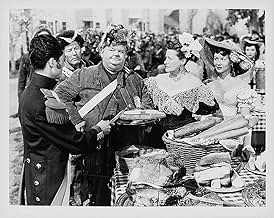
What truly makes this film 'special' for me is Wayne's sidekick, portrayed by the legendary Oliver Hardy, of 'Laurel and Hardy' fame. Hardy, while a friend of Wayne, had only worked 'solo' once in a feature film in over twenty years (1939's "Zenobia"), and it took a LOT of coaxing (and Stan Laurel's 'blessing'), to get him to accept the role...and what a pleasure he is, to watch! Wayne and Hardy have a rich, warm chemistry, and the rotund comedian, with his infectious smile and Georgia drawl, makes even minor scenes (like swapping recipes with Ralston's mother) a joy.
With a first-rate supporting cast including Philip Dorn, Hugo Haas, Wayne 'regulars' Paul Fix, Jack Pennick, and Hank Worden, and Marie Windsor (who looks eerily like John Howard, in my opinion!), "The Fighting Kentuckian" is, despite the 'pans' you'll see in some of the reviews posted, one of my favorite John Wayne films...He was never more charming than you'll find him, here!
What truly makes this film 'special' for me is Wayne's sidekick, portrayed by the legendary Oliver Hardy, of 'Laurel and Hardy' fame. Hardy, while a friend of Wayne, had only worked 'solo' once in a feature film in over twenty years (1939's "Zenobia"), and it took a LOT of coaxing (and Stan Laurel's 'blessing'), to get him to accept the role...and what a pleasure he is, to watch! Wayne and Hardy have a rich, warm chemistry, and the rotund comedian, with his infectious smile and Georgia drawl, makes even minor scenes (like swapping recipes with Ralston's mother) a joy.
With a first-rate supporting cast including Philip Dorn, Hugo Haas, Wayne 'regulars' Paul Fix, Jack Pennick, and Hank Worden, and Marie Windsor (who looks eerily like John Howard, in my opinion!), "The Fighting Kentuckian" is, despite the 'pans' you'll see in some of the reviews posted, one of my favorite John Wayne films...He was never more charming than you'll find him, here!
Did you know
- TriviaJohn Wayne was so pleased with the chemistry between him and Oliver Hardy that he offered Hardy the role of "permanent comic sidekick" in subsequent movies. By the time this picture was released, Stan Laurel had recovered from his illness and was able to return to the Laurel & Hardy team so Hardy declined Wayne's offer.
- GoofsAuto tire tracks visible in dust during wagon and horse chase scene.
- Quotes
[repeated line]
Willie Paine: I'll see to the horses.
- Alternate versionsAlso available in a computer colorized version.
- ConnectionsFeatured in Frances Farmer Presents: The Fighting Kentuckian (1959)
- SoundtracksLet Me Down, Oh Hangman
(uncredited)
Traditional
Music Arranged by George Antheil
New Lyrics by George Waggner
- How long is The Fighting Kentuckian?Powered by Alexa
Details
Box office
- Gross US & Canada
- $1,550,000
- Runtime
- 1h 40m(100 min)
- Color
- Aspect ratio
- 1.37 : 1
Contribute to this page
Suggest an edit or add missing content