
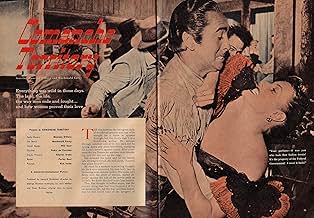
White settlers plan to defy the agreement between the government and the Comanche in order to mine for silver on Comanche lands, while scout Jim Bowie tries to keep the peace in the territor... Read allWhite settlers plan to defy the agreement between the government and the Comanche in order to mine for silver on Comanche lands, while scout Jim Bowie tries to keep the peace in the territory.White settlers plan to defy the agreement between the government and the Comanche in order to mine for silver on Comanche lands, while scout Jim Bowie tries to keep the peace in the territory.




- Townsman
- (uncredited)

- Townsman
- (uncredited)

- Rancher at Shindig
- (uncredited)

- Townsman
- (uncredited)
- Indian
- (uncredited)

- Newcomer at Shindig
- (uncredited)

- Townsman
- (uncredited)
- Director
- Writers
- All cast & crew
- Production, box office & more at IMDbPro
Featured reviews
Jim Bowie and Davy Crocket tangle with charming shrewish spitfire over treaty with Comanches
You won't find a character listed in the credits as Davy Crocket, so why do I claim such in my title? One of the main characters is Daniel Seeger, played by Will Geer. In his eastern formal dress and top hat, he doesn't look anything like Fess Parker's later coonskin-capped film Davy Crocket. But he claims to be a long time frontiersman, Indian fighter/trader and sometimes congressman, and sports what looks like a Kentucky rifle. What historical figure who went to Texas and became a friend of Jim Bowie fits this description? Will Geer was quite a diverse character, with a degree in horticulture, a sometimes folk singer and always a willing advocate for radical political reform. In consequence, he would soon be blacklisted as a result of congressional communist witch hunting. But not before acting as Don O'Connor's buddy in the pirate spoof "Double Crossbones".
You may not be familiar with Carey as a Western leading man. I was not. He rather reminds me of Ray Milland. He may have lacked the larger-than-life physical image of the top Western leading men, but he proved a scrappy adversary of the evil and wrong-headed elements in this story, and his character eventually managed to make a friend out of Maureen's belligerent character, sealed in the parting shot, which you will like.
Now, what's all this talk about treaties between the US government and the Comanches? Remember, Texas at this time was still part of Mexico and would not become part of the US for another decade. Nonetheless, Sam Houston did arrive in Texas in 1833 to try to arrange a treaty between the US and Comanches. Mexican authorities were not amused and booted him out for a while. All the shenanigans in the film about disappearing and prospective treaty papers are pretty silly, although they form an important part of the plot.
What's all the fuss about a big silver strike in Comanche territory, that also is the central issue in the plot? I'm not aware of any such historical silver strike. However, it does have a slight historical basis. The real Jim Bowie did lead an expedition to central Texas in search of some diggings by Native Americans and , later, Mexicans, reputed to have yielded silver. But, nothing of consequence resulted. The screenplay story is quite different.
Overall, I found this quite an enjoyable film, with lots of humor, colorful characters, both hostile and friendly relations with Comanches, and insider, as well as outsider, badman elements. Most of the Comanches looked like real NAs. Probably, Quisima: the chief, is a corruption of the name of the last free Comanche chief: Quanah, historically relevant not for several decades later. The firearms generally had the look of the flintlocks of this period.
Along with "Against All Flags", and "The Redhead from Wyoming", released a couple years later, Maureen's character in this film allows her to be at her most charming shrewish spitfire self, and thus my favorite incarnations of her. Rather reminds me of my wife. Her spars with favorite leading man John Wayne in "The Quiet Man" and the much later "McClintock" may be much better known, but I prefer these two much shorter Universal films, which are now available as parts of cheap DVD sets of some lesser known films of that era.
Good western, not more
Dumb title, interesting adventure flick
"Comanche honours his treaties. Hope his white brother do the same when time come."
Feisty, buckskin-wearing female lead Maureen O'Hara later recalled it as "a fairly decent western and the film in which I mastered the American bullwhip. By the time the picture was over, I could snap a gigarette out of someone's mouth".
It's fellas like him that give the white man a bad name.
A government treaty set up to protect sacred Comanche land is due to expire, just as silver has been found beneath the mountains on the land. James Bowie (Carey) has been sent to negotiate a new treaty with the Comanche leaders, thus allowing the silver to be mined without upsetting the Indians. But there are underhand plans being drawn up by settlers in the town of Crooked Tongue, a town run by feisty Katie Howard (O'Hara). Can Bowie prevent the pillaging of the sacred Indian land? Something that will inevitably lead to blood being shed ...
Good solid B Western that gets in and does its job without pretension or pointless filler. Shot in Technicolor and filmed impressively on location in Sedona, Arizona (Big & Little Parks/Red Rock), it's a film that offers an interesting story and a good sprinkling of action. Cast are mostly fine, Geer files in for the Arthur Hunnicut/Walter Brennan type role, O'Hara is spunky and a Technicolor picture (check out that gorgeous black and green frock sequence) and Carey, whilst hardly a convincing or robust Jim Bowie, plays it with restraint and works off of Geer and O'Hara rather well. The action is competently staged by old pro Sherman, who also doesn't let the pace sag, and Gertsman's photography of the landscapes (particularly Red Rock) is the high point of the production.
Problems? Well Charles Drake as Katie Howard's crooked brother turns him into a pretty tepid villain, while the big saloon punch-up is beset by amateurish punch throwing. There's also the issue of non Native American actors playing Indians, which once in a while in the 50s did throw up the odd good turn, however here isn't one of them. Though in fairness they aren't helped by the script, which doesn't exactly give the Comanche characters some telling dialogue to impact on proceedings. Good to report that Pegasus' DVD release contains a very good print, there's the odd moment of colour fluctuation, but by and large it's a neat transfer. Though you may want to slightly tone down your colour setting since Sherman and Gertsman have gone for the high contrast option for the Technicolor filters! 6.5/10


Did you know
- TriviaPioneer James Bowie was born in Logan County, Kentucky, in 1796. He became a Mexican citizen in 1830, shortly after he moved to San Antonio, Texas, in 1828. He fought in the battle for Texas' independence in 1832 and served as a colonel in the Texas revolutionary army. James Bowie died in 1836 at the battle of the Alamo. He is credited with inventing the Bowie Knife.
- GoofsThe opening description and firearms set the time period at 1866. Jim Bowie died in the Alamo fight in March of 1836.
- Quotes
[Dan'l has been shot]
James Bowie: I'll get it out as quick as I can.
Dan'l Seeger: There's no hurry, son. Only don't throw it away. I like to save lead folks take out of me. I got nearly three pounds of it.
- How long is Comanche Territory?Powered by Alexa
Details
- Runtime
- 1h 16m(76 min)
- Aspect ratio
- 1.37 : 1