
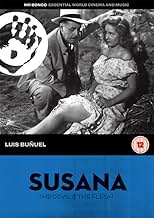
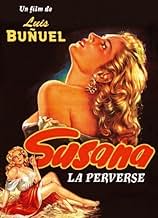
An unstable young woman escapes from a reformatory for seriously wayward girls and deceptively finds shelter in the kind home of a frighteningly nice and decent family. Little by little, she... Read allAn unstable young woman escapes from a reformatory for seriously wayward girls and deceptively finds shelter in the kind home of a frighteningly nice and decent family. Little by little, she causes unrest and discord among the members of the household until they are all fighting ... Read allAn unstable young woman escapes from a reformatory for seriously wayward girls and deceptively finds shelter in the kind home of a frighteningly nice and decent family. Little by little, she causes unrest and discord among the members of the household until they are all fighting with one another.
- Awards
- 1 nomination total


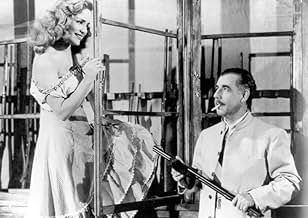


- Empleado de Guadalupe
- (uncredited)
- Empleada de Guadalupe
- (uncredited)
Featured reviews
works OK as a melodrama, sometimes better than OK, but it's still a Bunuel film
Sure, it definitely pales in comparison to the desire and temptation on parade and blasting at 11 in Un Chien Andalou or Viridiana. That's because Bunuel is keeping it on the down-low, which has its advantages and sort of disadvantages. On its own Susana is simply a melodrama, a story of this girl Susana (beautiful and talented if two-note Rosita Quintana) who escapes in one of those fun Bunuelian twists from a mental asylum to wind up on a rainy night in the care of a pretty religious farmhouse. She fits in with the chores and such, but also does her best to tempt the prudish on the farm (when she's asked to cover up she does, until no one's looking relatively), but winds up in a real pickle when tempting the wrong man.
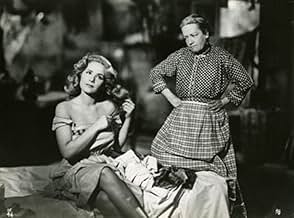
And, on its own terms, it's a pretty decent melodrama. Some good performances, a few very good scenes of dialog and tension, but also on the scale of a very good soap opera all the same. I can see where Bunuel might have had some tension during the making; it feels and is a studio production, and as such he had to stay well within the limitations of the subject matter and low-budget. But it is worth seeing because it is still a Bunuel picture, with moments like that scene at night where the two men look on, tongues practically dangling out of their mouths, watching as Susana simply brushes her hair in silhouette, or a few moments where the twisted humor ratchets up a notch or too (it's rare, but worth it, if only in the unintended or just dated "scandalous" nature of the content). It's safe stuff coming from the director of the Phantom of Liberty, but it's not at all a bad movie either.
the delicious snake in their midst.
The Fragility of an Apparently Well Established Order
She is brought into a dark and sinister cave which is teeming with rats and spiders. We know nothing about the reasons for this punishment and we can't avoid feeling sorry for her: Whatever she might have done, it does not justify an inhuman treatment such as this.
Susana is religious, and the god she calls on is kind and generous. So the miracle happens, the bars of the prison cell at which she is rattling suddenly give way and she succeeds in escaping into a night full of darkness and relentless rain.
She even can make it into paradise: A landowner's family takes her in, after she has told them a pack of lies. She is allowed to work as a maid and gains the confidence and the affection of the mother, while the father at first has a disapproving attitude towards her.
But the family's son and the steward live on the estate, too, and they don't fail to notice Susana's outstanding physical attraction. As the girl also knows how to place her charms, they both fall victim to her.
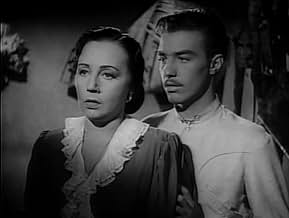
Susana, however, does not seem capable of developing any true feelings. Life is just a villainous game for her in which the rules are set by herself. The aim is to destroy the well established order. When finally even the landowner succumbs to the lure of love the initial situation becomes reversed and nothing stays the same: the mother turns into an enraged enemy, while father and son become rivals and the steward is dismissed.
It is then the latter who sets the decisive ball rolling which leads once more to a reversal of the circumstances: He finally makes use of his knowledge of Susana's escape from the reformatory, which up to now he kept to himself in order to increase his chances of winning Susana's favor, and Susana, however fiercely she may be defending herself, cannot avoid being arrested.
The game is lost, and, as it often happens in a melodrama, it is the refused lover, who makes it break down. In the end, the episode with Susana means nothing more than the memory of a nightmare for the landowner's family. And, after the re-establishment of the initial situation, the characters cannot help asking themselves if everything has really happened.
The attentive spectator will come to a different conclusion. He will notice the fundamental fragility of an order that is well established only in appearance. And he will not be able to avoid drawing a frightful parallel to his own life, in which nothing is secure and reliable either.
SUSANA is a fetching microcosm of Buñuel's views on human frailties, unambitious, simple but integral and surprisingly gratifying
In fact, the movie itself is grounded on a surreal precondition, in the opening scenes, Susana is locked up in a solitary cell, she entreats God in front of a cross materialised by the shadows of the metal bars, to give her a way out since she can not change her nature, which is made by God himself, so God grants her wish, as if he wants to cast a prank on us, releases the snake into the Garden of Eden. The script runs formulaic-ally where three different types of men all become the victims of Susana's seduction, Rosita Quintana successful captures her carnal allure with crude histrionics, for the spunky Jesús, she is the unattainable wench who promises him something sweet but refuses his pushing courtship; for the bookish Alberto, she is a proactive seductress from whom he is too green to resist, and for the patrician Guadalupe, she becomes a damsel in distress, who inadvertently rekindles his sexual urge which a married middle-age man can no longer obtain from his wife. While men are succumbing to their primitive lust, after seeing through her veiled pretence, Carmen and Felisa strike up, only that would be too late if Buñuel had opted for a more sinister finale.
The happy ending is a policy of appeasement, even the mare miraculously regains its vitality, but the re-gained conformity and harmony appear so ironic thanks to Buñuel's poker-faced mockery - how simple a weed in the field can bring about moral corruption to a conventional middle-class family. SUSANA is a fetching microcosm of Buñuel's views on human frailties, unambitious, simple but integral and surprisingly gratifying.
What happened to Susana?
Susana escapes from the reformatory in which she was locked. It's a dark and stormy night. Meanwhile in a ranch nearby the members of a peaceful family follow their occupations. An old servant maid is mumbling that in nights like this the devil walks around. Thunder and lightning. Susana's face appears in the window. She faints. She is brought inside the house. Susana is a young girl with a wayward sensuality (remember, we are in 1951). Her presence will bring discord and threaten the stability of the family.
Buñuel, even in his most surrealistic films, was always deeply anchored in the reality. That is why his films are so strong. His films have a taste of earth, humanity, sensuality. "Susana" is in fact a very sensual film. The camera subtly follows Susana, her chaotic sensuality, and the other characters' reactions to her. She's the main character but not much is told about her. She was locked in a reformatory. Why? We are not told. The world doesn't accept her and her ways. Does she know what she really wants? Unfortunately it was not possible for Buñuel to give us a deeper portrait of Susana. We see her mostly through the eyes of the outside world. Why is Susana like that? What happened to Susana?
"Susana" is an over-the-top melodrama - seemingly innocent, but in the "happy ending", that seems to come out of a fairy tale, some people may detect a hidden laughter. The film was a big success in Mexico and contributed to establish definitely Buñuel as a commercially viable director.
Rosita Quintana as Susana proves her wide acting range (a shy governess in "La Ausente" and a sensual temptress in "Susana"). She's beautiful and in "Susana", she's a real volcano. Fernando Soler also distinguishes himself as the pater familias (he was also the moralist judge in "Sensualidad" and the dissolute drinking father in "Oveja Negra").
Actors and scenery are harmoniously integrated in "Susana" and Buñuel is (as always) a master of images and very adept in creating mood. Highly recommended!


Did you know
- How long is Susana?Powered by Alexa
Details
- Release date
- Country of origin
- Official site
- Language
- Also known as
- Susanna - Tochter des Lasters
- Filming locations
- Production companies
- See more company credits at IMDbPro
- Runtime
- 1h 26m(86 min)
- Color
- Aspect ratio
- 1.37 : 1