IMDb RATING
6.6/10
3.5K
YOUR RATING


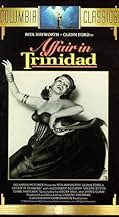
Nightclub singer and her brother-in-law try to find her husband's killer.Nightclub singer and her brother-in-law try to find her husband's killer.Nightclub singer and her brother-in-law try to find her husband's killer.
- Nominated for 1 Oscar
- 1 nomination total



Freddie Baker
- Baker - Airport Clerk
- (uncredited)
Mary Bayless
- Cafe Patron
- (uncredited)
Don Blackman
- The Bobby
- (uncredited)
6.63.4K
1
2
3
4
5
6
7
8
9
10
Featured reviews
Rekindled and ignited
To address some issues: there is a familiarity with 'Gilda' which is just that and cannot possibly take anything away from what a triumph this film actually is.
Firstly, I love how it is such a classic, straight-to-the-point Hayworth vehicle. Business: Harry Cohn had to 'give away' Born Yesterday, which was intended for his number 1 star, to Judy Haliday; now she was "back!" just like the posters said; she had star power and wasn't given From Here To Eternity as her comeback simply because she had too much box-office to be in an ensemble picture; and what better way than to give fans a sure-fire treat - Hayworth and Glenn Ford in another simmering film noir? Except, this is no 'Gilda' - this is 'Affair In Trinidad'. Hayworth reinvents herself, her talent bristling with abandon in her opening number The Trinidad Lady. The swirling intro to this film is over in seconds and there she is - still the star and definitely not off the pedestal. We can see the transformation is what films can get away with just that little bit more - when Hayworth 'slides' to show off her amazing legs it's like a revelation, a force that cannot be held back. This is Rita dancing with her trademark unearthly grace, yet now she has experience that she can convey like never before.
This is certainly true with her acting too. She had always been able to give spirited performances that she isn't always - superficially at least - given much credit for. But here she handles her scenes with great texture, assurance and (key to most starlets of the era's guaranteed appeal) vulnerability. My favourite scene is when she is 'stealing time' to peek through documents for the police - she gets a rare kind of drama not normally given to her before. It's just en interesting, daft moment that is perhaps just typical 1950's melodrama, but glamorous and crucial at the same time.
We also see the impressive actress Valerie Bettis, who is very much a character that was emerging in this period - a very vamp-like, sardonic lady with a smouldering alcohol-sustained sexuality, in the vein of Gloria Swanson, Bette Davis, etc. She eats the scenery, which is an acquired taste, but well worth it. The actress in question is Valerie Bettis who it would appear was a successful TV actress in the same decade. Her character Veronica Huebling certainly tried to use her sex appeal to entrap and exploit men, the way she believes Chris Emery (Hayworth) is able to, which possibly explains her heavy drinking.
Juanita Moore conveys a powerful presence also, managing some interesting lines. Some of which are dated, or perhaps just twee, but to be enjoyed nonetheless.
When Hayworth famously tosses her hair again, we don't need to hear any 'Gilda' comparisons. She had moved on, she had made straight-forward vehicles all through her ascent to super-stardom and fans will definitely appreciate the familiar elements resonating their own special glory, but shaken together as it is, we get something new that is definitely worth investigation.
Firstly, I love how it is such a classic, straight-to-the-point Hayworth vehicle. Business: Harry Cohn had to 'give away' Born Yesterday, which was intended for his number 1 star, to Judy Haliday; now she was "back!" just like the posters said; she had star power and wasn't given From Here To Eternity as her comeback simply because she had too much box-office to be in an ensemble picture; and what better way than to give fans a sure-fire treat - Hayworth and Glenn Ford in another simmering film noir? Except, this is no 'Gilda' - this is 'Affair In Trinidad'. Hayworth reinvents herself, her talent bristling with abandon in her opening number The Trinidad Lady. The swirling intro to this film is over in seconds and there she is - still the star and definitely not off the pedestal. We can see the transformation is what films can get away with just that little bit more - when Hayworth 'slides' to show off her amazing legs it's like a revelation, a force that cannot be held back. This is Rita dancing with her trademark unearthly grace, yet now she has experience that she can convey like never before.
This is certainly true with her acting too. She had always been able to give spirited performances that she isn't always - superficially at least - given much credit for. But here she handles her scenes with great texture, assurance and (key to most starlets of the era's guaranteed appeal) vulnerability. My favourite scene is when she is 'stealing time' to peek through documents for the police - she gets a rare kind of drama not normally given to her before. It's just en interesting, daft moment that is perhaps just typical 1950's melodrama, but glamorous and crucial at the same time.
We also see the impressive actress Valerie Bettis, who is very much a character that was emerging in this period - a very vamp-like, sardonic lady with a smouldering alcohol-sustained sexuality, in the vein of Gloria Swanson, Bette Davis, etc. She eats the scenery, which is an acquired taste, but well worth it. The actress in question is Valerie Bettis who it would appear was a successful TV actress in the same decade. Her character Veronica Huebling certainly tried to use her sex appeal to entrap and exploit men, the way she believes Chris Emery (Hayworth) is able to, which possibly explains her heavy drinking.
Juanita Moore conveys a powerful presence also, managing some interesting lines. Some of which are dated, or perhaps just twee, but to be enjoyed nonetheless.
When Hayworth famously tosses her hair again, we don't need to hear any 'Gilda' comparisons. She had moved on, she had made straight-forward vehicles all through her ascent to super-stardom and fans will definitely appreciate the familiar elements resonating their own special glory, but shaken together as it is, we get something new that is definitely worth investigation.
Chica chica boom! Chica boom!
When one approaches a 1940's title like 'Affair In Trinidad', you'll be hard pressed to figure that it's some sort of musical with Fred Astaire and Ginger Rogers, or some madcap Marx Brothers comedy, not a hard edged murder mystery, yet that's what this badly titled movie is. Not that there's nothing wrong with the movie, I liked it. It's just the title is sort of curious. Rita Hayworth is a.. uh.. entertainer in very sleazy club (check out the people "returning" downstairs (cough) and keeps the people entertained by singing and dancing very suggestively to a song called "Trinidad Lady". Actually, she's SMOKING (as in hot!) in this scene, her dress and dancing are amazing. But soon, the police arrive on the scene, her husband has committed suicide, and they want to find out the reasons leading to his death. Glenn Ford, playing as steely jawed as Glenn Ford can, who plays his brother, wants to know too! From there, it's a whirlwind of deception, romance and thrills (well, not really), that is not really suspenseful, because we find out early on who did it, we just have to find out why (and that reason is a silly post-war hokum). Oh well, Hayworth IS pretty to look at, and Glenn Ford is great as usual, so the combination of the two is sorta fun to watch.
former glory
In the British colony of Trinidad, American Neil Emery is found dead in an apparent suicide. His nightclub performer wife Chris (Rita Hayworth) is informed by Anderson from the American consulate and policeman Inspector Smythe. Neil's brother Steve (Glenn Ford) arrives expecting to see Neil. The police discovers Neil was actually murdered and suspects Neil's rich powerful friend Max Fabian. They recruit Chris to investigate the mysterious Fabian but she can't tell Steve.
Rita Hayworth returns to Hollywood after about four years married to a prince. This is trying to return to the glory of Gilda reuniting with Glenn Ford and recycling the plot of Notorious. She is a bit older and not quite the same powerful bombshell in her heyday. Everything feels like a mere shadow of former glory. With a lot more imagination, that could have been used to the movie's advantage. This one is pass its prime before it started. This may not be a classic but it is reminiscent of past greatness.
Rita Hayworth returns to Hollywood after about four years married to a prince. This is trying to return to the glory of Gilda reuniting with Glenn Ford and recycling the plot of Notorious. She is a bit older and not quite the same powerful bombshell in her heyday. Everything feels like a mere shadow of former glory. With a lot more imagination, that could have been used to the movie's advantage. This one is pass its prime before it started. This may not be a classic but it is reminiscent of past greatness.
Despite the stars, it's no "Gilda".
In 1946, Columbia Pictures had a huge hit on its hands with "Gilda". Now, six years later, the studio has reunited its stars, Glenn Ford and Rita Hayworth, for a similar sort of film. However, despite the similarities of the plot, this one just doesn't measure up and is a mostly tepid film that could have used a much better script.
The film begins with the death of Rita's husband. Oddly, she never seemed all too broken up because of this and when the police ask her to 'dig around', she agrees to hang out with an unsavory friend who probably was responsible for the man's death (which was incorrectly ruled a suicide). Now think about it...the police asking her to walk into a dangerous place AND involve herself in an illegal search! However, the dead husband's brother (Ford) blunders in and mostly spends his time overacting--either screaming at Rita and blaming her for the death OR begging her pardon and apologizing for the outburst--followed by making out with her! Frankly, none of this made a lot of sense. And so, by the time the film was over, I was annoyed--annoyed because the romance made no sense at all (what was the motivation AND didn't Rita's husband just die!?). In addition, the whole thing came off as a bit talky and dull. A disappointment, that's for sure.
The film begins with the death of Rita's husband. Oddly, she never seemed all too broken up because of this and when the police ask her to 'dig around', she agrees to hang out with an unsavory friend who probably was responsible for the man's death (which was incorrectly ruled a suicide). Now think about it...the police asking her to walk into a dangerous place AND involve herself in an illegal search! However, the dead husband's brother (Ford) blunders in and mostly spends his time overacting--either screaming at Rita and blaming her for the death OR begging her pardon and apologizing for the outburst--followed by making out with her! Frankly, none of this made a lot of sense. And so, by the time the film was over, I was annoyed--annoyed because the romance made no sense at all (what was the motivation AND didn't Rita's husband just die!?). In addition, the whole thing came off as a bit talky and dull. A disappointment, that's for sure.
Rita Hayworth And Glenn Ford Can Not Repeat The Success Of "Gilda"
During the time that this 1952 film was being filmed, its star, Rita Hayworth was thinking of terminating her contract with Columbia Pictures. Why didn't she? It would've prevented her from making films like this. This film plays like an obvious attempt to repeat the big box office success of "Gilda", a 1946 Columbia Picture starring Hayworth as she is reteamed with her "Gilda" costar Glenn Ford. The farfetched plot has nightclub singer Hayworth and her brother-in-law (Ford) joining forces to track down her husband's murderer. In the box office results, the film was a disappointment and it eventually inspired longtime Columbia Pictures contract players Hayworth and Ford to pursue film careers as freelances.


Did you know
- TriviaThe production is credited to the Beckworth Corporation, named for Rita Hayworth and her daughter Rebecca Welles, but Beckworth wasn't an actual production company. It was a tax dodge set up by Hayworth and Columbia Pictures president Harry Cohn to allow her fee for the film to be considered a capital gain rather than a salary, and therefore taxed at a lower rate.
- GoofsWhen Max returns Chris to her house after the inquest, the black wreath that had been on the front door when Steve arrived earlier is missing as they get out of the car but reappears as they approach the door.
- Quotes
Trinidad Band: [singing] A chick-a-chick boom, a chick-a-chick boom / Announces you're in the room with the Trinidad Lady. / A chick-a-chick boom, a chick-a-chick boom / Your ticker goes boom-boom-boom for the Trinidad Lady.
Chris Emery: [singing] It's only that I do what I love and love what I do / Can't help the mad desire that's deep inside of you. / You realize the fault isn't mine, you are to blame / You want what you can't have, and you're just the same.
- ConnectionsEdited into Voskovec & Werich - paralelní osudy (2012)
- SoundtracksI've Been Kissed Before
(uncredited)
Written by Lester Lee and Bob Russell
Performed by Rita Hayworth (dubbed by Jo Ann Greer)
Details
- Release date
- Country of origin
- Language
- Also known as
- Girl from Amen Valley
- Filming locations
- Production company
- See more company credits at IMDbPro
Box office
- Budget
- $1,200,000 (estimated)
- Gross worldwide
- $47
- Runtime
- 1h 38m(98 min)
- Color
- Aspect ratio
- 1.37 : 1
Contribute to this page
Suggest an edit or add missing content