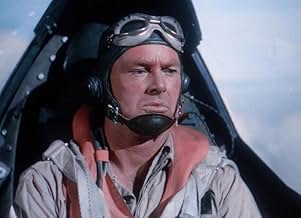
During the Korean War, aboard the U.S.S. Princeton, Navy Commander Dan Collier reminisces about his first assignment on the same aircraft carrier in the war against Japan.During the Korean War, aboard the U.S.S. Princeton, Navy Commander Dan Collier reminisces about his first assignment on the same aircraft carrier in the war against Japan.During the Korean War, aboard the U.S.S. Princeton, Navy Commander Dan Collier reminisces about his first assignment on the same aircraft carrier in the war against Japan.
- Nominated for 1 Oscar
- 1 nomination total
William Phipps
- Red Kelley
- (as Bill Phipps)
Peter Adams
- Plane Captain
- (uncredited)
Richard Bartlett
- Sailor
- (uncredited)
James Best
- Radio Operator
- (uncredited)
David Bond
- Chaplain
- (uncredited)
William Cabanne
- Officer
- (uncredited)
Clancy Cooper
- Captain
- (uncredited)
Bob Cudlip
- Plane Captain
- (uncredited)
Richard Emory
- Intelligence Officer
- (uncredited)
- Director
- Writer
- All cast & crew
- Production, box office & more at IMDbPro
5.9637
1
2
3
4
5
6
7
8
9
10
Featured reviews
Flat Top
The army and the air force had their go at this plot, so I suppose it was bound to be the navy's turn. Richard Carlson in the man expected to take over the squadron of fliers when their boss gets incapacitated, but instead of the mild-mannered "Joe", they get the hard as nails "Collier" (Sterling Hayden). He immediately sets the cat amongst the pigeons by grounding one of their popular but reckless number and by proceeding to rule the team with a rod of iron. Naturally, this earns him the enmity of his command but with their carrier about to head into danger against the heavily armed Japanese Imperial Fleet, we all know that discipline is going to be key (and that there is precisely no jeopardy at all with the rest of the plot!). Carlsen tries a little here, but Hayden is about as wooden as the deck of the USS Princeton upon which much of this was filmed. In the end, it's really all about some impressive aerial photography of training sessions and dogfights that is fairly clearly sourced from archive. It's feel-good wartime fayre but its mediocrity isn't much to write home about.
A decent war film for its time.
I am into WW2 aircraft carriers and the Pacific War and I find this film to be a good one for its time. The editing is great and there is only a couple of war film segments that appear twice. Unlike Midway, they don't use modern carrier shots and even through it is not completely tied to a battle or campaign, every thing gets explained(In Midway, they didn't show the fact that the USS Yorktown CV5 sinks, or at least is supposed to sink). Over all, I'll give this film 3 1/2 stars out of five.
From Monogram, in color!
My attraction to this B feature from 1952 is the above summary. Tragic perhaps to most, but to me, not even remotely interested in the Navy or war films or Sterling Hayden and Richard Carlson or anything to do with guns (it might as well have been a western too, for that matter, but it isn't) ... my only and complete fascination is that it was made by Monogram using interesting Cinecolor. I actually quite enjoyed FLAT TOP for about an hour then I lost the thread of the story. It seemed to be a never ending circuit of missions/Japs/well filmed interesting dogfights, pink explosions in cine-color and men in jets looking out the window. I think this was one of those films that worked well in huge theaters full of kids or servicemen. Monogram seemed to have well scammed a great idea to make a film: Get permission and co operation from the US Navy to film aboard one real aircraft carrier ( A: no sets needed) using lots of men in uniform (B: no costumes needed and C: hundreds of free extras) cobbled a story together about jostling dogfight commanders and some disciplinary tactics (scenes in small rooms using A+B and some outdoors/on deck filler scenes using C. The actual footage of some spectacular genuine dogfight action seemed to be plentiful (again, provided by the Navy or the War dept) as there was a lot of fight scenes and flying through explosions and bits of blown apart planes (all very interesting and adding to the reality) and on and on it went. Some back projection with actors wobbling and swerving their cockpit and presto: one Govt sanctioned movie as a Korean War propaganda and recruitment piece now showing thu 1952 in 10,000 theaters. Very profitable. My fascination with Monogram's production methods satisfied again. the Red/Bue cine-color was interesting as it resulted in tan skin tones with a lot of blue/grey (handy if you film an aircraft carrier and a sky) and a lot of orange/red (good for lifejackets and explosions). There was no yellow in the film and no actual green. It all worked as I am sure it was expected to. The music was excellent, the studio photography good too. Very well edited into 85 minutes. My research in Australia showed that it had a good run and stayed in play up until the 60s believe it or not. Monogram ceased to be a production name in 1953 when they changed name completely to Allied Artists. People criticize Monogram's inventive budget production methods but I find them ingenious.
You could do better than this...
ugly film--lots of degraded/fuzzy actual color stock footage. dropping torpedo?! Coursairs becoming Hellcats Hayden a bit one-dimensional and the men are rather mutinous! pretty much "Flying Leathernecks" Jack Larson
"Flat Top" is from a genre that few have heard of--crappy war films that are made up of HUGE chunks of stock footage. Rarely is the footage used well and in almost every case, the real footage is obvious because it's so grainy--and often a bit irrelevant. While I love a good airplane film, I hate most of these films because historical accuracy is unimportant--slapping together old clips into a semi-coherent movie to save a few bucks is all that matters. Can you tell that I was not a huge fan of this film?
As I said, the clips often are poorly done. In this film, it's better than many but as a guy who knows quite a bit about WWII aircraft, I was shocked to see what were supposed to be a Coursair fighter plane dropping a torpedo (this is like a guy giving birth--it just won't happen). Many times, instead of Coursairs, the film shows Hellcats--both excellent Navy fighter planes but they looked nothing alike. But when a Coursair suddenly becomes a Hellcat in mid-air (or vice-versa), it's just very sloppy. Also, and this is picky, I know, but they show post-WWII Coursairs as well (with the four screw propellers instead of three) as well as a Skyraider (DEFINITELY a post-WWII plane). And, as I pointed out above, the clips they used were in color but VERY fuzzy and often seemed like filler--and almost all the crashing into the deck shots have been used before repeatedly in other films!
As for the plot, it's VERY standard fare--and it pretty much "The Flying Leathernecks" and a bunch of other films all over again. You have a tough-as-nails commander (Sterling Hayden) and a second officer (Richard Carlson) who is more concerned about being pals with the men. Somehow these two completely incompatible approaches need to be reconciled. To make things worse, this isn't that interesting a film to plane and non-plane buffs.
Sloppy, derivative and not particularly good. Unless you are REALLY bored, you could do a lot better.
"Flat Top" is from a genre that few have heard of--crappy war films that are made up of HUGE chunks of stock footage. Rarely is the footage used well and in almost every case, the real footage is obvious because it's so grainy--and often a bit irrelevant. While I love a good airplane film, I hate most of these films because historical accuracy is unimportant--slapping together old clips into a semi-coherent movie to save a few bucks is all that matters. Can you tell that I was not a huge fan of this film?
As I said, the clips often are poorly done. In this film, it's better than many but as a guy who knows quite a bit about WWII aircraft, I was shocked to see what were supposed to be a Coursair fighter plane dropping a torpedo (this is like a guy giving birth--it just won't happen). Many times, instead of Coursairs, the film shows Hellcats--both excellent Navy fighter planes but they looked nothing alike. But when a Coursair suddenly becomes a Hellcat in mid-air (or vice-versa), it's just very sloppy. Also, and this is picky, I know, but they show post-WWII Coursairs as well (with the four screw propellers instead of three) as well as a Skyraider (DEFINITELY a post-WWII plane). And, as I pointed out above, the clips they used were in color but VERY fuzzy and often seemed like filler--and almost all the crashing into the deck shots have been used before repeatedly in other films!
As for the plot, it's VERY standard fare--and it pretty much "The Flying Leathernecks" and a bunch of other films all over again. You have a tough-as-nails commander (Sterling Hayden) and a second officer (Richard Carlson) who is more concerned about being pals with the men. Somehow these two completely incompatible approaches need to be reconciled. To make things worse, this isn't that interesting a film to plane and non-plane buffs.
Sloppy, derivative and not particularly good. Unless you are REALLY bored, you could do a lot better.
You'll do as I say!!
A story of a green squadron on a US carrier in the Pacific in 1944. When they land on the USS Princetown, they find their new CO is a cold, tough as oak, stickler for the book. The CO also delivers his lines as though he's made of oak.
There is plenty of good flying action. I also liked the historical footage of battleships conducting shore bombardment.
The plot is leaky and the squadrons' planes morph from Corsairs, to Hellcats and even to Helldivers. It is all pretty predictable and the characters are hard to feel attached to.
But I think the hardest thing to stomach is the levity displayed by the US pilots when they are killing people. It's a war people, not a football game.
Das Boot, Enemy at the gates or even Tora Tora Tora are a much better bet for your evening battle flick.
Did you know
- TriviaThe film premiered on Armistice Day (Nov. 11) of 1952 in the harbor of San Diego (CA) aboard the USS Princeton, on which the film was mostly shot.
- GoofsThe pilots left the carrier in F4U Corsairs, and the first mission showed ordnance dropped by SB2C Helldivers and the landings were done showing F4F Wildcats with the 'after-landing' unmistakable wing-folding characteristic feature of the Wildcat. Some plane-to-plane shots showed the silhouette of the F4F very clearly.
- Quotes
Lt. (j.g.) Joe Rodgers: I've got no excuses, sir. I guess I got excited.
Cmdr. Dan Collier: Well, there's no room for excitement in the Navy, Mr. Rogers!
Details
- Release date
- Country of origin
- Language
- Also known as
- Sturmgeschwader Komet
- Filming locations
- Pearl Harbor, O'ahu, Hawaii, USA(fleet and naval battle scenes)
- Production company
- See more company credits at IMDbPro
- Runtime
- 1h 23m(83 min)
- Aspect ratio
- 1.37 : 1
Contribute to this page
Suggest an edit or add missing content