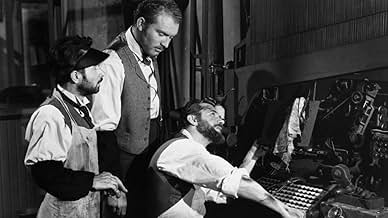
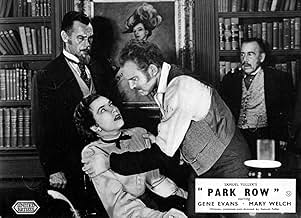
The Globe is a small, but visionary newspaper started by Phineas Mitchell, an editor recently fired by The Star. The two newspapers become enemies, and the Star's ruthless heiress Charity Ha... Read allThe Globe is a small, but visionary newspaper started by Phineas Mitchell, an editor recently fired by The Star. The two newspapers become enemies, and the Star's ruthless heiress Charity Hackett decides to eliminate the competition.The Globe is a small, but visionary newspaper started by Phineas Mitchell, an editor recently fired by The Star. The two newspapers become enemies, and the Star's ruthless heiress Charity Hackett decides to eliminate the competition.
- Jenny O'Rourke
- (as Tina Rome)
- Barfly
- (uncredited)
- Barfly
- (uncredited)
- Irate Liberty Fund Contributor
- (uncredited)
- Barfly
- (uncredited)
- Director
- Writer
- All cast & crew
- Production, box office & more at IMDbPro
Featured reviews
An engaging and entertaining tribute to American Journalism
"Park Row" is small but an engaging and entertaining tribute to American journalism. Under the opening credits we see a huge rolling title that lists about 2,000 American daily newspapers and this story is dedicated to them.
Set in the 1880s New York, the film is about the rivalry between The Globe and The Star. An aspiring newspaper editor (Gene Evans) sets up his own daily The Globe after a man jumps off the Brooklyn Bridge. He struggles to compete with his former employer's (Mary Welch) newspaper The Star, who happens to be in love with him, while the Statue of Liberty is being donated to the U.S. by France.
Unlike Fuller's bleak and lurid "Shock Corridor", "Park Row" is full of reverential optimism and is packed with so much gusto and excitement, featuring some terrific tracking shots that will make your head spin.
Highly recommended.
A bit uneven but still amazingly good due to how it was made.
The story is about a guy who is fired from one New York newspaper and decides to start his own. However, the deck is definitely stacked against him and a tough female newspaper owner seems willing to do anything to see his paper fail--and she takes this competition very personally. At first, she laughs off his attempts to put out a paper. But, when he starts seeing success after success, the competition becomes very dirty. In fact, the ugliness of this fight surprised me...it was THAT tough!
The film has some amazingly good camera-work--with great lighting and composition. It never looks cheap. Additionally, Evans is memorable as a tough guy who not only can out-think but out-punch his competition! His intensity is what makes the film. Overall, despite a few rough moments, it's a great textbook example that a film doesn't have to be expensive or filled with mega-stars to be a very good picture.
One of Sam Fuller's best pictures
The plot of "Park Row" is relatively thin. Gene Evans is the newspaper man who becomes the editor of a crusading newspaper in opposition to the more powerful paper from which he's just been fired. It is, in other words, a feelgood movie about a David triumphing over a mean old Goliath, (in this case represented by Mary Welch's excellent performance as the owner of the rival paper), but it's a populist picture with none of the sentimentality that Capra would have brought to it. Indeed, being a Sam Fuller picture, there's a fair amount of violence en route to the happy ending. It also has one of Fuller's best scripts; this is a movie full of crisp dialogue that makes great use of factual material. Amazingly, despite it's substantial critical reputation, it's seldom revived. Time, I think, to rectify that.
A poor mans "Citizen Kane"?...low budget homage to early days of american journalism is full of the same electrically vital love of cinemacraft...and is even more honest about the world of new
Newspaper Wars
Park Row is the street to the east of New York City's City Hall and it only runs three short blocks. But back in 1886 several papers of the tabloid variety had their offices and printing establishments there. This film Park Row is the story of two of them where the feuding got downright personal.
Mary Hackett who is a real queen of mean fires a whole bunch of her staff over editorial policy disagreement including Gene Evans who takes the fired workers and starts his own tabloid. He gets a super big break when George O'Hanlon playing the legendary Steve Brodie makes his famous dive off the Brooklyn Bridge and Evans gets the bead on the story first. After that Hackett fights and fights real dirty. She especially doesn't like the fact that Evans has spurned her.
Samuel Fuller directed this admirable B film with a cast of no real names, but that in itself gives it a realistic look. That look is at an era that is gone, but not forgotten. By the way another look at this same era can be seen in the film Newsies which is currently on Broadway now.
Still without the singing and dancing of Newsies, I think Park Row will give you an idea of what was going on during those times.
Did you know
- TriviaDirector Samuel Fuller put up his own money to make the movie and lost it all.
- GoofsApproximately 20 minutes into the film, there's a wall calendar showing the date as "1886 June 15 Monday." In 1886 June 15 was a Tuesday.
- Quotes
Phineas Mitchell: The press is good or evil according to the character of those who direct it.
- Crazy creditsInstead of "The End", the picture ends with "Thirty"; newspaper jargon for "that's all. There ain't no more!"
- ConnectionsFeatured in The Typewriter, the Rifle & the Movie Camera (1996)
- How long is Park Row?Powered by Alexa
Details
- Release date
- Country of origin
- Languages
- Also known as
- Park Row - Eine Zeitung für New York
- Filming locations
- Production company
- See more company credits at IMDbPro
Box office
- Budget
- $200,000 (estimated)
- Runtime
- 1h 23m(83 min)
- Color
- Sound mix
- Aspect ratio
- 1.37 : 1