IMDb RATING
6.3/10
1.2K
YOUR RATING


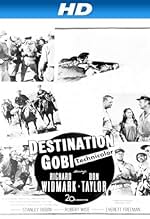
In 1944, US Navy specialists run a weather station in the Gobi desert where they are harassed by Japanese warplanes but aided by local Mongol nomads.In 1944, US Navy specialists run a weather station in the Gobi desert where they are harassed by Japanese warplanes but aided by local Mongol nomads.In 1944, US Navy specialists run a weather station in the Gobi desert where they are harassed by Japanese warplanes but aided by local Mongol nomads.



Max Showalter
- Walter Landers
- (as Casey Adams)


Edgar Barrier
- Yin Tang
- (uncredited)

Willis Bouchey
- Capt. Gates
- (uncredited)
James Conaty
- Admiral
- (uncredited)

Franklyn Farnum
- Quartermaster General
- (uncredited)
John Hedloe
- Pilot
- (uncredited)

Earl Holliman
- Frank Swenson
- (uncredited)
Frank Iwanaga
- Lieutenant
- (uncredited)
- Director
- Writers
- All cast & crew
- Production, box office & more at IMDbPro
6.31.2K
1
2
3
4
5
6
7
8
9
10
Featured reviews
DESTINATION GOBI (Robert Wise, 1953) **1/2
While supposedly presenting “one of the strangest stories of WWII” (denoted in historical records merely by the cryptic phrase “Saddles For Gobi” – explained later), this film hardly constitutes the most engrossing or exciting war adventure to be depicted on the screen…and, besides, emerges as an even greater disappointment coming from a director of Wise’s stature! That said, the unusual desert location and attractive color cinematography makes it a pleasant – if forgettable – actioner. Apart from this, the fact that it’s one of Wise’s (and star Richard Widmark’s) rarest efforts, has made me leap at the chance of acquiring a copy of it (albeit an imperfect one, given the alarmingly frequent jerkiness of the image) – gleaned from a broadcast on French Satellite TV! – particularly in view of Widmark’s recent passing.
The interesting thing here is that, what starts off as a routine mission involving U.S. Navy personnel operating in a desert weather station, develops into a story of survival – as, following an aerial attack by the Japanese, the remaining members of the outfit trek towards the sea in an attempt to reach the Navy base on duty at Okinawa. Ironically, both the studio (Fox) and the star involved had already made a film about that campaign – Lewis Milestone’s HALLS OF MONTEZUMA (1950), which I’d watched on Italian TV but may check out again now (on DVD-R) as part of my ongoing Widmark tribute.
Amidst the typical camaraderie, the men suffer the elements, manage an unexpected alliance with a horde of Mongols (achieved by procuring the latter with saddles for their horses requisitioned from the U.S.!), are conned by a shady camel merchant, apparently betrayed to the Japanese forces by the Mongols themselves (though it transpires that the latter’s internment camp is actually close to the seashore) and then fight off the enemy on a ramshackle river boat. In the end, it’s certainly watchable and efficiently enough handled – but, as I said, the material per se isn’t inspiring enough to bring out the best from the talents involved…
The interesting thing here is that, what starts off as a routine mission involving U.S. Navy personnel operating in a desert weather station, develops into a story of survival – as, following an aerial attack by the Japanese, the remaining members of the outfit trek towards the sea in an attempt to reach the Navy base on duty at Okinawa. Ironically, both the studio (Fox) and the star involved had already made a film about that campaign – Lewis Milestone’s HALLS OF MONTEZUMA (1950), which I’d watched on Italian TV but may check out again now (on DVD-R) as part of my ongoing Widmark tribute.
Amidst the typical camaraderie, the men suffer the elements, manage an unexpected alliance with a horde of Mongols (achieved by procuring the latter with saddles for their horses requisitioned from the U.S.!), are conned by a shady camel merchant, apparently betrayed to the Japanese forces by the Mongols themselves (though it transpires that the latter’s internment camp is actually close to the seashore) and then fight off the enemy on a ramshackle river boat. In the end, it’s certainly watchable and efficiently enough handled – but, as I said, the material per se isn’t inspiring enough to bring out the best from the talents involved…
McHale's Navy
The title suggests something more rugged. But for once they weren't joking when the opening crawl declared this "one of the strangest stories of World War II" (although they probably were when they cast Mervyn Vye as the leader of "the First Mongolian Cavalry". While another of the locals is a kleptomaniac nicknamed 'Harpo' who like his namesake communicates through mime).
The tale of "a bunch of weathermen chasing balloons" across Inner Mongolia, the most arduous part of shooting Robert Wise's first colour film was probably lugging the enormous Technicolor camera about; which paradoxically makes it incongruously pretty to contemplate.
The tale of "a bunch of weathermen chasing balloons" across Inner Mongolia, the most arduous part of shooting Robert Wise's first colour film was probably lugging the enormous Technicolor camera about; which paradoxically makes it incongruously pretty to contemplate.
Saddle Up, Mongols
Destination Gobi finds Richard Widmark assigned as the ranking non-commissioned officer on a Navy weather station in the Gobi Desert. Wrap your mind around that concept, Navy personnel in the middle of the Gobi Desert.
It's not an assignment that a guy who was a CPO on the USS Enterprise in 1944 is looking for. But that's what he's drawn. Widmark is to assist Captain Russell Collins in setting up one of a series of weather station in Inner Mongolia, that is that part of Mongolia located inside the Great Wall of China.
Collins is a meteorologist with a Navy commission, so Widmark is really the guy in charge. Setting up the advance outpost, the dozen or so sailors have to establish good relations with the local Mongol tribesmen who pretty much live as they did under Genghis Khan. The gifts that put it over are a requisition for some old army saddles from the late U.S. Cavalry.
Later on the Japanese bomb the station and Collins and others are killed. It's up to Widmark to get his men out of the Gobi Desert and avoid falling into the hands of the Japanese. The Mongols and their saddles prove to be of invaluable assistance.
I think Destination Gobi got a bit off track after the Japanese attack. The first part of the film was quite good, especially depicting the Mongol culture. But after the attack the escapades of the men trying to get to U.S. lines which in this case means to Eastern China and across the water to Okinawa was a bit much. The Japanese were shown to be as dumb as the Axis powers were shown during World War II and the height of the propaganda films made back then. Richard Loo who played so many nasty Japanese back in the day was the Japanese commander and he must have had a recurring case of deja vu.
Still Widmark does a fine job as does Murvyn Vye who is the head Mongol. They are ably supported by such stalwart character players as Don Taylor, Martin Milner, Casey Adams, Darryl Hickman, and Earl Holliman.
Destination Gobi could have been a much better film.
It's not an assignment that a guy who was a CPO on the USS Enterprise in 1944 is looking for. But that's what he's drawn. Widmark is to assist Captain Russell Collins in setting up one of a series of weather station in Inner Mongolia, that is that part of Mongolia located inside the Great Wall of China.
Collins is a meteorologist with a Navy commission, so Widmark is really the guy in charge. Setting up the advance outpost, the dozen or so sailors have to establish good relations with the local Mongol tribesmen who pretty much live as they did under Genghis Khan. The gifts that put it over are a requisition for some old army saddles from the late U.S. Cavalry.
Later on the Japanese bomb the station and Collins and others are killed. It's up to Widmark to get his men out of the Gobi Desert and avoid falling into the hands of the Japanese. The Mongols and their saddles prove to be of invaluable assistance.
I think Destination Gobi got a bit off track after the Japanese attack. The first part of the film was quite good, especially depicting the Mongol culture. But after the attack the escapades of the men trying to get to U.S. lines which in this case means to Eastern China and across the water to Okinawa was a bit much. The Japanese were shown to be as dumb as the Axis powers were shown during World War II and the height of the propaganda films made back then. Richard Loo who played so many nasty Japanese back in the day was the Japanese commander and he must have had a recurring case of deja vu.
Still Widmark does a fine job as does Murvyn Vye who is the head Mongol. They are ably supported by such stalwart character players as Don Taylor, Martin Milner, Casey Adams, Darryl Hickman, and Earl Holliman.
Destination Gobi could have been a much better film.
Mongols, Meterorologist and McHale.
Destination Gobi is directed by Robert Wise and written by Everett Freeman. It stars Richard Widmark, Don Taylor, Casey Adams & Murvyn Vye.
"In the Navy records in Washington, there is an obscure entry reading 'Saddles for Gobi.' This film is based on the story behind that entry--one of the strangest stories of World War II."
An odd story makes for an oddly entertaining yarn as Widmark and co troop across the Gobi Desert after a Japanese air attack on their weather station base. Other problems exist too, as the Mongol tribe they have befriended may not actually be friends. Poor Widmark, he's a Navy man out in the desert and the motley crew under his command are getting rather restless.
Amazingly based on a true incident, tho we can safely assume there's much poetic license used by the makers, Destination Gobi has a nice blend of action, drama, adventure and comedy. The cast work well as a unit and run with the oddity of the plot, while Wise directs with customary assuredness. It's not one you would sit thru too often once viewed for the first time, but while it's on it's never less than engaging . 6.5/10
"In the Navy records in Washington, there is an obscure entry reading 'Saddles for Gobi.' This film is based on the story behind that entry--one of the strangest stories of World War II."
An odd story makes for an oddly entertaining yarn as Widmark and co troop across the Gobi Desert after a Japanese air attack on their weather station base. Other problems exist too, as the Mongol tribe they have befriended may not actually be friends. Poor Widmark, he's a Navy man out in the desert and the motley crew under his command are getting rather restless.
Amazingly based on a true incident, tho we can safely assume there's much poetic license used by the makers, Destination Gobi has a nice blend of action, drama, adventure and comedy. The cast work well as a unit and run with the oddity of the plot, while Wise directs with customary assuredness. It's not one you would sit thru too often once viewed for the first time, but while it's on it's never less than engaging . 6.5/10
Better than average war film which gets extra credit for its unique setting in the Gobi Desert.
This film has the feel of a documentary as sailor Richard Widmark frets at his role at a remote weather station in the Gobi Desert and yearns to get a ship under him again. Ultimately, he returns to the sea in an unexpected fashion.
The relationship between the sailors and the nomadic Mongols is a crucial part of the film. The nomads are credibly portrayed as human beings who are neither all good or all bad. The film gets high marks for its portrayal of the Mongol culture. It would have been so easy for the film to show people who looked like the Native American Indians Hollywood films are so comfortable with. The Mongol yurts have a realistic look and the film truly succeeds here in portraying a different and likeable culture.
There is little action in this film, but that's really not a problem. The unusual and probably unique story line more than makes up for it. The ending is a little hard to believe, but remember that anything is possible in films. Enjoy it.
The relationship between the sailors and the nomadic Mongols is a crucial part of the film. The nomads are credibly portrayed as human beings who are neither all good or all bad. The film gets high marks for its portrayal of the Mongol culture. It would have been so easy for the film to show people who looked like the Native American Indians Hollywood films are so comfortable with. The Mongol yurts have a realistic look and the film truly succeeds here in portraying a different and likeable culture.
There is little action in this film, but that's really not a problem. The unusual and probably unique story line more than makes up for it. The ending is a little hard to believe, but remember that anything is possible in films. Enjoy it.


Did you know
- TriviaNixon and Fallon, NV were both used as location sites, and Paiute Indians residing on a reservation in Nixon played Mongol extras.
- GoofsMcHale claims that "Gobi Desert" means "wall of spears." Actually, "Gobi" is the Mongolian word for "desert."
- Quotes
[Walter flirts successfully with a Mongolian woman]
Jenkins: Well, looks like you made a hit, Walter my boy. Tell me, how do you do it?
Walter Landers: My training as a meterorologist. I can take one look at a girl and tell weather.
- Crazy creditsOpening credits prologue: In the Navy records in Washington, there is an obscure entry reading "Saddles for Gobi."
This film is based on the story behind that entry--one of the strangest stories of World War II.
- ConnectionsEdited into All This and World War II (1976)
- How long is Destination Gobi?Powered by Alexa
Details
Box office
- Budget
- $1,340,000 (estimated)
- Runtime
- 1h 30m(90 min)
- Color
- Aspect ratio
- 1.37 : 1
Contribute to this page
Suggest an edit or add missing content