

A tale of ambition, family, love, and war set in the midst of the Japanese Civil Wars of the sixteenth century.A tale of ambition, family, love, and war set in the midst of the Japanese Civil Wars of the sixteenth century.A tale of ambition, family, love, and war set in the midst of the Japanese Civil Wars of the sixteenth century.
- Nominated for 1 Oscar
- 6 wins & 2 nominations total


Eitarô Ozawa
- Tôbei
- (as Sakae Ozawa)


8.127.8K
1
2
3
4
5
6
7
8
9
10
Featured reviews
Family, War, Greedy and Ghosts
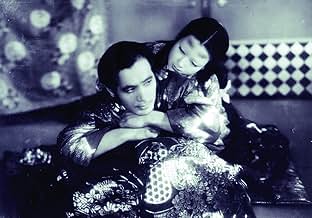
In the beginning of the springtime in the period of the Japanese Civil Wars of the Sixteenth Century in Lake Biwa in the Province of Omi, the family man farmer and craftsman Genjurô (Masayuki Mori) travels to Nagahama to sell his wares and makes a small fortune. His neighbor Tobei (Sakae Ozawa) that is a fool man dreams on becoming a samurai, but he can not afford to buy the necessary outfit. The greedy Genjurô and Tobei work together manufacturing clay potteries, expecting to sell the pieces and enrich; however, their wives Miyage (Kinuyo Tanaka) and Ohama (Mitsuko Mito) are worried about the army of the cruel Shibata that is coming to their village and they warn their ambitious husbands. Their village is looted but the families flee and survive; Genjurô and Tobei decide to travel by boat with their wives and baby to sell the wares in a bigger town. When they meet another boat that was attacked by pirates, Genjurô decides to leave his wife and son on the bank of the river, promising to return in ten days. Genjurô, Tobei and Ohama raise a large amount but Tobei leaves his wife to buy the samurai outfit and seek fame and fortune. Meanwhile the female aristocratic Lady Wakasa (Machiko Kyô) and her servant ask Genjurô to bring her shopping to her fancy Kutsuki House. Sooner Genjurô and Tobei discover the price they have to pay for their ambition.
"Ugetsu Monogatari" is the first movie that I have watched of Kenji Mizoguchi and I am impressed with this masterpiece. This supernatural story is very well constructed in a historic context of the Japanese Civil Wars of the Sengoku period, with two family dramas caused by the blindness of greed. This feature is supported by a magnificent cinematography in black and white, and the scene in the foggy lake is a piece of art. The performances are awesome, and the cast really seems to be living in the Sixteenth Century in Japan. My vote is nine.
Title (Brazil): "Contos da Lua Vaga" ("Tales of the Vague Moon")
"Ugetsu Monogatari" is the first movie that I have watched of Kenji Mizoguchi and I am impressed with this masterpiece. This supernatural story is very well constructed in a historic context of the Japanese Civil Wars of the Sengoku period, with two family dramas caused by the blindness of greed. This feature is supported by a magnificent cinematography in black and white, and the scene in the foggy lake is a piece of art. The performances are awesome, and the cast really seems to be living in the Sixteenth Century in Japan. My vote is nine.
Title (Brazil): "Contos da Lua Vaga" ("Tales of the Vague Moon")
Haunting and beautiful
This was my first Mizoguchi movie, so perhaps I watched it a little with child´s eyes. I liked it very much - it´s more fast-paced than I would expect from Japanese filmmaking. Mizoguchi is indeed a visual poet, the visual composition of every sequence looks as have been carefully planned, with much more importance given to imagery rather than dialogue. "Ugetsu" main themes, I believe, are the submission of women on feudal Japan - the transformation of the lives of the wifes of the two pottery dealers is treated very handsomely, each one striving to lead a decent life after being abandoned by their husbands, but failing in the end. The boat scene, with the encounter of a dying man, is also very beautiful. It´s a major turning point in the film, similar to a scene in Kurosawa´s "Throne of Blood" (mist, swamp, incertainty...)
Kurosawa Akira, Yasujiro Ozu , AND Kenji Mizoguchi: The greatest from Japan
One of the greatest of all Japanese films, this makes many Top 10 lists of the greatest films of all time.
Genjuro (Masayuki Mori), a potter, and his brother Tobei (Eitaro Ozawa), a farmer, are seeking fame and fortune, or fortune and fame as the names are listed.
The lake scene is not to be missed. It is beautiful and creepy. After being warned about pirates, the two me head off alone and meet Machiko Kyo, who was also the woman in Rashomon.
There is a beauty in this film that can't be described adequately. The camera paints a picture that is enchanting and melodic.
Kenji Mizoguchi, who went on to do the magnificent Sansho the Bailiff, has given us a pleasure that will be enjoyed again and again.
Bruce Bennett at the New York Sun said it best, "When the name Kenji Mizoguchi is intoned, every piece of camera equipment on earth should execute a deep bow."
Genjuro (Masayuki Mori), a potter, and his brother Tobei (Eitaro Ozawa), a farmer, are seeking fame and fortune, or fortune and fame as the names are listed.
The lake scene is not to be missed. It is beautiful and creepy. After being warned about pirates, the two me head off alone and meet Machiko Kyo, who was also the woman in Rashomon.
There is a beauty in this film that can't be described adequately. The camera paints a picture that is enchanting and melodic.
Kenji Mizoguchi, who went on to do the magnificent Sansho the Bailiff, has given us a pleasure that will be enjoyed again and again.
Bruce Bennett at the New York Sun said it best, "When the name Kenji Mizoguchi is intoned, every piece of camera equipment on earth should execute a deep bow."
Songs and tales
The movie starts out pretty uncomfortably, two peasants in 16th century Japan who dream of richness and glory so blindly, they can't even hear the pretty straight-forward protests of their loving wives who try to convince them that their happiness is fine at home. When one, a pottery smith, makes a small bundle selling his wares, they decide to make a much larger batch together and become rich.
Forced out of their homes by an approaching war and uncertain where to go, they take their wares to a thriving market place, where the second peasant's ambition to be a samurai divides them and causes all four characters, the two peasants and their wives, to be separated, all fending for themselves amongst the war and various classes differently.
At this point the film reverses itself and instead of being a pretty skin-deep, tragic bud of greed, it blooms into a beautiful and haunting tale of obsession and illusion. The two main stories of the peasants and their wives are opposite only in their imaged realism, where one peasant falls completely under the curse of an enchanting ghost and the other lies and steals his way to fame, only both of them are eventually knocked down from their own hubris and forced to finally awaken to what their wives have said all along.
It's quite exquisite, this movie, with its long takes and its lack of the usual constructs that make up messages of obsession and greed. Once it gets beyond the small, uncomfortable, claustrophobic world of the peasant's home, it becomes audaciously challenging and mysterious, so that the same small home becomes amazingly wonderful and comforting. The very essence of the movie is breathed into the emotions of the audience in very subtle ways, making a very unforgettable cinematic experience.
--PolarisDiB
Forced out of their homes by an approaching war and uncertain where to go, they take their wares to a thriving market place, where the second peasant's ambition to be a samurai divides them and causes all four characters, the two peasants and their wives, to be separated, all fending for themselves amongst the war and various classes differently.
At this point the film reverses itself and instead of being a pretty skin-deep, tragic bud of greed, it blooms into a beautiful and haunting tale of obsession and illusion. The two main stories of the peasants and their wives are opposite only in their imaged realism, where one peasant falls completely under the curse of an enchanting ghost and the other lies and steals his way to fame, only both of them are eventually knocked down from their own hubris and forced to finally awaken to what their wives have said all along.
It's quite exquisite, this movie, with its long takes and its lack of the usual constructs that make up messages of obsession and greed. Once it gets beyond the small, uncomfortable, claustrophobic world of the peasant's home, it becomes audaciously challenging and mysterious, so that the same small home becomes amazingly wonderful and comforting. The very essence of the movie is breathed into the emotions of the audience in very subtle ways, making a very unforgettable cinematic experience.
--PolarisDiB
10notmicro
magical and moving
This holds a special place in my heart, and I still consider it to be absolutely one of the very greatest films ever made for adults. The work of a mature artist, it resonates with Buddhist practice, and is a profoundly moving tale of the suffering of the human condition, the violence of war, the possibilities of art uplifting the spirit, the possibilities of redemption of character. The closing scene is one of such deeply-felt compassion and understanding that it is almost frightening; it prefigures in a way the stunning and more personal close of the subsequent Mizoguchi film "Sansho the Baliff".
On a lighter level, it is an amusingly sly allegory of the actual history of Japan for the 20 or so years prior to 1953, where in the end the women, embittered (or dead) as a result of their men's quixotic quest for military glory or war-profiteering, entreat them to give up their misguided and destructive dreams, settle down, and get back to their real responsibilities.
Which they did.
Originally available on LaserDisc.
On a lighter level, it is an amusingly sly allegory of the actual history of Japan for the 20 or so years prior to 1953, where in the end the women, embittered (or dead) as a result of their men's quixotic quest for military glory or war-profiteering, entreat them to give up their misguided and destructive dreams, settle down, and get back to their real responsibilities.
Which they did.
Originally available on LaserDisc.


Did you know
- TriviaThe plot is a combination of two tales from the work of Ueda Akinari called "Tales of moon and rain".
- GoofsAfter the soldier cuts off the general's head there's no blood on his sword.
- ConnectionsFeatured in Origins of the 21st Century (2000)
- How long is Ugetsu?Powered by Alexa
Details
- Release date
- Country of origin
- Language
- Also known as
- Tales of Ugetsu
- Filming locations
- Daiei Studios, Tokyo, Japan(Studio)
- Production company
- See more company credits at IMDbPro
Box office
- Gross US & Canada
- $11,197
- Opening weekend US & Canada
- $6,154
- Mar 5, 2017
- Gross worldwide
- $24,959
- Runtime
- 1h 36m(96 min)
- Color
- Aspect ratio
- 1.37 : 1
Contribute to this page
Suggest an edit or add missing content