
In Post-Bellum Texas, an army captain tries to keep the peace between overtaxed, impoverished farmers and greedy carpetbaggers.In Post-Bellum Texas, an army captain tries to keep the peace between overtaxed, impoverished farmers and greedy carpetbaggers.In Post-Bellum Texas, an army captain tries to keep the peace between overtaxed, impoverished farmers and greedy carpetbaggers.



- Hodges' Sergeant
- (uncredited)
- Texan
- (uncredited)

- Walter Morgan
- (uncredited)


- Trooper
- (uncredited)
- Texan
- (uncredited)

- Kehoe
- (uncredited)
- Director
- Writer
- All cast & crew
- Production, box office & more at IMDbPro
Featured reviews
Complex but Entertaining
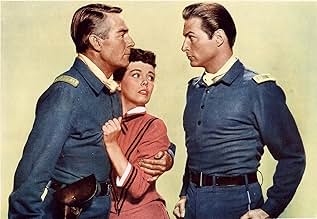
The rivalry between the two captains, Scott and Barker, is an interesting feature, especially when it extends to Scott's wife (Kirk). That scene where the home-sick wife is captivated by the handsome Barker is both well played and unusual for a western. Note too how Scott is compelled by the byplay to fade into the background, another unusual feature for a western hero.
Though filmed just west of LA, the rolling scenery makes a good Technicolor backdrop to the action. Much credit for making the elements work should go to director de Toth who was skilled at handling conflict as shown in his masterwork, Ramrod (1947). The redoubtable Sam Peckinpah also selected de Toth to direct many episodes of his groundbreaking TV series The Westerner (1960).
On the whole, it's a complicated story of personal and political conflict but still delivers the goods for fans of westerns.
Quite The Little Self Perpetuating Racket
Randolph Scott is a Union army captain, but also a Texan and he sees both sides. Henry Hull is his put upon commanding officer and Charles McGraw plays a leader of a local gang who have risen up like Robin Hood among the oppressed. These guys aren't Ku Klux Klan nightriders by any means though.
Our villains are Hugh Sanders and Elisha Cook, Jr. a pair of scurvy lowlifes if there ever were. They've got quite the little self perpetuating racket. The more they extort, the more McGraw raids, the more Sanders and Cook cry that the army has to stay in Texas. Just about anything is blamed on McGraw and his men.
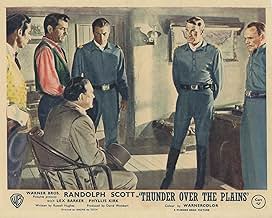
There's also a domestic crisis of sorts with newly arrived captain Lex Barker, an arrogant sort who was on duty in Washington and would like to get back there. Barker's bored and he makes a play for Phyllis Kirk who is married to Randolph Scott. Since they don't like each other from the beginning that only increases the problem.
Andre DeToth who did several westerns including a few with Randolph Scott brought home a good one here. With themes like an attempt at adultery here, this was not a western for the Saturday matinée kiddie trade. DeToth's best in my opinion is one called Ramrod with Joel McCrea and his then wife Veronica Lake, but this one is pretty good too.
DeToth also learned from the best and the final shootout scene with Scott against four men bears no small resemblance to High Noon, released a year earlier.
Definitely one of Randolph Scott's best westerns of the Fifties.
thunder over the plains
Plus, there's Phyllis Kirk.
Solid Western
First, there's an intelligent script by Russell Hughes, who wrote for some good radio shows like "Nightbeat" and Alan Ladd's "Box 13", as well as such films as Anthony Mann's "Last Frontier", Delmer Daves' "Jubal", and even the best of the giant-bug movies, "Them".
Then, there's the look and feel of the film. Director Andre De Toth and his great cinematographer Bert Glennon (who had done remarkable work with the likes of Josef von Sternberg and John Ford) light and shoot for realism and emotional impact. Glennon had also shot "Man Behind the Gun" (available on the flip side of this DVD), so I suppose director Felix Feist could be blamed for that film's phony-looking stage sets. Here, in "Thunder... ", a barroom scene looks like it was shot in a real barroom (foreshadowing Clint Eastwood's "natural lighting" technique by decades) and exteriors are shot outdoors. To be fair, the Feist film may have had budget or producer issues, but given that film's potential (dealing with water rights, corrupt politicians, the possible secession of southern California, even the semi-legendary Joaquin Murrietta as a supporting character) it still seems like a typical, entertaining, 40's-style B-movie. "Thunder...", released the same year, 1953, seems more forward-looking, more compelling, more of the age of the "adult" Westerns, even though the literally flag-waving ending with its narrative paean to the great state of Texas kind of pulls us back to B-movie-land.
Outstanding little movie
Scott never looks unbelievable in his part.
Lex Barker, former Tarzan and later superman "Old Shatterhand", plays against his image as arrogant villain. And I think he does it very well.
The story is entertaining and there are a lot of other good actors like Henry Hull, Phyllis Kirk and Elisha Cook jr. in it.
This really is an enjoyable B-western directed by veteran Andre de Toth.


Did you know
- TriviaCharles McGraw and James Brown both appeared in Corvette K-225 (1943), which starred Randolph Scott.
- GoofsThe Cavalry men are seen using Colt Model 1873 pistols in a movie that takes place in 1869. This model was developed for the US Army in 1873. Civilian sales started in 1875, and the 4-3/4 barrel length wasn't available until 1877.
- Quotes
Norah Porter: Whatever became of Frances Bilky?
Captain Bill Hodges: I don't know. She married a colonel, I think. Maybe it was a general. At any rate, she outranks all of us.
Norah Porter: But that's wonderful! Now she'll have her lifelong ambition to lead the cotillion. Well, I guess that's what I always wanted too.
Captain Bill Hodges: You don't have anything like that around here, do you, Captain?
Captain David Porter: Oh, I don't know. The Indians come down once a month and dance for us.
- ConnectionsReferenced in They Came to Rob Las Vegas (1968)
- How long is Thunder Over the Plains?Powered by Alexa
Details
- Runtime
- 1h 22m(82 min)
- Aspect ratio
- 1.37 : 1