IMDb RATING
5.8/10
675
YOUR RATING

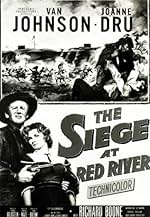
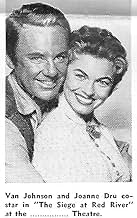
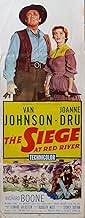
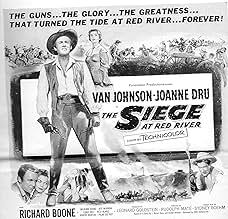
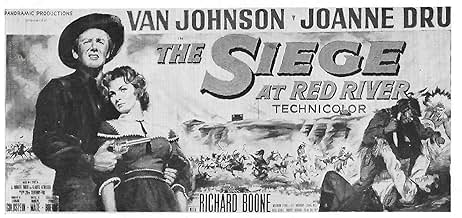
Cavalry Captain Simmons attempts to prevent the delivery of Gatling Guns into the hands of hostile Indians.Cavalry Captain Simmons attempts to prevent the delivery of Gatling Guns into the hands of hostile Indians.Cavalry Captain Simmons attempts to prevent the delivery of Gatling Guns into the hands of hostile Indians.
- Director
- Writers
- Stars


Robert Adler
- Raider
- (uncredited)
Carl Andre
- Raider
- (uncredited)

Forest Burns
- Union Soldier
- (uncredited)

Harry Carter
- Union Lookout
- (uncredited)

Gene Coogan
- Union Soldier
- (uncredited)

Jack Curtis
- Bartender
- (uncredited)
Russell Custer
- Townsman
- (uncredited)
- Director
- Writers
- All cast & crew
- Production, box office & more at IMDbPro
5.8675
1
2
3
4
5
6
7
8
9
10
Featured reviews
An underrated superior "B" Western
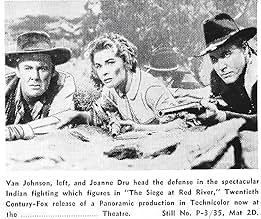
This western is,in my opinion,very underrated,and gives a nice blend of adventure,thrills,actiion and wry humour with the addition of some very catchy tunes. Van Johnson gives a good performance as one of a pair of undercover Confederate agents,carrying a stolen Gatling Gun through Union territory to aid the cause of the South. They travel as medicine salesmen contacting Confederate agents as they travel and picking up Joanne Dru on the way. The love interest between her and Van Johnson provide some nice humerous touches. Richard Boone steals the film,of course, as a really nasty,bullying,woman hating,unscrupulous,murdering cut-throat,who steals the Gatling gun from Van Johnson and sells it to the Indians and joins them, for money,of course, in attacking the Cavalry Fort. The fights,action scenes and Indian attack are very well-done. At the end Van Johnson gives Boone his come-uppance,the day is saved and Van goes off with Joanne into the sunset, but all in a very satisfying manner. Milburn Stone and Jeff Morrow provide excellent support. The direction,writing and acting are above par from all concerned. It is a western that one can see time and time again and still obtain great enjoyment.
Decent early 50's Western with Van Johnson and Richard Boone marred by dubious bits
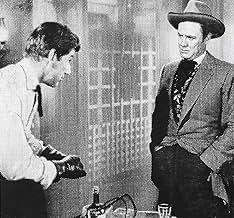
A Confederate captain (Johnson) goes undercover in the North to steal a Gatling gun with his sergeant (Milburn Stone), but a Pinkerton operative is suspicious (Jeff Morrow). As they take advantage of an unknowing Rebel-hating woman (Joanne Dru), they hook up with a mercenary (Boone) to help them get through Indian country.
The era of 1953-1954 featured great Westerns like "Shane," "Destry," "Garden of Evil," "Johnny Guitar" and "Vera Cruz," as well as formidable ones like "Arrowhead," "Escape from Fort Bravo," "Gun Fury," "Hondo," "Pony Express," "Broken Lance" and "The Raid." I bring that up because "Siege at Red River" (1954) doesn't exactly place with these Westerns as it's flawed by amusing, yet generally unfitting humor and a too-busy giddy-up score, which is seriously quaint.
This isn't helped by splicing in Indian-fighting footage at the climax from "She Wore a Yellow Ribbon" from five years earlier. Another problem is the disingenuous geography in the first half that's supposed to be areas near the Ohio River, but is obviously the Southwest (of course, this was more of a 'B' Western and it would simply cost too much to transplant the cast & crew to somewhere in the East for those particular scenes).
Nevertheless, there's a lot to enjoy in this old Western. Van Johnson's non-cowboy mannerisms actual fit the role since Capt. James S. Simmons/Jim Farraday hails from Atlanta back East. Johnson had charisma to spare and Milburn Stone is entertaining as the sidekick. Meanwhile Boone was unsurpassable as the unlikable character with "toxic masculinity." Add to this winsome Dru, the beautiful scenery and the interesting Gatling gun subplot and you have an entertaining enough early 50's Western with some lame elements.
It runs 1 hour, 25 minutes, with outside shooting done in east-central Utah at Professor Valley, Colorado River, Castle Valley and Dead Horse Point; as well as in Durango, Colorado, which is 158 miles southeast of there.
GRADE: B-/C+
The era of 1953-1954 featured great Westerns like "Shane," "Destry," "Garden of Evil," "Johnny Guitar" and "Vera Cruz," as well as formidable ones like "Arrowhead," "Escape from Fort Bravo," "Gun Fury," "Hondo," "Pony Express," "Broken Lance" and "The Raid." I bring that up because "Siege at Red River" (1954) doesn't exactly place with these Westerns as it's flawed by amusing, yet generally unfitting humor and a too-busy giddy-up score, which is seriously quaint.
This isn't helped by splicing in Indian-fighting footage at the climax from "She Wore a Yellow Ribbon" from five years earlier. Another problem is the disingenuous geography in the first half that's supposed to be areas near the Ohio River, but is obviously the Southwest (of course, this was more of a 'B' Western and it would simply cost too much to transplant the cast & crew to somewhere in the East for those particular scenes).
Nevertheless, there's a lot to enjoy in this old Western. Van Johnson's non-cowboy mannerisms actual fit the role since Capt. James S. Simmons/Jim Farraday hails from Atlanta back East. Johnson had charisma to spare and Milburn Stone is entertaining as the sidekick. Meanwhile Boone was unsurpassable as the unlikable character with "toxic masculinity." Add to this winsome Dru, the beautiful scenery and the interesting Gatling gun subplot and you have an entertaining enough early 50's Western with some lame elements.
It runs 1 hour, 25 minutes, with outside shooting done in east-central Utah at Professor Valley, Colorado River, Castle Valley and Dead Horse Point; as well as in Durango, Colorado, which is 158 miles southeast of there.
GRADE: B-/C+
amusing at best
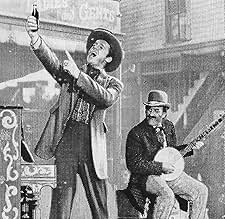
Two Confederate agents (Van Johnson and Milburn Stone) head west in order to bring a Gatling gun back to the South in the hopes of winning the Civil War. In order to travel with the famous gun through hostile Commanche territory they hire Indian trader Richard Boone to lead the way. Johnson and Stone hide their true identities by masquerading as sales reps for a cure all tonic and actually perform a song together in order to draw in a crowd. Amongst the crowds are various Confederate sympathizers who slip them concealed notes about where to go next. Also in the mix is Joanne Dru who plays a health care provider and who falls for Johnson's ruse as the tonic sales rep while gradually discovering his true Confederate identity. The action is mostly laughable, especially a big fight with Indians, though they (the Commanches) do get their hands on the Gatling gun and get a chance to use it. However, any film with Richard Boone in it is worth watching. He does not disappoint here as a sore tempered loser at poker and treacherous Indian trader. A few years later the film Rio Conchos portrayed a similar story of the Civil War out west, and this one also starred Boone. It's about ten times better than Siege At Red River.
Modest, but excellent Western from Dreyer's former cameraman.
In 1954, a Western about the Civil War is not just about the Civil War. 'Siege at Red River' opens with the robbery of a Union train by a bunch of outlaws. The Union soldiers, including a detective, combine the Military and the Law - they are protecting a secret new super-weapon - the Gatling Gun, the first example of mechanised warfare which means surefire victory for which ever side possesses it.
If we substitute the Gatling with a nuclear warhead, the Civil War with the Cold War; and if we note that the bandits make off in a red mail van, and that their leader wears a red cravat, and we assume them as commies, than the Western becomes an Allegory. This is not surprising - from its inception the genre has celebrated the UNITED States and played out and resolved its crises, while the likes of President Reagan have used it to signify a sense of genuine Americanness, so it is natural the genre should be marshalled in such a time of perceived crisis.
As the film is directed by the great Rudolph Mate, former cinematographer for, among others, Carl Dreyer, one of the genuine maestros of the cinema, we might assume that if his film is a Cold War Allegory, it will be far from simplistic. The linking of Communism with disruption, criminality, secrecy and murder is not a surprise; if we do make the link, when our first shock is that the bandit leader is played by the film's star. The benefits of the star persona - wit, charm, a (relatively) rounded personality (he is a grim avenger and gun smuggler, but also a musician, orator and gentleman; he is connected with role-play and the theatre) are in contrast with the monolithic forces of law and order; while he has multiple interests besides the war, they have only that defining interest. Further, while his motives are essentially decent and right-minded, the 'good' guys are not only street-bawling thugs, but perpetrators of vile, near-genocidal acts.
The film doesn't go so far as to salvage Farraday's oppositional position - the conflict between North and South is on one level displaced on gender, where it can be resolved in romance; and on another, generic level, displaced on a third enemy - the murderous amoral smuggler and the Indians - so the opposing American forces can finally reconcile. But it's not a happy reconciliation - the massacre of the Indians is only cathartic if we ignore that they too, like the Americans in the Fort, have women and children; and the finale is only happy if we accept the couple's words, and not the narrative reality, that he is an outlaw evading justice and leaving the woman he has learned to love. This fact of separation from the site of reconciliation implicitly questions that reconciliation.
There are other features - the anti-realistic use of colour; the drunk scene, where the dominant male point of view suddenly switches to the drunken, gun-shooting female, linked to her frank, disruptive, transformative sexuality and contrasted with the ship-lashing, neurotic villain; the use of song, espeically 'Tapioca', and its movement from rebel code to music hall; the argument that nation is an arbitrary series of signs - the Indians shoot first at the US flag, not the army; the image of the Niagara Falls on the music hall curtains - where national identity is constructed and negotiated, not 'natural'; a sophisticated attitude to patriotism, war and friendship - that all add up to a more thoughtful Western than its routine reputation might suggest.
If we substitute the Gatling with a nuclear warhead, the Civil War with the Cold War; and if we note that the bandits make off in a red mail van, and that their leader wears a red cravat, and we assume them as commies, than the Western becomes an Allegory. This is not surprising - from its inception the genre has celebrated the UNITED States and played out and resolved its crises, while the likes of President Reagan have used it to signify a sense of genuine Americanness, so it is natural the genre should be marshalled in such a time of perceived crisis.
As the film is directed by the great Rudolph Mate, former cinematographer for, among others, Carl Dreyer, one of the genuine maestros of the cinema, we might assume that if his film is a Cold War Allegory, it will be far from simplistic. The linking of Communism with disruption, criminality, secrecy and murder is not a surprise; if we do make the link, when our first shock is that the bandit leader is played by the film's star. The benefits of the star persona - wit, charm, a (relatively) rounded personality (he is a grim avenger and gun smuggler, but also a musician, orator and gentleman; he is connected with role-play and the theatre) are in contrast with the monolithic forces of law and order; while he has multiple interests besides the war, they have only that defining interest. Further, while his motives are essentially decent and right-minded, the 'good' guys are not only street-bawling thugs, but perpetrators of vile, near-genocidal acts.
The film doesn't go so far as to salvage Farraday's oppositional position - the conflict between North and South is on one level displaced on gender, where it can be resolved in romance; and on another, generic level, displaced on a third enemy - the murderous amoral smuggler and the Indians - so the opposing American forces can finally reconcile. But it's not a happy reconciliation - the massacre of the Indians is only cathartic if we ignore that they too, like the Americans in the Fort, have women and children; and the finale is only happy if we accept the couple's words, and not the narrative reality, that he is an outlaw evading justice and leaving the woman he has learned to love. This fact of separation from the site of reconciliation implicitly questions that reconciliation.
There are other features - the anti-realistic use of colour; the drunk scene, where the dominant male point of view suddenly switches to the drunken, gun-shooting female, linked to her frank, disruptive, transformative sexuality and contrasted with the ship-lashing, neurotic villain; the use of song, espeically 'Tapioca', and its movement from rebel code to music hall; the argument that nation is an arbitrary series of signs - the Indians shoot first at the US flag, not the army; the image of the Niagara Falls on the music hall curtains - where national identity is constructed and negotiated, not 'natural'; a sophisticated attitude to patriotism, war and friendship - that all add up to a more thoughtful Western than its routine reputation might suggest.
Travels of a stolen Gatling gun
This western is about two unreconstructed southerners who steal a Gatling gun from Union soldiers which winds up in the hands of an outlaw who sells the gun to Indians for gold. The film dwells on character development and takes a great deal of time detailing the two southern agents' travels from town to town delivering coded messages and trying to arrange a rendezvous with a contact to deliver the Gatling. The picture is another Blue vs. Gray conflict in the west with the Indians on the warpath against the soldiers, a plot angle that has been done better in other westerns. Van Johnson is okay as the hero and Joanne Dru is the gal who falls for Johnson. Richard Boone is a standout as a gun-running renegade in a role as a heavy he would reprise in other westerns. The supporting cast and color photography are good.


Did you know
- TriviaJean Peters was tested for a role.
- GoofsMost of the men in the film are clean shaven. Not only was this not period correct (most men had at least a mustache if not full facial hair) being clean shaven was difficult and potentially dangerous (the possibility of infection is high) in areas where clean water was scarce.
- ConnectionsFeatures Buffalo Bill (1944)
Details
- Runtime
- 1h 26m(86 min)
- Aspect ratio
- 1.66 : 1
Contribute to this page
Suggest an edit or add missing content