IMDb RATING
5.8/10
675
YOUR RATING

Cavalry Captain Simmons attempts to prevent the delivery of Gatling Guns into the hands of hostile Indians.Cavalry Captain Simmons attempts to prevent the delivery of Gatling Guns into the hands of hostile Indians.Cavalry Captain Simmons attempts to prevent the delivery of Gatling Guns into the hands of hostile Indians.
- Director
- Writers
- Stars


Robert Adler
- Raider
- (uncredited)
Carl Andre
- Raider
- (uncredited)

Forest Burns
- Union Soldier
- (uncredited)

Harry Carter
- Union Lookout
- (uncredited)

Gene Coogan
- Union Soldier
- (uncredited)

Jack Curtis
- Bartender
- (uncredited)
Russell Custer
- Townsman
- (uncredited)
- Director
- Writers
- All cast & crew
- Production, box office & more at IMDbPro
5.8675
1
2
3
4
5
6
7
8
9
10
Featured reviews
Modest, but excellent Western from Dreyer's former cameraman.
In 1954, a Western about the Civil War is not just about the Civil War. 'Siege at Red River' opens with the robbery of a Union train by a bunch of outlaws. The Union soldiers, including a detective, combine the Military and the Law - they are protecting a secret new super-weapon - the Gatling Gun, the first example of mechanised warfare which means surefire victory for which ever side possesses it.
If we substitute the Gatling with a nuclear warhead, the Civil War with the Cold War; and if we note that the bandits make off in a red mail van, and that their leader wears a red cravat, and we assume them as commies, than the Western becomes an Allegory. This is not surprising - from its inception the genre has celebrated the UNITED States and played out and resolved its crises, while the likes of President Reagan have used it to signify a sense of genuine Americanness, so it is natural the genre should be marshalled in such a time of perceived crisis.
As the film is directed by the great Rudolph Mate, former cinematographer for, among others, Carl Dreyer, one of the genuine maestros of the cinema, we might assume that if his film is a Cold War Allegory, it will be far from simplistic. The linking of Communism with disruption, criminality, secrecy and murder is not a surprise; if we do make the link, when our first shock is that the bandit leader is played by the film's star. The benefits of the star persona - wit, charm, a (relatively) rounded personality (he is a grim avenger and gun smuggler, but also a musician, orator and gentleman; he is connected with role-play and the theatre) are in contrast with the monolithic forces of law and order; while he has multiple interests besides the war, they have only that defining interest. Further, while his motives are essentially decent and right-minded, the 'good' guys are not only street-bawling thugs, but perpetrators of vile, near-genocidal acts.
The film doesn't go so far as to salvage Farraday's oppositional position - the conflict between North and South is on one level displaced on gender, where it can be resolved in romance; and on another, generic level, displaced on a third enemy - the murderous amoral smuggler and the Indians - so the opposing American forces can finally reconcile. But it's not a happy reconciliation - the massacre of the Indians is only cathartic if we ignore that they too, like the Americans in the Fort, have women and children; and the finale is only happy if we accept the couple's words, and not the narrative reality, that he is an outlaw evading justice and leaving the woman he has learned to love. This fact of separation from the site of reconciliation implicitly questions that reconciliation.
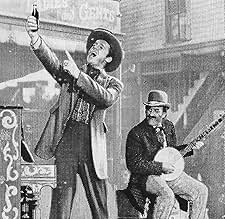
There are other features - the anti-realistic use of colour; the drunk scene, where the dominant male point of view suddenly switches to the drunken, gun-shooting female, linked to her frank, disruptive, transformative sexuality and contrasted with the ship-lashing, neurotic villain; the use of song, espeically 'Tapioca', and its movement from rebel code to music hall; the argument that nation is an arbitrary series of signs - the Indians shoot first at the US flag, not the army; the image of the Niagara Falls on the music hall curtains - where national identity is constructed and negotiated, not 'natural'; a sophisticated attitude to patriotism, war and friendship - that all add up to a more thoughtful Western than its routine reputation might suggest.
If we substitute the Gatling with a nuclear warhead, the Civil War with the Cold War; and if we note that the bandits make off in a red mail van, and that their leader wears a red cravat, and we assume them as commies, than the Western becomes an Allegory. This is not surprising - from its inception the genre has celebrated the UNITED States and played out and resolved its crises, while the likes of President Reagan have used it to signify a sense of genuine Americanness, so it is natural the genre should be marshalled in such a time of perceived crisis.
As the film is directed by the great Rudolph Mate, former cinematographer for, among others, Carl Dreyer, one of the genuine maestros of the cinema, we might assume that if his film is a Cold War Allegory, it will be far from simplistic. The linking of Communism with disruption, criminality, secrecy and murder is not a surprise; if we do make the link, when our first shock is that the bandit leader is played by the film's star. The benefits of the star persona - wit, charm, a (relatively) rounded personality (he is a grim avenger and gun smuggler, but also a musician, orator and gentleman; he is connected with role-play and the theatre) are in contrast with the monolithic forces of law and order; while he has multiple interests besides the war, they have only that defining interest. Further, while his motives are essentially decent and right-minded, the 'good' guys are not only street-bawling thugs, but perpetrators of vile, near-genocidal acts.
The film doesn't go so far as to salvage Farraday's oppositional position - the conflict between North and South is on one level displaced on gender, where it can be resolved in romance; and on another, generic level, displaced on a third enemy - the murderous amoral smuggler and the Indians - so the opposing American forces can finally reconcile. But it's not a happy reconciliation - the massacre of the Indians is only cathartic if we ignore that they too, like the Americans in the Fort, have women and children; and the finale is only happy if we accept the couple's words, and not the narrative reality, that he is an outlaw evading justice and leaving the woman he has learned to love. This fact of separation from the site of reconciliation implicitly questions that reconciliation.
There are other features - the anti-realistic use of colour; the drunk scene, where the dominant male point of view suddenly switches to the drunken, gun-shooting female, linked to her frank, disruptive, transformative sexuality and contrasted with the ship-lashing, neurotic villain; the use of song, espeically 'Tapioca', and its movement from rebel code to music hall; the argument that nation is an arbitrary series of signs - the Indians shoot first at the US flag, not the army; the image of the Niagara Falls on the music hall curtains - where national identity is constructed and negotiated, not 'natural'; a sophisticated attitude to patriotism, war and friendship - that all add up to a more thoughtful Western than its routine reputation might suggest.
Feds and Rebs agin the Reds
It's a typical 50's Technicolor Western trotting out all the usual ingredients with the usual vim – no-nonsense people and plot was the motto.
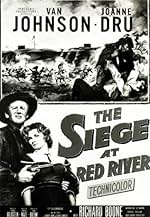
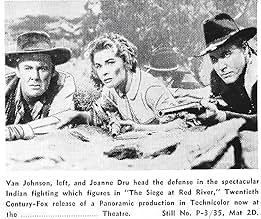
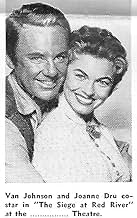
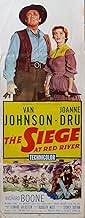
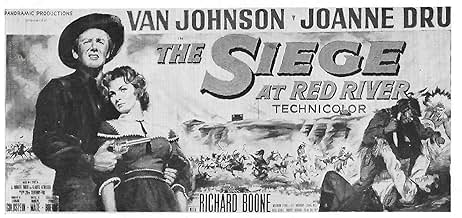
Two Rebs steal the being-developed Gatling Gun from the Feds in an ingenious segment, eventually toting it further south but ending up stuck in a small town. This town gets quickly filled to the brim with Federal soldiers still on the hunt for their gun. Van Johnson (Reb) and Joanne Dru (Fed) fall for each other of course although of course they don't realise it until the climax. What interested me was the implication that the gun could be used by civilised whites against each other in a civilised slaughter but that selling it to the savage Reds was beyond the Pale. Both Feds and Rebs are eventually united to prevent the Reds using it during the noisy 5 minute siege. And of course the implication was only the Reds were low enough to actually use the horrible weapon the Feds had had the brains to design – at the time of production America had the same idea about the Russian Reds and the atom bomb.
It has a bit of everything Western in: romance and fights, trains and horses, shootings and slapstick comedy. It's fun, I loved it.
Two Rebs steal the being-developed Gatling Gun from the Feds in an ingenious segment, eventually toting it further south but ending up stuck in a small town. This town gets quickly filled to the brim with Federal soldiers still on the hunt for their gun. Van Johnson (Reb) and Joanne Dru (Fed) fall for each other of course although of course they don't realise it until the climax. What interested me was the implication that the gun could be used by civilised whites against each other in a civilised slaughter but that selling it to the savage Reds was beyond the Pale. Both Feds and Rebs are eventually united to prevent the Reds using it during the noisy 5 minute siege. And of course the implication was only the Reds were low enough to actually use the horrible weapon the Feds had had the brains to design – at the time of production America had the same idea about the Russian Reds and the atom bomb.
It has a bit of everything Western in: romance and fights, trains and horses, shootings and slapstick comedy. It's fun, I loved it.
An Unpretentious Western
An unpretentious Western totally unlike ' The Unforgiven ' which I reviewed just before this film. This is the kind of Western that is there as simple entertainment for those who like the genre. It gives a picture of the West as it really never was and the audiences of the time ( early to middle 1950's ) loved its nonsense because it kept to its formula. This formula consisted of colourful scenery, villains and heroes, women with improbably good clothes and makeup, a few battle scenes, horses and Indians and a lot of delightful hokum. The epitome of this is Saloon Bar music with the same ' tune ' played in film after film; 2Oth Century Fox was the past master of this ridiculous fiction. The whole concept of this image of the West was there to lull its audience into lies about how conquered America was constructed to put its indigenous people into Reservations. I accept the lie of this image of how the West was won as simple and superficial enjoyment; a guilty pleasure that entertains. This is totally unlike the Western with a message and often a fake finger wagging liberalism. This liberalism was to ease a conscience; a collective conscience of guilt and I dislike it. As they say in Film Noir ' it was too late for tears '. This simple film is all about the Gatling Gun and how it must not end up in Native American hands. It has a ridiculous song which is endearing and has Van Johnson, Joanne Dru and Richard Boone. An ' A ' cast in a basically' B ' film, and they all act to form and just as the audience expected them to do. There is a stirring climax and the Gatling Gun ( a horrible form of human extermination ) and it is made to look like a naughty toy. The mindless child I still am thoroughly enjoyed it.
Routine yet amiable western
In the last days of the American Civil War, a Confederate gun smuggler ends up helping to defend a Union fort when his weapons are sold to the Shawnee Indians.
Routine yet amiable western with light-hearted moments as well as tense ones. Van Johnson stars as a salesman going town with his assistance singing "tapioca." Clever bit is that it's a code word. It moves leisurely, and gets more exciting as it progresses and ends with a rousing cavalry vs Indians fight featuring a Gatling gun. Joanna Dru and Richard Boone as a villain also star. Van Johnson does well in his only western. Well photographed with fantastic rugged terrain.
Routine yet amiable western with light-hearted moments as well as tense ones. Van Johnson stars as a salesman going town with his assistance singing "tapioca." Clever bit is that it's a code word. It moves leisurely, and gets more exciting as it progresses and ends with a rousing cavalry vs Indians fight featuring a Gatling gun. Joanna Dru and Richard Boone as a villain also star. Van Johnson does well in his only western. Well photographed with fantastic rugged terrain.
Sounds familiar
I don't know why, but the Van Johnson's role seems to have been inspired by a Randolph Scott's character in a western from the forties, for Warner, where he played a Confederate soldier fighting for something lost in advance; of course as a Confederate officer.... Maybe I am wrong, I have not in mind all the Randolph Scott's characters, but this Confederate soldier trying to do his best to win or at best change the course of the war, I have seen this before. However this lead character can't be shown as the evil guy, only ambivalent. This is not my Rudolph Maté's western favorite. Worth watching for any western buff.


Did you know
- TriviaJean Peters was tested for a role.
- GoofsMost of the men in the film are clean shaven. Not only was this not period correct (most men had at least a mustache if not full facial hair) being clean shaven was difficult and potentially dangerous (the possibility of infection is high) in areas where clean water was scarce.
- ConnectionsFeatures Buffalo Bill (1944)
Details
- Runtime
- 1h 26m(86 min)
- Aspect ratio
- 1.66 : 1
Contribute to this page
Suggest an edit or add missing content