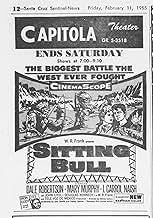
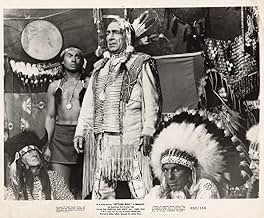
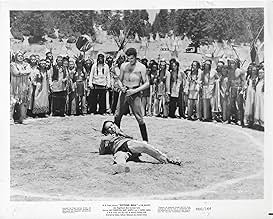
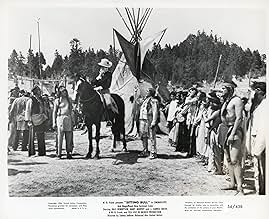
A cavalry officer sympathetic to the wronged Sioux fixes a meeting between Chief Sitting Bull and President Grant but a dishonest Indian Agent and a hateful General Custer test the Sioux's p... Read allA cavalry officer sympathetic to the wronged Sioux fixes a meeting between Chief Sitting Bull and President Grant but a dishonest Indian Agent and a hateful General Custer test the Sioux's patience, threatening to derail the peace-talks.A cavalry officer sympathetic to the wronged Sioux fixes a meeting between Chief Sitting Bull and President Grant but a dishonest Indian Agent and a hateful General Custer test the Sioux's patience, threatening to derail the peace-talks.
- Charles Wentworth
- (as Bill Hopper)
- Webber - Indian Agent
- (as Tom Brown Henry)
- White Cloud
- (uncredited)
- Trooper Foster
- (uncredited)
- Young Buffalo
- (uncredited)
- Trooper
- (uncredited)
- Capt. Swain
- (uncredited)
- Director
- Writers
- All cast & crew
- Production, box office & more at IMDbPro
Featured reviews
Much better than its current rating of 5.7!
The story revolves around an officer who has been demoted. Bob Parrish (Dale Robertson) is not your typical cavalry officer, as he thinks that the American government should respect and treat the natives much better than they do. As he put it, 'they just want to live and raise their families'. But folks like General Custer and the rest give him a lot of guff and they seem to follow the old axiom, 'the only good Indian is a dead Indian'. What's to become of him and his mission to work WITH the natives instead of AGAINST them?
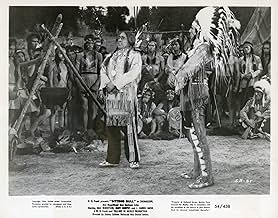
It is ironic that not only did Iron Eyes Cody appear in the film as Crazy Horse, but he was the consultant to the production about native culture. Only later in life did folks learn that Cody (the most American Indian looking guy on the planet) was actually an Italian!! But you can't blame the film....at the time everyone thought Cody was exactly what and who he pretended to be! But he and the filmmakers STILL got so much right in this one...and the movie holds up far better than most from the genre*. Well worth seeing and an excellent picture in so many ways.
*For the worst possible depiction of this same story, try "They Died With Their Boots On". While the cast was incredibly impressive (with Errol Flynn and Olivia de Havilland), the facts are pretty much tossed out the window and Custer is depicted as a great man...not the incompetent he actually was.
"When the white man win a battle they call it Victory. When the Indians win they call it Massacre".
Interesting "Custer's Last Stand" Film!
The story involves the efforts of the fictional Major Bob Parrish (Dale Robertson) and Sioux Chief Sitting Bull (J. Carroll Naish) to prevent a war between the Sioux nations and the U.S. Cavalry. On one side, Sitting Bull's chiefs led by Crazy Horse (Iron Eyes Cody) and Colonel Custer (Douglas Kennedy) on the other push their superiors into war.
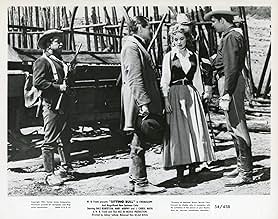
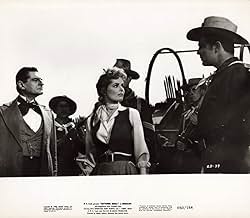
The requisite love triangle involves Parrish, the General's daughter Kathy (Mary Murphy) and newspaperman Wentworth (william Hopper). Kathy turns away from Parrish when he is charged with insubordination and reduced in rank to Captain. She then becomes engaged to Wentworth.
Parrish meanwhile with the assistance of former black slave "Sam" (Joel Flueller)arranges a meeting between President U.S. Grant (John Hamilton) and Sitting Bull. However, before the meeting can take place several incidents occur and war breaks out culminating with Custer's last stand at the Little Big Horn.
J. Carroll Naish lends dignity to his portrayal of Sitting Bull. We see him as an intelligent caring and cautious leader who will stoop to war only as a last resort. In a move unusual for its time black actor Joel Flueller was cast in one of the leading roles in the film.
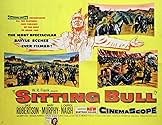
The battle scenes are spectacular and well staged by director Sidney Salkow. In spite of the contrived Hollywood ending, this western is a lot better than some would have you believe.
Great cast and score, lousy script
During the movie, I was also struck by the lush score. Naturally, the TV network didn't have the decency to show all the credits, but to my ear it sounded like the outstanding work of Raoul Kraushaar -- and praise all the gods of technology for IMDb, I was right.
In my opinion, he is a terribly under-rated composer. Even the cheapest Allied Artists movies attain the ranks of quality when he wrote the score.
J. Carroll Naish as the title character is another under-rated actor. That is, he does not seem to be known among viewers although apparently he was never out of work. He almost always played some accented character, some Latin or European or, as in this case, "Indian" character. And he was almost always extremely believable.
The rest of the cast, from the excellent Dale Robertson to the excellent John Hamilton, were almost uniformly perfect.
Heroic confrontation between Sioux chief and US cavalry , including battle of Little Big Horn
This exciting movie contains western action , romance , shoot-outs and spectacular battles . The yarn was shot outside of Mexico City and in the Churubusco Azteca studios . Washed-out print , the film needs urgently a perfect remastering . It appears as a technical adviser and designer Indian costumes , a secondary actor named Iron Eyes Cody , usual player as Indian roles (Great Sioux Massacre , A man called Horse) , though with Sicilian origin . The motion picture was regularly directed by Sidney Salkow .
The film is a fiction , but partially based on real events . The reality happened in December 1873 when the Commissioner of Indian Affairs directed all Sioux bands to enter reservations by the end of January 1876 or be declared hostile . Many bands of Sioux did not meet this deadline and were attacked by US troops . Crazy Horse and his Oglala people moved north to join forces with Sitting Bull , by the spring of 1876 some 3000 Teton Sioux and Northern Cheyenne warriors had assembled at Sitting Bull's camp in the valley of the Little Big Horn in Montana. On 25 June 1876 Crazy Horse and other war chiefs led the allied warriors against General Custer and his seventh Cavalry , Custer and all the man under his direct command were killed . This victory , however , brought relentless retaliation from the army and Sioux were scattered . Sitting Bull and his followers fled to Canada and stayed there until July 1881 , when he returned to the US and surrendered at Fort Buford , Montana . After he was placed on a South Dakota reservation . For a year Sitting Bull went a tour with Buffalo Bill's Wild West Show . He continued to regard himself as chief of his people and he earned the enmity of an Indian agent . On 25 December 1890 , Indian policemen went to take the chief , his followers tried to prevent this and in the struggle he was shot dead .
Did you know
- TriviaThe film was shot outside of Mexico City, and star Mary Murphy caught "Montezuma's Revenge" and was very ill throughout the six-week shoot. Most of her scenes are relatively brief, possibly because of this.
- GoofsBack of Mary's dress shows an obvious zipper.
- Quotes
Sitting Bull: I have wanted peace. I have prayed for peace. There have been battles. But when the white soldiers win a battle, they call it victory. When the Indians win, they call it massacre.
- Crazy creditsDuring the opening titles, the film's 'Technical Advisor and Indian Costumes' is credited to 'Iron Eyes Cody' who is also parenthetically credited as being a '(Famous T.V. Star)'.
- ConnectionsFeatured in The Great Sioux Massacre (1965)
- SoundtracksGreat Spirit
Music and Lyrics by Max Rich
- How long is Sitting Bull?Powered by Alexa
Details
- Release date
- Countries of origin
- Language
- Also known as
- Sitting Bull, el indio heroico
- Filming locations
- Production companies
- See more company credits at IMDbPro
Box office
- Gross US & Canada
- $1,500,000
- Runtime
- 1h 45m(105 min)
- Sound mix
- Aspect ratio
- 2.55 : 1