
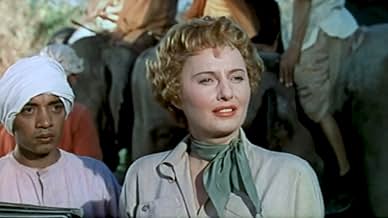
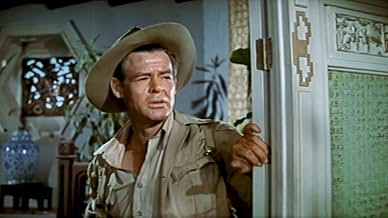
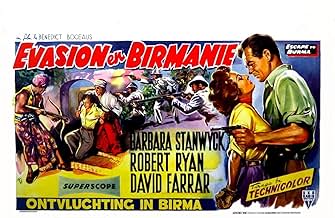
A fugitive in British Burma hides on a teak plantation, thanks to a mutual attraction with owner Gwen Moore.A fugitive in British Burma hides on a teak plantation, thanks to a mutual attraction with owner Gwen Moore.A fugitive in British Burma hides on a teak plantation, thanks to a mutual attraction with owner Gwen Moore.
- Director
- Writers
- Stars




Wag Blesing
- Minor Role
- (uncredited)
- Director
- Writers
- All cast & crew
- Production, box office & more at IMDbPro
5.5757
1
2
3
4
5
6
7
8
9
10
Featured reviews
A strange, refreshing film from undervalued maestro Dwan.
It is one of the cliches of mainstream Hollywood cinema that the desire of the hero is limited to two options - a good girl (marriage, security, family, society), and a bad girl (lust, transgression). In this scenario, women are barely people at all, more embodiments of Law and Desire, the socially acceptable and unacceptable.
Not the least of this brilliant film's achievements is the way it transfers this cliche to the heroine, making it new and strange. It is the two male characters who represent the two options open to the woman - Robert Ryan is the outlaw, suspected murderer and jewel thief, sexually direct; David Farrer is the policeman, punctiliously obeisant to the law, sexually repressed.
Ryan hasn't stepped foot in Barbara Stanwyk's elephant ranch before he's made himself at home, made her frankly voracious and got her talking about 'marriage', which we suspect has little to do with religious ceremonies. Farrer no sooner arrives then he wants to take a man home with him. The film's most striking scene occurs near the climax, in the symbolic space of an abandoned, monkey infested Buddhist temple, the two men grappling like Lawrentian blood brothers, and Stanwyk gaping hungrily on, absolutely thrilled.
This central twist is part of the film's wider iconoclasm. Like more renowned peers (Minnelli, Sirk etc.), Dwan takes reactionary material and dismantles it. Firstly, the film offers an odd mish-mash of genres. The film is supposedly set in Burma and its environs, but this is an Orient in the tradition of Powell and Pressburger, the hero of whose 'Black Narcissus' stars here (Farrer).
Whereas 'Narcissus' was a work of complete, defiant artifice, 'Escape' offers a disturbing clash between real location footage and cramped studio sets, often within the one scene which, especially in action sequences, has a jarring, alienating effect. The most notable example occurs early on, when Ryan and Stanwyk hunt a marauding tiger - the effect takes us out of the 'realistic' adventure and alerts us to a more symbolic plane.
Although the film is set in the east, the three genres it evokes originate much further away. Even though the film is an action adventure - and a very exciting one, full of chases, gun-fights and dangerous animals - it is also a melodrama, about a lonely woman stranded in the middle of nowhere, powerful but so starved of 'companionship' she'll attach herself to the first man who comes along. Some of the lighting effects and careful compositions recall the contemporary melodramas of Sirk. The film also belongs to the jungle sub-genre, full of thick forests and animals being cute.
Most important, however, the film is a transposed Western, with Ryan as the outlaw hiding out in Stanwyk's ranch, and Farrer the sherriff sent to being him back. Except, like Ray's 'Johnny Guitar', the colour, the mise-en-scene, the extravagant sexual rituals tend to undermine macho Western self-importance; a female 'Eastern' reflecting back the male Western.
As the scene I mentioned earlier suggests - the brawl in the temple - the idea of play figures throughout, with narrative action turned into ritual or theatre, with extras, ceremonial gestures, and, most importantly, an audience. The most alarming of these is Ryan's torture, but throughout there is an emphasis on people watching, usually obscurely, through gaps and grills, or being framed in proscenium arches within the narrative frame.
Another motif alerting us to mistrust appearances is the mirror- so often a symbol of metamorphosis or revelation; actual mirrors co-exist with mirroring scenes, for example the symmetrical skulking of Stanwyk and the tiger watched by Ryan (doubly mirrored and reversed in the temple scene)
Not the least of this brilliant film's achievements is the way it transfers this cliche to the heroine, making it new and strange. It is the two male characters who represent the two options open to the woman - Robert Ryan is the outlaw, suspected murderer and jewel thief, sexually direct; David Farrer is the policeman, punctiliously obeisant to the law, sexually repressed.
Ryan hasn't stepped foot in Barbara Stanwyk's elephant ranch before he's made himself at home, made her frankly voracious and got her talking about 'marriage', which we suspect has little to do with religious ceremonies. Farrer no sooner arrives then he wants to take a man home with him. The film's most striking scene occurs near the climax, in the symbolic space of an abandoned, monkey infested Buddhist temple, the two men grappling like Lawrentian blood brothers, and Stanwyk gaping hungrily on, absolutely thrilled.
This central twist is part of the film's wider iconoclasm. Like more renowned peers (Minnelli, Sirk etc.), Dwan takes reactionary material and dismantles it. Firstly, the film offers an odd mish-mash of genres. The film is supposedly set in Burma and its environs, but this is an Orient in the tradition of Powell and Pressburger, the hero of whose 'Black Narcissus' stars here (Farrer).
Whereas 'Narcissus' was a work of complete, defiant artifice, 'Escape' offers a disturbing clash between real location footage and cramped studio sets, often within the one scene which, especially in action sequences, has a jarring, alienating effect. The most notable example occurs early on, when Ryan and Stanwyk hunt a marauding tiger - the effect takes us out of the 'realistic' adventure and alerts us to a more symbolic plane.
Although the film is set in the east, the three genres it evokes originate much further away. Even though the film is an action adventure - and a very exciting one, full of chases, gun-fights and dangerous animals - it is also a melodrama, about a lonely woman stranded in the middle of nowhere, powerful but so starved of 'companionship' she'll attach herself to the first man who comes along. Some of the lighting effects and careful compositions recall the contemporary melodramas of Sirk. The film also belongs to the jungle sub-genre, full of thick forests and animals being cute.
Most important, however, the film is a transposed Western, with Ryan as the outlaw hiding out in Stanwyk's ranch, and Farrer the sherriff sent to being him back. Except, like Ray's 'Johnny Guitar', the colour, the mise-en-scene, the extravagant sexual rituals tend to undermine macho Western self-importance; a female 'Eastern' reflecting back the male Western.
As the scene I mentioned earlier suggests - the brawl in the temple - the idea of play figures throughout, with narrative action turned into ritual or theatre, with extras, ceremonial gestures, and, most importantly, an audience. The most alarming of these is Ryan's torture, but throughout there is an emphasis on people watching, usually obscurely, through gaps and grills, or being framed in proscenium arches within the narrative frame.
Another motif alerting us to mistrust appearances is the mirror- so often a symbol of metamorphosis or revelation; actual mirrors co-exist with mirroring scenes, for example the symmetrical skulking of Stanwyk and the tiger watched by Ryan (doubly mirrored and reversed in the temple scene)
Entertaining adventure fare.
Escape to Burma is just one of a series of adventure features starring the estimable Barbara Stanwyck. However, where this film stands out above many of her other pictures from this period is that the supporting cast can actually act.
In fact, the male actors Robert Ryan and David Farrar, are so good in their roles as outlaw and law enforcer that they almost overshadow the matriarch Stanwyck herself. Almost.
Escape to Burma is standard Hollywood fare, but entertaining nevertheless; ideal for a rainy day. There are much worse ways to spend 85 minutes.
In fact, the male actors Robert Ryan and David Farrar, are so good in their roles as outlaw and law enforcer that they almost overshadow the matriarch Stanwyck herself. Almost.
Escape to Burma is standard Hollywood fare, but entertaining nevertheless; ideal for a rainy day. There are much worse ways to spend 85 minutes.
Mediocre camp, mildly enjoyable
Direction, acting and virtually everything else about this mid-fifties pulp action flick are too flat to make it more than mildly enjoyable in a camp way. Ryan and Farrar fare better than Stanwyck, whose performance here unintentionally verges on self-parody. Stanwyck is very watchable here, but the script is so lazy and routine that her typical (and admirable) energy in tackling the role works against her. Ryan more appropriately gives the script its due,expressing obvious contempt for some of his lines. For a fifties flick, the quick sexual hookup of Ryan and Stanwyck is surprising (though a 10-year-old kid could see the film and not know what was happening between them).
I think this and "Cattle Queen of Montana" are Stanwyck's only color films. Black and white works better for her; the heavy makeup here makes her look inappropriately feverish, even for a jungle flick.
"Escape to Burma" is enjoyably bad in a mild way. I loved the back-lot jungle sets and obvious tropical foliage decoration. Nice house Stanwyck has there in the jungle too. Super art direction (always an RKO forte).
"Slightly Scarlet," "Silver Lode" and "The River's Edge" are far more enjoyable and interesting Allan Dwan efforts from the fifties.
I think this and "Cattle Queen of Montana" are Stanwyck's only color films. Black and white works better for her; the heavy makeup here makes her look inappropriately feverish, even for a jungle flick.
"Escape to Burma" is enjoyably bad in a mild way. I loved the back-lot jungle sets and obvious tropical foliage decoration. Nice house Stanwyck has there in the jungle too. Super art direction (always an RKO forte).
"Slightly Scarlet," "Silver Lode" and "The River's Edge" are far more enjoyable and interesting Allan Dwan efforts from the fifties.
Escaping From Burma To Burma
Robert Warwick is an independent Burmese price, and his son has been murdered, shot dead. All the evidence points to Robert Ryan. Local British commissioner Reginald Denny says that Ryan must be brought to Rangoon and tried, and orders the most able police officer available to him, David Farrar, to do so. But Ryan makes his way through the jungle to the teak plantation run by Barbara Stanwyck, and gains her trust and love. When Farrar shows up, she helps Ryan escape. Farar pursues him.
Director Allan Dwan's 399th movie is beautifully photographed by John Alton, and with Ryan and Stanwyck, there are some impressive pyrotechnics in the acting. Unfortunately, there's some annoying idiot plotting in the denouement, evidence that would have wrapped the entire story up in less than ten minutes. Of course, then we couldn't have seen Miss Stanwyck lording it over the locals, treating well-behaved elephants kindly, . Neither would we have witnessed a slugfest between Ryan and Farrar, nor a gun battle in which Warwick's troops try to murder the three principals in a savages-invading-the-fort dust-up that was hoary by the time this movie was made. If that's your idea of a good time..
Director Allan Dwan's 399th movie is beautifully photographed by John Alton, and with Ryan and Stanwyck, there are some impressive pyrotechnics in the acting. Unfortunately, there's some annoying idiot plotting in the denouement, evidence that would have wrapped the entire story up in less than ten minutes. Of course, then we couldn't have seen Miss Stanwyck lording it over the locals, treating well-behaved elephants kindly, . Neither would we have witnessed a slugfest between Ryan and Farrar, nor a gun battle in which Warwick's troops try to murder the three principals in a savages-invading-the-fort dust-up that was hoary by the time this movie was made. If that's your idea of a good time..
No reference to great political changes in Burma at the time
In Escape To Burma no time is referenced in the story. Knowing that Burma declared its independence from Great Britain in 1948 and in 1945 for the first half of the year they were in the middle of World War II being fought the actions here would seem to take place in the years before the war. That would seem to be the only explanation for the total lack of any reference to the reality of what was going in Burma, it wasn't the political landscape of the country as it was in 1955 the year the film came out.
Barbara Stanwyck is the owner of a teak plantation and she gets a pair of gentlemen callers. The first is Robert Ryan fleeing from a charge of murder of the son of the local maharajah. The second is David Farrar the British policeman sent by provincial governor Reginald Denny after him.
There's also the maharajah's own forces and they're not about to wait for justice British style. They've got their own nasty methods to deal with assassins even if they were business partners with the prince.
Escape To Burma is an interesting if rather pedestrian action/adventure film. Ryan is the best here. Given the kind of roles he's played and the ambiguous nature of his character we never know how this will turn out. In fact the story of the killing of the prince is something of a let down.
But fans of the stars should be happy.
Barbara Stanwyck is the owner of a teak plantation and she gets a pair of gentlemen callers. The first is Robert Ryan fleeing from a charge of murder of the son of the local maharajah. The second is David Farrar the British policeman sent by provincial governor Reginald Denny after him.
There's also the maharajah's own forces and they're not about to wait for justice British style. They've got their own nasty methods to deal with assassins even if they were business partners with the prince.
Escape To Burma is an interesting if rather pedestrian action/adventure film. Ryan is the best here. Given the kind of roles he's played and the ambiguous nature of his character we never know how this will turn out. In fact the story of the killing of the prince is something of a let down.
But fans of the stars should be happy.


Did you know
- TriviaSharon Lee's debut.
- GoofsIn the Burmese jungle temple, some of the apes are chimpanzees, which only live in Africa.
- Quotes
Gwen Moore: You may mount.
- ConnectionsReferenced in The Exiles (1961)
- How long is Escape to Burma?Powered by Alexa
Details
- Release date
- Country of origin
- Language
- Also known as
- Bow Tamely to Me
- Filming locations
- World Animal Jungle Compound, Thousands Oaks, California, USA(tiger hunt scene)
- Production companies
- See more company credits at IMDbPro
- Runtime
- 1h 27m(87 min)
- Aspect ratio
- 2.00 : 1
Contribute to this page
Suggest an edit or add missing content