IMDb RATING
7.0/10
4.8K
YOUR RATING


Follow the story of a couple who goes to a small French fishing village to try to solve the problems of their deteriorating marriage.Follow the story of a couple who goes to a small French fishing village to try to solve the problems of their deteriorating marriage.Follow the story of a couple who goes to a small French fishing village to try to solve the problems of their deteriorating marriage.




- Director
- Writer
- All cast & crew
- Production, box office & more at IMDbPro
7.04.7K
1
2
3
4
5
6
7
8
9
10
Featured reviews
Varda's First Feature
«La Pointe-Courte» was Agnès Varda's first feature film and the first film-manifesto of the "nouvelle vague". In it, Varda broke with some narrative traditions, following neorealist strategies, distancing Bertolt Brecht style and a "mise-en-caméra" close to direct cinema, which was gaining ground around the world at that time, including France where it was euphemistically called "cinéma vérité".
The different influences blend well in the same story, but not all ot them have the same appeal and, in the final analysis, my balance leans more towards the narrative of fiction of anthropological affiliation, than towards the aesthetic compositions of a couple in crisis with which Varda disguises melodrama, aurally reinforced by self-referential declamations of the man and the woman. In fact, in the synopsis that I have read (and in Varda's own words), the story of this couple is taken as the principal storyline, when, in fact, the neighborhood and its fishermen are the true "anti-stars".
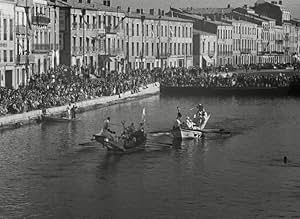
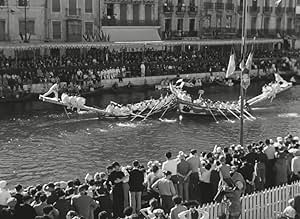
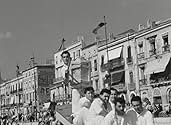
With natural actors (the inhabitants of the fishing neighborhood of La Pointe-Courte, in the South of France) Varda tells a story that serves as a unifying thread of the different influences, in which local men insist on fishing in a small contaminated maritime "lagoon" and are consequently persecuted by the Department of Health. At the same time, the filmmaker shows us events that animate their lives: the first love, the patriarchy confrontations, the sporting joust, the death of a child...
On the other hand, Varda, who always alluded to happiness or its absence in her filmography, takes us away from the neorealist liveliness and immerses us in long affective ramblings (which were common in the "nouvelle vague" works, especially in the films by Godard, Rohmer and Resnais), which are nothing more than the process of sentimental adjustment of one La Pointe-Courte native (Philippe Noiret) and his Parisian wife (Silvia Monfort).
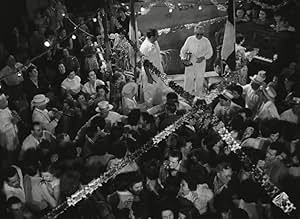
As if sensing the strength of the La Pointe-Courte people and their lives, Varda opened and closed the film with images of the neighborhood and its faces: in the first sequence, morning breakfasts are interrupted by the appearance of officials from the Department of Health, and in the end, a popular dance is enlivened by a band that is frozen in the final shot. Without intending to, Agnès Varda left us a moment of film history, of a corner of France, of a popular culture on the coast, as a worthy preamble to her prestigious career.
The different influences blend well in the same story, but not all ot them have the same appeal and, in the final analysis, my balance leans more towards the narrative of fiction of anthropological affiliation, than towards the aesthetic compositions of a couple in crisis with which Varda disguises melodrama, aurally reinforced by self-referential declamations of the man and the woman. In fact, in the synopsis that I have read (and in Varda's own words), the story of this couple is taken as the principal storyline, when, in fact, the neighborhood and its fishermen are the true "anti-stars".
With natural actors (the inhabitants of the fishing neighborhood of La Pointe-Courte, in the South of France) Varda tells a story that serves as a unifying thread of the different influences, in which local men insist on fishing in a small contaminated maritime "lagoon" and are consequently persecuted by the Department of Health. At the same time, the filmmaker shows us events that animate their lives: the first love, the patriarchy confrontations, the sporting joust, the death of a child...
On the other hand, Varda, who always alluded to happiness or its absence in her filmography, takes us away from the neorealist liveliness and immerses us in long affective ramblings (which were common in the "nouvelle vague" works, especially in the films by Godard, Rohmer and Resnais), which are nothing more than the process of sentimental adjustment of one La Pointe-Courte native (Philippe Noiret) and his Parisian wife (Silvia Monfort).
As if sensing the strength of the La Pointe-Courte people and their lives, Varda opened and closed the film with images of the neighborhood and its faces: in the first sequence, morning breakfasts are interrupted by the appearance of officials from the Department of Health, and in the end, a popular dance is enlivened by a band that is frozen in the final shot. Without intending to, Agnès Varda left us a moment of film history, of a corner of France, of a popular culture on the coast, as a worthy preamble to her prestigious career.
Varda's debut and the beginnings of the French New Wave
Agnes Varda never got her just due for having made the first true film of the French New Wave. Part of it was because this picture didn't get much play at the time - even in France, but, a larger factor was that she wasn't as tight with the Truffuat and Godard Cahiers du Cinema clique who also got the first wide attention with films like 400 BLOWS and BREATHLESS. And, oh yes, she was a woman.
History aside, Varda's debut feature displays attributes associated with the Nouvelle Vague so prominently, that it is indeed a shame that she isn't properly credited.
The low budget shooting on the run, the elliptical dialogue between the lead couple (Philippe Noiret and Silvia Monfort) and the often off-kilter stylish compositions and editing. The score is largely a droning clarinet. It's all there in LA POINTE COURTE.
Varda's interest in photography which led to her career-long interest in Documentary filmmaking also marks the film, for the central romance shares time equally with a portrait of the tiny fishing community where it's set (the Noiret character's hometown). The ambitions of the film are small, but, it's still quite a low key delight. It should be better known and recognized as the true start of that famous French filmmaking Revolution.
Impressive debut, with great docu-fictional filmmaking and an OK love story
La Pointe-Courte was the first feature written, edited (in part, with Resnais) and directed by Agnes Varda, but she came previously from still photography, and her clarity, empathy and specificity with a place and it's many details, from the rocks of the shore to how the water shimmers to the plethora of cats (and of course someone even comments on that), is evident right away. At time of writing this, I don't know the full backstory of how she came to become close and immerse herself with the people in this seaside town or village or whatever you call it, but they clearly are open to her and welcoming for her to see and show us all how they fish and talk among themselves and discuss matters important to them- such as outsiders coming in to tell them what to do. And sometimes we get to look close at a detail like how small snakes and crabs go into a bucket.
I don't think Varda would use this term, but like La Terra Trema or Stromboli, it's a depiction of a time and place, in crisp black and white 35mm film, that is authentic and unvarnished and a bit neo-realist-y. She also places a love story at the center which is coming apart at the seams, and in case it isn't clear the man and the woman walk and talk for minutes on end and speak on their hopelessness for their relationship (or more the woman than the man, he would like for it to work and she sees nothing productive ahead).
This is shot at points like a director figuring out what a style will be, and there are a few times shots are styled to be reflective of the characters abstract feelings, perhaps to each other. When the woman talks to her man, who will soon be her ex, she does that thing Bergman would do a decade later where her face is split down the middle by the man looking the other way (so like him one way her another but not at each other), and he does so too. Or with the two of them carrying on their conversation facing the camera in different places shot to shot. This latter part works well, in a poetic-detached sort of way. The other proto Bergman ones, maybe not so much.
Like watching Kubrick with Killer's Kiss or Fear and Desire, the fascination is getting a look at the Start of it all from a talent with a sharp, dramatically alive set of eyes, and in here where the sensibility of Varda was as someone who, in her case and in what I find very inspiring in the opposite way of like a Scorsese or his ilk, wasn't inspired or taking in homage from other films. From what I've read, she wasn't a Film Buff like the other Nouvelle Vague who would come up after and with her, and was just inspired more by what she was interested in: working class people who work hard and live hard and are noble, the delicacy in the poetry of movement, and cats. If this film is a little less than great or just compared to her other films it's that the strengths lie in the more documentary aspects. The (falling apart) love story is sincere but less convincing, maybe because the actors are mostly the same morose-detached tone for the entire time.
La Pointe-Courte is a very impressive debut, and for what it may be lacking in satisfying relationship scenes it more than makes up for with everything, all the local people and their minor joys and sadness and world weariness around the central characters. In other words, half of it is captivating because of the people Varda has found and made into movie stars, and the other half that is more like a "Film" is a bit more pretentious.
I don't think Varda would use this term, but like La Terra Trema or Stromboli, it's a depiction of a time and place, in crisp black and white 35mm film, that is authentic and unvarnished and a bit neo-realist-y. She also places a love story at the center which is coming apart at the seams, and in case it isn't clear the man and the woman walk and talk for minutes on end and speak on their hopelessness for their relationship (or more the woman than the man, he would like for it to work and she sees nothing productive ahead).
This is shot at points like a director figuring out what a style will be, and there are a few times shots are styled to be reflective of the characters abstract feelings, perhaps to each other. When the woman talks to her man, who will soon be her ex, she does that thing Bergman would do a decade later where her face is split down the middle by the man looking the other way (so like him one way her another but not at each other), and he does so too. Or with the two of them carrying on their conversation facing the camera in different places shot to shot. This latter part works well, in a poetic-detached sort of way. The other proto Bergman ones, maybe not so much.
Like watching Kubrick with Killer's Kiss or Fear and Desire, the fascination is getting a look at the Start of it all from a talent with a sharp, dramatically alive set of eyes, and in here where the sensibility of Varda was as someone who, in her case and in what I find very inspiring in the opposite way of like a Scorsese or his ilk, wasn't inspired or taking in homage from other films. From what I've read, she wasn't a Film Buff like the other Nouvelle Vague who would come up after and with her, and was just inspired more by what she was interested in: working class people who work hard and live hard and are noble, the delicacy in the poetry of movement, and cats. If this film is a little less than great or just compared to her other films it's that the strengths lie in the more documentary aspects. The (falling apart) love story is sincere but less convincing, maybe because the actors are mostly the same morose-detached tone for the entire time.
La Pointe-Courte is a very impressive debut, and for what it may be lacking in satisfying relationship scenes it more than makes up for with everything, all the local people and their minor joys and sadness and world weariness around the central characters. In other words, half of it is captivating because of the people Varda has found and made into movie stars, and the other half that is more like a "Film" is a bit more pretentious.
There is no new wave, there is only the ocean (Chabrol).
Agnès Varda's career began by the seaside in a small fisher port near Sète and temporarily ended in 2009 with "Les Plages D'Agnès" (Agnès' Beaches). Her debut was a commercial fiasco, only one theater in Paris showed it when it was released (Jean Louis Chéret, Studio-Parnasse).
The part of the man was first intended for George Wilson but he became ill and Philippe Noiret replaced him. This actor didn't like his performance, he thought he was too young (26) and the choice of Wilson was relevant (34). He said he was absent and the character eluded him. The critics thrashed him.
Hailed as the first movie of the Nouvelle Vague, the movie owes at least as much to Italian Neo-realism (Rossellini's "Viaggio In Italia" which depicted a couple's trip whose marriage was on the rocks and Visconti's "La Terra Trema" which dealt with the plight of the fishermen in a small village).
What is definitely "Nouvelle Vague" is the shoestring budget (four times less than "Breathless") and the literary, intellectual, "overwritten" dialogs which seem today almost unbearable; this bourgeois couple complaining about their heartaches, contemplating their navels, walks through the crowd as if the inhabitants of the village didn't exist. They don't relate to them: the only move the man makes is to give an ice-cream to a child. That's not much for someone who spent his whole childhood in the place. Filming on location wasn't the Nouvelle Vague's invention as too many naive people still believe today; for the record "l'Hirondelle Et La Mésange" was filmed entirely on location in...1928.
The depiction of the village wanders drastically from the precepts of the Nouvelle Vague busy being born but recalls the two Italian works mentioned above. We feel that Varda cares for them even if her two principals don't. She cares for their problems with the food hygiene people or with the coastguards'. She feels for Raphaël the young man to be jailed for five days as the gendarmes do for him. We learn he is an Inscrit Maritime (that was the name of the conscripts who lived on the seaside) and he is to do his military service: even if Varda doesn't mention it, we do know he'll have to fight in a dirty war (the Algeria war), like Antoine in "Cleo De 5 à 7".
I don't think like the precedent user that Varda's debut was her best. Actually "Cléo..." is much better. There are similarities between the two works: both Cléo and the couple move in a world they can't relate to. But the key to the 1961 effort is the fact that Cléo opens up and thanks to a soldier soon returning to fight becomes aware that people exist outside her petty world. When she takes her glasses off, what a symbol! But for the man and the woman of "La Pointe Courte" (The Short Headland) -they are only referred through this, bearing no names- they will stay with their inflated egos, their selfishness.
"They are always talking, they mustn't be happy" says a fisher's wife.
The short headland was a blind alley.
The part of the man was first intended for George Wilson but he became ill and Philippe Noiret replaced him. This actor didn't like his performance, he thought he was too young (26) and the choice of Wilson was relevant (34). He said he was absent and the character eluded him. The critics thrashed him.
Hailed as the first movie of the Nouvelle Vague, the movie owes at least as much to Italian Neo-realism (Rossellini's "Viaggio In Italia" which depicted a couple's trip whose marriage was on the rocks and Visconti's "La Terra Trema" which dealt with the plight of the fishermen in a small village).
What is definitely "Nouvelle Vague" is the shoestring budget (four times less than "Breathless") and the literary, intellectual, "overwritten" dialogs which seem today almost unbearable; this bourgeois couple complaining about their heartaches, contemplating their navels, walks through the crowd as if the inhabitants of the village didn't exist. They don't relate to them: the only move the man makes is to give an ice-cream to a child. That's not much for someone who spent his whole childhood in the place. Filming on location wasn't the Nouvelle Vague's invention as too many naive people still believe today; for the record "l'Hirondelle Et La Mésange" was filmed entirely on location in...1928.
The depiction of the village wanders drastically from the precepts of the Nouvelle Vague busy being born but recalls the two Italian works mentioned above. We feel that Varda cares for them even if her two principals don't. She cares for their problems with the food hygiene people or with the coastguards'. She feels for Raphaël the young man to be jailed for five days as the gendarmes do for him. We learn he is an Inscrit Maritime (that was the name of the conscripts who lived on the seaside) and he is to do his military service: even if Varda doesn't mention it, we do know he'll have to fight in a dirty war (the Algeria war), like Antoine in "Cleo De 5 à 7".
I don't think like the precedent user that Varda's debut was her best. Actually "Cléo..." is much better. There are similarities between the two works: both Cléo and the couple move in a world they can't relate to. But the key to the 1961 effort is the fact that Cléo opens up and thanks to a soldier soon returning to fight becomes aware that people exist outside her petty world. When she takes her glasses off, what a symbol! But for the man and the woman of "La Pointe Courte" (The Short Headland) -they are only referred through this, bearing no names- they will stay with their inflated egos, their selfishness.
"They are always talking, they mustn't be happy" says a fisher's wife.
The short headland was a blind alley.
Not very deep
Agnès Varda began her career in 1954 as a feature film director with this movie that tells two separate stories in reciprocal counterpoint: daily life at a fishing village near Sète in France with its joys and dramatic moments and the relationship between husband and wife when she who is a Parisian returns to him after he had chosen to return to his birthplace where he feels now very happy but that doesn't seem to please her very much at first and puts their marriage in danger. This situation is given in a series of soft dialogues between them which don't reveal themselves deep and meaningful enough to make us feel the sentiments behind them. Varda has done much better later with such very good movies like "Le Bonheur" or "Cléo de 5 à 7". However this movie is also classified as a landmark in the New Wave of French cinema that began about that time with names like Truffaut, Godard and Chabrol. It's this historical value that mainly makes this movie worth to be seen.


Did you know
- TriviaThis film is considered by many critics as the starting point of the French New Wave film movement.
- GoofsThe entire movie has been shot without sound and dubbed later, and it shows. At several points in the movie, the dialogue does not match the lip movements at all. For instance, early in the movie, when Jules' wife tells the other woman that it was Jules who scared the inspectors.
- ConnectionsFeatured in Great Directors (2009)
- How long is La Pointe Courte?Powered by Alexa
Details
Box office
- Gross worldwide
- $1,596
- Runtime
- 1h 21m(81 min)
- Color
- Sound mix
- Aspect ratio
- 1.37 : 1
Contribute to this page
Suggest an edit or add missing content