

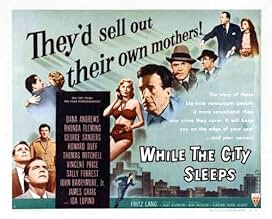
A serial killer has been killing beautiful women in New York City and the new owner of a media company offers a high position in the company to the first of his senior executives who can get... Read allA serial killer has been killing beautiful women in New York City and the new owner of a media company offers a high position in the company to the first of his senior executives who can get the earliest scoop on the case.A serial killer has been killing beautiful women in New York City and the new owner of a media company offers a high position in the company to the first of his senior executives who can get the earliest scoop on the case.
- Director
- Writers
- Stars


- Robert Manners
- (as John Barrymore Jr.)


- Judith Felton
- (as Sandy White)

- Tim - Police Desk Sergeant
- (as Larry Blake)

- Mike O'Leary
- (as Edward Hinton)

- Director
- Writers
- All cast & crew
- Production, box office & more at IMDbPro
Featured reviews
Not As Good As Advertised
I just thought it wasn't up to the lofty standard set by Lang in earlier films like 'M" and "The Testament Of Dr. Mabuse", but truth be told, these pictures were made many years before this one. Too much dialogue here, and this picture dearly needed an injection of excitement to break the tedium of the love stories in the sub-plot.
I like Dana Andrews, Thomas Mitchell, George Sanders, et al. A big boost was provided by Ida Lupino, always professional, as a sleep-around newspaper columnist. I also felt Barrymore tended toward ham in his portrayal of the psycho killer. My overall impression is of a master director who was losing his fastball, which is a shame. It could have been so much better.
5/10 - Website no longer prints my star rating.
Lang tries a more popular style of crime drama as his American career winds down
But Lang swiftly shifts registers; the young psycho-killer is but leaven for his loaf. His prime focus proves to be how the search to catch the culprit plays out in the executive suite of a huge media syndicate. Its founder, Amos Kyne (Robert Warwick), rules his empire from a hospital bed in his office; his last order, before his ticker tocks its last, is to label the anonymous Barrymore `the lipstick killer' and play him big. (`Kyne' seems deliberately to evoke another press magnate, Charles Foster Kane, even down to the maps showing his coast-to-coast reach and the encircled `K' logo that could have been ripped off the gates of Xanadu.)
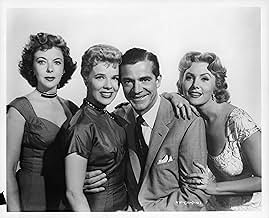
Kyne's power, however, devolves to his pompous, petty son (Vincent Price). Knowing they hold him in contempt, he sets the heads of his various divisions to finding the killer, with a new directorship as the prize. Among the contenders are Thomas Mitchell, editor of the syndicate's flagship newspaper, the Sentinel; George Sanders, chief of its wire service; and James Craig, who runs its photo operation. Above the fray is Pulitzer-Prize winning TV commentator Dana Andrews, whose only ambition is to be left alone to pursue his drinking and his girl (Sally Forrest). Nor are any women eligible for the prize, though Price's trophy wife (Rhonda Fleming) pulls strings on behalf of her lover Craig, while mink-wrapped sob sister Ida Lupino (`Champagne cocktail. Brandy float.') initiates like maneuvers for her squeeze, Sanders.
Indifference to the prize, however, doesn't dampen Andrews' journalistic ardor. Not only does he use his broadcast to bait the `momma's boy' (who watches in his jammies as his mother, Mae Marsh, dotingly dithers around), he sets up Forrest as bait. For all his menace, Barrymore's not the brightest lad in the boroughs, and thus can be excused for mixing up his targets....
With its high-powered (and hammy) cast, its blend of psychopathology and cutthroat corporate culture, While The City Sleeps would end up standing as Lang's last American film but one (the far-fetched Beyond A Reasonable Doubt, also starring Andrews). His following so many plot strands results in a thinning of atmosphere, some fragmentation of focus there's a buoyancy of tone which was decidedly absent from his other films of the 50s, like Clash By Night or The Big Heat or Human Desire. While The City Sleeps tempers hard-core noir with more mainstream motives. It's a slick, entertaining, and at times even scary movie.
Uneven Tone Undermines Movie
I don't know if the fault is with the actress or the way her character is written but "Nancy" feels like she has been dropped into the movie from a Doris Day film. She even looks like a tiny version of Doris Day. Her playful dialogue with Dana Andrews is completely "off" for this film and their scenes really throw the movie out of sync. Nancy belongs in a romantic comedy. She does not belong in a drama about the media and what the various players will do to get ahead.
Lumbering, Lang or no Lang
Maybe you can follow the power plays going on among the eight or so cast principals. After a while, I gave up. Folks interested in newspaper stories might find the movie worthwhile. To me, however, the various machinations come across as little more than glorified soap opera in dull shades of gray. The movie does come to life when Lipstick Killer Barrymore Jr. comes on screen and the palaver pauses for a refreshing few minutes. Too bad, the screenplay didn't allow Lang to focus more on one of his specialties, the killer's interesting mental state. But then, the script had to multiply the sub-plots and the superfluous scenes so as to accommodate the various star cameos they were paying for.
There may be a good story buried somewhere in the pottage, and there are some snappy lines, but the overall result lumbers along, Lang or no Lang. Speaking of censorship, the curvaceous Fleming's various poses and sexy calisthenics, along with the script's smirking innuendo, typifies how the industry was reacting to the challenge of TV despite Production Code constraints, and definitely dates the production to that era. In passing—is it my imagination or does the circle-K logo of Kyne enterprises duplicate the logo for Kane's publishing empire in the much superior Citizen Kane (1940), and if so, what would be the point? Also, "kine" is an archaic term for cows, just as "swine" is for pigs. Was that intentional, and if so, what would be the point of that? Anyway, the movie shows clearly RKO's floundering efforts during a period of general studio decline.
Lang's cynical critique of American values
The film is set in the world of newspapers and news agencies, so you expect an aura of venality from the outset. Vincent Price is the vain, self-centered scion of a recently deceased magnate who has taken over his father's business and wants someone else to do all the work. So he creates a new executive position then sets three of his top men against each other vying for the job. The one who 'catches' or names the serial killer terrorizing women in New York, gets it.
Like many of Lang's films, "While the City Sleeps" had the tawdry feel of a B-movie. There is a kind of rough urgency to it that a more main-streamed movie might have lacked. (You could say Lang's genius was for making silk purses out of sow's ears). He didn't work with 'stars' but character players. About the biggest name in the movie and the 'star' of the picture is Dana Andrews, (superb, he was a very under-rated actor), as the Pulitzer Prize winning journalist who, like many of Lang's characters, is less noble than he first appears. As for the rest, despite there being two Oscar winners in the cast, (George Sanders, one of his poorer performances, and Thomas Mitchell, excellent), they were mainly the stable diet of the B-movie, though that said there is a terrific performance from the under-rated Sally Forrest as Andrews' girl who he is not above using as bait to catch the killer and a typically flamboyant one from Ida Lupino.
After this, Lang was to make only one more film in America before returning to his native Germany, the equally cynical "Beyond a Reasonable Doubt". Indeed it's Lang's cynicism and his critique of American values and mores that set him apart, that put him, like those other European émigrés, Otto Preminger and Douglas Sirk at a critical remove from his American counterparts. In this respect, perhaps, the only American who can be compared to him is Samuel Fuller.


Did you know
- TriviaThe movie was adapted from a novel; The Bloody Spur by Charles Einstein (1953) which was based on a real murder case that took place in 1946. In that year, William Heirens killed three women and left a message scrawled in lipstick on a bathroom mirror after the second murder. In the message, he urged the police to catch him before he killed again. Because of this, the press dubbed him "The Lipstick Killer".
- GoofsWhen Robert Manners (John Drew Barrymore, as John Barrymore Jr.) is watching Edward Mobley (Dana Andrews) on TV, he is clutching a copy of "Tales From The Crypt". When he drops it to the floor, a closeup of the comic book now shows it to be titled "The Strangler".
- Quotes
Ed Mobely: You know, you have very nice legs.
Nancy Liggett: Aren't you sweet.
Ed Mobely: Nice stockings too. What holds your stockings up?
Nancy Liggett: There's a lot your mother should have told you.
Ed Mobely: I didn't ask my mother. I asked you.
- ConnectionsFeatured in Histoire(s) du cinéma: Toutes les histoires (1988)
- How long is While the City Sleeps?Powered by Alexa
Details
Box office
- Gross worldwide
- $7,652
- Runtime
- 1h 40m(100 min)
- Color