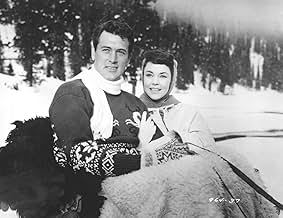
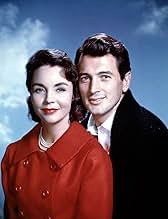
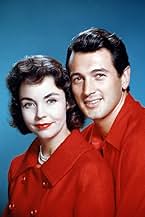
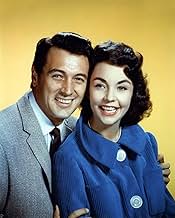
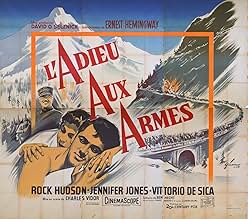
An English nurse and an American ambulance driver on the Italian front during World War 1 fall in love, but the horrors surrounding them challenge their romance to the limit.An English nurse and an American ambulance driver on the Italian front during World War 1 fall in love, but the horrors surrounding them challenge their romance to the limit.An English nurse and an American ambulance driver on the Italian front during World War 1 fall in love, but the horrors surrounding them challenge their romance to the limit.
- Directors
- Writers
- Stars
- Nominated for 1 Oscar
- 1 win & 2 nominations total
- Major Stampi
- (as Jose Nieto)
- Captain Bassi
- (as Georges Brehat)
- Court Martial Colonel
- (uncredited)
- Nino the Doorkeeper
- (uncredited)
- Directors
- Writers
- All cast & crew
- Production, box office & more at IMDbPro
Featured reviews
Hemingway strikes out again!!!
David O. Selznick wanted to create something that would rank alongside his 'Gone with the Wind' as an epic romance with a war background--but the talky script defeated everyone. Hemingway himself publicly disowned the movie, claiming that Jones was far too old for the part and unhappy about the film in general. At any rate, it was not the hoped for success and did nothing to halt the decline of Selznick's career--or Jennifer Jones' career for that matter. A big disappointment.
What's Wrong With This Picture?
Simply put, I'm never convinced, not even for a moment, that what is happening is real and not just another movie. Too bad.
Fortunes of War
The Unique Problems Of Hemingway And Selznick
No Selznick when it came to the career of his wife Jennifer Jones lost all kinds of sense of balance. Another reviewer was quite right, Jean Simmons, Joan Collins, Elizabeth Taylor all would have made acceptable Catherine Barkleys.
One thing also to remember that we're not even starting out with pure Hemingway to begin with. Both this version and the 1932 version that starred Gary Cooper and Helen Hayes are not just based on the novel, they are based on a play that was adapted from the novel by Laurence Stallings who wrote What Price Glory. The play ran for 30 performances in 1930 and starred Glenn Anders and Elissa Landi on Broadway. I suspect the Depression had a lot to do with the closing as it did many shows that year.
Originally John Huston was slated to direct and he had directed Jones in both We Were Strangers and Beat The Devil with little or no interference from Selznick. But Selznick fired Huston and replaced him with Charles Vidor because allegedly too much attention was paid to Rock Hudson and not enough to Jennifer.
That's ironic as all get out because the novel itself is as all Hemingway works is male chauvinistic in the extreme. If he wanted to showcase Jennifer, any Hemingway just ain't the vehicle. He should have used one of the Bronte sisters.
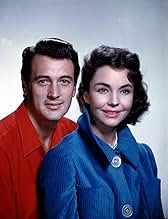
Since the novel is male oriented Rock Hudson makes a fine Fredric Henry, the idealistic man who volunteers on the Italian front as an ambulance driver to experience war so he can write about it when it's over. On that Italian front it didn't look like it was ever going to be over.
That's another problem with this work, how do you sell it to the movie going public, as a romance or an anti-war tract? If you're Adolph Zukor for Paramount or David O. Selznick probably romance is the aspect that does sell.
The third major character in the film is that of the Italian army doctor Major Rinaldi played here by Vittorio DeSica. This version is more faithful to the book and presents Rinaldi as a three dimensional character.
In the 1932 version Adolphe Menjou was Rinaldi and Menjou did fine with the part as your typical suave continental type. Here Rinaldi's outspokenness about the futility of the Italian campaign leads to tragedy. It also led to an Oscar nomination for Vittorio DeSica as Best Supporting Actor. It was the only recognition A Farewell To Arms got from the Academy and DeSica lost to Red Buttons for Sayonara.
Whether Huston or Vidor did them, the battle scenes and the scenes of retreat are shattering and moving. Given the unique problems of Hemingway and Selznick, we're lucky the film came out as good as it did.
Amazing visually but dull
Did you know
- TriviaRock Hudson turned down The Bridge on the River Kwai (1957), Sayonara (1957) and Ben-Hur (1959) in order to make this film. He later said this was the biggest mistake of his career.
- GoofsCatherine is supposed to be British, yet she has an American accent.
- Quotes
Major Alessandro Rinaldi: The British have opened a new hospital near Orsino. I am now in love with one of the nurses, Miss Barkley. I have even thought of marrying Miss Barkley, but, I must confess, she has one drawback. Her attitude is uncooperative.
Lt. Frederick Henry: You must be slipping.
Major Alessandro Rinaldi: No, but she is very strange, very moody. Who knows. She might even prefer you to me.
- Crazy creditsProducer David O. Selznick tries to imitate the opening credits of his classic film, Gone with the Wind (1939), by having the letters of the title "A Farewell to Arms" sweep slowly across the screen from right to left.
- ConnectionsFeatured in The Time Tunnel: The Ghost of Nero (1967)
- How long is A Farewell to Arms?Powered by Alexa
Details
- Release date
- Country of origin
- Languages
- Also known as
- Adiós a las armas
- Filming locations
- Venzone, Udine, Friuli-Venezia Giulia, Italy(first 20 minutes)
- Production company
- See more company credits at IMDbPro
Box office
- Budget
- $4,353,000 (estimated)
- Gross worldwide
- $18,989
- Runtime
- 2h 32m(152 min)
- Color
- Aspect ratio
- 2.35 : 1